About a month ago, I returned to Sabah in east Malaysia for my fourth tour of duty as a guide for Quest Nature Tours. I've always said that Borneo is one of my favourite tours that I run and even after three previous trips I was looking forward to returning. One of the main reasons is that I would be joined by my wife, Laura and it would be her first visit to one of the largest islands in the world. More than 100 bird "lifers" awaited her, plus dozens of new mammals, herps, and everything else!
Before I get into this year's tour, I just wanted to provide some background on the island of Borneo and why it is interesting for a naturalist to visit, given its biogeographical history. I originally published this information after my first visit to Borneo in 2017.
The island of Borneo is the third largest island in the world, only trailing Greenland and New Guinea. Located southeast of mainland Asia and northwest of Australia, Borneo is actually composed of three different countries. The northern 1/3 of the island belongs to Malaysia and the southern 2/3 belongs to Indonesia, while the sovereign state of Brunei is located in the northern part of the island. The Malaysian side is composed of two states: Sarawak in the south and west, and Sabah in the northeast. Several other large islands are located near Borneo. To the east is Sulawesi, to the south is Java and to the southwest is Sumatra.
.jpeg)
While Borneo is currently manifested as an island, over geological time this is usually not the case. The waters between mainland southeast Asia, Java, Sumatra and Borneo are all quite shallow, and during periods of low water levels (such as during glacial maxima) these areas can be all connected by land, which is the case about 80% of the time. Collectively, this part of the world is known as the Sundaic shelf or Sundaland, and Borneo, Java, Sumatra and mainland Malaysia/Thailand share many species as a result. Many of these species have "Sunda" in their common name.
 |
| Sunda Frogmouth |
Sir Alfred Russel Wallace was one of the first naturalists to devote a lot of his time to understanding the biogeography of the Sundaic shelf and the Indonesian archipelago; in fact he is often referred to as the father of biogeography. Sir Wallace is perhaps most famous for conceiving of the idea of the theory of evolution and natural selection based off of his findings and discoveries as he traveled throughout the area. He came upon the idea independently of Charles Darwin, prompting Charles Darwin to rush to publish his thoughts. One of Sir Wallace's other important findings was the discovery of Wallace's Line; that is, a deep sea trench that essentially splits the Indonesian archipelago in half, running north-south and passing to the east of Borneo. Wallace found it interesting how the islands of Bali and Lombok, despite only being separated by 35 km, had vastly different flora and fauna. In his book "The Malay Archipelago" he states "In Bali we have barbets, fruit thrushes and woodpeckers; on passing over to Lombok we see these no more, but on Lombok we have an abundance of cockatoos, honeysuckers and brush-turkeys which we do not see in Bali or further west". Wallace observed similar differences between the fauna of Borneo and Sulawesi, and elsewhere in the archipelago.
 |
| Standardwing Bird-of-Paradise from Halmahera - a bird family found east of Wallace's Line |
We now know that deep-sea trenches form Wallace's Line. Even during times of glacial maxima when sea levels are at the lowest, the depth of these trenches prevent land bridges from joining the islands on either side of the line. As a result, the flora and fauna west of the line are Asian in origin, while to the east of the line the flora and fauna are decidedly Australasian in origin. Many species groups will not cross over open water, causing the line to act as a barrier preventing gene flow.
One tenet of island biogeography is that in general, biological diversity is proportional to the size of the island. Being one of the largest islands in the region, Borneo is quite diverse, rivalling the mainland (Thailand, Malaysia) in species diversity. While formerly Borneo was blanketed with tropical forest, deforestation within the last 60 years has impacted most of the island. The Indonesian portion of the island has been the most heavily affected and forests are continually being turned into oil palm plantations each and every day. While only about 30% of the original forest cover remains in Borneo, many organizations have been hard at work in recent years advocating for the protection of the remaining forests. The Malaysian government has stepped up and now some areas on the Malaysian side of the island receive protection. Ecotourism has exploded in recent years as world class eco-lodges have began popping up over the northern part of the island (Sabah province). Hopefully this will lead to more interest in Borneo and more protection for the areas that has not yet been exploited by deforestation.
October 2, 2024
Laura and I landed by 11:00 AM in Kota Kinabalu. It had been a long day and a half of travel, but at least we were able to spend our overnight layover in Kuala Lumpur at a cheap hotel that we found near the airport. Four hours of sleep on a bed is much more preferable than attempting to sleep while sitting in a chair at the airport.
As tempting as it would have been to check into the hotel and rest, this was out of the question. After all, it was Laura's first visit to Borneo and lifers awaited! A day before leaving Canada we made the decision to rent a car from the airport upon our arrival in Kota Kinabalu. We had the rest of the day and most of the following day free, so we could do our own traveling before the tour officially commenced.
We picked up the car from Avis without any hassle and by lunchtime we were driving the streets of the city. In Malaysia you drive on the left hand side of the road, which may seem daunting for some North American drivers. Fortunately, I have driven on the left many times before on trips in the United Kingdom, Tobago, Malaysia and Thailand, and I find that my brain switches over right away. Still, driving on the left in busy traffic kept me alert!
We ran a few errands and then our first birding stop was the Likas Lagoon, located close to the ocean in the north part of the city. This wetland is anything but scenic as it is a human-made lagoon adjacent to a busy road, but it can be quite birdy. Our mid-day visit wasn't as productive as I had hoped as very few shorebirds were present, but it was still enjoyable to set up the scope and check out the birds here on the other side of the world.
 |
| Chestnut Munia - Likas Lagoon, Kota Kinabalu, Sabah, Malaysia |
Most of the heron-types were accounted for including nice comparison of Medium Egrets (formerly known as Intermediate Egrets) with Cattle and Great Egrets.
 |
| Medium Egret - Likas Lagoon, Kota Kinabalu, Sabah, Malaysia |
We tallied only four common species of shorebirds, while both expected terns (Whiskered and White-winged) were viewed well. Songbirds included common coastal species like Pied Triller, Common Iora and White-breasted Woodswallow. We finally found Laura a lifer just as we were leaving; Green Imperial-Pigeon. And we had to stop to pick up iced teh terik (pull tea; a mixture of strong black tea and condensed milk that is a staple here). It was quite refreshing to drink the milky tea in the hot, early afternoon conditions.
 |
| Brahminy Kite - Likas Lagoon, Kota Kinabalu, Sabah, Malaysia |
We next drove to the south end of the city to visit the Penampang rice paddies, a site that I had never visited before. It was now 3:30 PM and heavy clouds were moving in. This made it a bit more comfortable to watch birds compared to the blazing sun at the Likas Lagoon.
 |
Oriental Reed Warbler - Penampang rice paddies, Kota Kinabalu, Sabah, Malaysia
|
Migrant songbirds were in abundance and we found quite a few Long-tailed Shrikes and a single Oriental Reed Warbler, along with other migrants like Arctic Warbler and Asian Brown Flycatcher. The shrikes were particularly attractive and nice to study at close range.
 |
Long-tailed Shrike - Penampang rice paddies, Kota Kinabalu, Sabah, Malaysia
|
I had two main target birds here, both of which would be new species for me. We easily found the first - Striated Grassbird.
 |
| Striated Grassbird - Penampang rice paddies, Kota Kinabalu, Sabah, Malaysia |
The grassbirds were much bigger than I expected for some reason. Since most of my birding has been in the Americas, my brain decided that they looked like a cross between a reedhaunter and a grass-finch. We saw many of them and even watched some doing their display flights. Neat birds!
 |
| Striated Grassbird - Penampang rice paddies, Kota Kinabalu, Sabah, Malaysia |
 |
| Striated Grassbird - Penampang rice paddies, Kota Kinabalu, Sabah, Malaysia |
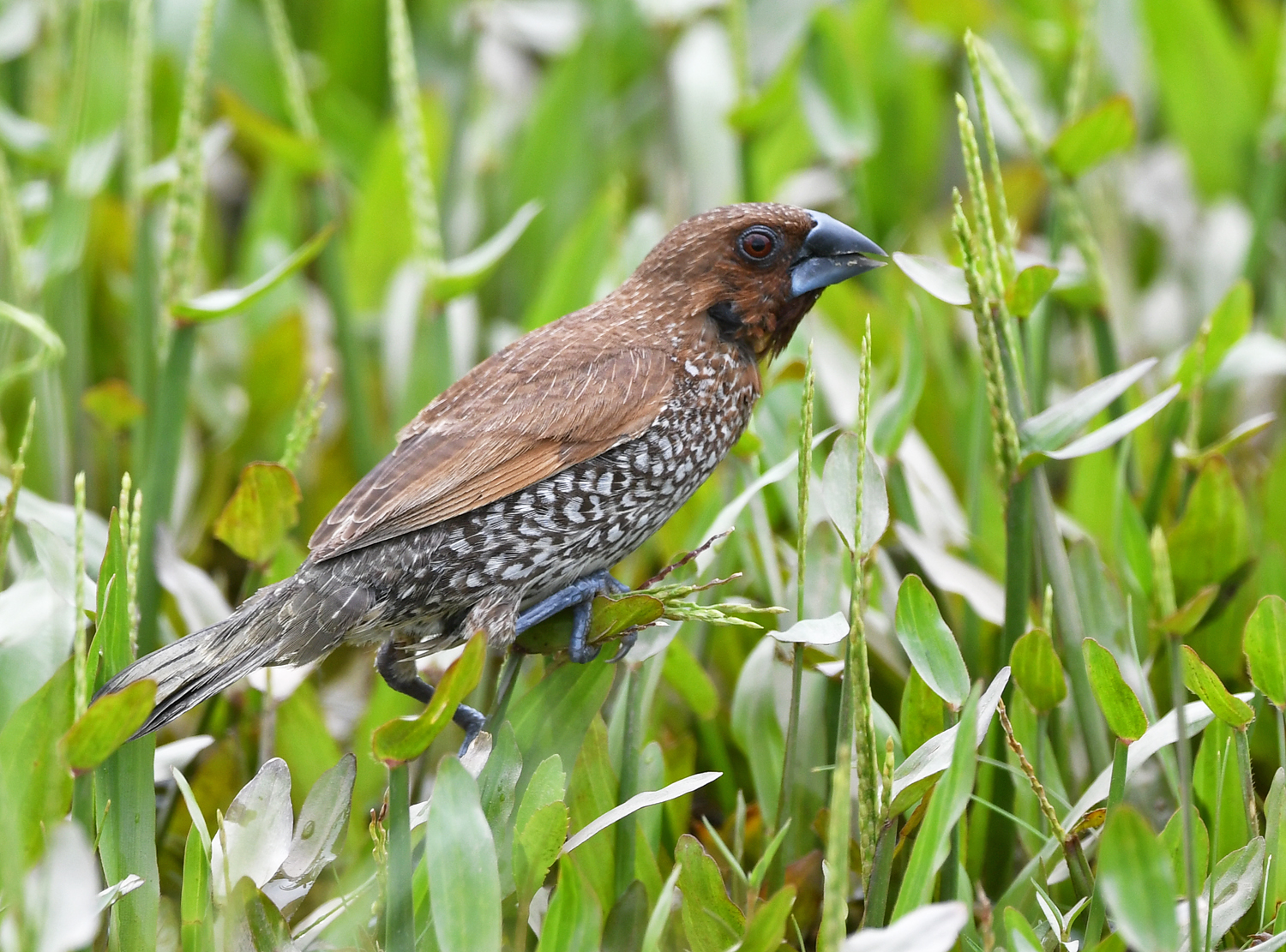
We found our first Bornean endemic of the trip - several Dusky Munias mixed in with hundreds of Chestnut Munias - and observed a few Wandering Whistling-Ducks in flight. Herons and rails were less common that I was expecting but highlights included a single White-browed Crake, several of the ubiquitous White-breasted Waterhens, and a Cinnamon Bittern.
 |
| Wandering Whistling-Ducks - Penampang rice paddies, Kota Kinabalu, Sabah, Malaysia |
We spotted our first Blue-eared Kingfisher of the trip which was a highly-anticipated lifer for Laura. The colours on Asian kingfishers are absolutely outrageous, and completely out-class any of "our" kingfishers from the Americas.
 |
| Blue-eared Kingfisher - Penampang rice paddies, Kota Kinabalu, Sabah, Malaysia |
 |
| Blue-eared Kingfisher - Penampang rice paddies, Kota Kinabalu, Sabah, Malaysia |
My other target was being a little tricky and we were unable to turn up any Black-backed Swamphens over the first hour. We walked down a side road that seemed to lead to some thicker vegetation - surely, the preferred haunts of the swamphens.
 |
| Swamphen habitat - Penampang rice paddies, Kota Kinabalu, Sabah, Malaysia |
And we easily found a couple of them! Just as we were walking back to the car the ominous gray clouds gave way to light rain; foreshadowing of the heavy showers that would be arriving in the evening.
 |
| Black-backed Swamphen - Penampang rice paddies, Kota Kinabalu, Sabah, Malaysia |
Before returning to the hotel we made one final pit-stop in an area where I had previously seen Nankeen Night Herons. Within a couple of minutes we had found a half-dozen of them, and we enjoyed watching this final lifer for Laura in the fading light.
 |
| Nankeen Night Heron - Kota Kinabalu, Sabah, Malaysia |
October 3, 2024
Today was officially the start of the tour, but it wouldn't begin until 5:00 PM when I had plans to meet our local guide in the hotel lobby, followed shortly by a meeting with all the travellers at 6:00 PM and then our welcome dinner. Laura and I wanted to make the most of our day: we would travel up into the Crocker Mountains southeast of Kota Kinabalu.
The tour wouldn't be visiting this area which was an extra incentive for us to spend our free day here. Many of the bird species overlap with Mount Kinabalu, meaning that it would be good practice for us before birding with the Quest group. And it would provide Laura with the opportunity for many new birds, some of which we surely wouldn't see with the group, such as Mountain Barbet and Bornean Bulbul.
I had previously visited this area in 2017 but it had been many years and I was eager to return. We left the hotel at 4:30 AM and I made the easy 1.5 hour drive into the mountains while Laura caught up on sleep in the passenger's seat.
You basically have two options for birding the Crocker Range: you either explore along the shoulder of the main road cutting through these mountains, or you investigate a quiet side-road that leads to a telecommunications tower at 1960 m in elevation. We began our day along the main road, stopping whenever we heard mixed flocks. We ended up birding the elevation band between 1200 and 1500 m in elevation.
 |
| Crocker Range, Sabah, Malaysia |
Birding a new area is always hectic on the first morning, especially if you come across some mixed flocks. I enjoyed living vicariously through Laura as her mind was blown time and time again by new birds. Bornean Treepie. Chestnut-headed Laughingthrush. Mountain Barbet. Chestnut-crested Yuhina. Yellow-breasted Warbler. Black-capped White-eye. It was a little overwhelming!
 |
| Mountain Barbet - Crocker Range, Sabah, Malaysia |
The roadsides near the Rafflesia Information Center were particularly productive. A small flock of Pygmy Heleias (formerly called Pygmy White-eyes) was a nice surprise, as I had only encountered this endemic species to Borneo's highlands on one previous occasion, and I had never photographed it. We came across two pairs over the morning.
 |
| Pygmy Heleia - Crocker Range, Sabah, Malaysia |
Some interesting bird vocalizations piqued my interest around the next bend. A bit of playback and my suspicions were confirmed: Bornean Leafbirds! I had missed this mountain endemic on all three of my previous tours and so this was a long-awaited lifer for me. The views were brief but diagnostic and my photos were terrible, but we would improve on these views later during the official tour, as the photo below indicates.
 |
| Bornean Leafbird - Kinabalu Park, Sabah, Malaysia (taken on October 5, 2024) |
We made it as far as the Masakob waterfall before turning around and walking back to the vehicle. Here, I saw the unmistakeable brilliant emerald flash of a Whitehead's Broadbill shoot across the road. Unfortunately, Laura was facing the other direction and missed it, and despite some effort it never reappeared at the roadside. Can't get them all...
 |
| Bornean Ashy Drongo - Crocker Range, Sabah, Malaysia |
Other highlights from our roadside wanderings included a flyover Japanese Sparrowhawk (a scarce migrant in Sabah), Gray-throated and Temminck's Babblers, our only Black-and-crimson Oriole of the trip, and a baby Black-capped White-eye following its parent around.
 |
| Japanese Sparrowhawk - Crocker Range, Sabah, Malaysia |
 |
| Black-capped White-eye (juvenile) - Crocker Range, Sabah, Malaysia |
As expected, the mid-morning sun had nudged many butterflies to take to the wing and so I photographed a handful of these as well.
 |
| Mycalesis pitana - Crocker Range, Sabah, Malaysia |
 |
| Common Three-ring (Ypthima pandocus) - Crocker Range, Sabah, Malaysia |
Happy with the fruits of our early morning labour, we backtracked to the mountain pass and took the narrow gravel road towards the telecommunications tower (the Gunung Alab substation). Though the traffic all morning had been manageable, it was still frequent enough to be an annoyance when birding a mixed flock. The peaceful road to the telecommunications tower was a nice change of pace.
 |
| Road to Gunung Alab substation - Crocker Range, Sabah, Malaysia |
Right away, we found one of my target birds here, another species endemic to Borneo's highlands that I had never photographed before. This Mountain Serpent-Eagle announced its presence by vocalizing. We frantically looked around until I spotted it high in the sky. Though they look pretty much identical to the Crested Serpent-Eagles that are found in the lowlands, the Mountain Serpent-Eagle's vocalizations are different. Visually they are apparently a bit darker and longer-winged as well, but I haven't found these to be useful criteria in my own limited experience.
 |
| Mountain Serpent-Eagle - Crocker Range, Sabah, Malaysia |
We were at a higher elevation than the morning's birding and so there was a noticeable difference in the species assemblage as well. Several Aberrant Bush-Warblers were singing from the roadside ferns.
 |
| Aberrant Bush-Warbler - Crocker Range, Sabah, Malaysia |
This jumping spider was eye-catching!
 |
| Thiania sp. - Crocker Range, Sabah, Malaysia |
We reached the entrance gate to the ranger's station and after chatting briefly with the guard, we parked there and continued on foot up the road towards the telecommunications tower. Of course, we couldn't help but stop and check out the residual moths on the wall of one of the buildings. I can imagine that the mothing would be insane in these diverse mountains!
 |
| Spilosoma ericsoni - Crocker Range, Sabah, Malaysia |
 |
| Orthocabera sp. - Crocker Range, Sabah, Malaysia |
 |
| Lemyra sp. - Crocker Range, Sabah, Malaysia |
As we slowly made our way up the road, we stopped frequently to photograph the different species of orchids, gingers, lobelias, pitcher plants and others. A botanist's dream...
 |
| Spathoglottis microchilina - Crocker Range, Sabah, Malaysia |
 |
| Nepenthes zakriana - Crocker Range, Sabah, Malaysia |
 |
| Rhododendron javanicum - Crocker Range, Sabah, Malaysia |
 |
| Lobelia borneensis - Crocker Range, Sabah, Malaysia |
We bumped into a mixed flock and teased out a few interesting birds. First were some Bornean Green-Magpies with a roving group of Bornean Treepies. Next were a pair of Fruit-hunters, one of the most desirable endemics of Borneo's highlands for visiting birders. These thrushes can be somewhat nomadic and difficult to nail down on a birding trip. I have been fortunate and seen them on all four of my Borneo tours, but they are never guaranteed. Also of interest in the flock was at least one Mountain Black-eye, which was a long-awaited lifer for me. This songbird lives in the high elevations, and though they can occasionally be found at Timpohon Gate in Kinabalu Park, I have never been quite lucky enough. Shortly after finding the mixed flock we bumped into a birding group from the United States. They were quite interested in the Fruit-hunters and Mountain Black-eyes and we helped them get on the birds.
Continuing on, we made it to the telecommunications tower and spent some time at a bird-hide that had been set up to see several species of partridges. Though we heard the Crimson-headed and Red-breasted Partridges vocalizing from somewhere down the hillside, none came in to the hide during our short visit. Morning would have been preferable, but you can't be everywhere at dawn! Instead, we had to be satisfied with a handful of Bornean Mountain Ground Squirrels and a pair of Snowy-browed Flycatchers.
 |
| Bornean Mountain Ground Squirrel (Sundasciurus everetti) - Crocker Range, Sabah, Malaysia |
Satisfied with our morning, Laura and I drove back down to the main highway and stopped at the restaurant situated at the junction. I had remembered delicious and cheap fried noodles from my 2017 trip, and we were pleased to find that the noodles were still on offer and very delicious.
Feeling sated, we returned to the telecommunications road for a final hour or so of naturalizing before it was time to hit the road and return to Kota Kinabalu. The birding was slow, so I focused on finding interesting plants and insects.
 |
| Tea Tree (Leptospermum sp.) - Crocker Range, Sabah, Malaysia |
 |
| Malabar Melastome (Melastoma malabathricum) - Crocker Range, Sabah, Malaysia |
 |
| Rhododendron fallacinum - Crocker Range, Sabah, Malaysia |
 |
| Nisitrus musicus - Crocker Range, Sabah, Malaysia |
When I caught up with Laura she had just finished watching a pair of Mountain Wren-Babblers, yet another new species for her. I had never photographed this Bornean endemic before and so we spent a few more minutes with the birds. They were quite active though, and I never quite managed the photo that I was hoping for.
 |
| Mountain Wren-Babbler - Crocker Range, Sabah, Malaysia |
And with that, it was time to return to Kota Kinabalu and begin the tour. The drive back was uneventful and by 4:30 PM we had made it back to the hotel. My next blog post will document events from the tour itself.




.jpg)


.jpeg)


