Tuesday, 23 August 2022

Parque Nacional Huascarán - Part 1

I have mentioned previously on this blog how Laura and I had a dilemma when planning ten weeks in Peru. Do we go all out, covering off the entire country north to south? Or do we take things a little slower so that we could avoid a ton of really long drives and overnight buses, and spend a little bit of extra time at some of the locales? In the end, we opted for the latter and we avoided all travel in northern Peru. Hopefully, we will return to this beautiful country in the future to explore the northern third, but for this trip we focused on the central and southern portions. Of course, it goes without saying that one can spend a lifetime in Peru and only scratch the surface from an ecological point of view.

The furthest north that we planned to visit was a gorgeous national park that features the tallest mountain peaks in Peru. Parque Nacional Huascarán comprises most of the mountain range called the Cordillera Blanca. The park is around 150 km long and averages 25 km in width, and it is famous for its aquamarine lakes, snow-capped peaks and mountaineering activities. 

Parque Nacional Huascarán, Ancash, Peru

The birding in Huascarán can also be incredible. While species diversity above 4000m is not very high, here it is a matter of quality over quantity. Vast groves of Polylepis forest can be reached along bumpy gravel roads, and this rare ecosystem is home to unique species like the White-cheeked Cotinga, Giant Conebill and Plain-tailed Warbling Finch. Some of the other birds that we hoped to eye up included the Green-headed Hillstar, Ancash Tapaculo, Pale-tailed Canastero and Tit-like Dacnis, to name a few. We booked four nights in a hotel in the town of Caraz. It came equipped with a kitchen and proved to be an excellent base for our explorations in Huascarán. 


August 4, 2022

Today had mostly been a write off as we navigated the "highway" from Huánuco to Huallanca. Due to unforeseen construction delays - virtually the entire stretch of road was being worked on by various crews - it took us all day to drive this stretch. Most of it was unpaved as well. But we found a cheap hotel in Huallanca that also served excellent trucha frita (whole fried trout), a fitting end to the day. 

We christened our rental car with the name "Pardusco" after this drive. Meaning brownish in Spanish, Pardusco is also the common name for a tanager that is endemic to the eastern Andes of Peru, a species that we had recently observed at Bosque Unchog. This photo was taken along the "highway".

Pardusco


August 5, 2022

Our first stop on the morning of August 5 was a nearby lake called Laguna Contaycocha. The air was chilly at the elevation of 3900m but the birds were active. 

Laguna Contaycocha, Ancash, Peru

One could not help but notice the large numbers of Giant Coots. Some were busily repairing nests, while others were preoccupied with feeding their young, still in that awkward phase. 

Giant Coot - Laguna Contaycocha, Ancash, Peru

Miniature Giant Coot - Laguna Contaycocha, Ancash, Peru

Flocks of waterfowl included quite a few Andean Ducks, some at close range and looking sharp.

Andean Duck - Laguna Contaycocha, Ancash, Peru

We heard our first Ancash Tapaculo, spotted a White-browed Chat-Tyrant, and listened to a very close Stripe-headed Antpitta that did not want to come out and play. We also found our first Tit-like Dacnis (a female), which was a sign of things to come. This species is abundant in certain sectors of Huascarán. 

Tit-like Dacnis - Laguna Contaycocha, Ancash, Peru

We drove for most of the morning to reach Parque Nacional Huascarán. At one point, we turned off the highway at a rough mountain road; this track is the southernmost pass through the Cordillera Blanca. We considered driving the entire road, from the eastern side through the mountains to Laguna Patococha on the western side. However, given the remoteness of the area, the quality of the road (or lack thereof), the nonexistent cell service and the battery issues that we had had with the Toyota, we thought better of this decision. The scenery was beautiful in the small stretch that we did explore, however. 


Below, Laura is checking out her lifer Streak-throated Canastero while Andean Flickers call from somewhere in the distance. 

By lunchtime, we had driven around the bottom end of the Cordillera Blanca and had began to head north along the western flank. We reached the opposite side of the mountain road we had considered driving earlier, and turned eastwards. We payed our entrance fee to the indigenous group that allows access to this road and completed the 10 kilometre or so journey to Laguna Patococha. It was beautiful.

Laguna Patococha, Ancash, Peru

Silvery Grebes and various ducks dotted the water's surface, while Puna Ibises and Chilean Flamingos probed the shallows. Somewhere off in the distance, the raucous vocalizations of Andean Lapwings caught our ears. Laura and I even ruined the beautiful montane scene by indulging in a selfie or two...

Laguna Patococha, Ancash, Peru

After a quick snack, we went for a stroll around the edge of the lake. One of our target birds was present - the Green-headed Hillstar. We watched a male feeding on the bright yellow flowers of a cactus, the only nectar source we could find in this chilly environment. 

Green-headed Hillstar - Laguna Patococha, Ancash, Peru

The Green-headed Hillstar has a relatively small range in the high Andes of northern and central Peru. Like all hillstars they are quite an attractive hummingbird, especially when the emeral gorget catches the light just so!

Green-headed Hillstar - Laguna Patococha, Ancash, Peru

It is incredible that hummingbirds can survive at these extreme altitudes where the temperatures drop below freezing each and every night. They have evolved with their environment and rely on the few nectar sources around, such as the yellow-flowered cactus which I have identified as Oroya borchersii. Like the hillstar, the cactus also has a rather small global range in north and central Peru. 

Oroya borchersii - Laguna Patococha, Ancash, Peru

Oroya borchersii - Laguna Patococha, Ancash, Peru

Our visit to Laguna Patococha was a prudent choice, since it was the only site where we observed the Green-headed Hillstar. 

Green-headed Hillstar - Laguna Patococha, Ancash, Peru

One of the iconic plants of this region of the Andes is an incredible bromeliad called Queen of the Andes (Puya raimondii). This endangered species is the largest bromeliad in the world with inflorescences reaching over 15 m in height! We saw some mature individuals off in the distance, but we were unable to approach them closely since we wanted to avoid entering the park and paying the fee. Instead, we settled for several young individuals and a deceased one. 

Queen Of The Andes (Puya raimondii) - Laguna Patococha, Ancash, Peru

Queen Of The Andes (Puya raimondii) - Laguna Patococha, Ancash, Peru

Did I mention how the scenery at Laguna Patococha was just incredible? 

 Laguna Patococha, Ancash, Peru

Laura and I completed our walk around the lake, observing a few additional birds: Taczanowski's and Puna Ground-Tyrants, a Short-billed Pipit and numerous Streak-throated Canasteros. 

Taczanowski's Ground-Tyrant - Laguna Patococha, Ancash, Peru

Streak-throated Canastero - Laguna Patococha, Ancash, Peru

The Silvery Grebes were looking particularly photogenic as we rounded the last part of the lake. 

Silvery Grebe - Laguna Patococha, Ancash, Peru

Silvery Grebe - Laguna Patococha, Ancash, Peru

Silvery Grebe - Laguna Patococha, Ancash, Peru

We finished up at the lake and retraced our drive back to the highway. From here, we turned north and completed the last two hours of the drive to the town of Caraz. We were excited for what the next few days had in store. 

Monday, 22 August 2022

Carpish Tunnel, Paty Trail, And Bosque Montepotrero

Laura and I booked an apartment in the city of Huánuco for four nights. This was ostensively to give us ample time to explore some of the beautiful natural areas east of here, but it also gave us a chance to make some home-cooked meals, do laundry, and relax a little after being on the move for quite a few days in a row. 

Our visit to Bosque Unchog, featured in my latest post, was the crown jewel of our stay in Huánuco but we explored some other areas as well. 


August 1, 2022

Laura and I enjoyed a well deserved sleep-in until 6:30 AM. I made coffee and tea and fried some eggs for a leisurely breakfast. After driving eastwards over the crest of the Andes, it was already 8:30 AM when we arrived at our first destination for the day. Bad birders we are!

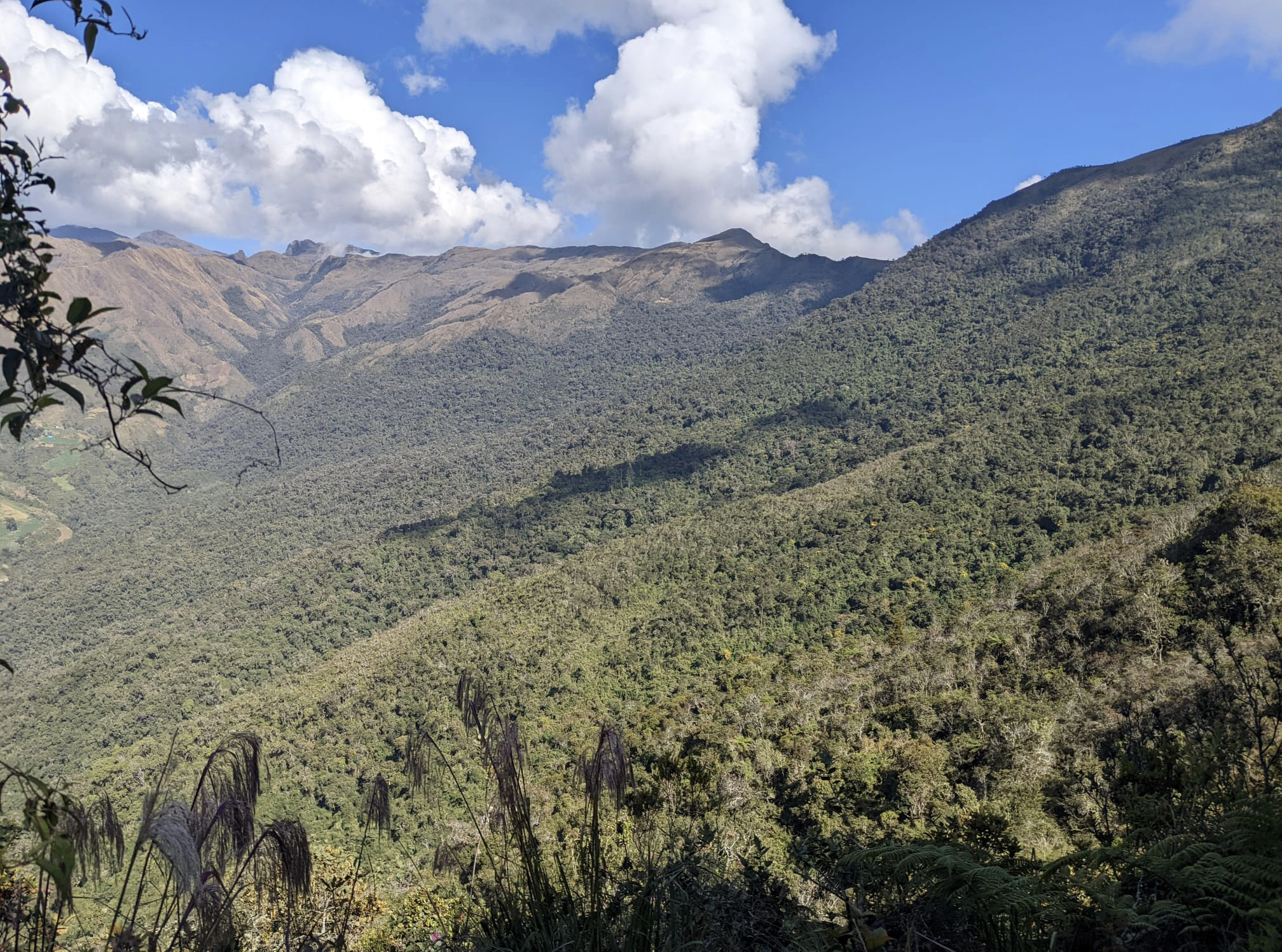
The Carpish Tunnel is a famous birding site at around 2700 m in elevation. Driving eastwards from Huánuco, the vegetation is representative of the relatively arid conditions due to the rain-shadow effects of the eastern Andes. By the time that one drives through the Carpish Tunnel and emerges on the eastern side, the landscape has become verdant. It is quite the contrast. 

Carpish Tunnel Trail, Huánuco, Peru

Unfortunately, these conditions are suitable for more than just native plants growing in diverse forests. Humans have chopped down much of the vegetation, replacing it with hydrangea monocultures. The Carpish Tunnel trail used to cut through beautiful montane forest, though it is now just a sliver of its former glory. At least there is quite a bit off untouched forest off in the distance. It will remain this way for a few years at least, until someone has the bright idea to build a new road to continue the deforestation. 

 Carpish Tunnel Trail, Huánuco, Peru

But, enough of the negativity. Several decent forest patches remain along the Carpish Tunnel trail, and with them come an excellent variety of birds. Within minutes of our arrival we had already heard Bay and Chestnut Antpittas, spotted a Gray-breasted Mountain-Toucan, and picked through a mixed flock. 

Gray-breasted Mountain-Toucan - Carpish Tunnel Trail, Huánuco, Peru

We did not have very many targets along the Carpish Tunnel trail and simply enjoyed a nice walk with an excellent variety of birds. Tschudi's Tapaculo was a highlight; we had heard this species on a few previous occasions, but this time, one cooperated and perched up for a few seconds. 

Tschudi's Tapaculo - Carpish Tunnel Trail, Huánuco, Peru

Laura had never seen a Plushcap before. Though they are somewhat widespread in Andean cloud forests, they are rarely a common species. I had only bumped into Plushcaps on a couple of previous occasions. Today was her lucky day - we easily found a half-dozen or so in mixed flocks.

Plushcap - Carpish Tunnel Trail, Huánuco, Peru

Some of the other highlights during our morning hike included a vocal Large-footed Tapaculo, a Rufous Spinetail, Grass-green Tanagers, a Golden-browed Chat-Tyrant, great looks at White-eared Solitaires and a healthy selection of tanagers and hummingbirds. Barred Fruiteaters also proved to be common, allowing us to have some spectacular views of this attractive species. 

Barred Fruiteater - Carpish Tunnel Trail, Huánuco, Peru

Barred Fruiteater - Carpish Tunnel Trail, Huánuco, Peru

The sun peeked out in the second half of our walk, instigating many insects to come out of the woodwork. 

Pedaliodes sp. - Carpish Tunnel Trail, Huánuco, Peru

Oreiallagma quadricolor - Carpish Tunnel Trail, Huánuco, Peru

Silky Wanderer (Leptophobia eleone) - Carpish Tunnel Trail, Huánuco, Peru

Pepsis sp. - Carpish Tunnel Trail, Huánuco, Peru

Lasiophila sp. - Carpish Tunnel Trail, Huánuco, Peru

It was not quite midday yet and so Laura and I drove a little further down the road to the Paty Trail. This is a site that requires several days of exploration to tease out its avian treasures. Part of the reason is that there is a long, steep walk down a gravel road through cutover sections to reach the better quality forest below. Laura and I made it part way down the slope before deciding that it was not in our best interests to continue. We did not feel like climbing 400-500+ meters in elevation back up, especially since the clock was already approaching noon. The only semi-noteworthy sighting we had in our very short visit was this dead-on-road snake which I have yet to identify. 


Laura and I found this sign a little disheartening. Surrounded by plastic garbage strewn about, the sign dictates that the land beyond is an area of conservation. All we could see was cut-down forest. Who needs actual protections for the environment, when we can just have the idea of environmental protection? It is the same thing, right? 

Paty Trail, Huánuco, Peru


August 3, 2022

We still had one full day in Huánuco remaining. We decided to stop in at a relatively new protected area called Bosque Montepotrero. This is a community-run forest that also happens to be one of the more accessible sites to search for the range-restricted Panao Antpitta. In 2020, the Rufous Antpitta was split into a number of different species. The Panao Antpitta was "created" by this taxonomic fracturing, and it has a small range in the eastern Andes, mainly east of Huánuco. 

The first stretch of trail passes along the side of a cutover hillside surrounded by pasture. Montepotrero is a fitting name for this reserve, as potrero translates to pastureland. In some of the scrubby areas we found a nice variety of birds including Laura's first Brown-flanked Tanager. We also watched attractive hummingbirds like the Green-tailed Trainbearer and the Mountain Velvetbreast. 

Brown-flanked Tanager - Bosque Montepotrero, Huánuco, Peru

Brown-flanked Tanager - Bosque Montepotrero, Huánuco, Peru

We paid our 5 soles per person entrance fee and were shown the way to the forest by the enthusiastic guard. The trail passed along the edge of the hillside, with forest extending down the steep slope to our left. The path itself was quite level, making the walk very easy.

Bosque Montepotrero, Huánuco, Peru

Bosque Montepotrero, Huánuco, Peru

We found the Panao Antpittas to be quite common by voice, but despite our best efforts we were unable to obtain any views of the little skulkers. Still, I managed some decent recordings so I was relatively happy. 

Other than the antpittas, the birding was relatively slow for us but we only spent a couple of hours here. In truth, I was more focused on butterflies since the sun was out in full force. 

Pronophila sp. - Bosque Montepotrero, Huánuco, Peru

And with that, we headed back to our car and drove back to our apartment in Huánuco to relax for the rest of the day. Our plan for the following morning was to begin the long drive to Huascarán National Park, home to some of the highest mountain peaks in Peru and a number of interesting birds. 

Thursday, 18 August 2022

Visiting The Legendary Bosque Unchog

Bosque Unchog is a place of great lore in South American birding. The elfin forest above the town of Acomayo along the eastern crest of the Andes in Peru had been unexplored from an ornithological point of view until the mid 1970s. In the early 1970s half-brothers Reyes Rivera and Manuel Villar discovered several species completely unknown to science in the hills above their homes in Acomayo, including the Pardusco and Golden-backed Mountain-Tanager. In 1974, young ornithologist Ted Parker was invited to join the Louisiana State University Museum of Ornithology's Peruvian expedition, and during his trip he spent several days high up in the elfin forest at Quilluacocha, the site where Villar had first discovered the Golden-backed Mountain-Tanager. At the time of Parker's trip, only Villar, Rivera, and Villar's father had ever observed the bird. 

Golden-backed Mountain-Tanager - Bosque Unchog, Huánuco, Peru

Ted Parker is a larger than life figure in South American ornithology due to his impressive field skills - some have said that he was the most skilled birder who had ever explored the Neotropics. Most aspiring Neotropical birders (myself included) see him as a sort of legend. Unfortunately, his untimely death caused by a 1993 plane crash in a remote region of Ecuador prevented him from fulfilling his incredible potential, but in his few years he was instrumental in discovering several new species to science, while also voice-recording many dozens (hundreds?) for the very first time. It is often incorrectly reported that he discovered the Golden-backed Mountain-Tanager and Bay-vented Cotinga - rather, he was the initial ornithologist to observe them, as well as photograph them and record their voices and life histories for the first time. 

Bosque Unchog, Huánuco, Peru

Visiting Bosque Unchog is a little simpler now compared to Parker and Rivera's arduous trek from Acomayo to the ridge back in January of 1975. A gravel road snakes up the steep hillsides to the town of Cochabamba, and eight kilometres further to Bosque Unchog. Until recent years, it was only possible to traverse the final stretch with 4x4 but the road has been recently improved; so much so that a small car can now make the journey!


August 2, 2022

Laura and I set off well before dawn from our AirBnB apartment in Huánuco, expecting a 2.5 hour drive to reach the site. I had braced myself for a hair-raising drive up the mountainside in the dark with our Toyota Corolla. Surprisingly, there were almost no sketchy bits to the road and we arrived at Bosque Unchog shortly after 5:30 AM. The sky was only just beginning to lighten. Laura rested in the car until dawn while I set out with my bluetooth speaker and binoculars, eager to start my eBird checklist with some birds more typically encountered at night. 

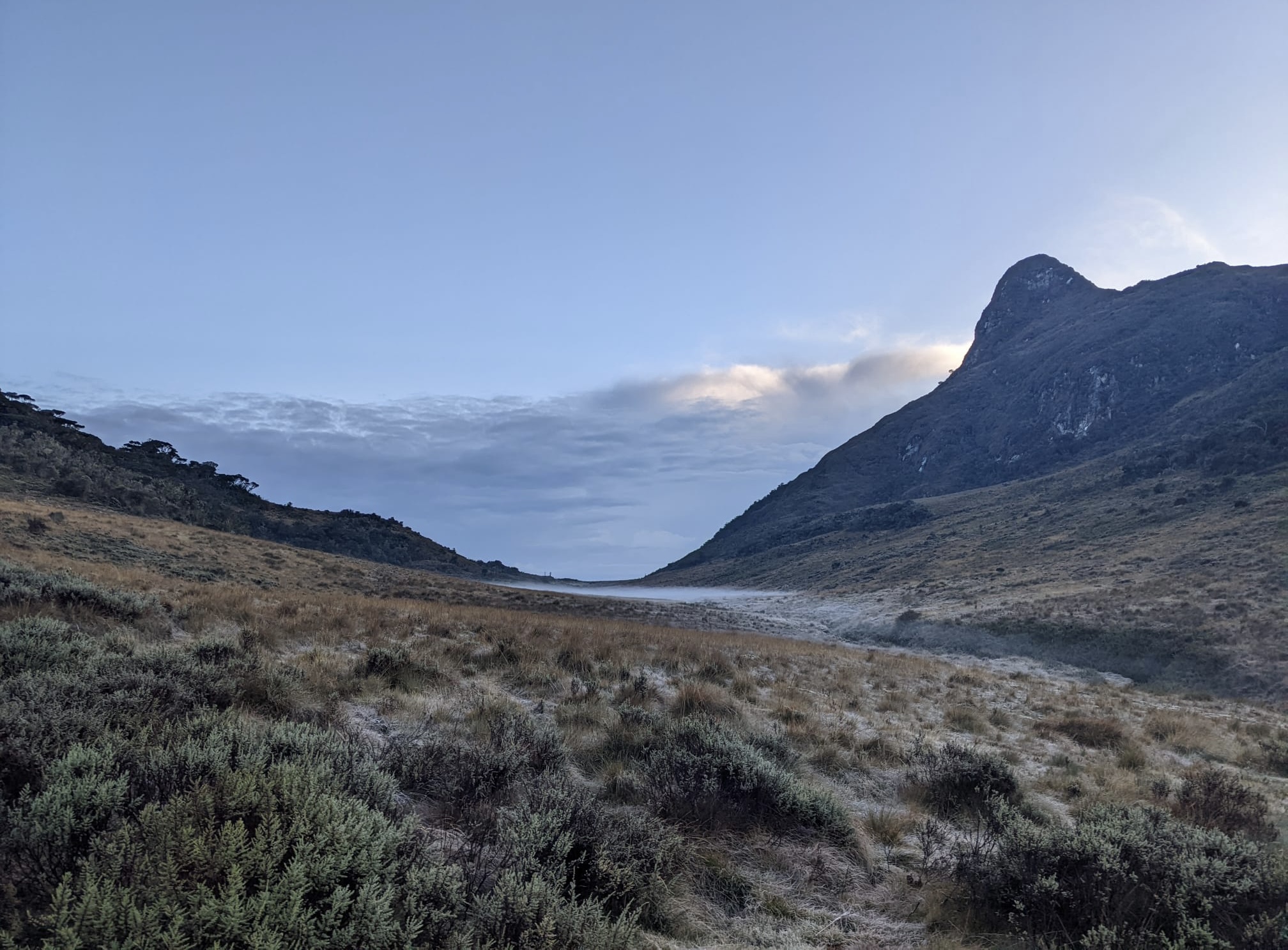
I returned 45 minutes later with a heard-only Jameson's Snipe for my efforts (along with far too many Great Thrushes). Laura and I ate breakfast, loaded our packs for the day's hike, and set off down the rough trail passing through bunchgrass meadows laden with bromeliads and orchids, still frosty from the chilly night. 

Bosque Unchog, Huánuco, Peru

Bosque Unchog is home to four species in particular that are high on any visiting birder's wish list. These are the Bay-vented Cotinga, Pardusco, Rufous-browed Hemispingus and of course, the spectacular Golden-backed Mountain-Tanager. While these birds have since been discovered further afield in other remote sections of the eastern Peruvian Andes, Bosque Unchog remains the only easily accessible and reliable location for all four species. 

We had to wait a little while before knocking the first target off the list. As we strolled through the meadows and near to one small Polylepis patch, we added a number of species to our list including several lifers - heard-only Neblina Tapaculos and several attractive Coppery Metaltails. Both are endemic species to Peru, only finding habitat in treeline scrub at the eastern crest of the Andes. The metaltails were surprisingly common during our hike. 

Coppery Metaltail - Bosque Unchog, Huánuco, Peru

We reached the second Polylepis patch and began our descent. We had neared the area where our four main target species are often found. 

Bosque Unchog, Huánuco, Peru

Polylepis forest - Bosque Unchog, Huánuco, Peru

And then it happened. Through a window in the stunted forest, I noticed some movement along a distant hillside. A Golden-backed Mountain-Tanager, in all its glory! Laura and I excitedly watched a pair of them through the gap and, with a stroke of luck, both flew directly towards us and alighted in the trees above our heads. The lighting was poor for photos, but we could easily appreciate the colours (and huge size) of these gorgeous mountain-tanagers. 

It was our lucky day. We ended up seeing several pairs of Golden-backed Mountain-Tanagers between the second and third Polylepis groves. We conservatively estimated six individuals, but there may have been more. Here are some of my favourite photos of them. 

Golden-backed Mountain-Tanager - Bosque Unchog, Huánuco, Peru

Some of the individuals seemed to not care at all about our presence, actively foraging only a few meters from us!

Golden-backed Mountain-Tanager - Bosque Unchog, Huánuco, Peru

Golden-backed Mountain-Tanagers - Bosque Unchog, Huánuco, Peru

Golden-backed Mountain-Tanagers - Bosque Unchog, Huánuco, Peru

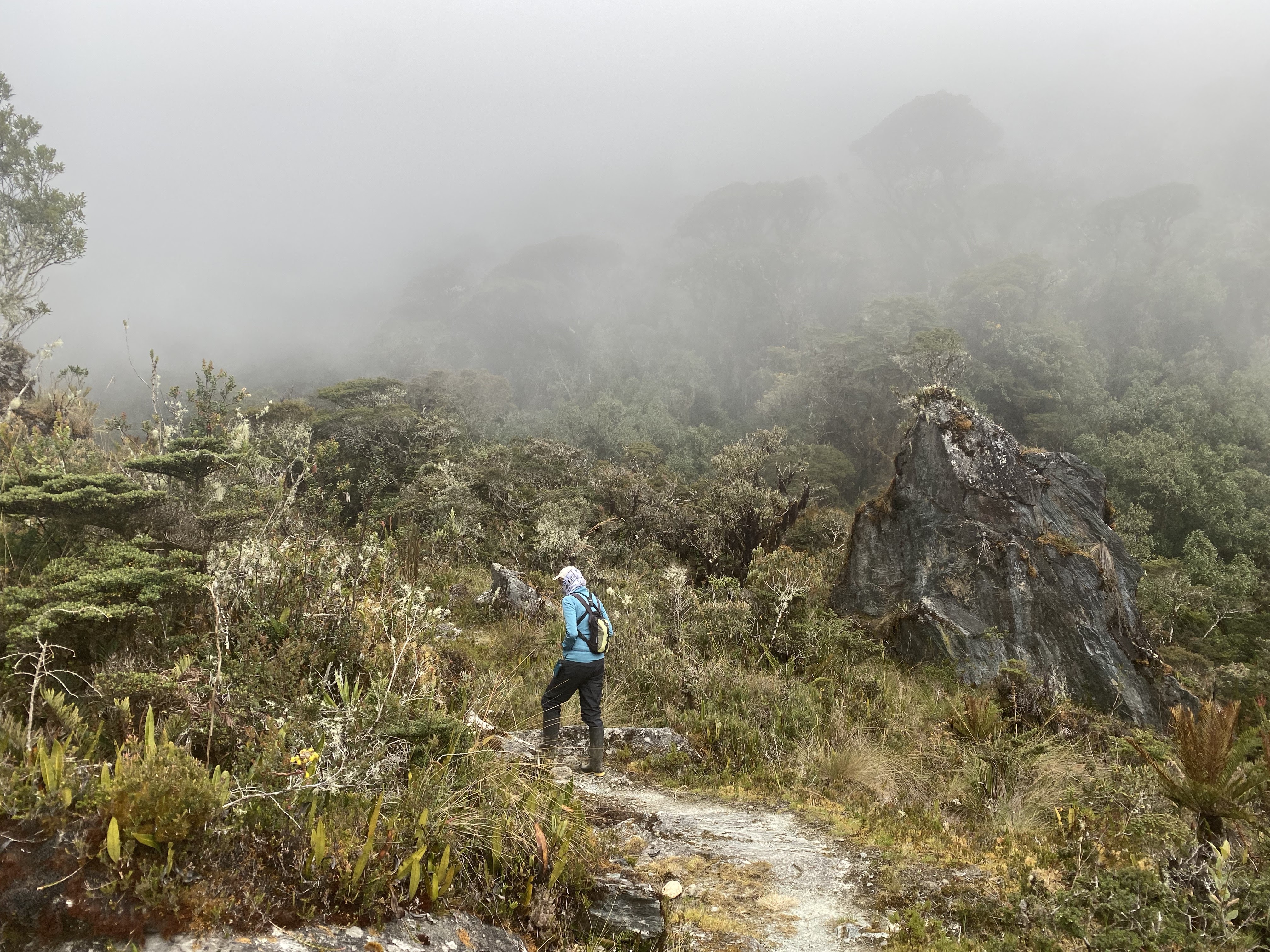
Nothing could top that! The fog began to roll in around this time, causing some concern. How would we be able to spot distant cotingas perched on treetops? 

Bosque Unchog, Huánuco, Peru

While the Bay-vented Cotinga was next on our hit list, another cotinga was complicating things. The Red-crested Cotinga is a very cool bird, but it is one that we have found on many previous occasions throughout its large range in the Andes. We were beginning to harbour a little bit of animosity towards the species when we spotted our fourth Red-crested Cotinga with not a Bay-vented in sight. 

Red-crested Cotinga - Bosque Unchog, Huánuco, Peru

Finally, our persistence paid off. I spotted a distant cotinga sporting a brownish chest and belly. It was too far for good photos so the following was all I could manage. It would have been handy to have my scope with us, but I had decided to leave it in the car as it would be a little cumbersome to carry with us all day long. We hoped for closer encounters later in the day, but this would be the only Bay-vented Cotinga that we would see.

Bay-vented Cotinga - Bosque Unchog, Huánuco, Peru

With two out of our four big targets in the bag, the pressure was lessened somewhat. Strangely, we had not encountered any Parduscos even though they are supposedly a common constituent of mixed flocks. The Rufous-browed Hemispingus was also missing. This species is the most difficult of the Big Four and many birders who visit Bosque Unchog miss this species. It does not help that its song is extremely similar to that of the very common Moustached Flowerpiercer. On several occasions I was pretty sure that we were listening to a hemispingus, only to have a flowerpiercer pop out. Interestingly, many birder's checklists list the hemispingus as "heard only"...

Bosque Unchog, Huánuco, Peru

Even during relatively slow periods, we added new birds here and there. Unfortunately, three of the species new to us remained as heard-only, including White-winged and Neblina Tapaculos and Chachapoyas Antpitta. Another lifer for us was the Line-fronted Canastero, a species which is at home in these stunted, bromeliad-rich habitats at the treeline. 

Line-fronted Canastero - Bosque Unchog, Huánuco, Peru

Line-fronted Canastero - Bosque Unchog, Huánuco, Peru

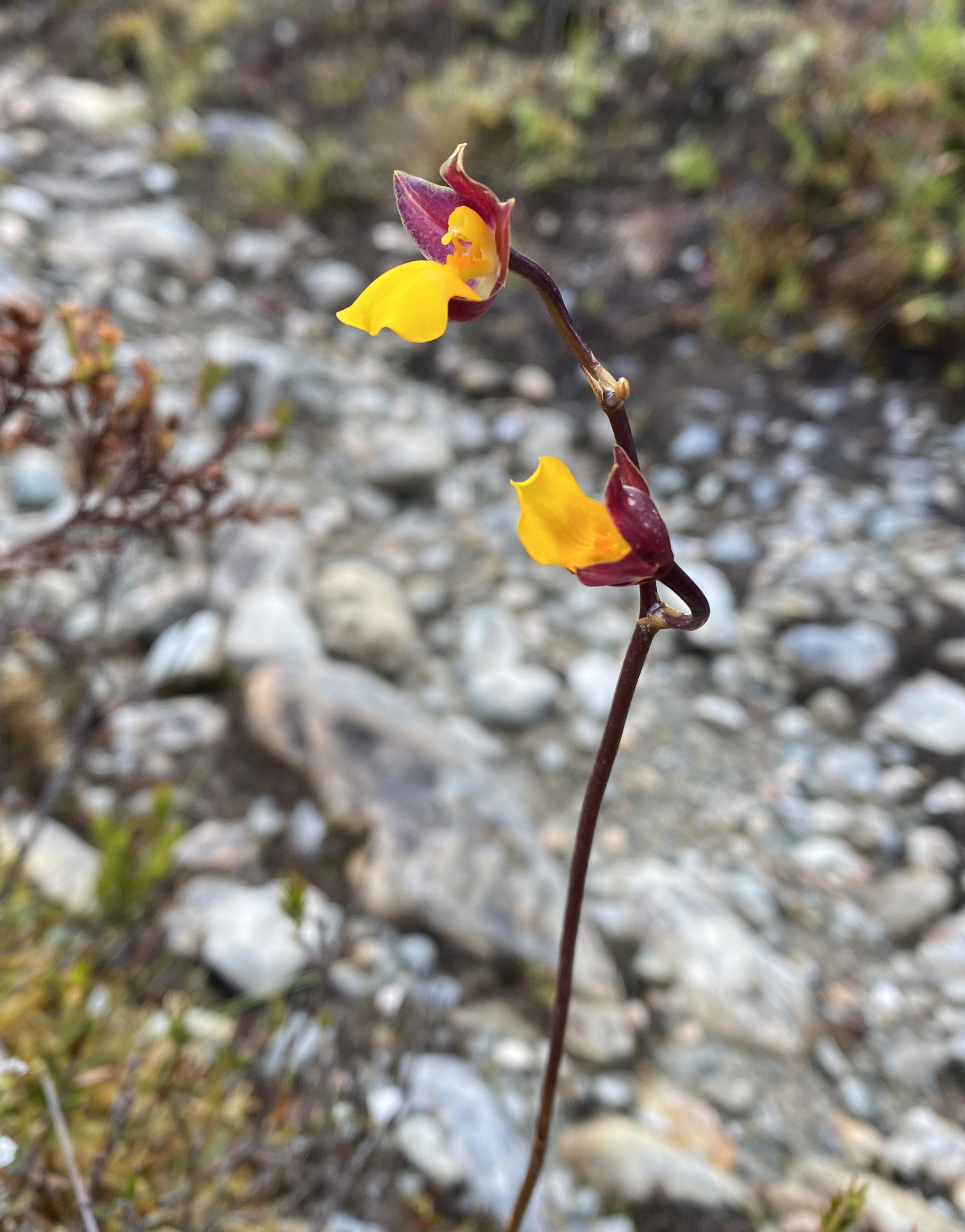
Speaking of bromeliads, it was hard not to marvel at the plant life at this site. I am not in the least a plant expert, but I could imagine that a botanist would be in heaven here.

Begonia hirta - Bosque Unchog, Huánuco, Peru

Telipogon sp. - Bosque Unchog, Huánuco, Peru

Leach Orchid (Stelis sp.) - Bosque Unchog, Huánuco, Peru

Golden Cyrtochilum (Cyrtochilum aureum) - Bosque Unchog, Huánuco, Peru

Puya laccata - Bosque Unchog, Huánuco, Peru

Incan Earring (Brachyotum ledifolium) - Bosque Unchog, Huánuco, Peru

Finally, various chips and zeets in the distance led us down the slippery trail towards our first mixed flock of the day. Mixed in with the bunch were a handful of Parduscos. This unique little bird is not as flashy as a Golden-backed Mountain-Tanager but it is also a member of the tanager family, Thraupidae. 

Pardusco - Bosque Unchog, Huánuco, Peru

The Pardusco was one of several tanagers that were discovered by Rivera and Villar in 1973. At the time of Parker and Rivera's expedition in 1975, it had not yet been formally described, and Parker became the first to extensively study it and document its behaviour. 

Pardusco - Bosque Unchog, Huánuco, Peru

Pardusco - Bosque Unchog, Huánuco, Peru

Quite a few other species formed the mixed flock including White-browed Spinetail, White-chinned Thistletail, Ochraceous-breasted Flycatcher, White-throated Tyrannulet, Citrine Warbler and Blue-backed Conebill. Arguably the most incredibly-plumaged species in the flock was the Yellow-scarfed Tanager. I think that Laura and I both have this Peruvian endemic species as one of our favourite Peruvian birds. 

Yellow-scarfed Tanager - Bosque Unchog, Huánuco, Peru

Anecdotally, it seems that quite a few tanagers found in the elfin forests of the eastern Andes sport flashy yellows on part of their bodies. I wonder if it helps them keep track of each other visually in an environment that is often socked in with fog? Perhaps someone has already looked into this...

Yellow-scarfed Tanager - Bosque Unchog, Huánuco, Peru

For the rest of the day Laura and I had one goal: to spot a Rufous-browed Hemispingus. We tried high and low, spending close to an hour deep in the third Polylepis patch where they are often recorded by visiting birders. On the walk back up we kept an eye and an ear out in all suitable areas. I heard one strong candidate singing (and recorded its song), but with the interference of a nearby creek and a vocalizing hummingbird it is hard to say for sure if a Rufous-browed Hemispingus was involved. 

Bosque Unchog, Huánuco, Peru

Laura and I took our time retracing our steps during the early afternoon. It was tough going as we needed to gain over 400 m in elevation, while hiking in the thin air found over 3500 m. During one break in our travels, I stopped to photograph some Páramo Pipits for the first time. With some patience I was able to approach one quite closely for photos. 

Páramo Pipit - Bosque Unchog, Huánuco, Peru

Páramo Pipit - Bosque Unchog, Huánuco, Peru

Páramo Pipit - Bosque Unchog, Huánuco, Peru

One last-ditch attempt for the hemispingus occurred during the steep ascent through dense forest in Polylepis patch #2, seemingly perfect habitat for our target. Again, we were unsuccessful. 

The rest of the climb was arduous and we needed to take frequent brakes. I'm afraid that I may have killed Laura with the steep ascent...

 Bosque Unchog, Huánuco, Peru

Fortunately, we both made it to the top alive and with our wits mostly about us. The day had been incredible - just us, the birds, the orchids and the incredible mountain scenery. It was truly one of my favourite days spent in Peru thus far!

We made a couple of brief stops on the drive back down to Cochabamba as we were now on the dry portion of the mountain, home to different species than those which reside on the moisture-laden side where we had hiked. One of the birds that I caught up with was the Brown-flanked Tanager, a species endemic to central Peru. And with that, we left the area behind to recuperate at our apartment in Huánuco. What a day...

Brown-flanked Tanager - Cochabamba, Huánuco, Peru