I’ve written about the Chaco region before – that vast dry, scrubby area south of the Amazon which happens to cover much of central and northern Argentina. Laura and I had skirted the edge of the Chaco earlier in the trip, including near Laguna Salinas Grande and in the Salta area. But now that we had finished in the northwest, our route would take us eastwards through the heart of the Chaco. Awaiting us on the other side were the lush, humid environs of Misiones province in the far northeast of Argentina, an area characterized as Atlantic rainforest. But before that, we spent a few days traversing the Chaco and looking for some of its endemic wildlife.
January 29, 2023 (continued)
We left Parque Nacional Calilegua by the late morning and spent most of the day driving south and then east. We weren’t sure how far we would make it, but in the end, we drove all the way to the town of Taco Pozo. Along the way, we broke up the drive with a brief stop near General Güemes during the hottest part of the early afternoon. We followed a road that penetrated some nice Chaco scrub south of town.
We would have loved to spend a morning here. Alas, that wasn’t possible, and the overpriced and run-down accommodations in General Güemes made that decision easy for us. But our brief foray down the road produced several sightings of Cinereous Tyrant, an uncommon flycatcher that can be tricky to find in the Chaco. We also spotted a Red-legged Seriema on the way out, though the hoped-for Black-legged Seriema was a no-show. Of course, that wasn’t a big surprise given the time of day and the brief duration of our visit.
 |
| Cinereous Tyrant (male) - General Güemes area, Salta, Argentina |
It was late in the afternoon when we pulled into Taco Pozo and we easily found accommodations at a basic motel in town. The room was simple but the price was right. Since sunset was not forecast until after 8 PM, I had some time to do some exploring before dark. Laura stayed back at the hotel; the temperatures were, after all, in the mid-30s.
My evening wanderings were initially unproductive, in part due to the quality of the roads. While the day had been hot and sunny, previous rains had encouraged the creation of deep ruts, some of which were impassible with my small car. Other roads were still flooded.
I wasted most of the remaining daylight with these dead ends. In the end, I parked just off the highway west of town and clambered through a makeshift landfill towards a dirt road that ran to the north. While birding data for Taco Pozo is relatively limited, I had read about this particular road from previous trip reports. My friends Adam Timpf and David Bell had explored here during their visit in 2016, too. I spent the last hour of light walking briskly up this road, trying to make up as much ground before the sun set.
 |
| Unidentified millipede - Taco Pozo, Chaco, Argentina |
None of my main target birds cooperated (Quebracho Crested-Tinamou, Black-legged Seriema, Black-bodied Woodpecker) while I also struck out with the secondary targets (Turquoise-fronted Parrot, Stripe-backed Antbird). Still, it was a beautiful evening with plenty of birds, despite the heat.
As night fell I prepared for nocturnal birds. I hadn’t made it as far as I would have liked, to an area where Chaco Owls had been reported. And my occasional trawling with playback did not produce any response. But I managed to find two new species. First, a trio of Scissor-tailed Nightjars, calling and flying around (I somehow managed to snag a flight shot of one!), and then, a Little Nightjar perched halfway up a tree.
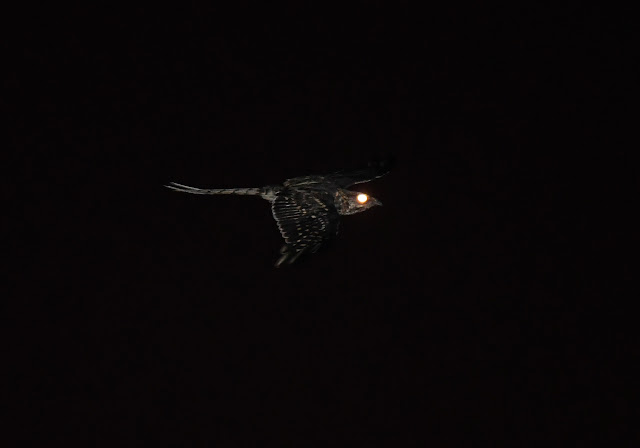 |
| Scissor-tailed Nightjar - Taco Pozo, Chaco, Argentina |
 |
| Little Nightjar - Taco Pozo, Chaco, Argentina |
Other night birds included a total of eight Tropical Screech-Owls and three Common Potoos by voice, as well as a flyover Nacunda Nighthawk. But the real stars of the evening were the frogs.
Frog diversity in the Chaco is relatively high, but during most of the year, this isn't obvious. Many species spend a significant percentage of their life underground, away from the unrelenting sun and dry conditions. During the summer, heavy rains spur every species to come to the surface to breed en masse. The heavy rains from a few days earlier must have triggered this, as I found quite a few species along the road and in the ephemeral puddles.
 |
| Weeping Frog (Physalaemus biligonigerus) - Taco Pozo, Chaco, Argentina |
 |
| Lesser Snouted Tree Frog (Scinax nasicus) - Taco Pozo, Chaco, Argentina |
The horned frogs were the stars of the show. This family, Ceratophryidae, has only twelve species, of which I had only seen one previously. All of the horned frogs are distinctive in shape and highly sought after by field-herpers like myself. And this evening, I found three species of horned frog!
 |
| Cranwell's Horned Frog (Ceratophrys cranwelli) - Taco Pozo, Chaco, Argentina |
Budgett’s Frog was one that I had wanted to see in the wild for years. It is a common species in the pet trade that I had been familiar with since I was a herpetoculture-obsessed youth. While I couldn’t get my hands on any, I found a few of them in a puddle, their distinctive faces staring back up at me.
 |
| Budgett's Frog (Lepidobatrachus laevis) - Taco Pozo, Chaco, Argentina |
The rarest horned frog was this one, Chacophrys pierottii. It is also endemic to a small region of the Chaco and it is rarely seen.
 |
| Chaco Horned Frog (Chacophrys pierottii) - Taco Pozo, Chaco, Argentina |
This was another interesting discovery: Elachistocleis haroi, which is a type of Narrowmouth Toad (family Microhylidae). It is also an infrequently observed species and one that I didn’t have on my radar.
 |
| Elachistocleis haroi - Taco Pozo, Chaco, Argentina |
Cururu Toad, which is closely related to the famous Cane Toad, was the most frequently encountered species on the road. Some of the specimens were monsters.
 |
| Cururu Toad (Rhinella diptycha) - Taco Pozo, Chaco, Argentina |
The most vividly-coloured anuran of the night was this Waxy Monkey Leaf Frog, which is another species I was familiar with from the pet trade. It was a dream come true to see one in the wild.
 |
| Waxy Monkey Leaf Frog (Phyllomedusa sauvagii) - Taco Pozo, Chaco, Argentina |
My only regret was that I did not bring my macro lens, flash and diffuser with me. I had birds on the mind and didn’t expect the frogging to be this good, so I was limited to my big lens and my iPhone.
 |
| Chaco Horned Frog (Chacophrys pierottii) - Taco Pozo, Chaco, Argentina |
 |
| Chaco Granulated Toad (Rhinella major) - Taco Pozo, Chaco, Argentina |
January 30, 2023
Laura and I were up early to beat the heat that is characteristic of the Chaco during the summer. But we needn’t have worried – overnight rain, heavy cloud cover and the threat of additional rain ensured that the temperatures stayed relatively reasonable for the entire morning. Laura and I drove east of town to a northbound road, and parked near the beginning where some deep ruts prevented further passage by car.
 |
| Taco Pozo, Chaco, Argentina |
And the birding was excellent. Within a few minutes of our arrival, several Black-legged Seriemas began vocalizing somewhere off in the distance. They would be a common constituent of the morning’s soundtrack, but we would, unfortunately, not see any. A partial miss.
We had better luck with Quebracho Crested-Tinamous. This species has a limited range in northern Argentina and western Paraguay. We heard quite a few throughout the morning and were rewarded with a sighting of two individuals.
 |
| Quebracho Crested-Tinamou - Taco Pozo, Chaco, Argentina |
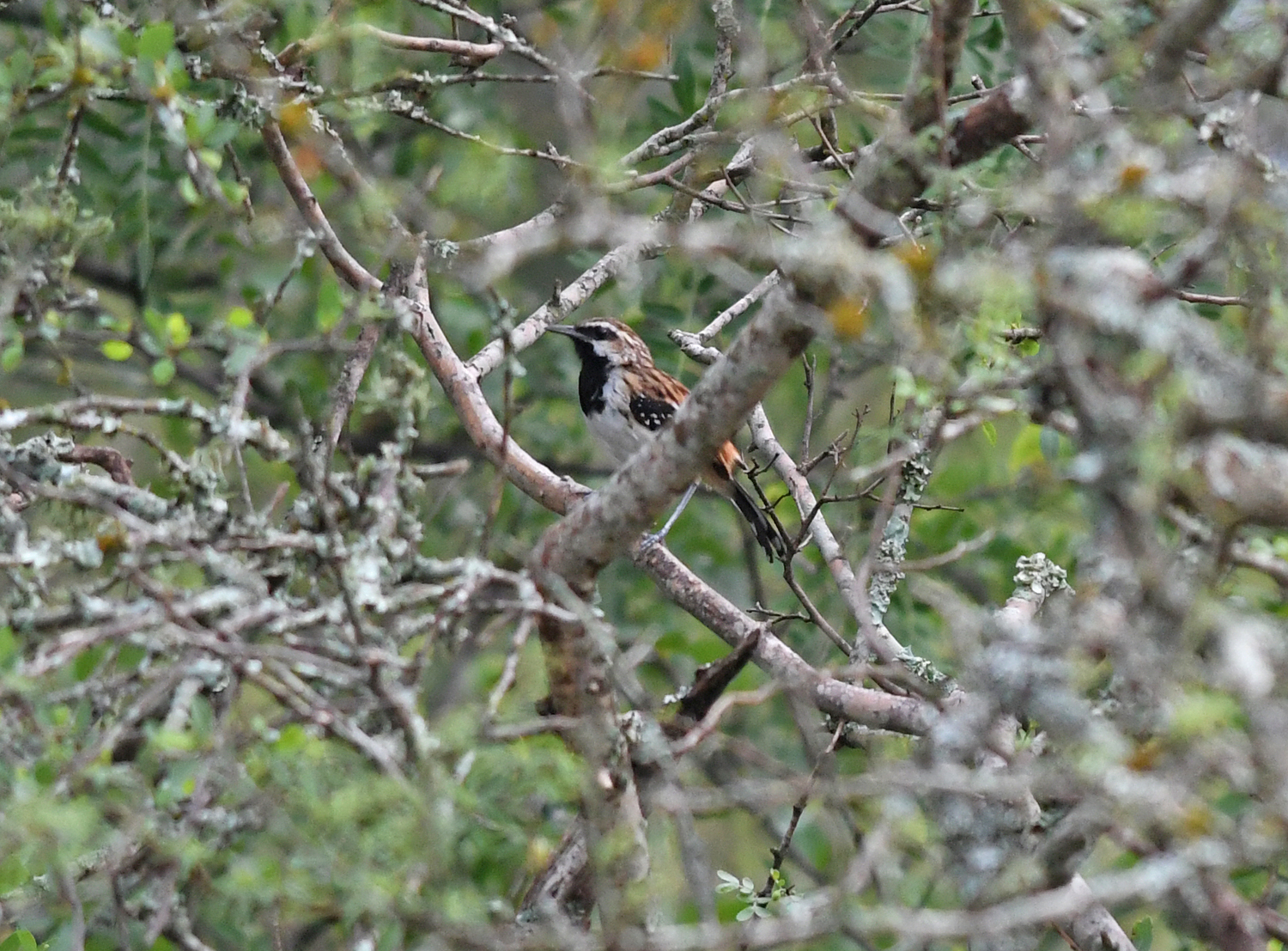
Turquoise-fronted Parrots flew by on occasion, while we also found a vocal pair of Stripe-backed Antbirds. We even located a few Cinereous Tyrants.
 |
| Stripe-backed Antbird - Taco Pozo, Chaco, Argentina |
 |
| Cinereous Tyrant (female) - Taco Pozo, Chaco, Argentina |
We walked north for just over four kilometres before turning around and retracing our steps back. Unfortunately, our big miss was the Black-bodied Woodpecker which is a thinly-distributed Chaco endemic that we were running out of chances for. Numerous Cream-backed Woodpeckers flew over and each time, we had a brief moment of hope until we could clinch the identification. But in the end, we had to admit defeat.
 |
| Cream-backed Woodpecker - Taco Pozo, Chaco, Argentina |
Since we still had time before we needed to leave Taco Pozo, and the temperatures were surprisingly still bearable, we walked one other dirt road. This one also headed north but it was west of town, right at the provincial boundary. Via eBird, I had gleaned that there were records of Black-bodied Woodpecker and Black-legged Seriema from here.
 |
| Hepatic Tanager - west of Taco Pozo, Chaco, Argentina |
We again struck out with those species, but we found a few things of interest including our first good looks at some Crested Gallitos and our first Hepatic Tanager for Argentina.
 |
| Crested Gallito - west of Taco Pozo, Chaco, Argentina |
And with that we headed east, leaving Taco Pozo behind. The drive was fairly uneventful – just hundreds of kilometers of Chaco scrub. It was hot and windy at this point and birdlife was infrequent, but we observed Chaco Chachalacas for the first time as well as a few new birds for our Argentina lists – White-tailed Kite and White-tailed Hawk.
 |
| Chaco Chachalaca - east of Taco Pozo, Chaco, Argentina |
 |
| White-tailed Hawk - Concepción del Bermeja, Chaco, Argentina |
That evening we made it as far as the town of Aviá Teraí before finding a place to rest for the night. I had done some sleuthing a few days earlier and discovered, from a trip report, a hotel which had records of Chaco Owl and Black-bodied Woodpecker. There weren’t many recent checklists from this site so I did not want to get my hopes up, but we inquired about a room.
This ended up being our favourite hotel of the trip. The room and bed were very comfortable, the hotel was set upon forested grounds, there was a restaurant on site, and I was even able to set up my moth sheet! The property backed onto a nice little tract of Chaco forest, giving me hope that our target species resided here.
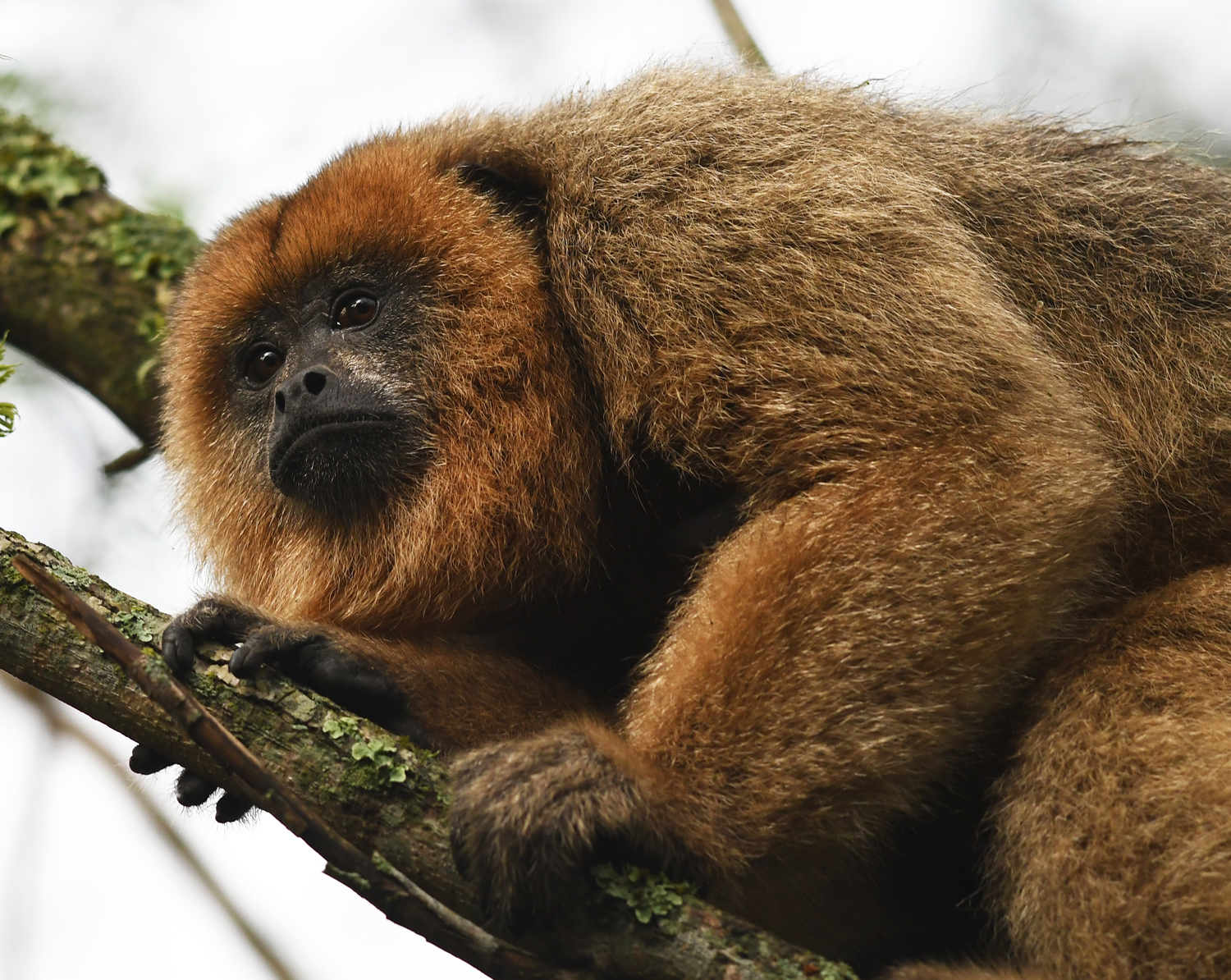
That afternoon, we enjoyed watching the antics of a family of Black-and-gold Howler Monkeys from our front porch.
 |
| Black-and-gold Howler - Hotel Las Curiosas, Aviá Teraí, Chaco, Argentina |
 |
| Black-and-gold Howler - Hotel Las Curiosas, Aviá Teraí, Chaco, Argentina |
The males are black, while the females and immatures are golden. They were a riot to watch…
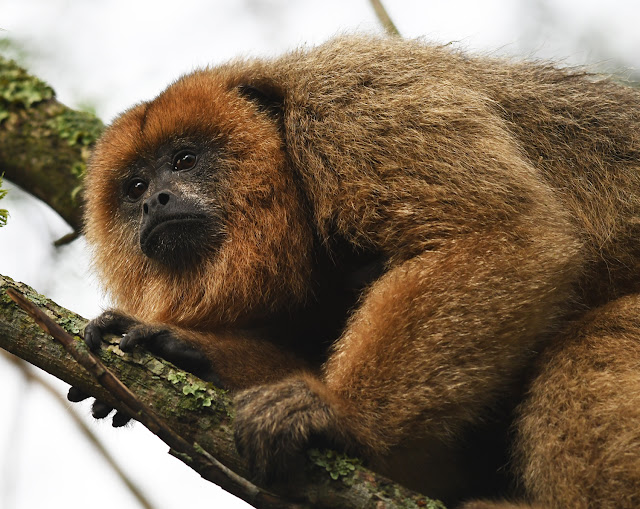 |
| Black-and-gold Howler - Hotel Las Curiosas, Aviá Teraí, Chaco, Argentina |
The howlers seemed to enjoy teasing the resident dogs that lived at the hotel property. They would break off sticks and drop them on the dogs, and you could tell that it wasn't the first interaction that they had had with each other.
 |
| Black-and-gold Howler - Hotel Las Curiosas, Aviá Teraí, Chaco, Argentina |
 |
| Stand-off - Hotel Las Curiosas, Aviá Teraí, Chaco, Argentina |
 |
| Black-and-gold Howler - Hotel Las Curiosas, Aviá Teraí, Chaco, Argentina |
I stayed back at the room to work on photo editing, while Laura went for a walk around the grounds. My phone started ringing which could only mean one thing. Her frantic voice confirmed my suspicions: she had found Black-bodied Woodpeckers! I grabbed my camera and took off running…
 |
| Black-bodied Woodpecker - Hotel Las Curiosas, Aviá Teraí, Chaco, Argentina |
I was in near disbelief, but there it was in front of us. A male Black-bodied Woodpecker. This rare species of woodpecker seemed rather mythical at this point, and I had pretty much given up hope of seeing it on this trip. But Laura had come through at the last moment, finding a pair of these gorgeous birds.
 |
| Black-bodied Woodpecker - Hotel Las Curiosas, Aviá Teraí, Chaco, Argentina |
The excitement for the day was not over. As night fell, Laura and I went for a stroll on the grounds in search of herps and Chaco Owls. Spoiler alert: we were successful on both fronts!
 |
| Leptodactylus latinasus - Hotel Las Curiosas, Aviá Teraí, Chaco, Argentina |
 |
| Weeping Frog (Physalaemus biligonigerus) - Hotel Las Curiosas, Aviá Teraí, Chaco, Argentina |
While the frog diversity wasn’t as high as the previous night, we found a half-dozen species breeding on the property including a few new ones for us.
 |
| Pseudis sp. - Hotel Las Curiosas, Aviá Teraí, Chaco, Argentina |
We also experienced an incredible moment with a trio of Chaco Owls! These were likely a mated pair and one of their offspring, and they came in and checked us out for a few minutes. We listened to their purring calls from the surrounding trees and could see one silhouetted by the moonlight. Just magical.
 |
| Chaco Owl - Hotel Las Curiosas, Aviá Teraí, Chaco, Argentina |
 |
| Chaco Owl - Hotel Las Curiosas, Aviá Teraí, Chaco, Argentina |
Our walk produced a few more highlights, including Laura’s first Little Nightjar, a Common Potoo, and this handsome tarantula.
 |
| Eupalaestrus sp. - Hotel Las Curiosas, Aviá Teraí, Chaco, Argentina |
As I mentioned earlier, I set up my moth sheet/light against the forest edge as well.
Up to this point in the trip we had stayed mainly in small hotels in towns, which did not really allow the opportunity for mothing escapades. This was actually the first time that I set up the sheet in Argentina. Though the action was relatively slow, I was happy to photograph moths and other insects for the first time in a long time and to marvel at some species that I had, surely, never seen before.