Thursday, 6 September 2012

James Bay part 5 (August 9 to August 12, 2012)

Introductory Post
July 28 to 30, 2012 - Moosonee, Little Piskwamish Point
July 31 to August 2, 2012 - Little Piskwamish Point
August 3 to 5, 2012 - Longridge Point
August 6 to 8, 2012 - Longridge Point
August 9 to 12, 2012 - Longridge Point
August 12 to 15, 2012 - Longridge Point

This is my fifth of six posts covering the day to day highlights from James Bay. At this point, I have covered from July 28th to August 8. I had added four year birds: Nelson's Sparrow, Red Knot, Black Guillemot, and Arctic Tern (my main target!).

August 9, 2012
We awoke to a cool morning with a temperature around 5 degrees Celcius. The bird song, consisting primarily of sparrows the last few days, had abruptly stopped so the air had an autumn feel about it. Today I did some invertebrate sampling with Andrew. It had to be done once a week and consisted of sampling the mudflats along a 1 km transect to hopefully find out what the shorebirds were eating. This took most of the day, so needless to say not much birding was done!

High tide was later in the evening so I spent the afternoon relaxing and having a quick nap. Around 4:30 PM Jean and I headed out to the river-mouth to see what we could find, though the rest of the group hung back. We didn't find another Arctic Tern, however I was more than happy to see this juvenile Red-necked Phalarope!

Red-necked Phalarope -  Longridge Point, James Bay

Other than the single bird I found at Little Piskwamish on August 1st, this was the only other Red-necked Phalarope that our group had seen on the coast. Of course, that got the rest of the crew to come out to take a look! The evening light was perfect and the bird was completely unconcerned, so I was able to get some good photos from only a dozen feet away.

Red-necked Phalarope -  Longridge Point, James Bay

I managed to photograph some of the other people without them noticing. Ian, scoping those birds like its his job...

Ian -  Longridge Point, James Bay

And Andrew, with a rare serious look on his face.

Andrew -  Longridge Point, James Bay

Of course, how could I ignore the roosting Hudsonian Godwits on a calm evening with perfect light?

Hudwits and Bonies - Longridge Point, James Bay

Hudwits and Bonies - Longridge Point, James Bay

I think that Ruddy Turnstones are the most entertaining of all the shorebirds. They make the strangest sounds, have a round body with a stout little head (plus a myriad of interesting colours and patterns), and spend all day walking around and flipping over anything they can....This is a rare moment when they are actually resting.

Ruddy Turnstones -  Longridge Point, James Bay

August 10, 2012
On my 5th last full day on the coast I was assigned to walk to the tip of Longridge Point with Deborah. It was a little more relaxing than my previous trips to the tip, without the pressure of having to find an Arctic Tern!

Deborah -  Longridge Point, James Bay

I had a couple of moments this day which really were incredible. The first came almost first thing in the morning as Deborah and I were censusing the shorebirds at the rivermouth. Deborah asked, "What's that animal?" I took a glance and explained that it was a Black-bellied Plover. She mentioned that no, she wasn't looking at a shorebird but a canine-looking animal. I looked up and just about shit myself as there was a beautiful Gray Wolf trotting along the high tide mark, less than 100 meters away! We had great looks at it in the scope as it looked at us before eventually leaving and disappearing into the forest.

The second moment was once Deborah and I had returned to camp. I was walking around the main cabin, looking for a big drum for Ian and I to burn our garbage in, when I stopped to look at some Boreal Chickadees in the trees. One came quite close and landed on a branch no more than 18 inches from my face! I just stared at him for the longest time as he peered back at me, making a fantastic variety of little chips and seet notes. I could see every detail of his feathers as he chattered away! I didn't have a camera, but here's a photo of one of the local BOCHs using a tarp as a bath.

Boreal Chick having a bath -  Longridge Point, James Bay

August 11, 2012
For some reason every time I go birding with Barb Charlton (aka the Barbarian...lol) we have incredible luck, though I think it is more about our skill than anything! :) We have been successful chasing just about every rarity we have tried for this year as well as finding a few good birds while we were together! Most recently was the Black Guillemot from August 5. Today I headed to the south end of our area, Beluga Point, with Barb to see what we could find. Our streak continued, though it wasn't for a bird sighting!

Barb scanning for birds -  Longridge Point, James Bay

We were scanning the lake while families of Common Terns screamed at us. Shorebirds were relatively weak in diversity and not much was moving on the warm, still morning. As I was scanning I was surprised to see a couple of big white shapes rise to the surface for a few seconds - belugas!!! Barb and I ended up watching the 3 belugas for quite some time as they checked out the bay between the aptly named Beluga Point and Longridge Point. I was very impressed by not only their size but also their speed in the water - not quite what I expected!

Common Tern -  Longridge Point, James Bay

Beluga whale was a new addition to my Ontario whale list (the list is now up to 1 species). It trumped the rest of our sightings from this morning! 

The afternoon was hot and calm so we felt warranted to sit around and have a few beers. I photographed this azure. It would be considered a Spring Azure from the field guides, but it is very late in the year for a Spring Azure and is definitely not a Summer Azure. Some people consider the azures from around here a different species, as of yet undescribed.

azure sp. - Longridge Point, James Bay

August 12, 2012
The morning broke warm and sunny for the third day in a row - a nice change from the cool and rainy weather that had dominated the early part of the trip. On this day I hiked out to the west bay with Ian, but not before hanging out with the family of tame Ruffed Grouse that hung around camp!

Ruffed Grouse - Longridge Point, James Bay

There were four 3/4-sized babies and they seemed to enjoy themselves having a dustbath just off the side of the main path. Pretty cute!

Ruffed Grouse - Longridge Point, James Bay

The day got even better as we was scanning the usual crew of Canada Geese that hung out in West Bay. We heard an unusual goose sound and looked up to see a flock of 34 Snow Geese heading south! We radioded the rest of the crew and fortunately everybody else got on them. This seems really early for south bound Snow Geese, but what do I know.

The day was absolutely fantastic. We were off to a good start with a small flock of Whimbrels flying by. Our species total was up quickly with the addition of Killdeer, Semi Plover, Black-bellied Plover, Semi Sandpiper, Least Sandpiper, White-rumped Sandpiper, both yellowlegs, Ruddy Turnstone, Sanderling, Hudsonian Godwit, and Dunlin. Walking in the grassy mudflats added a bunch of Pectoral Sandpipers, and in a nearby pool were some Short-billed Dowitchers. We came across a large group of Black-bellied Plovers on some drier areas and I quickly got on a juvenile Buff-breasted Sandpiper! This was a year-bird, my 5th of the trip and bringing me up to 326 for the year. While unsuccessfully trying to relocate it we came across an adult Baird's Sandpiper and adult American Golden-plover, bringing our shorebird total to 18 for the day! 

That evening I headed down to the creek to try to get some shorebird photos. A few Wilson's Snipes flushed and a Spotted Sandpiper called, giving me an even 20 species of shorebirds for the day. Some gulls were flying overhead and the light was just perfect.

Bonaparte's Gull - Longridge Point, James Bay

A nice Little Gull joined the fray.

Little Gull - Longridge Point, James Bay

The wind was calm, the mosquitoes weren't as friendly as usual, and I was able to get close to the shorebirds. This juvenile Greater Yellowlegs was more tolerant than most...

Greater Yellowlegs - Longridge Point, James Bay

Of course, I was focused again with the godwits since this would be one of my last opportunities to photograph this beautiful species. Its not often I see this species from so close!

Hudsonian Godwit - Longridge Point, James Bay

My last post will be up shortly, covering the last few days of the trip.

Tuesday, 4 September 2012

James Bay part 4 (August 6 to August 8, 2012)

Introductory Post
July 28 to 30, 2012 - Moosonee, Little Piskwamish Point
July 31 to August 2, 2012 - Little Piskwamish Point
August 3 to 5, 2012 - Longridge Point
August 6 to 8, 2012 - Longridge Point
August 9 to 12, 2012 - Longridge Point
August 12 to 15, 2012 - Longridge Point

August 6, 2012
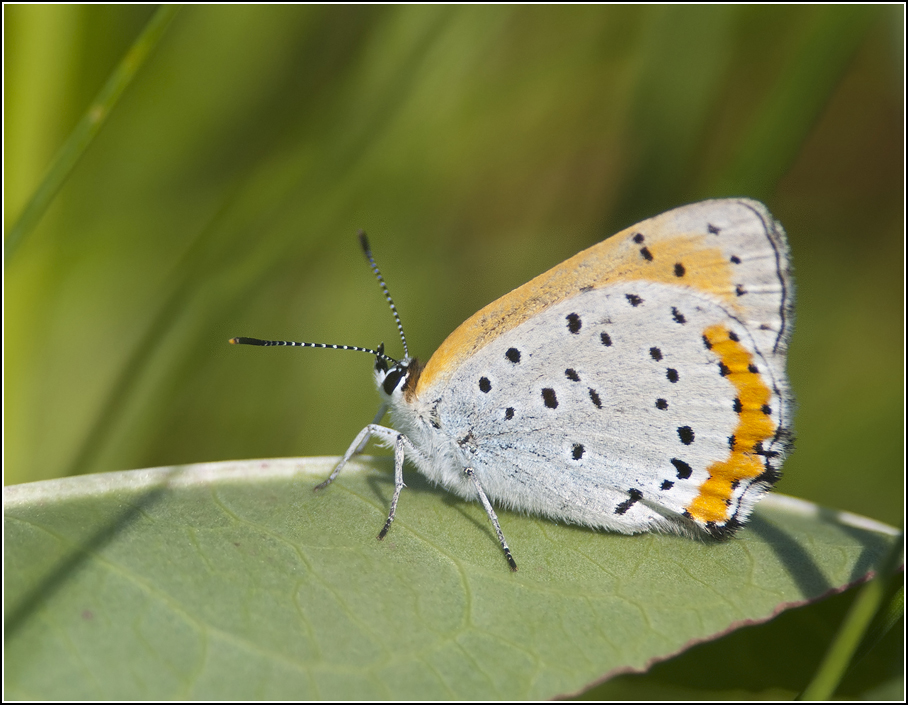
This was my seventh full day on the coast of James Bay and the time had really started to fly by at this point! On the previous day I had noticed a few Bronze Coppers amongst the sedge meadows, a new species of butterfly for me. This morning, I went out with my camera as it was warm and sunny. It didn't take long before I found a few.

Bronze Copper - Longridge Point

This James Bay population was found a few years ago and is quite isolated from the other populations. Along with Marbled Godwits, Nelson's Sparrows, Le Conte's Sparrows, and Wilson's Pharalopes, they are a relict prairie species which has a disjunct population in the James Bay lowlands. Here, the sedge meadows mimic prairies found farther south and west.

Bronze Copper - Longridge Point

Ian, Andrew and I walked to the end of Longridge Point later in the morning. I was still trying hard to get Arctic Terns and the tip of Longridge was one of the locations I was told was "guaranteed" for them. I figured the more time I spend out there doing a sea-watch, the better!

A highlight from the few hours of seawatching we did was a pair of juvenile Little Gulls which hung out at the very tip. Eventually they flew off as the tide came in. A neat plumage that I don't see enough!

Little Gulls - Longridge Point

The other star attraction at the tip of Longridge was a ratty looking Snowy Owl that was found by the previous group 2 weeks prior. This was my second trip to the tip of Longridge and the first time that I came across the owl.

Snowy Owl - Longridge Point

Snowy Owls breed in the arctic and should be much farther north then the James Bay lowlands in early August. This appeared to be a young bird, probably one that wouldn't breed this year anyways. It appeared wary and healthy the whole time we were there (we ended up seeing it regularly for the entire 12 days), and was probably dining on shorebirds, gulls, or even ducks.

Snowy Owl - Longridge Point

After a few hours of lakewatching our tern count was about 4 Caspian, 16 Common, and 0 Arctic. I was starting to become more worried as another day had passed without Arctic Terns.

We did see some other interesting birds for the day. In my notes, I mention several species which were new for me for the James Bay lowlands (Greater Scaup, Green-winged Teal, Bank Swallow, American Redstart, and Yellow-rumped Warbler). We also had a few more Red Crossbills plus the usual medley of Gray Jays, Boreal Chickadees and White-winged Crossbills. A single Whimbrel was nice to see and we had a flock of 40+ Red Knots which didn't hang around. This bear was sniffing around and eating berries on the walk back to camp!

Black Bear - Longridge Point

Over the last couple of days we had seen warm south winds and we found some interesting "vagrant" insects from the south. On the 6th we had both Wandering and Spot-winged Gliders, and on the 5th I found this pretty worn Great Spangled Fritillary near camp. We ended up seeing another one later in the trip.

Great Spangled Fritillary - Longridge Point

August 7, 2012
The story of the day today - Arctic Tern!!! Unfortunately though, I wasn't lucky enough to see it.

The day started unexpectedly early. Barb and Deborah had decided to wake up extra early to try to be at the farthest southern point we census, Beluga Point, by high tide. They were up at 5:30 AM and by 6:00 AM I heard the news - Arctic Tern at the river mouth!

I was out the door in 30 seconds and raced down to the river mouth. They had seen it sitting on a rock near some Bonaparte's Gulls, though it was last seen flying out to the bay. I searched for several hours but came up empty, so I headed back to camp to get ready for the day. Another miss, but at least I now knew that Arctic Tern(s) were around! I did see my first Clay-colored Sparrow for the James Bay lowlands while I was searching for the tern.

This cute little Hudson Bay Toad was hanging around camp so I had to take a photo. Its incredible how variable they are.

Hudson Bay Toad - Longridge Point

I decided to volunteer to census Longridge Point with Andrew today, with hopes that the Arctic Tern might make a flyby at some point. The rain picked up but eventually it died down and we were able to walk to the tip. I walked along the low tide line the whole way as there were some terns and gulls concentrated there. Several Caspians, a group of Commons hunting the shore, but of course, no Arctic!

We did have some good birds at the tip, highlighted by our first Baird's Sandpiper of the trip (a year bird for Andrew). We identified it by call and eventually found it up on the ridge.

The other highlight was an adult Red-necked Grebe which hung out on the south side of the tip for a bit of time. Crappy shot, but identifiable! Red-necked Grebes are rare in southern James Bay.

Red-necked Grebe - Longridge Point

This underwing moth was flying around amongst the pebbles and driftwood of the long spit out to the point. I have tentatively identified it as Semirelict Underwing.

Semirelict Underwing - Longridge Point

Other birds seen for the day include building numbers of Whimbrels and the Snowy Owl again. At this point I decided to change my stategy for the remaining week on the coast. Instead of trying to get my Arctic Tern by lakewatching at the tip of Longridge (a strategy which clearly hadn't worked so far), I was going to focus on the inner bay and the rivermouth. Barb and Deborah had theirs there, so maybe this was a preferred spot for Arctic Terns.

August 8, 2012
The first three words scribbled in my journal for this date are: "ARCTIC F****** TERN!!!!" I finally got it, the number one target for the trip!

The day started out like most of the others...up by 7:00 or so, a breakfast of oatmeal with raisins, almonds, and apples, and hot coffee. I spent some time in the morning looking for butterflies with Andrew before looking for birds along the coast. It was a hot and sunny day and butterflies were everywhere! Of course, I didn't turn down very many oppurtunities to photograph the numerous Bronze Coppers.

Bronze Copper - Longridge Point

The drier areas with low bushes seemed ideal for both Clay-colored Sparrows and Le Conte's Sparrows. I was more interested in the latter and spent a bit of time trying to get good looks at them. They are a very secretive sparrow, but they don't flush easily, allowing one to get great, close-up looks at them if one has a bit of patience. A highlight for me was having scope views of a fresh juvenile from only 15 feet away! Here is an adult, below.

Le Conte's Sparrow - Longridge Point

As I was walking along the edge of a creek I flushed a large white butterfly with black blotches and knew immediately what it was. Western White! This was a new butterfly for both Andy and I so we took a lot of photos!

Western White - Longridge Point

Western White - Longridge Point

Western White - Longridge Point

Eventually I made my way to the coast, south of the camp but not far enough to be at Beluga Point. I did a count as all the shorebirds and gulls flew by to roost at the river mouth as the tide was coming in. Hopefully, an Arctic Tern would be with them!

Little and Bonaparte's Gulls - Longridge Point

Lots of terns, about 1400 Bonaparte's Gulls, some Little Gulls, but no Arctic Terns yet again. Little Gulls were relatively common - I think we saw them just about every day! Several nice flocks of Hudsonian Godwits went by, but I didn't see a single knot.

That evening I decided to stay in and cook dinner while the rest of the crew went to check the river mouth at high tide. Just as I was boiling the water, I heard a crackling on the radio - Barb was saying "Arctic Tern at the river mouth"!

In the sudden rush of adrenaline I couldn't remember where I had put my binoculars or scope, so I just grabbed my camera (fortunately it was nearby) and sprinted! I think I covered the 1.5 kms in about 5 minutes, just in time to see a small white tern fly over as I made it to where the group was standing!

Arctic Tern - Longridge Point

It called several times, eventually flying back to the river and settling in on a rock. Success!!!! Deborah and Barb graciously let me use their optics and I could study the long tail, small head and short legs and bill of the Arctic Tern - features that separate it from the Common Tern. What a relief it was! Andy and I were both ecstatic to add this to our year-list!

Parts five and six to come.

Saturday, 1 September 2012

Jaegers and Sabine's Gulls at the beach

A great day to head down to the beach today...

I didn't make it to Van Wagner's Beach today until shortly after 3 this afternoon because I was meeting up with a friend, but I think I timed it perfectly!

Within minutes of arriving, Gavin Platt picked out a jaeger not too far out with turned out to be a sub-adult Long-tailed Jaeger. It was a new Ontario bird for him, so congrats! Not 5 minutes later I was scanning when I came across a group of 3 Parasitic Jaegers harassing a gull very close. This was the last jaeger I needed for the year, year bird #330. In ten minutes we had seen more jaegers than the entire morning and afternoon until then.

The fun would not end there! We kept having jaegers flying by and harassing gulls - mostly Parasitics, but at least one juvenile-ish Long-tailed Jaeger chasing an adult Parasitic at a close range. Pretty incredible to see these guys up close!

As the afternoon started to turn into the evening things got a lot better. I was checking out some distant jaegers when I noticed some gulls rising off the water that appeared to be Sabine's Gulls. The whole group got on them and they all appeared to be Sabine's! We had a count of 52 of them as they swirled around above the water after being harassed by the jaegers. Even more astonishing was the fact that at least 6 adult birds were mixed in. Only occasionally are adult Sabine's Gulls seen in Ontario, so to see 6 was unprecedented. Needless to say the 52 Sabine's Gulls was a high count for Hamilton, and probably southern Ontario. Throughout the rest of the time I was there groups of Sabine's would occasionally be seen, so there could have been more than 52.

It was a fantastic way to spend a couple of hours, though I was a little tired of explaining to all the passerbys what we were "photographing" with our spotting scopes! Tomorrow I am leaving for Canadas' right coast (Nova Soctia) for a few days. See you all on the 11th! I'll post updates about all the cool birds I'll see out there :)

Shorebirding!

It was a hot day with a strong west wind, not ideal for most types of birding. There weren't any year-birds to chase, looking for migrant Passerines is useless in strong winds, and the winds were the wrong direction to head down to Van Wagner's Beach to look for jaegers. Instead I decided that I would try my luck shorebirding in some of the counties west of me.

The Milverton lagoons in northern Perth County were my first stop. The front pond was full of water but the middle pond had lowered levels, revealing extensive mudflats. Obtaining shelter from the pumphouse, I spent quite some time studying the mix of shorebirds carefully. Out of the ~170 shorebirds the highlight was a group of 4 Baird's Sandpipers. The back lagoon also was just starting to show some mudflats and some shorebirds were back there, though nothing unusual. This site should certainly be checked more often as I think it is a great spot for a Ruff to show up! Lots of Pectoral Sandpipers and Yellowlegs present.

Next up were the Mitchell lagoons (aka West Perth Wetlands). The back pond that is gated still had extensive mudflats and a great variety of shorebirds. There were about 30 American Golden-Plovers, a single Black-bellied Plover, a juvenile Short-billed Dowitcher, 11 juvenile Stilt Sandpipers, and the highlight - 2 Hudsonian Godwits. Again there were great numbers of all the common shorebirds and I left Mitchell with 15 species for the afternoon.

I crossed the county line into Oxford and immediately went to the east end of Wildwood Lake, a location I had never been before. While scanning from the road, the juvenile Marbled Godwit which had been reported was present but I was also surprised to see a Buff-breasted Sandpiper! I think it is a pretty good Oxford bird (couldn't find any records on Ebird). I could see many more shorebirds in the distance so I walked around the edge of the mudflats to check it out.

Buff-breasted Sandpiper - Wildwood Lake

Needless to say this was some of the best shorebirding I had done in southern Ontario since the spring. Birds were everywhere! In this photo is a juvenile Baird's Sandpiper (left), juvenile Buff-breasted Sandpiper (centre) and adult Killdeer (right).

shorebirds - Wildwood Lake


There were several raptors in the area that would occasionally put up all the shorebirds, including a Cooper's Hawk and a Peregrine Falcon. Eventually they all would land again and continue feeding frantically.

A distant photo of the Marbled Godwit...

Marbled Godwit and Ring-billed Gull - Wildwood Lake

Buff-breasted Sandpiper - Wildwood Lake

The Buff-breasted Sandpiper seemed quite unconcerned with my presence and ended up walking up to me as it fed, letting me get some close shots in the nice evening light.

Buff-breasted Sandpiper - Wildwood Lake

Other shorebirds present here included 1 White-rumped Sandpiper (ad), 6 Stilt Sandpipers (juv), and 1 Black-bellied Plover (ad) amongst more common species. I finished the day with 18 species of shorebirds. If I had started earlier in the day and gone to Lake Erie I probably could have added Red Knot, Sanderling, Ruddy Turnstone, Western Sandpiper, Red-necked Phalarope, and Wilson's Phalarope.

Thursday, 30 August 2012

James Bay part 3 (August 3 to August 5, 2012)

Introductory Post
July 28 to 30, 2012 - Moosonee, Little Piskwamish Point
July 31 to August 2, 2012 - Little Piskwamish Point
August 3 to 5, 2012 - Longridge Point
August 6 to 8, 2012 - Longridge Point
August 9 to 12, 2012 - Longridge Point
August 12 to 15, 2012 - Longridge Point

August 3, 2012
If you recall, at this point I had been at Little Piskwamish, the camp located furthest south, with Andrew Keaveney and Ian Sturdee for 3 days. The plan was for us to walk the 15 km to Little Piskwamish Point to spend the rest of the trip with Jean Iron, Barb Charlton, and Deborah Cramer.

August 3 broke calm and sunny with a light breeze from the south. Via satellite phone with Mark Peck the previous night, we had determined that the conditions would be perfect for the long walk. We woke up, cleaned up the camp, and prepared for the long walk, which we would soon discover was a lot longer than we were originally told! We each had a pack with all of our gear as well as our scope and the shotgun, adding to the difficulty. Unfortunately for Ian, he had a couple of up-close and personal experiences with the mud.


The day was cool, sunny with the winds at our back as we hiked. Fortunately the terrain was excellent and we followed a series of gravel ridges for most of the day, making for easy walking. Every 1 or 2 kilometres we would take a break, something that was entirely necessary because of how much extra weight in gear we were lugging along! At one point we reached an extensive marsh where last year's crew had found some Marsh Wrens the previous year. We didn't get any wrens but I was happy to see and photograph my first Mustard Whites.


What was probably the bird of the entire trip ended up being one that got away. As we were walking we heard an unfamiliar shorebird call. The bird repeated the loud "curr-EEE" call several times as it flew over. I got on the large shorebird as it was heading away from us. It was up high but easy to see it was a tawny-brown in colour. Eventually we lost it as it disappeared far to the south. My first thought was Marbled Godwit as I couldn't recall what that species sounds like. Andrew played a bunch of calls on his phone and one of the calls matched perfectly! It was the call of Long-billed Curlew (which is also large and buffy/brown coloured). Unfortunately the bird was long gone...

Around mid afternoon we came across the old barge that I photographed earlier from the helicopter. Supposedly this was only a few km from the end!


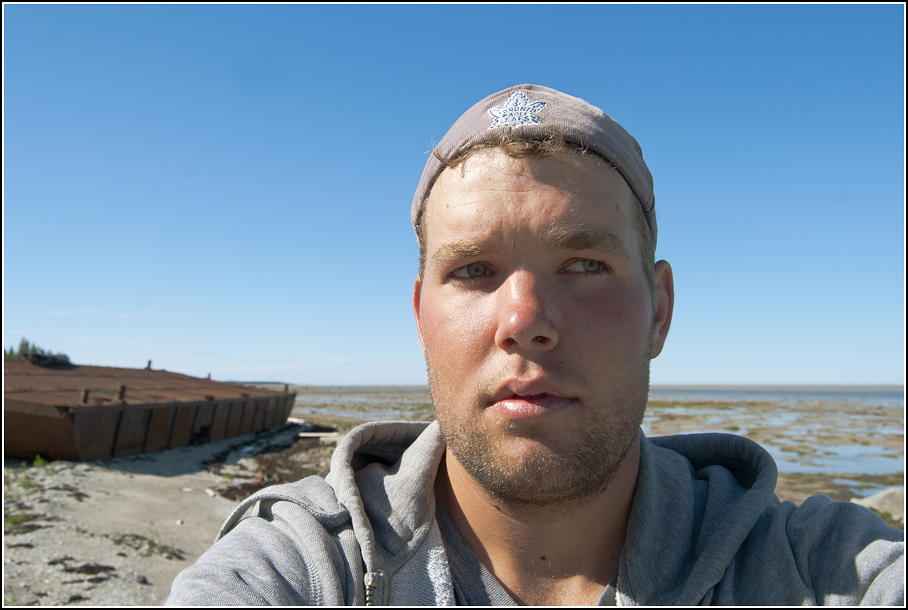
Self portrait - trying to convey how exhausted I felt...It turned out looking like I was confused, more than anything!


All along the walk I kept an eye and an ear open for Arctic Terns. This was really my only target species remaining for the trip! There were several Common Terns as well as some farther out that may have been Arctic Terns but it was really too tough to be sure.

After about 22 km of walking we finally reached the final bend and could see the camp out in the distance! Barb came out to meet us and we walked the last kilometre to camp, where the ladies had cooked us a huge feast of sausauge, cajun-style potatoes and onions, salad, pasta, beers, and chocolate for dessert. It sure beat what we were eating at the other camp - usually a can of beans/stew/chili or oatmeal. I have to say it was one of the hardest walks I have done!

August 4, 2012
We all slept in that morning then went out as a group to the end of Longridge Point which was about 6 km from camp. During high tide parts of the point are covered with waist deep water so one has to time the walk just right to make it to the end and back. In the photo below, the camp is near the bottom and the tip of Longridge Point is near the top right - not visible due to the fog.


We did not see a whole lot of interesting birds that day, specifically, not a single Red Knot. Apparently they were all but absent from this sight so far! One possible reason could be due to a failed breeding season, with many of the adults departing early. Another reason is that the preferred food item for Red Knots in James Bay, a type of bivalve, may not be present due to shifting water currents bringing the larvae elsewhere.
Bird highlights for the day included a flock of 16 Red Crossbills which was previously thought to occur only very occasionally in southern James Bay. We ended up seeing them almost every day, along with hundreds of White-winged Crossbills. I was very happy to hear a Yellow Rail ticking away near camp, which was a new Ontario "self-found" bird.

August 5, 2012
Today I had plans to check out the west bay and points beyond with Barb and Deborah, about a 16 km round trip. I still wasn't fully recovered from the long walk a few days ago, but it sure was nice walking on a flat beach without being encumbered by a large pack!


I had a bit of fun taking some landscape shots with the interesting sky and flat beach.


Eventually we made it out to the point just as the tide was starting to come in. We had some good birds, including a few Red Knots and a handful of Whimbrels flying by. Hudwits were common everywhere we went at this site...


I was busy scanning for shorebirds and mostly, scanning for Arctic Terns when Barb calmly mentions from beside me, "I think I have a guillemot sitting on a rock". I think my response was along the lines of "Sure you do, Barb", since Black Guillemots aren't really found in this part of James Bay this time of year. She was serious though, so I took a look in her scope. Sure enough, sitting on a pile of rocks next to 4 cormorants, was a small black bird with a broad white wing patch sitting on the rock! It was very distant, but we could clearly see its upright posture and its diagnostic black and white breeding plumage. Wow! I had not expected this species at all! Black Guillemots are somewhat regular in late autumn and I had hoped to see it at Netitishi Point in the fall, so I had it categorized as a code 3. Even then, they are not guaranteed at Netitishi so this was a bonus bird, and year bird # 324. I took my scope and Barb's camera with a plan to walk all the way around the bay to the point when the birds were roosting, but I was called back after I had just started since it had disappeared once the tide had started to cover its rocks.

On the walk back to camp, we had a few more interesting birds including a flock of Red Knots where I was able to read one flag. We had our first Short-billed Dowitcher of the trip, a crisp looking juvenile. I'll add the photo once Barb emails it to me (it is on her camera since I didn't bring my bird lens with me that day).  I did grab this photo of a Yellow Warbler later that day which was a new photographed species for the year.


It was a great day with an unexpected year bird. I still didn't have an Arctic Tern, a fact that I was starting to get slightly worried about since James Bay would be my last chance for it. But on the bright side we still had another 10 days or so on the coast. Stay tuned for post four as I continue my quest for Arctic Terns!