Wednesday, 12 March 2014

Panama: January 2010 (part 8)

Part 1 - Gamboa lowlands and Pipeline Road
Part 2 - Road-cruising and night-hiking at El Valle de Anton
Part 3 - More from El Valle de Anton
Part 4 - Creek-walking in El Valle de Anton
Part 5 - A brand new species for science!
Part 6 - Snakes and interesting frogs at El Valle de Anton
Part 7 - Night-hiking at El Valle de Anton
Part 8 - El Cope
Part 9 - El Cope, again
Part 10 - Back to El Valle de Anton
Part 11 - Night-hiking at Pipeline Road

After our extended stay in El Valle, Jon and I took the rental back down to the highway and across into Penonome. From here we drove towards the mountains, eventually driving nearly up the side of one.

As we ascended, the temperature decreased and the air became mistier. Eventually the road became too difficult to ascend, and wanting to take advantage of the last few hours of daylight, we left the SUV on the shoulder and began hiking up.

Eventually we reached our destination - La Mica Biological Station. We took a few photos near one of the buildings as the mist washed over the area.


Eventually it was nightfall as we began hiking in the area around the station. While there was some rain, it was very light (mostly just dripping from the trees), and the temperature was relatively warm in the sheltered areas away from the wind. I saw the first Green Tree Anole (which evaded my camera) and soon frogs were easily found on the trail and on the trailside vegetation.

Pristimantis cerasinus

Pristimantis cerasinus

At one point I startled this Long-billed Gnatwren, which was roosting right over the trail. I grabbed a quick photo then moved on.

Long-billed Gnatwren

We were hoping to keep our streak of "consecutive days with a new snake species" alive. After a few hours, I discovered the new snake - this time a Northern Cat-eyed Snake (Leptodeira septentrionalis).

Leptodeira septentrionalis - Northern Cat-eyed Snake

Leptodeira septentrionalis - Northern Cat-eyed Snake

The rain frog diversity was astounding. I don't have my notes on me, but will try and dig them up to identify these frogs. 

Craugastor sp.

Pristimantis sp.

Not surprisingly, Masked Smiliscas were common here as well. They really are an impressive frog, even with how common they are.

Smilisca phaeota

Smilisca phaeota

I will continue with the remainder of our time in El Cope next...

Monday, 10 March 2014

Panama: January 2010 (part 7)

Part 1 - Gamboa lowlands and Pipeline Road
Part 2 - Road-cruising and night-hiking at El Valle de Anton
Part 3 - More from El Valle de Anton
Part 4 - Creek-walking in El Valle de Anton
Part 5 - A brand new species for science!
Part 6 - Snakes and interesting frogs at El Valle de Anton
Part 7 - Night-hiking at El Valle de Anton
Part 8 - El Cope
Part 9 - El Cope, again
Part 10 - Back to El Valle de Anton
Part 11 - Night-hiking at Pipeline Road

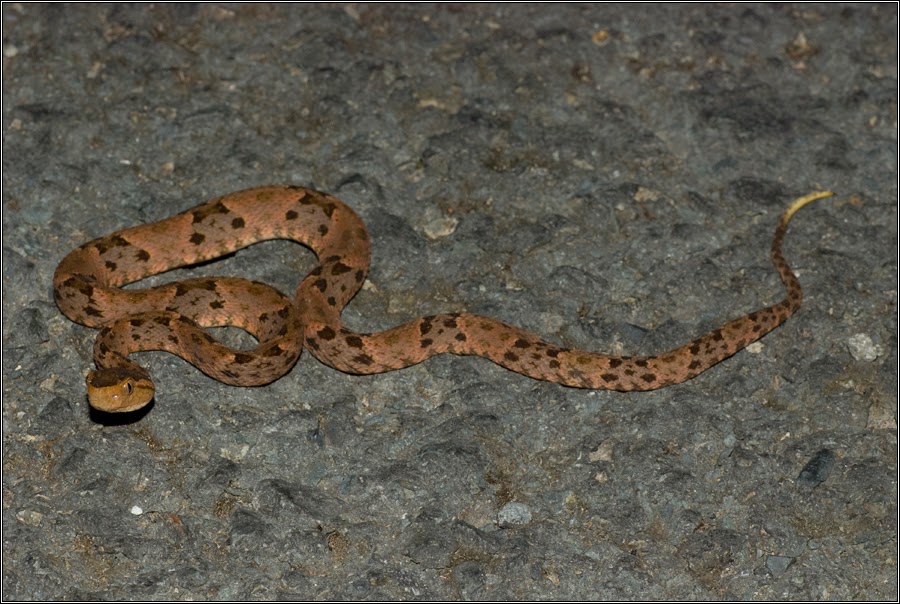
In a previous installment I mentioned the numerous Fer-de-lances that Jon and I had found on a particular road at dusk. I will begin this post with a few more photos of additional road-cruised Fer-de-lances!

While most of El Valle consists of beautiful forest, surrounding the volcano are some heavily de-forested areas . Since I often forget to take "scenery" style photos while traveling, I took a few minutes to try to capture the evening light over the hills.


Like our previous road-cruising adventures, this one was no different in that the only snake we observed was a Fer-de-lance!

Bothrops asper - Fer-de-lance

Bothrops asper - Fer-de-lance

There were two other main highlights seen while night-hiking in El Valle which I have not mentioned yet.

Dunn's Spinytail Lizard (Morunasaurus groi) is a poorly known species of lizard that inhabits steep hillsides in tropical forests in Panama and Colombia. They look more like miniature dinosaurs than anything else! This species lives deep within mud burrows located on steep, muddy, and generally difficult to access hillsides.

Luckily, Mario knew of a place where this species could be found and so we ventured there one evening. It didn't take too long to encounter a couple of these prehistoric lizards!

Morunasaurus groi - Dunn's Spinytail Lizard

Morunasaurus groi - Dunn's Spinytail Lizard

The other main highlight occurred just a few nights after we discovered the likely undescribed Ninia species (see Part 5). Mario again first spotted the tiny snake, barely 6 inches long, by carefully rifling through some leaf litter on the forest floor.

Again, it was a species whose identify Mario was uncertain of, and it took some carefully keying-out the following day to identify it. It appeared to be a species of ant larvae-eating snake, Geophis bellus.


Geophis bellus

Geophis bellus was described in 2003, based on a specimen found in 1964. This specimen was found near Cerro Jefe in Central Panama and the species has never been observed since. This is only the second one ever seen then, and these are the first photos of a live one. Despite its scarcity they are probably somewhat common in certain habitats, but their secretive and fossorial nature make them extremely difficult to find.

Geophis bellus

Geophis bellus

While we were photographing the above snake, we noticed a toad nearby, just hanging out. It ended up being another new species for our trip list - an Incilius coniferus. This species is found in lowland rainforest including disturbed areas and gardens.

Incilius coniferus

Incilius coniferus

While herps were obviously the main priority of the trip for us we did see other interesting species, including some that had feathers! While bushwacking through a thicket during one of our many night-hikes, we disturbed a couple of Rufous-capped Warblers tucked in for the night. This is the best that I could do with my macro lens.

Rufous-capped Warbler

The next two installments will cover an entirely different area - the cloud forests at El Cope!

Saturday, 8 March 2014

Panama: January 2010 (part 6)

Part 1 - Gamboa lowlands and Pipeline Road
Part 2 - Road-cruising and night-hiking at El Valle de Anton
Part 3 - More from El Valle de Anton
Part 4 - Creek-walking in El Valle de Anton
Part 5 - A brand new species for science!
Part 6 - Snakes and interesting frogs at El Valle de Anton
Part 7 - Night-hiking at El Valle de Anton
Part 8 - El Cope
Part 9 - El Cope, again
Part 10 - Back to El Valle de Anton
Part 11 - Night-hiking at Pipeline Road

The Crowned Treefrog, or Spiny-headed Treefrog, is one of the coolest looking frogs found in Panama. It is a large treefrog that is beautifully patterned with black, tan, and white, but the best distinguishing feature, and the one thing that sets it apart from other frog species in the area, is the presence of several large spines protruding up from the hind-crown!

I did not think that I had much of a chance of seeing this species on our trip as they live high in the canopy for most of the year, hanging out in bromeliads.


I can't recall the specifics of when we found one, but I do remember marveling over the really strange looking frog. Throughout the course of our trip, we came across several of them!

Anotheca spinosa - Spiny-headed Treefrog

Anotheca spinosa - Spiny-headed Treefrog

We did come across several other snakes throughout our time night-hiking in El Valle. Imantodes is a genus of snake containing seven species, commonly known as vine snakes or tree snakes. These arboreal lizard eating specialists are remarkably thin - so much so that they appear anatomically impossible! The Blunt-headed Treesnake is probably the most widespread of this genus. One night I glimpsed the unique slender shape of one cruising some low-level branches. We caught it and photographed it the next morning before release.

Imantodes cenchoa - Blunt-headed Treesnake

Imantodes cenchoa - Blunt-headed Treesnake

Future Imantodes cenchoa food....

Norops limifrons - Slender Anole

The Dipsas genus also contains slender, mostly arboreal species as well. Most Dipsas species prey on snails and slugs! During one night-hike, Mario came up with a great find as he noticed this Dipsas temporalis. Very little is known about this species and it was a fantastic find for El Valle.

Dipsas temporalis

Dipsas temporalis

Moving back to frogs for a moment. Chytridiomycosis is an infectious disease in amphibians caused by a zoosporic fungus. In recent years, prevalence of this fungus has exploded in the tropics, causing massive extinctions in certain areas. One species hit hard by the "chytrid fungus" is La Loma Robber Frog (Pristimantis caryophyllaceus). Once common in several localities in Costa Rica, Panama, and Colombia, it has disappeared from many of the areas where it was once common. One key ID feature is the sharp tubercles on the heels.

Pristimantis caryophyllaceus - La Loma Robber Frog

Part 7 will include the last of our night-hiking adventures in El Valle.

Thursday, 6 March 2014

Panama: January 2010 (part 5) - a completely new species!

Part 1 - Gamboa lowlands and Pipeline Road
Part 2 - Road-cruising and night-hiking at El Valle de Anton
Part 3 - More from El Valle de Anton
Part 4 - Creek-walking in El Valle de Anton
Part 5 - A brand new species for science!
Part 6 - Snakes and interesting frogs at El Valle de Anton
Part 7 - Night-hiking at El Valle de Anton
Part 8 - El Cope
Part 9 - El Cope, again
Part 10 - Back to El Valle de Anton
Part 11 - Night-hiking at Pipeline Road

I don't know if you haven't been able to tell at this point, but I really like night-hiking. There is something about wandering in the depths of a tropical forest, equipped with headlamp and flashlight, wondering what exotic and fascinating species your beam will land on next. It can be extremely tiring after a few hours though - likely due to the fact that your eyes are straining and focused for so long at a time. But the species you see can certainly make it all worthwhile!

One evening, Jon, Mario and I were trekking through the forest, looking for snakes, frogs, and salamanders. I had stopped to photograph several different frogs and invertebrates at that point.

Smilisca sila


While we were hiking along, Mario stopped to look under a rotting log and a flash of black appeared. A snake! He grabbed it and we began studying it.

Mario was very familiar with the snakes of El Valle, having lived and worked there as a herpetologist and guide for many years, and yet he did not know what species it was. We could tell it was in the Ninia genus (Coffee Snakes, a genus of fossorial snakes), but it did not fit the known species for the area.

We brought the snake back to Mario's serpentarium and spent part of the next day trying to figure out what it was. It did not key out as one of the known species of Ninia! It most closely resembled Ninia atrata but the number and placement of ventral and subcaudal scales was incorrect, if I recall, among a few other things. Mario thought that it was highly likely that this was a new, un-described species of Ninia and so he kept the individual. That morning, we took some time to photograph it!

Ninia species

Ninia species

Ninia species

Needless to say this was the main highlight of our Panama trip! The next installment will include some more night-hiking adventures from El Valle.

Tuesday, 4 March 2014

Panama: January 2010 (part 4)

Part 1 - Gamboa lowlands and Pipeline Road
Part 2 - Road-cruising and night-hiking at El Valle de Anton
Part 3 - More from El Valle de Anton
Part 4 - Creek-walking in El Valle de Anton
Part 5 - A brand new species for science!
Part 6 - Snakes and interesting frogs at El Valle de Anton
Part 7 - Night-hiking at El Valle de Anton
Part 8 - El Cope
Part 9 - El Cope, again
Part 10 - Back to El Valle de Anton
Part 11 - Night-hiking at Pipeline Road

While night-hiking was probably the most productive way to find herps on our trip, we were fairly successful during the day as well. Like many herpers, snakes are favorites of both Jon and so we focused a lot of our effort into finding them. They say that in the tropics you are doing well if you see one snake a day. We averaged about two snakes a day throughout the trip, and other than numerous Fer-de-lances, nearly every snake we saw was a new species for the trip!

One day, Jon and I arrived in El Valle around late morning. The previous night had seen us out herping until nearly 3:00 AM, so by the time we had roused ourselves in the morning and made the hour long drive to El Valle the sun was high in the sky and the temperature was increasing. By the time we reached our destination by car, a nice stream in mid-elevation forest, the humidity had dropped and the numerous foliage had obscured the suns rays, cooling down the temperatures.


During the dry season, species from all over will move towards streams such as this one. It was our hope that snakes would be concentrated along this particular creek.

Several species of rain frogs were seen along the banks, and Stream Anoles occasionally scampered away.

Norops oxylophus - Stream Anole

Norops oxylophus - Stream Anole

Jon and I split up, me heading upstream and he continuing downstream. About an hour later I thought I had heard an excited yell. By the time I had met up with Jon, he had a huge grin on his face and a red and black snake in his hand.


It was a False Coral Snake (Erythrolamprus minus), a lifer for both of us! This species dines primarily on snakes and it was probably visiting the creek bed for the same reason that we did - to find snakes! While not venomous, it mimics a couple of species of coral snakes and likely gains some sort of protection from this mimicry.

Erythrolamprus mimus - False Coral Snake

Erythrolamprus mimus - False Coral Snake

 We saw very little else of interest on that hike apart from some common lizards and rain frogs. Below are some shots of a Pristimantis gaigei, one of my favorite rain frogs. I can't recall if I took the following photos on this hike or on a different one.

Pristimantis gaigei

Pristimantis gaigei

Pristimantis gaigei

Part 5 will contain some more night-hiking photos, including the find of the trip!

Sunday, 2 March 2014

Panama: January 2010 (part 3)

Part 1 - Gamboa lowlands and Pipeline Road
Part 2 - Road-cruising and night-hiking at El Valle de Anton
Part 3 - More from El Valle de Anton
Part 4 - Creek-walking in El Valle de Anton
Part 5 - A brand new species for science!
Part 6 - Snakes and interesting frogs at El Valle de Anton
Part 7 - Night-hiking at El Valle de Anton
Part 8 - El Cope
Part 9 - El Cope, again
Part 10 - Back to El Valle de Anton
Part 11 - Night-hiking at Pipeline Road

Early in the trip, perhaps our first day in El Valle, Jon and I went for an afternoon hike that transversed through several habitat types. As we were moving between a marshy area and secondary forest, Jon suddenly noticed a snake slowly crawling through a tree at eye-level and made a quick snag!


It was a Chironius exoletus, also known as the Green Sipo or Green Keelback. As you can tell in the above photo, they do not have the friendliest disposition...

This is an active diurnal species that preys mainly on treefrogs, lizards, and birds. It ended up being the only one we observed on the trip!

Chrionius exoletus - Green Sipo

Chrionius exoletus - Green Sipo

Chrionius exoletus - Green Sipo

Several species of ameivas were seen during the day. Most were too quick to catch, but one lingered for a second too long when we discovered it under a board. This is a Delicate Ameiva (Ameiva leptophrys).

Ameiva leptophrys - Delicate Ameiva

As the trip wore on I become more and more interested in the wide diversity of rain frogs found anywhere in the forest. I quickly became adept at picking them out their silhouettes with my headlamp beam as they sat on the opposite side of a leaf. There is no excellent field guide to amphibians in Panama but with Mario's help I soon recognized some of the common species. Here is a small sample of some of the rain frogs from the forests around El Valle.

Pristimantis cruentus - Golden-groined Rain Frog

One of my favorite finds was this one - Craugastor tabasarae. This species was recently described in 2004 and at the time of the trip was only known from El Cope, a town located high up in the cloud forest about 30 miles west of El Valle.

Craugastor tabasarae

These notoriously difficult to identify and variable species are often identified not by one single fieldmark but by a combination. Common field marks include the eye colour, colour and pattern of the ventrum or inner thighs, and head and body shape. Other features, like colour or dorsal pattern, can be quite variable between species.

Pristimantis cruentus - Golden-groined Rain Frog

Pristimantis cruentus - Golden-groined Rain Frog

Craugastor crassidigitus - Spot-shouldered Rain Frog

The next species is easily identified at night by its extremely pale coloration and light spots. Like most of the species featured in this post, Pristimantis pardalis has a very limited range, being found only in a small area of Costa Rica and Panama.

Pristimantis pardalis 

Pristimantis ridens

One of the best fieldmarks for the above species is the presence of a dark mark just above the tympanum ("ear").

Pristimantis ridens

The Rainforest Rocket Frog (Silverstoneia flotator) was another abundant species throughout the lowlands of Panama. I believe we found this one in a dry creek bed.

Silverstoneia flotator - Rainforest Rocket Frog


Pristimantis pardalis

This post is starting to get a bit long so I will cut if off here. Lots more to come.