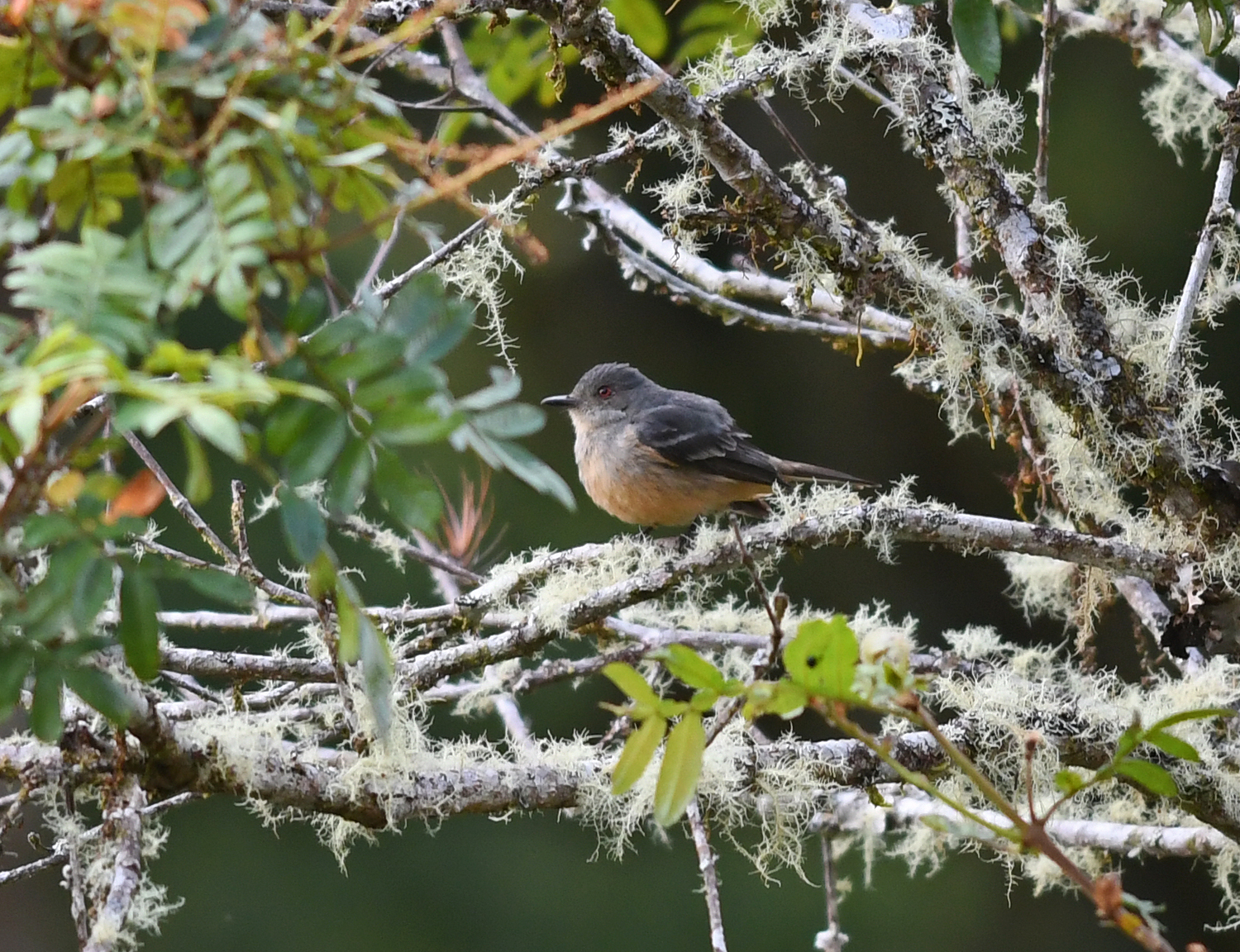
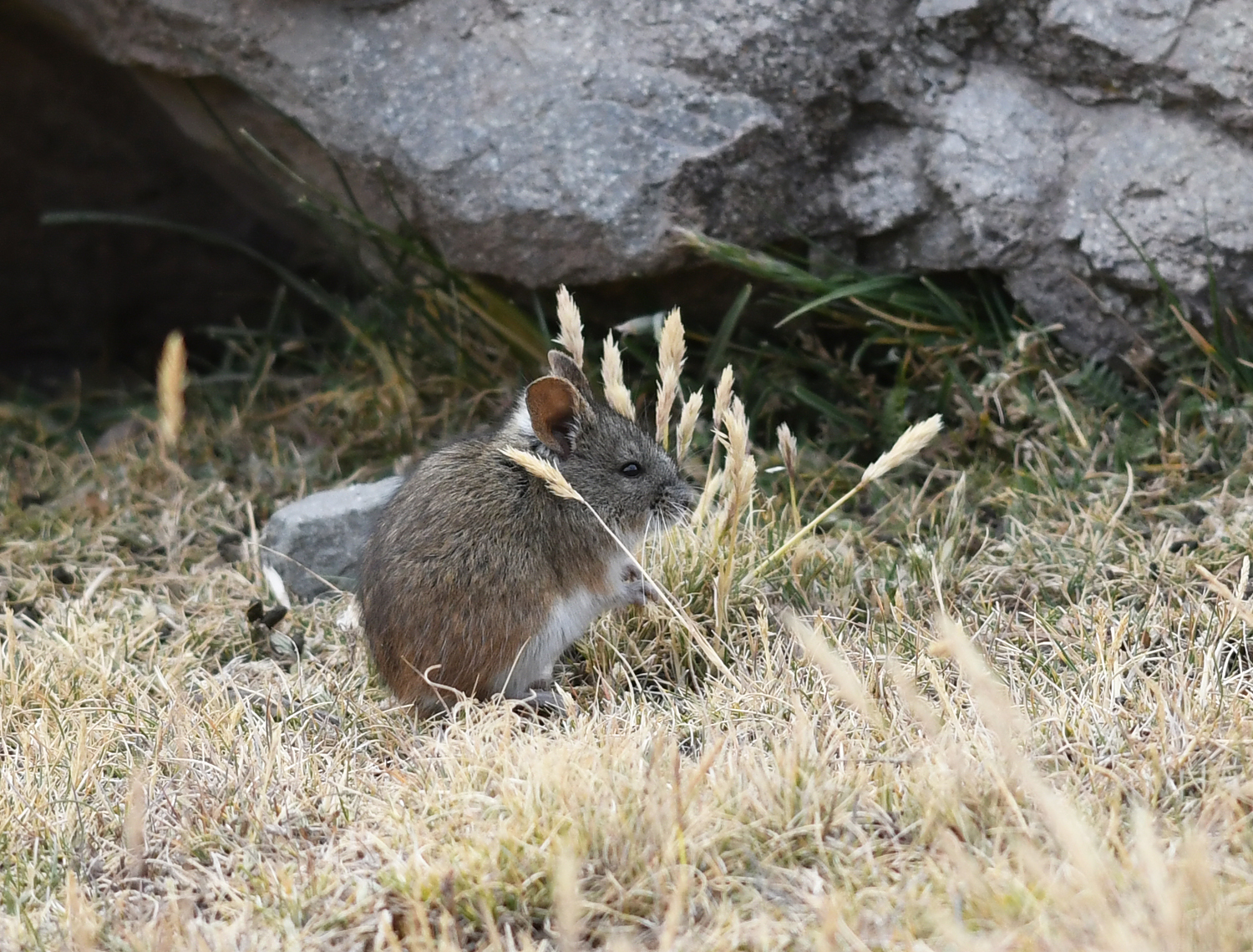
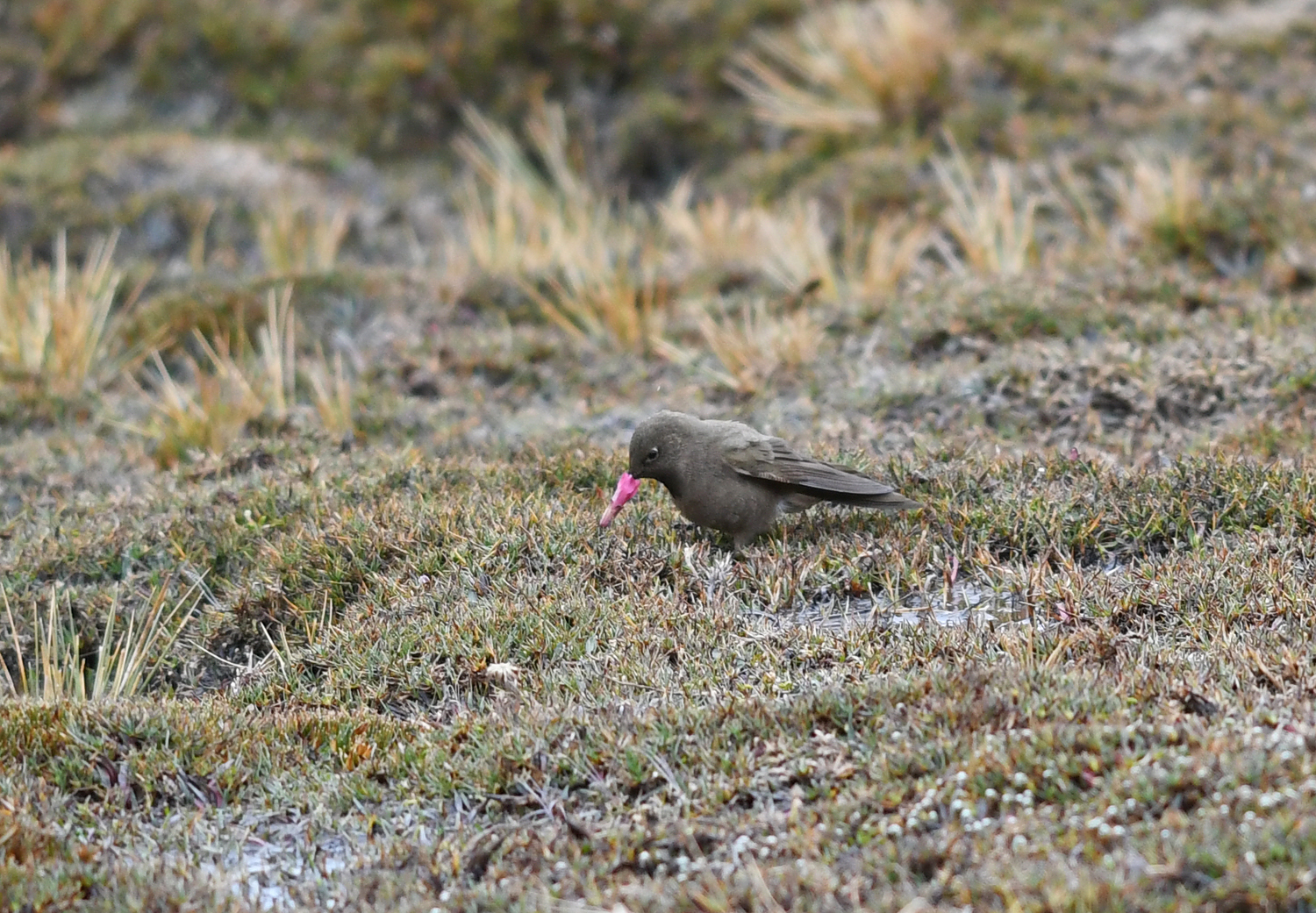
The Manu Road is the most famous birding road in Peru, and it is probably neck and neck with Panama’s Camino del Oleoducto (Pipeline Road) as the most well-known in the Neotropics among birders and naturalists. The big appeal is that the road traverses a whole range of intact ecosystems along the humid and mega-diverse east slope of the Andes, from elfin forest above 3000 m to Amazonian lowlands at 400 m. Laura and I have plans to spend a good deal of time along the Manu Road later this summer.
Manu is not the only road that bisects excellent forest and other habitats along the eastern slope of the Andes. The Satipo Road is not as well known, and indeed, it is a much shorter road that doesn't pass through the same extent of intact habitat. The bottom of the road (the town of Satipo) sits at about 700 m in elevation, and the forest is relatively fragmented in the lower sections. However, excellent quality puna grasslands can be found at the top while unbroken elfin and montane forest is located below it. Satipo Road sees little traffic and a small car with low clearance can access the entire road, provided that one can drive with patience and a little creativity.
 |
| Satipo Road, Junín, Peru |
Until recently, accommodations were nonexistent along Satipo Road and so most birders camped. Gunnar Engblom from Kolibri Expeditions is assisting the communities of Calabaza and Apaya, located around 2100 m elevation along the road, with starting an ecotourism project. The plan is to create a birding lodge of sorts. At the moment the accommodations are very basic – think four simple beds in a barren concrete building, outdoor toilets and cold showers – and in our experience are extremely overpriced given the conditions (we were charged $25 USD each (=$50 USD) per night). Typically, in central Peru one can find a good quality hotel good wifi, hot water and comfortable beds for around $15-20 USD per night. However, this gave us a place to stay near some of the best birding areas and we had no other options, so we didn’t complain too much.
 |
| Our accommodations along the Satipo Road in Apaya, Junín, Peru |
 |
| Our accommodations along the Satipo Road in Apaya, Junín, Peru |
July 19, 2022
Luckily, the protests from the previous day appeared to have subsided, or at least they did not impact our route up and over the eastern ridge of the Andes. Most of the day was spent in the car, driving from Concepción to Calabaza, though we made a few birding stops. Near the top of the road we spent some time at Lagunas Pomacocha and Habasccocha, situated at around 4470 m in elevation.
 |
| Laguna Habasccocha, Junín, Peru |
It was quite chilly and very windy but the birding was great, with several species of ducks, two Chilean Flamingos, Andean Geese, and a large flock of Silvery Grebes.
 |
| Crested Duck - Laguna Pomacocha, Junín, Peru |
 |
| Chilean Flamingo - Laguna Pomacocha, Junín, Peru |
 |
| Andean Duck - Laguna Pomacocha, Junín, Peru |
Landbirds were scarce at this elevation but several Common Miners worked the rocky ground, the ubiquitous Cream-winged Cinclodes was along the edges of the lake and we spotted our first Andean Negrito in a marshy section.
 |
| Common Miner - Laguna Pomacocha, Junín, Peru |
We made a short midday stop at a site where others had eBirded some of the specialty birds of this region, including the recently described Jalca Tapaculo and the extremely range-restricted Eye-ringed Thistletail. Both of these birds are found at the treeline and the Jalca Tapaculo is known for the extremely un-tapaculo-like behavior of scampering over and perching on rocks.
 |
| Muclio area, Junín, Peru |
We heard a couple of thistletails and right before leaving, Laura spotted movement in a bush which morphed into a Jalca Tapaculo. We also enjoyed our first Moustached Flowerpiercer, a handsome little bird that we would see frequently at the right elevation.
 |
| Jalca Tapaculo - Muclio area, Junín, Peru |
 |
| Moustached Flowerpiercer - Muclio area, Junín, Peru |
A little further down the road, two Mountain Caracaras were looking particularly photogenic.
 |
| Mountain Caracara - Muclio area, Junín, Peru |
Eventually, we passed the town of Toldopampa and started our descent towards the elfin forest. I made one stop for Junin Canastero (no dice), though a Striated Earthcreeper provided a decent photo subject.
 |
| Striated Earthcreeper - Toldopampa, Junín, Peru |
We drove down towards Calabaza, passing through beautiful montane forest. I was tempted to stop to bird this area, but we needed to reach Calabaza in decent time. Besides, we would bird this area properly the next morning. Laura and I rolled into town and found Juan, a birding guide who Gunnar had connected us with, and who was opening and prepping the building where we were staying. Laura and I had plans to hire Juan for one of our days in Calabaza, to visit the nearby Andamarca Valley with him.
Laura and I birded for half an hour around the building where we would be staying, hearing our first Bay Antpitta and finding some common species for the elevation.
July 20, 2022
It had been a chilly night but with dawn came the promise of tantalizing bird possibilities. Laura and I drove back up the Satipo Road, stopping at a particular bridge (Puente Carrizales) in elfin forest that is home to several unique, high-elevation bird species of the area: Eye-ringed Thistletail, Junin Antpitta and Fire-throated Metaltail among them.
 |
| Puente Carrizales, Junín, Peru |
I was thankful for my decision to bring my long johns and toque for this trip, since the car’s thermometer read 3 degrees Celsius upon our arrival. Laura and I bundled up and headed out – besides, lifers would warm us up!
A Golden-headed Quetzal was a surprise find, surely near its elevational limit here.
 |
| Golden-headed Quetal - Satipo Road, Junín, Peru |
It took us almost no time at all to find two Fire-throated Metaltails. This species has a narrow elevational range and is only found in central Peru.
 |
| Fire-throated Metaltail - Satipo Road, Junín, Peru |
While we were looking at the metaltails, a few tanagers up ahead caught our attention. We were floored to see that they were Golden-collared Tanagers!
 |
| Golden-collared Tanagers - Satipo Road, Junín, Peru |
This beautiful species is found in the eastern Andes from central Peru to central Bolivia and it isn’t often reported along Satipo Road. What a beaut!
 |
| Golden-collared Tanager - Satipo Road, Junín, Peru |
The birding continued to be strong as the sun slowly warmed the landscape. We heard a Junin Antpitta (it wouldn’t come out to play), listened to a Tschudi’s Tapaculo (ditto), and tracked down a pair of Eye-ringed Thistletails which we actually observed. This was some sweet redemption after yesterday’s heard-only experience with the thistletails. Photography was a bit of a challenge with these skulkers, though...
 |
| Eye-ringed Thistletail - Satipo Road, Junín, Peru |
 |
| Eye-ringed Thistletail - Satipo Road, Junín, Peru |
We slowly made our way back down the road, stopping every 100 m or so of elevation change. This was a successful tactic and the lifers kept coming.
 |
| Ochraceous-breasted Flycatcher - Satipo Road, Junín, Peru |
 |
| Steremnia monachella - Satipo Road, Junín, Peru |
 |
| Peruvian Wren - Satipo Road, Junín, Peru |
Some of the species were familiar ones to us from previous trips, such as this Scarlet-bellied Mountain-Tanager.
 |
| Scarlet-bellied Mountain-Tanager - Satipo Road, Junín, Peru |
The Slaty Brushfinches here are a candidate for a future split, often referred to as Taczanowski’s Brushfinch.
 |
| Slaty Brushfinch - Satipo Road, Junín, Peru |
The Superciliaried Hemispinguses were a bit confusing since I wasn’t aware of this subspecies which is quite grayscale. The ones we have seen further north are very yellow.
 |
| Superciliaried Hemispingus - Satipo Road, Junín, Peru |
The road followed a beautiful river valley for its length. During one stop, we found a pair of White-capped Dippers. The subspecies in this part of the Andes is almost completely black with just a white cap and throat.
 |
| White-capped Dipper - Satipo Road, Junín, Peru |
It was around this time that our day went downhill in a hurry. I’m not sure the exact reason why – perhaps I had left the lights on – but we quickly discovered that the car’s battery was dead. This was a big problem given the lack of traffic along the road. Typically, I prefer to rent a vehicle with a manual transmission, in part because it affords the possibility of a push-start in case of a dead battery. But this time, the rental agency had given us an automatic. We had no jumper cables; our our hope was that a vehicle containing cables eventually passed us along the road.
After fifteen minutes a moto taxi heading east passed us, so Laura hopped in with them to head to town where she might find help. I stayed at the car, hoping to procure assistance there while Laura tried in town. Eventually, a Toyota Hilux passed me and so I flagged it down. The three occupants were a father and his two adult children, and his 18-year-old son, Fran, happened to be a mechanic. They did not have jumper cables, and neither of us had wrenches either to remove the truck’s battery to connect to mine. We decided that the next best plan would be to tow my car down the mountain to Calabaza. They left to find a rope, returning twenty minutes later.
 |
| Bomarea sp. - Satipo Road, Junín, Peru |
Once the rope was fastened between the vehicles we rode down the mountain together, the Hilux pulling my dead Corolla, taking care not to bump the vehicles into each other given the very short length of rope. The hour-long ride in the Corolla with Fran gave me ample opportunity to practice my Spanish. Laura was waiting for us in town, having arranged assistance with a truck that could head up towards me in three hours’ time once they finished some other business, but fortunately we did not have to wait this long given the new friends I had made. Once in town, Fran and the others found some tools, removed the Hilux’s battery, connected it to mine using wrenches as conductors, and the Corolla fired up. Success! We thanked them profusely, gave them some money due to the extra time and gas they spent, and then bought them lunch before they went on their way!
Laura and I spent the last couple of hours in the late afternoon birding a stretch of road just up the hill from Calabaza. We added a few more lifers, including a flock that contained a Dusky-green Oropendola and several beautiful White-collared Jays.
 |
| White-collared Jay - Satipo Road, Junín, Peru |
I've got a thing for beautiful montane jays, and these ones fit the bill!
 |
| White-collared Jay - Satipo Road, Junín, Peru |
 |
| White-collared Jay - Satipo Road, Junín, Peru |
This Booted Racket-tail also provided a nice photoshoot. The birds on the eastern slope of the Andes show buffy “boots”, unlike the gleaming white puff-legs shown by birds on the western slope.
 |
| Booted Racket-tail - Satipo Road, Junín, Peru |
 |
| Booted Racket-tail - Satipo Road, Junín, Peru |
 |
| Booted Racket-tail - Satipo Road, Junín, Peru |
Below are a few other bird photographs from our afternoon birding sesh.
 |
| Collared Inca - Satipo Road, Junín, Peru |
 |
| Rufous-tailed Tyrant - Satipo Road, Junín, Peru |
 |
| Capped Conebill - Satipo Road, Junín, Peru |
 |
| Common Chlorospingus - Satipo Road, Junín, Peru |
 |
| Montane Woodcreeper - Satipo Road, Junín, Peru |
 |
| Flame-faced Tanager - Satipo Road, Junín, Peru |
 |
| Crimson-mantled Woodpecker - Satipo Road, Junín, Peru |
 |
| Speckle-faced Parrots - Satipo Road, Junín, Peru |
We rolled back into town and met Juan at the accommodations. He pointed out a vocalizing Leymebamba Antpitta and the three of us tracked down a Blue-banded Toucanet. It had been a very busy (and somewhat stressful) day, but in the end I had found 14 new bird species, and Laura had seen close to 20!
 |
| Blue-banded Toucanet - Satipo Road, Junín, Peru |
The next morning, Laura, Juan and I had plans to drive into the Andamarca Valley for a day of birding. This dry valley is home to quite a few unique birds found only here.