Though I haven't been blogging with the same fervour that I exhibited during our first month in Peru, Laura and I have still been very busy with many excellent sightings. Our pace has quickened in recent weeks and opportunities to blog have been few and far between. This has been caused in part by a lack of internet in many of our recently frequented locales, but mainly it is due to the fact that we have been in the eastern lowlands where biodiversity is insanely high. I could not waste any precious time on my computer when lifers awaited!
But all good things must come to an end, and tomorrow we fly back to Canada. I will try to increase the frequency in which I pump out blog posts in the upcoming week or two and attempt to reduce the backlog (a never-ending battle, it seems). In the meantime, I want to skip forward a month and write about an event that happened very recently while the memories are still fresh in my mind.
Laura and I concluded our Peru trip with a five night stay at a research station in the Amazonian lowlands called Los Amigos Biological Station. Situated on the banks of the Río Madre de Díos, Los Amigos boasts a bird list of nearly 600 species, plus 10 monkey species and untold herps, plants, insects and more. The birding is incredibly productive due to the diversity of habitats found a short walk from the station clearing.
 |
| Ryland's Bald-faced Saki - Los Amigos Biological Station, Madre De Díos, Peru |
For our last full day at Los Amigos, I planned to complete a birding Big Day. That is, I hoped to identify as many bird species as possible in 24 hours. Now, Big Days are not for everyone. The point of one is not to enjoy watching birds, nor is it to slowly uncover the avian secrets found in an area. A Big Day is, simply, a listing endeavour. A sport of some kind. It is merely an attempt to identify birds quickly and efficiently. Often, 50% or more of the bird species encountered on a Big Day are heard-only. But while I enjoy many other aspects of birding as well, the adrenaline rush of bird listing is fun for me, as is the challenge of trying to plan a route that maximizes the number of bird species that I can come across within a certain time period. With all of the time I have spent in the Amazonian lowlands this year (and especially, in the previous few weeks), I felt prepared enough to attempt my own Amazonian Big Day.
 |
| Rufous Motmot - Los Amigos Biological Station, Madre De Díos, Peru |
The temperature was supposed to drop on our penultimate day at Los Amigos, accompanied by moderate winds and some rain. The final day would, in theory, be calm, cool and rain-less after the system passed through - pretty much ideal conditions. So much of a Big Day in the Amazon comes down to weather, as hot conditions shut down bird activity during the middle of the day and one only has around 12 hours of daylight to work with in the first place.
But the weather gods had other plans and the forecasted rains and winds were a little delayed, hitting in the early hours of my planned Big Day of September 23. I dutifully went ahead with things anyways, hitting the trails at 3:00 AM. Despite the ominous grumbles of thunder and flashes of distant lighting in the sky, the night birding was pretty good. Four species of owls vocalized, including a bonus Spectacled Owl, while Gray and Variegated Tinamous and Starred Wood-Quails were also heard. I even saw a recently fledged Ocellated Poorwill! The Lined Forest-Falcon fired up five minutes behind schedule at 5:10, followed shorty by the Collared Puffbird. But then the rain hit. Twenty minutes later, having experienced a very weak dawn chorus and an uptick in the precipitation, I decided to call it quits, a mere forty species in.
 |
| Ocellated Poorwill - Los Amigos Biological Station, Madre De Díos, Peru |
But I had a new plan. While this was our final full day in the Amazon, we would not be departing until noon on the following day. What if I waited for the rain to pass and initiated the Big Day during the late morning, continuing until late morning the next day? And that is what I did. While this would not be a "true" Big Day taking place in during one calendar day, it would be a Big 24 Hours.
This proved to be a very good decision as the rain stopped by 7 AM, and the strong winds died down by the early afternoon. The afternoon was beautifully cool with a high of 26 degrees, a refreshing change from the 36 degree highs that we had been experiencing at Los Amigos up to that point. And the morning of September 24 was perfectly calm and cool with an excellent dawn chorus and good bird activity.
Before I get into the nitty gritty details of the Big Day, a quick comment about Los Amigos and why it is ideally suited for such an endeavour.
A number of diverse and high-quality habitats can be easily reached on foot from the field station, including mature terra firme (upland rainforest), mature varzea (floodplain forest), bamboo, scrubby successional growth/secondary forest, aguajales (palm swamps), several oxbows in various states of revegetation, and two ríos (rivers). The field station itself is situated on a bluff overlooking the Río Madre de Dios with excellent sight lines, and a number of fruiting trees around the station clearing are always filled with birds. It would probably be easy-ish to tally 150 species in a day from the station clearing alone.
 |
| Yellow-bellied Dacnis - Los Amigos Biological Station, Madre De Díos, Peru |
I am not the first to attempt a Big Day at Los Amigos, and some of the other attempts have finished with staggeringly high totals. The most noteworthy Big Days that I can find on eBird were completed by Sean Williams in 2015 and Alex Wiebe in 2018. Sean concluded with 345 species, while Alex topped his mark with 347 species. They found more species in a single day than I saw during my Ontario Big Year in 2012. This blows my mind, but it makes sense given the abundance of habitats that they were able to visit. Both gentlemen are avid birders who had spent the previous months completing field work at Los Amigos. This meant that they were intimately familiar with every peep, trill and chip note made by any bird species. They also had stakeouts for quite a few of the tougher birds. Finally, Sean and Alex also had the benefit of cherrypicking the perfect day to complete their Big Days - i.e. calm, cool days after the passage of friajes (winter storms) where every bird would be active and many would be vocal, taking place during the proper moon cycle for good night-birding.
I knew that the final tally of my Big Day would not be in the same ballpark as Sean's or Alex's. My stay at Los Amigos was just a few days in length, meaning that I did not possess the same vast knowledge that they had accumulated. While I had spent the previous few weeks in the Amazon and I am a fanatical ear-birder, my knowledge of the soundscape at Los Amigos is much more limited. This likely cost me several dozen species. I also had only a few important stakeouts, and I was unable to pick the ultimate weather day. There was also a new moon during my stay, meaning that night birds would be rather quiet.
That being said, I finished with a much higher number than I had originally anticipated, a number that I doubt I will surpass on a Big Day anytime soon. With that all out of the way, here is the chronological narrative of my Big Day. I made note of the time and species for every 25-species milestone throughout the 24 hours.
-----------------------------------------
10:24 AM:
Laura had joined me in the forest for the morning and we walked around for a couple hours. My plan was to start the Big Day sometime around 10 AM, with the clock officially starting when we saw some good birds or found a mixed flock. At 10:24 we encountered a decent flock in some bamboo near the field station and the Big Day officially began with a perched Yellow-billed Nunbird, a somewhat local species at Los Amigos. Those first few minutes were frantic as we picked through the flock, adding some good ones in Inambari Woodcreeper, Swainson's Flycatcher and Brown-rumped Foliage-gleaner.
 |
| Inambari Woodcreeper - Los Amigos Biological Station, Madre De Díos, Peru |
10:35 AM:
I hit the first 25 species milestone with a heard-only Fiery-capped Manakin as we reached the station clearing. The weather was still quite windy and so I decided to spend the late morning around the station, as the birding here is always steady regardless of the weather conditions, it seemed. It took another half hour to reach the 50 species mark with a flyover Greater Yellow-headed Vulture. Birding the clearing produced a nice tanager flock containing stunners like Paradise, Green-and-gold and Masked. I allowed myself a few extra seconds to enjoy these beauties, although on a Big Day there should be no time wasted appreciating the birds!
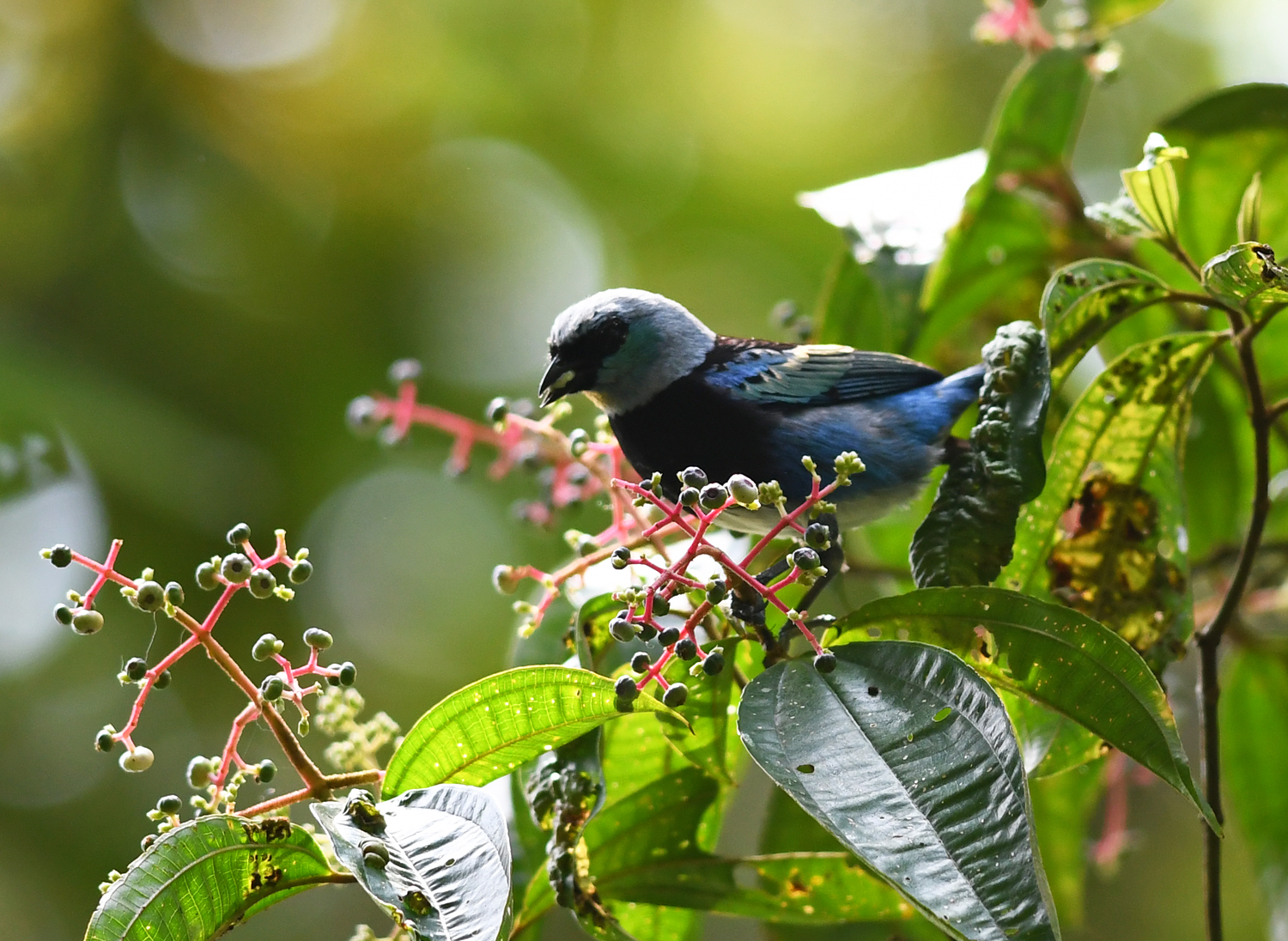 |
| Masked Tanager - Los Amigos Biological Station, Madre De Díos, Peru |
Some of the other good birds at the clearing included a heard-only Bat Falcon, some uncommon flycatchers (Small-billed Elaenia, Southern Scrub-Flycatcher), Epaulet Oriole, and all three dacnis species. A quick scan of the river produced Spotted Sandpiper and Great Egret, while a surprise Striped Cuckoo called from across the river. Unfortunately, the staked out Barred Antshrike remained silent, and I was unable to turn up the White-chinned Sapphire which had been frequenting the ornamental flowers outside of the dining hall all morning.
 |
| Southern Scrub-Flycatcher - Los Amigos Biological Station, Madre De Díos, Peru |
12:35 PM:
Laura and I left the clearing after our quick lunch break. I had kept my eyes glued on the ornamental flowers outside of the dining hall during lunch, hoping for the sapphire, but all that visited was a single Reddish Hermit. With 70 species we headed out with a plan of spending the afternoon birding the "lower terrace" of bottomland forest and several old oxbow wetlands.
12:40 PM:
The 75 species milestone was hit when a Gray-fronted Dove flew across the station clearing. We heard the stakeout White-headed Jacamar (a localized species) as we walked down the hill to the lower terrace, and at the bottom of the hill we hit our first big mixed flock. Quickly, we added around 20 species including a few that we would not see again at any other point during the Big Day: Turquoise Tanager, Purple Dacnis, Olive-backed Foliage-gleaner, Plain and Streaked Xenops and several ant-things.
1:15 PM:
I crossed the 100 species threshold with a singing Spot-winged Antshrike. During previous days the cicada noise in the afternoon had been deafening, nixing any chances of birding by ear. However, today the cooler temperatures had quieted the cicadas. In between mixed flocks I added quite a few by ear including Dull-capped Attila, Chestnut-shouldered Antwren, White-lored Tyrannulet and Wing-barred Piprites. We also stopped for our only ant swarm of the Big Day. Unfortunately, the only bird attending it was a single Black-faced Antthrush. I ended up missing several species typically found at ant swarms including White-throated Antbird.
 |
| Black-faced Antthrush - Los Amigos Biological Station, Madre De Díos, Peru |
2:08 PM:
Species #125 tallied was a female Flame-crested Tanager in a mixed flock. Laura and I had just reached Cocha Seca, our first oxbow lake of the day, seeing a female Band-tailed Manakin on the way. Cocha Seca is a very old oxbow that has been reclaimed with vegetation. Standing water has long-since disappeared. But the open scrubby habitat here can be very productive and we lucked out by hitting a mixed flock. In addition to the milestone Flame-crested Tanager, I also picked up my first lifer of the day in this flock (Plain Softtail) while we encountered several other species for the only time during the Big Day (Speckled Spinetail and Buff-breasted Wren).
2:30 PM:
Laura and I reached Cocha Lobo a few minutes behind schedule - the mixed flock birding had been both distracting and time-consuming, oh what a problem to have - and so we only spent around ten minutes here.
 |
| Cocha Lobo - Los Amigos Biological Station, Madre De Díos, Peru |
We added quite a few "good" Big Day birds including a singing Amazonian Streaked-Antwren, Hoatzins, several Anhingas and, best of all, a Green-and-rufous Kingfisher! The usual group of Proboscis Bats were looking particularly cute.
 |
| Proboscis Bats - Los Amigos Biological Station, Madre De Díos, Peru |
We then headed to our third and final oxbow of the afternoon called Cocha Amigo. It was a little difficult to stay on schedule due to the mixed flocks! Highlights included our only Chestnut Woodpecker and Plain-throated Antwrens for the Big Day, as well as a super cute Collared Puffbird and a surprise Crane Hawk. We even found a group of a half-dozen Curl-crested Aracaris, only our second ever encounter with this super cool species. I even added a lifer when we heard a Band-tailed Antbird sing. I would have loved to stay for a while to lure it into view, but the clock was ticking. That's a Big Day for you.
 |
| Curl-crested Aracari - Los Amigos Biological Station, Madre De Díos, Peru |
3:37 PM:
The 150 species mark was hit with a pair of flyover Chestnut-fronted Macaws. Some of our stakeouts at Cocha Amigo came through, such as the guaranteed nesting tree full of Casqued Caciques. I love these ridiculous birds....
 |
| Casqued Cacique - Los Amigos Biological Station, Madre De Díos, Peru |
We added a few other crucial species at Cocha Amigo including Amazon Kingfisher, Snowy Egret, Red-capped Cardinal, Greater Ani and Wattled Jacana. A Solitary Sandpiper was a bonus, though the staked-out Rufescent Tiger-Heron and Silvered Antbird were both no-shows.
We left Cocha Amigo right on schedule, giving us some time to bird our way through the floodplain forest back to the station. This was a productive walk and we steadily added a few species including a handsome Amazonian Barred-Woodcreeper. A ten-minute stop at the river overlook was quite worthwhile, adding Yellow-billed Tern, Cocoi Heron, Red-throated Caracara, and Black-capped and White-eyed Parakeets. It had been quite a productive afternoon!
 |
| White-eyed Parakeets - Los Amigos Biological Station, Madre De Díos, Peru |
5:10 PM
Sunset was approaching quickly as Laura and I hoofed it back to the station. My aim was to arrive with enough light to give the river one more scan. Species #175 was a singing Plumbeous Antbird, while quite a few other stakeouts cooperated (Rufous-fronted Antthrush, Ferruginous Pygmy-Owl, Thrush-like Antpitta). Dusk fell quickly and we were losing light in a hurry as we arrived at the station. Several Cinnamon-throated Woodcreepers sang, while we fetched the scope to check out the river. In the fading light, I scoped several Ladder-tailed Nightjars hunting over the shallows.
 |
| View from Los Amigos Biological Station, Madre De Díos, Peru |
Laura and I sat down on the chairs by the overlook, tired but exhilarated with a very productive start to the Big Day. But the additions kept coming! Somewhere along the river, a Pied Lapwing vocalized a few times. It was followed by a Point-tailed Palmcreeper rattling away from the palms across the river. And then the night birds started - Ocellated Poorwill, Common Pauraque and Tawny-bellied Screech Owls were quick additions.
 |
| Ocellated Poorwill - Los Amigos Biological Station, Madre De Díos, Peru |
7:20 PM:
Laura and I had a relaxed dinner before hitting the trails again. Herps were our main priority, though I was hoping for a few night birds of course. The temperatures were refreshingly cool. This diminished the herp action and frogs and snakes were few and far between, a contrast from the previous nights. My highlight was properly photographing the Amazonian Horned Frog which I had discovered during my Big Day false start earlier that morning.
 |
| Amazonian Horned Frog (Ceratophrys cornuta) - Los Amigos Biological Station, Madre De Díos, Peru |
Bird-wise it was quiet, my only addition being Crested Owl. Still, the first part of the Big Day had been a success with 193 species on my list. I set my alarm for 3:30 AM and sleep came very easily.
September 24, 2022, 3:30 AM:
I was rudely awakened from my slumber by 3:30 AM for the second morning in a row. But the adrenaline of the Big Day shook me awake and I headed out onto the trails. The staked out Black-banded Owl was calling as I passed by its location. Listening conditions were excellent in the pre-dawn darkness and the additions came slowly but steadily: Slaty-backed Forest Falcon, Variegated Tinamou, Starred Wood-Quail. I even heard my first ever Long-tailed Potoo, singing its distinctive "Raúllllll!" song.
During my walk I occasionally played the tapes of some of my target Dawn Chorus Singers quietly to myself, to keep their vocalizations fresh in my mind. Quite a few species only sing for a brief period before and/or during sunrise, staying quiet for much of the day afterwards. The dawn chorus could easily make or break one's day and I wanted to ensure that I was on my game.
5:05 AM:
The Lined Forest-Falcon called right on schedule as the sky ever so slightly began to brighten. Species #200, a big milestone. I steadied myself for a hectic hour of dawn chorus birding.
My strategy was to cover as much ground as possible in terra firme and bamboo habitats during this first hour to catch as many of the singers as possible. I only stopped a few times to record a couple of unfamiliar vocalizations. My eBird checklist for the morning was well into the 40s before I actually laid eyes on a bird. It was a pretty decent dawn chorus, though a little subdued compared to what I had expected. Some of my stakeouts did not cooperate (Blue-backed Manakin, Rufous-tailed Flatbill) but most did. I even added a lifer when a Banded Antbird sang!
Laura caught up with me in the bamboo around 5:30 AM and we added birds like Chestnut-headed Crake, Yellow-crowned Parrot, Long-crested Pygmy-Tyrant and both Dusky-tailed and Large-headed Flatbills.
 |
| Chestnut-fronted Macaws - Los Amigos Biological Station, Madre De Díos, Peru |
6:21 AM:
The next milestone, 225 species, happened as we exited the forest and emerged at the field station clearing: a Crowned Slaty-Flycatcher, teed up on a bare tree. We made a quick pass of the clearing, added a few birds like Southern Beardless-Tyrannulet and Mouse-colored Tyrannulet, and entered Trail 1 on the far side of the station. This path travels parallel to a former airstrip that once serviced the field station. The runway was abandoned years ago and it has since been reclaimed by nature. The extensive bamboo and thickets provide habitat for a wide array of species and the birding was top-notch. Additions came quickly - White-lined Antbird, Bran-coloured Flycatcher (a real looker, as you can guess by its name), Chattering Gnatwren and Bare-necked Fruitcrow to name a few. Laura locked onto a Dark-billed Cuckoo. This is an austral migrant which we have found frequently in recent weeks. Unfortunately, in typical cuckoo fashion, it slunk away before I could see it. I only noticed a retreating tail - not enough to count for my Big Day.
8:33 AM:
We were into the final stretch as we left the bamboo behind and re-entered mature terra firme. At this point, I began to focus on what species I was still missing. This was a productive strategy. For example, I realized I did not have Grayish Mourner and so I played a snippet of tape. Immediately one fired up from somewhere in the canopy. Along the walk I heard the Hairy Woodpecker-like call of a Black-tailed Leaftosser, a lifer for Laura and I. It provided good, though brief views from only a few meters away. Species #250 was the next big milestone, a number which I had set as my goal. A single Needle-billed Hermit hovered beside us for a few seconds before zipping off into the vastness of the forest.
We arrived at the tree where we had discovered a pair of scarce Scarlet-shouldered Parrotlets excavating a potential nesting cavity the previous day. Sadly, they were nowhere to be found, though a spectacular consolation prize was this sharp Collared Puffbird. Not a Big Day addition but one of the cutest puffbirds out there!
 |
| Collared Puffbird - Los Amigos Biological Station, Madre De Díos, Peru |
Now that I had reached my goal of 250, everything else would just be bonus, as they say. We arrived at Cocha Raya a little behind schedule but the additions kept piling up. A mixed flock produced Slaty-capped Shrike-Vireo and Royal Flycatcher. The stakeout Horned Screamers were making a racket from the oxbow. A Black-capped Donacobius sang, while the Short-crested Flycatchers were in their favourite tree. We even heard a singing Rusty-belted Tapaculo, a species which had been surprisingly absent up to that point.
10:09 AM:
We had added only a couple of new ones on our walk back to the station (Western Striolated-Puffbird was a highlight) and we entered the clearing with 15 minutes left in the Big Day. There were still quite a few possibilities here. The Blue-throated Piping-Guans, a mainstay in the clearing, were still absent. They ended up as a Big Miss on the Big Day. But in the waning minutes I found a pair of Social Flycatchers as well as a Yellow-green Vireo with the Chivi Vireo flock feeding in one of the fruiting trees.
10:23 AM:
With less than 60 seconds on the clock, species #265 grabbed my attention: a male Vermilion Flycatcher. And then the timer on Laura's phone went off, and the Big Day was over.
-----------------------------------------
I have to say that I was thrilled to have tallied 265 bird species in 24 hours, even if that total was still a far-cry from the record-shattering Big Days of yesteryear from Los Amigos. It was a personal challenge and I felt that I had succeeded. Though mentally and physically exhausting, it was exhilarating all the same. A big thanks to Laura for joining me for most of the Big Day! I will conclude with a few numbers of interest.
17: hours spent birding
265: total species encountered during the Big Day
117: species that were heard-only
25.5: total kilometers walked
143: ticks removed