The Sacred Valley is the epicenter of tourism in Peru. Probably well over 90% of all foreign tourists who visit Peru end up here, with their ultimate goal being the archaeological site of Machu Picchu.
But Laura and I had no plans of setting foot on Machu Picchu, much to the surprise of everyone that we chatted with during our stay in the Cusco region. While Machu Picchu looks like a spectacular site, the idea of spending a lot of money so that we could stand next to hundreds of people just did not appeal to us.
There were other things that drew us to the Sacred Valley, though. Birds, of course! And herps, and butterflies, and so much more. We had booked a rental car in advance for several weeks and I planned a route that would incorporate amazing birding sites while minimizing the number of tourists that we would bump into.
This blog post will cover several visits that we made to the Abra Málaga pass.
 |
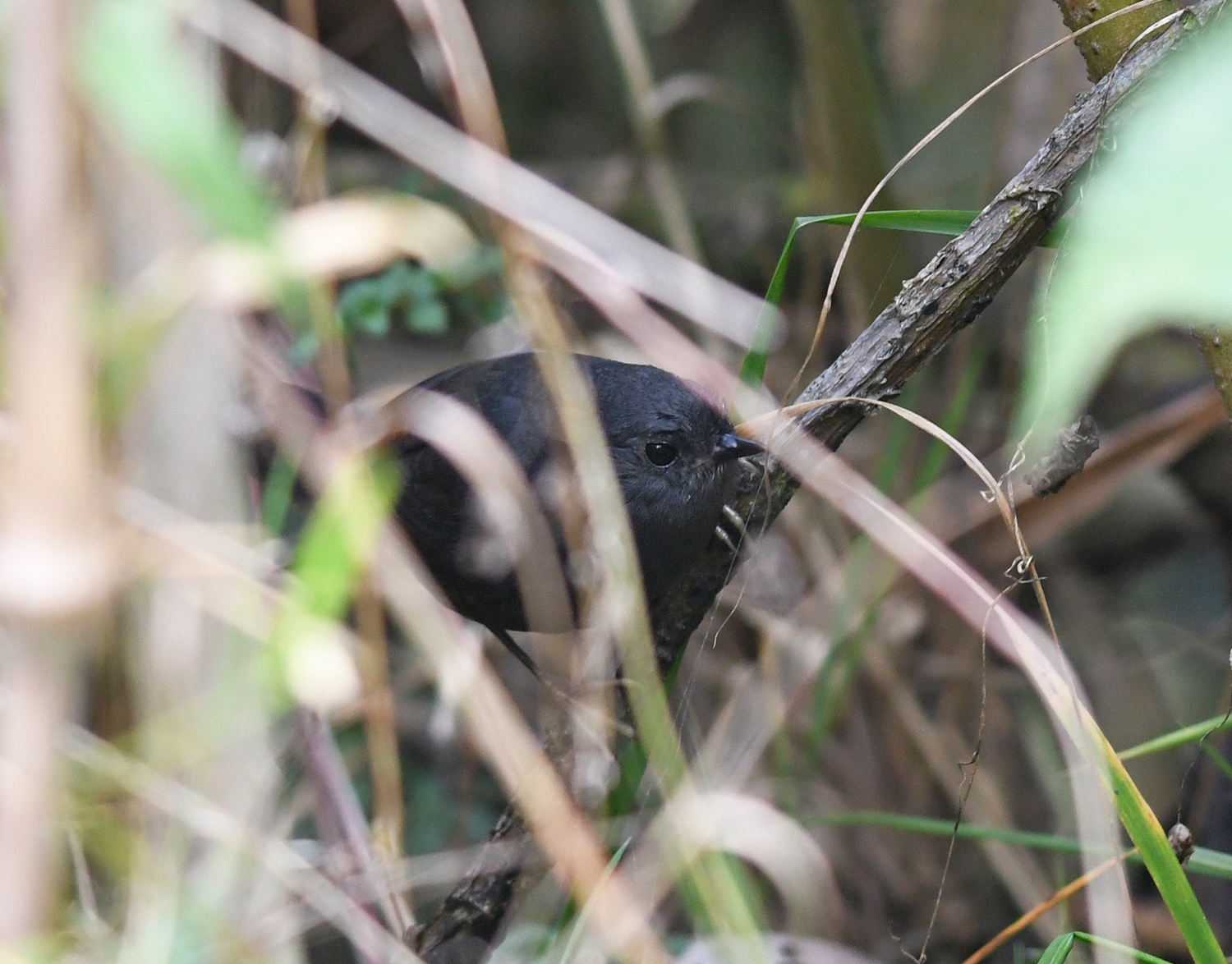
| Puna Tapaculo - Abra Málaga Thastayoc Royal Cinclodes, Cusco, Peru |
August 25, 2022
Our overnight bus from Arequipa was comfortable and the ride was relatively painless. We managed some light sleep, though both of us were rather bleary-eyed when we arrived at the terminal. The representative from the rental agency soon appeared to drop off the car and we were on our way, navigating Cusco traffic.
 |
| Llama - Abra Málaga, Cusco, Peru |
We left the city behind but we would have to wait a while longer to escape the tourists, since our lodging that night was in the town of Ollantaytambo. This town consists of beautiful cobblestone streets that were built hundreds of years ago, while the Ollantaytambo ruins, looming over the town from high up on the hillside, are visible from many points. Ollantaytambo has a rich cultural history going back nearly 600 years, though nowadays it appears to function as a jumping off point for people traveling to Machu Picchu. As expected, Ollantaytambo was chock full of North Americans and Europeans either preparing for, or having recently returned from their Machu Picchu visit. By my estimation roughly 50% of these people were decked out in a recently purchased alpaca sweater, apparently a mandatory item to bring home after visiting the Sacred Valley.
 |
| Metadaris cosinga - Abra Málaga, Cusco, Peru |
After grabbing a quick coffee in the main square, Laura and I continued through the town and up a winding road leading to a mountain pass called Abra Málaga. This is a world-famous birding road, and rightly so. The top of the pass is roughly 4400m in elevation and high-quality Polylepis patches are reachable on foot from here. The stretch of road between Ollantaytambo and the pass cuts alongside dry, scrubby hillsides that are home to a number of interesting birds including the localized White-tufted Sunbeam and Chestnut-breasted Mountain-Finch. The weather on the far side of the pass is much different, with frequent rain and fog. Puna grasslands give way to elfin forest, cloud forest and eventually lower montane forest. If it wasn’t for the frequent traffic this would be up there as one of my favourite birding roads.
Laura and I planned to hike around the Polylepis forest at the top, though we first made several pitstops along the way. Our main targets were the aforementioned sunbeam and mountain-finch, two species that are endemic to southern Peru. It was a beautiful sunny morning and spirits were high.
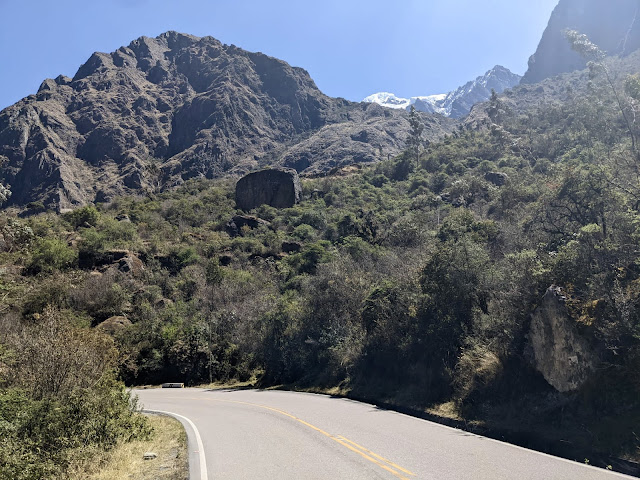 |
| Abra Málaga, Cusco, Peru |
We easily succeeded with both of our targets. I was particularly enthused with the White-tufted Sunbeam, a species that I have wanted to see for some time. It looks similar to the common and widespread Shining Sunbeam, though it is much darker and has that peculiar white blotch on its chest.
 |
| White-tufted Sunbeam - Abra Málaga, Cusco, Peru |
 |
| Chestnut-breasted Mountain Finch - Abra Málaga, Cusco, Peru |
We rolled up to the pass and readied our day-packs: we had arrived at the Abra Málaga Thastayoc Royal Cinclodes reserve. This is a privately-owned site where people can hike for a fee.
 |
| Abra Málaga Thastayoc Royal Cinclodes, Cusco, Peru |
The weather at the Abra Málaga pass can be fickle but luck was on our side this day. There was a distinct lack of fog, nor was there any precipitation. Laura and I took our time hiking up to the ridgeline. Though we were fairly well-acclimated to the elevation by this point of the trip, hiking up a slope above 4400m is still a bit of a challenge! The views from the top were worth it, though…
 |
| Abra Málaga Thastayoc Royal Cinclodes, Cusco, Peru |
The eponymous bird of this reserve, the Royal Cinclodes, is far from guaranteed. This Critically Endangered species has a small range in southern Peru and adjacent Bolivia and it lives in high-elevation Polylepis groves. It is sensitive to habitat disturbance and most of the original Polylepis is gone, having been used for firewood. Only a few hundred Royal Cinclodes remain in the wild. Many birders who visit the reserve end up dipping on the cinclodes. Evidently, they are relatively scarce here.
Laura and I took the path leading to the right after reaching the ridge and we spent the afternoon slowly descending into the valley below. Other than the cinclodes, we had several other birds we were hoping for. With time, some of them cooperated including a handsome group of Ash-breasted Tit-Tyrants and some White-browed Tit-Spinetails, though the latter disappeared before satisfying looks were had. Both of these species are Polylepis specialists, and both have a small global range.
 |
| Ash-breasted Tit-Tyrant - Abra Málaga Thastayoc Royal Cinclodes, Cusco, Peru |
Laura and I birded for a while, striking out on the cinclodes the whole way down. We decided to check one final Polylepis patch before turning around to begin the long, grueling hike back up to the ridge. Right after birding the patch, we began our ascent when I heard a funny bird song, one that I had memorized. Could it be the cinclodes? Laura and I listened closely but it refused to vocalize again. I believe Laura accused me of stringing, birder parlance for making up a bird, and we continued on. But then she spotted it – a Royal Cinclodes probing the earth underneath of a Polylepis tree!
 |
| Royal Cinclodes - Abra Málaga Thastayoc Royal Cinclodes, Cusco, Peru |
For the next ten minutes we watched the cinclodes as it foraged. It did not seem the least bit concerned with our presence and I came away with some photos that I was really happy with. Talk about a lucky sighting!
 |
| Royal Cinclodes - Abra Málaga Thastayoc Royal Cinclodes, Cusco, Peru |
Unlike other species of cinclodes which populate open areas, especially near water, Royal Cinclodes frequent dense Polylepis groves. It isn’t a particularly shy species but it is unobtrusive and can be easily missed in an area.
 |
| Royal Cinclodes - Abra Málaga Thastayoc Royal Cinclodes, Cusco, Peru |
 |
| Royal Cinclodes - Abra Málaga Thastayoc Royal Cinclodes, Cusco, Peru |
August 26, 2022
Since we had acquired little sleep on the bus during the previous night, we slept in this morning and did not leave our hostel in Ollantaytambo until around 7 AM. I photographed this Blue-and-yellow Tanager in the courtyard before we headed out.
 |
| Blue-and-yellow Tanager - Ollantaytambo, Cusco, Peru |
After breakfast, Laura and I returned to the Abra Málaga pass. Having succeeded with most of our targets from the day before, we passed on birding the dry side of the valley. We elected to skip the Abra Málaga Thastayoc Royal Cinclodes reserve, too. Instead, we continued to the humid side of the pass. The only birding stop we made was just before the pass so that we could tick our lifer Puna Tapaculo (heard-only, unfortunately).
 |
| Abra Málaga, Cusco, Peru |
I had grand plans of spending the morning sifting through mixed flocks all along the humid slope, picking up ten or more lifers. But, unfortunately, the morning did not play out as I had envisioned.
 |
| Abra Málaga, Cusco, Peru |
It was not a total bust of course, and we still ended with some great species for our lists (not to mention the incredible scenery). The slow birding was not entirely unexpected since we missed the most productive three hours of the morning due to our late arrival. The mixed flocks did not materialize and most of the lifers that we acquired provided brief views, or they remained as heard-only. It was the slowest seven-lifer day that I have had in quite some while! Four out of the seven were only heard, while I never even managed so much as “record photos” of the remaining three. One of those days!
 |
| Orophila diotima - Abra Málaga, Cusco, Peru |
The elfin forest produced a few nice sightings including our first Puna Thistletail, vocalizing Urubamba Antpittas and brief views of our first Scaled Metaltails. We found a few other species here including Tit-like Dacnis, three species of flowerpiercers, a Shining Sunbeam and a Violet-throated Starfrontlet. The only bird that remained in place long enough for a photo was this Rufous-breasted Chat-Tyrant.
 |
| Rufous-breasted Chat-Tyrant - Abra Málaga, Cusco, Peru |
Lower down, the birding slowed even more, though the spectacular scenery partially made up for that. Verónica, the snow-capped peak looming above us, shone in all her glory.
 |
| Nevado Verónica - Abra Málaga, Cusco, Peru |
We connected with a singing Diademed Tapaculo further down, while our first Red-and-white Antpitta sang as well. Duetting Inca Wrens rounded out the lifers for the morning.
 |
| Nevado Verónica - Abra Málaga, Cusco, Peru |
One of the morning’s highlight was a butterflying session at a creek crossing during the late morning. All butterfly enthusiasts know that late morning is prime time and today was no different. The rarest butterfly was Lymanopoda prusia, a species with very few publicly available photos online, but here are photos of a few others, too.
 |
| Manerebia sp. - Abra Málaga, Cusco, Peru |
 |
| Corades cistene - Abra Málaga, Cusco, Peru |
 |
| Orophila diotoma (left), Dione glycera (right) - Abra Málaga, Cusco, Peru |
 |
| Lymanopoda prusia - Abra Málaga, Cusco, Peru |
August 28, 2022
Laura and I returned to Abra Málaga a few days later after a very successful spin to the Vilcabamba Valley and back (more on that in the next post). On our way back to Ollantaytambo, we made a few quick stops along the humid side of the pass. The birding was pretty slow once again, and we again failed to find any mixed flocks. My highlight was finally succeeding in observing (and poorly photographing) a Trilling Tapaculo.
 |
| Trilling Tapaculo - Abra Málaga, Cusco, Peru |
We also found a Sapphire-vented Puffleg teed up on a dead snag. This was a new species for Laura!
 |
| Sapphire-vented Puffleg - Abra Málaga, Cusco, Peru |
August 29, 2022
Laura and I had overnighted once again in Ollantaytambo. It may be touristy, but it is conveniently located and is home to several restaurants that can make a half-decent wood-fired pizza. Good pizza is not always easy to find in Latin America.
Before leaving Ollantaytambo, we walked around in a bid to find a Bearded Mountaineer. This incredible hummingbird is endemic to southern Peru and only lives in dry inter-Andean valleys. Ollantaytambo is one site where they can be regularly found.
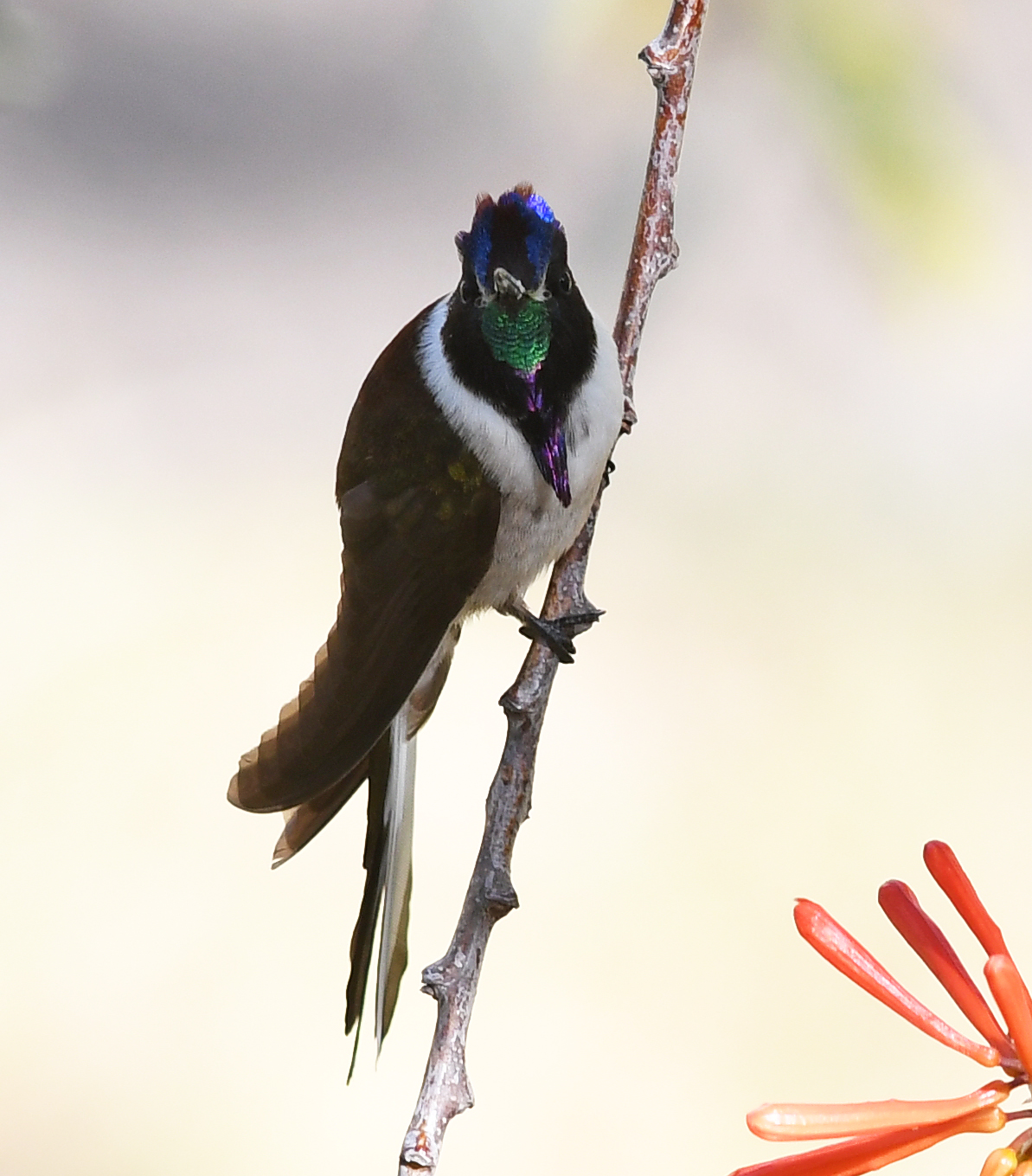
My strategy was to seek out yards with lots of flowers in hopes that the mountaineer would be present. It worked! The street we chose overlooked the landscaped properties of several high-end hotels, and we found a male Bearded Mountaineer with little effort. The lighting was not ideal but the colors of the forehead and beard still come through in this image.
 |
| Bearded Mountaineer - Ollantaytambo, Cusco, Peru |
 |
| Bearded Mountaineer - Ollantaytambo, Cusco, Peru |
September 12, 2022
Laura’s father, Mark, joined us for a week of exploration in southern Peru during the middle of September. We planned some cultural activities along with plenty of hiking and birding. The rugged beauty of Abra Málaga seemed like the perfect location to explore, after a few busy days of sightseeing in Cusco.
We returned to the Polylepis at the Abra Málaga Thastayoc Royal Cinclodes reserve during the first day. This time, we turned left once we reached the ridge and birded some of the forest patches not far from here.
 |
| Abra Málaga Thastayoc Royal Cinclodes, Cusco, Peru |
As you can see in the above photo, the fog had rolled in and it remained in place for the duration of our visit. At times, it shifted just enough for us to catch a glimpse across the valley, but snow-covered Veronica remained hidden.
 |
| Abra Málaga Thastayoc Royal Cinclodes, Cusco, Peru |
Birding Polylepis patches is all about quality over quantity. As expected given the altitude, species diversity is relatively low, but those that are present are usually specialists that have unique natural histories and limited ranges. We connected with a few of these birds with Mark. Undoubtedly, one of the highlights was this Puna Tapaculo which jumped out into the open and provided phenomenal views.
 |
| Puna Tapaculo - Abra Málaga Thastayoc Royal Cinclodes, Cusco, Peru |
We also bumped into a pair of White-browed Tit-Spinetails, a single Tawny-Tit Spinetail, several Ash-breasted Tit-Tyrants and a pair of Giant Conebills. Quality all around!
 |
| White-browed Tit-Spinetail - Abra Málaga Thastayoc Royal Cinclodes, Cusco, Peru |
The rain began when we reached the car and it followed us most of the way back to Ollantaytambo. Even though the fog had obscured the view of the mountain, we had lucked out once again with the weather.
September 13, 2022
But our luck would not last forever. Laura, Mark and I returned to Abra Málaga for one final visit the next morning, hoping to find the mixed flocks that surely live somewhere on the humid side of the pass.
 |
| Abra Málaga, Cusco, Peru |
We began on the dry side of the pass. One quick stop produced a number of great birds, many which were new for Mark, including Green-tailed Trainbearer, Andean Parakeet, Streak-throated Bush-Tyrant, Black-backed Grosbeak, Golden-billed Saltator and Chestnut-breasted Mountain Finch.
We crossed over the pass and continued down to the elfin forest. The morning continued to be memorable as we had walk-away views of a Puna Thistletail. These skulkers are not always easy to observe as they remain hidden deep in the bamboo.
 |
| Puna Thistletail - Abra Málaga, Cusco, Peru |
We only managed an hour or two of half-decent birding before the fog rolled in. Some of the highlights during this time included Scaled Metaltail, White-browed Conebill, and some heard-onlies: Urubamba and Undulated Antpittas, Inca Wrens and a Trilling Tapaculo.
 |
| Abra Málaga, Cusco, Peru |
Once we were socked in for good, we retreated back to the pass to warm up with some hot coffee that was for sale from one of the homesteads.


.jpg)