February 2, 2024
Traveling to Chiclayo in northern Peru isn't an easy endeavour. Luckily, we live less than an hour from a major international airport - Pearson Airport in Toronto - but there are few direct flights between Toronto and Lima (and none that were affordable for us for the dates we wanted), and flights to Chiclayo are all via Lima. After a very long travel day that included a red-eye from Toronto to Mexico City, another flight from Mexico City to Lima, and a third flight to Chiclayo, we were ready for bed. The warm breeze outside of the Chiclayo airport invigorated our senses - we were back in Latin America!
The representative for the rental agency met us at the airport and informed us that we were being upgraded to a Toyota Rav4, which was a pleasant surprise. Before long, we were on the road. If I wasn't fully awake after the long travel day, the hectic driving in Chiclayo certainly snapped me into focus! Fortunately, I have driven many times throughout Latin America and I quickly fell into a comfortable rhythm. I had forgotten about the excessively high and numerous speed bumps, and Chiclayo has its fair share of them. We found our hotel, located a cochera (secure parking area) to store our vehicle for the night, and went for a walk near the hotel to locate dinner. A hole-in-the-wall hamburger joint suited our needs. Sleep came easy that night.
February 3, 2024
Chiclayo is situated in the very dry coastal plain of Peru. The typical winds in South America drift from east to west across the continent, taking moisture from the Amazon basin with them and depositing this moisture on the east slope of the Andes as orographic precipitation. As a result, the air west of the Andes is very dry. The cold Humboldt Current passes the Peruvian coastline, and the cool marine air is not conducive to forming rainclouds as well. This all contributes to the arid conditions in coastal Peru.
But northern Peru isn't quite as dry as southern Peru and northern Chile, and vegetation does grow in some areas, especially near the river valleys which transport some small amounts of water from the Andes down into the Pacific Ocean. Unfortunately, almost all of this vegetation has been cleared for firewood but some pockets remain. It is here where a number of very special birds can be found, species restricted to northern Peru and southwestern Ecuador, such as the Peruvian Plantcutter and the Rufous Flycatcher.
 |
| Burrowing Owl - Mocupe area, Lambayeque, Peru |
Laura and I drove an hour south of Chiclayo to one of these vegetation patches near the village of Mocupe. Chiclayo isn't a visually appealing city, mainly due to the excessive amounts of plastic garbage seemingly everywhere, but as we approached the coast the amount of garbage lessened, mainly because the on-shore breezes pushes it all a bit further inland.
 |
| Mocupe area, Lambayeque, Peru |
As we opened the car door, we immediately heard a creaky sound that was familiar to us. A plantcutter! Just like that, we were looking at our first "lifer" of the trip, a Peruvian Plantcutter teed up on a thorny tree right beside the car.
 |
| Peruvian Plantcutter - Mocupe area, Lambayeque, Peru |
This one had pretty scruffy plumage but we admired him all the same. Adult males typically show extensive rufous on the belly and undertail coverts, as well as a striking black and white wing pattern. Perhaps this is a young male.
 |
| Peruvian Plantcutter - Mocupe area, Lambayeque, Peru |
Laura and I quickly strapped on our optics, applied sunscreen and headed out to see what other avian (and reptilian) wonders we could find.
 |
| Mocupe area, Lambayeque, Peru |
This was our first time in coastal north Peru, but we had visited the dry scrub of southwestern Ecaudor, so many of the birds overlapped. I hadn't really done any studying of the calls, but I recognized a few right away, such as Necklaced Spinetail, Streaked Saltator, Fasciated Wren and Superciliated Wren. A few of the sounds required us to find the actual bird to nail down the identification, such as Collared Warbling-Finch and Tumbes Tyrannulet.
 |
| Collared Warbling-Finch - Mocupe area, Lambayeque, Peru |
The day was young and the air was only warm instead of scorching hot. There were some biting flies, but only a few, and lizards scampered by regularly, while hummingbirds flitted in the new blossoms. Life was good!
 |
| Knobbed Pacific Iguana (Microlophus occipitalis) - Mocupe area, Lambayeque, Peru |
Speaking of hummingbirds, Laura and I were a little surprised by how many there were. However, it was spring in this part of Peru and the vegetation was more lush than we had expected. Most of the hummingbirds were Short-tailed Woodstars and Amazilia Hummingbirds, but there were quite a few Peruvian Sheartails as well. This species is gorgeous and we enjoyed our best-ever views of them.
 |
| Peruvian Sheartail - Mocupe area, Lambayeque, Peru |
One of our target species here was the Cinereous Finch and we quickly found our first pair. Despite its name it is actually a type of tanager, and I found their sooty gray plumage with contrasting yellow bill an attractive combination. Unfortunately, I wasn't able to get close enough for really good photos.
 |
| Cinereous Finch (right) - Mocupe area, Lambayeque, Peru |
One bird species that had become a bit of a nemesis for us is the Tschudi's Nightjar, a form of Band-winged Nightjar found in coastal Peru and Chile that had recently been elevated to species status. We had searched for them at a few sites in southern Peru to no avail, but Tschudi's Nightjars reside in the desert scrub here. We ventured in a ways from the road and flushed a few of them, along with some Lesser Nighthawks which provided a nice comparison. Despite some effort, we were unable to locate any of the ones we flushed once they landed again on the ground, so the flight views were all that we would get.
 |
| West Peruvian Dove - Mocupe area, Lambayeque, Peru |
The morning air rapidly warmed and lizard activity seemed to increase proportionately. We found at least three different species. This was the flashiest - a male Ecuador Desert Tegu (Dicrodon heterolepis).
 |
| Ecuador Desert Tegu (Dicrodon heterolepis) - Mocupe area, Lambayeque, Peru |
We found quite a few Peru Desert Tegus as well (Dicrodon guttulatum).
 |
| Peru Desert Tegu (Dicrodon guttulatum) - Mocupe area, Lambayeque, Peru |
At one point, a small flock of Sulphur-throated Finches alighted in a leafless shrub next to us. This species is rather nomadic and one that we only saw a couple of times in southwestern Ecuador.
 |
| Sulphur-throated Finches - Mocupe area, Lambayeque, Peru |
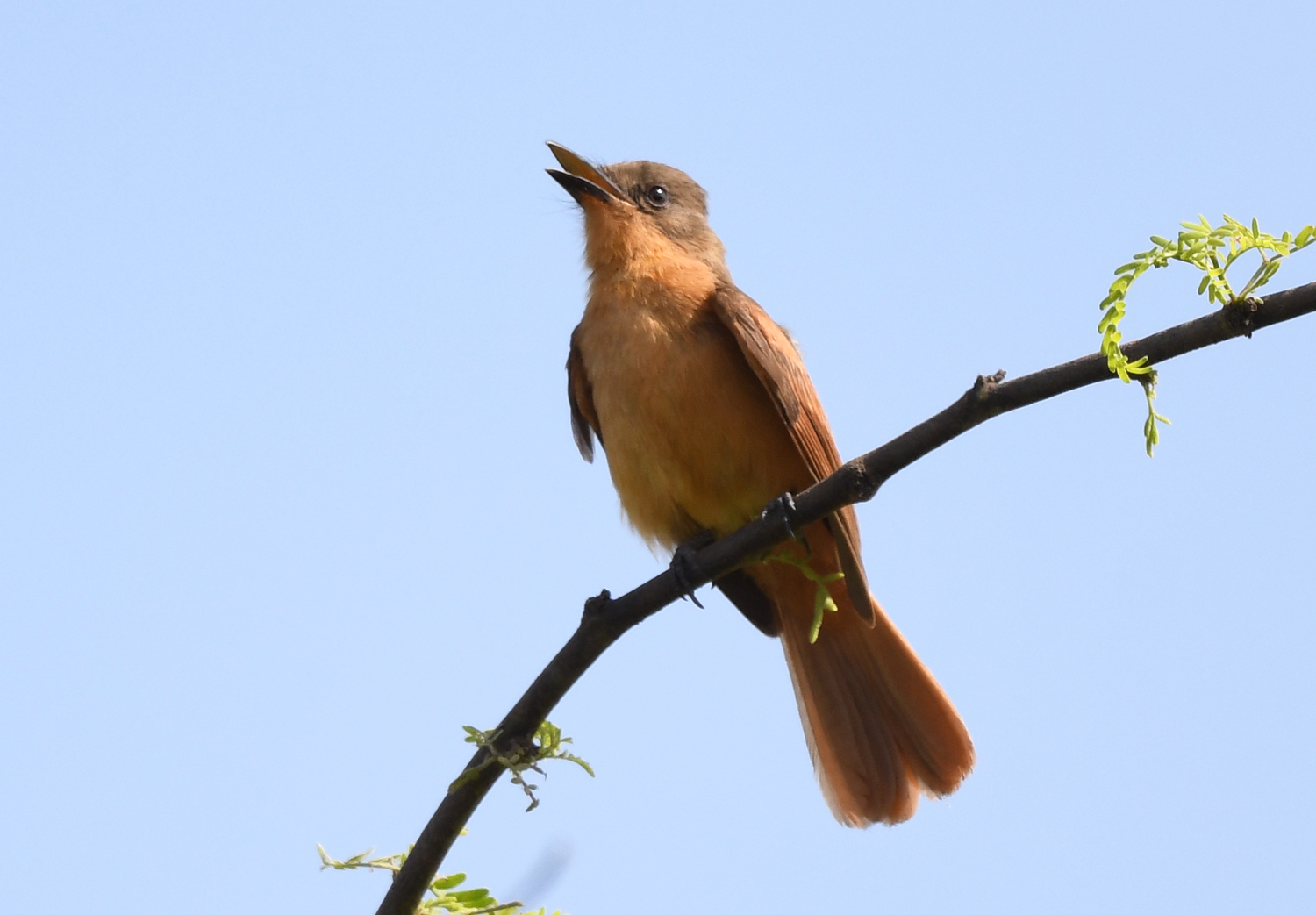
Laura and I still hadn't found any Rufous Flycatchers and the morning was getting quite hot. We switched tactics, heading back to the main road and walking north to where we had seen some larger trees next to an area that seemed popular for dumping garbage. Not the most scenic spot, but we were able to get off the road and away from all the garbage. Almost immediately we found a territorial Rufous Flycatcher. That was easy!
 |
| Rufous Flycatcher - Mocupe area, Lambayeque, Peru |
The Rufous Flycatcher is a member of the genus Myiarchus which includes the familiar Great Crested Flycatcher, a common summer resident where I live in southern Ontario. However, once one moves further south in North America and throughout South America, the diversity of Myiarchus flycatchers increases, and most areas have several species. The problem is that many of the species look frustratingly similar and are best told apart by vocalizations. Laura and I frequently refer to them as "a pain in my archus" (get it?). Luckily, the Rufous Flycatcher bucks that trend and is quite visually distinctive!
 |
| Rufous Flycatcher - Mocupe area, Lambayeque, Peru |
 |
| Rufous Flycatcher - Mocupe area, Lambayeque, Peru |
We found a few other interesting birds in this area, including a Pearl Kite, several Parrot-billed Seedeaters and a Golden-olive Woodpecker.
 |
| Pearl Kite - Mocupe area, Lambayeque, Peru |
 |
| Parrot-billed Seedeater - Mocupe area, Lambayeque, Peru |
A cracking male Peruvian Plantcutter perched down at eye-level, but turned his head right when I pulled the trigger on the photos. Just missed a great shot!
 |
| Peruvian Plantcutter - Mocupe area, Lambayeque, Peru |
We began walking back to the car when suddenly a fox appeared right in front of us! This wasn't any old fox, but a Sechuran Fox, which is a species restricted to the scrubby deserts of southern Ecuador and western Peru. We couldn't believe our luck to have such good looks at one on our first morning of the trip.
 |
| Sechuran Fox (Lycalopex sechurae) - Mocupe area, Lambayeque, Peru |
 |
Sechuran Fox (Lycalopex sechurae) - Mocupe area, Lambayeque, Peru
|
 |
Sechuran Fox (Lycalopex sechurae) - Mocupe area, Lambayeque, Peru
|
The temperatures were really ramping up and we had seen all of our target birds and so we opted for the air conditioning of our vehicle and left Mocupe. We spent the hottest hours of the day driving inland towards the Chaparrí area. The dry forests here are home to a number of different species. While most birders opt for the expensive Chaparrí ecolodge, we skipped this, choosing a place called Eco Camping Racarrumi that had several bungalows for rent. This proved to be a good choice as the cost was a lot less than the ecolodge, and we were surrounded by beautiful dry forest which was full of many birds.
 |
| Birding at Eco Camping Racarrumi, Lambayeque, Peru |
Laura took advantage of the hammock and we birded from the front porch, seeing beautiful species such as Baird's Flycatcher, White-tailed Jay and Golden Grosbeak.
 |
| White-tailed Jay - Eco Camping Racarrumi, Lambayeque, Peru |
 |
| Baird's Flycatcher - Eco Camping Racarrumi, Lambayeque, Peru |
 |
| Golden Grosbeak - Eco Camping Racarrumi, Lambayeque, Peru |
Photographic opportunities with some of the most common species were quite good, as well.
 |
| Long-tailed Mockingbird - Eco Camping Racarrumi, Lambayeque, Peru |
 |
| White-browed Gnatcatcher - Eco Camping Racarrumi, Lambayeque, Peru |
 |
| Saffron Finch - Eco Camping Racarrumi, Lambayeque, Peru |
Laura immediately found the two resident puppies and made quick friends, as she is known to do.
 |
| Making friends - Eco Camping Racarrumi, Lambayeque, Peru |
For the last couple hours of daylight, we drove over to the nearby Reservorio de Tinajones to look for waterbirds in the marshes and landbirds in the dry scrub. The birding here was excellent and I put the scope to good use.
 |
| Reservorio de Tinajones, Lambayeque, Peru |
 |
| Reservorio de Tinajones, Lambayeque, Peru |
Most interesting to us were the large numbers of Comb Ducks. This is a species that we have only seen on a handful of previous occasions, yet there were over 100 individuals here. The males look especially ridiculous with their "combs" on top of their bills.
 |
| Comb Ducks - Reservorio de Tinajones, Lambayeque, Peru |
 |
| Comb Ducks - Reservorio de Tinajones, Lambayeque, Peru |
We found around 50 species in the hour and a half before dusk, including an uncommon Yellow-billed Pintail and a group of four Chilean Flamingo, which is somewhat rare here. Cue the poor quality, digiscoped record shot:
 |
| Chilean Flamingos - Reservorio de Tinajones, Lambayeque, Peru |
While Laura relaxed at a nice viewpoint over the lake, I walked down the road a ways and turned up a photogenic Necklaced Spinetail and, right before dusk, a lifer in the form of a pair of Tumbes Sparrows.
 |
| Necklaced Spinetail - Reservorio de Tinajones, Lambayeque, Peru |
 |
| Tumbes Sparrow - Reservorio de Tinajones, Lambayeque, Peru |
The sunset was vibrant and we watched the sun slink away while the egrets gathered in a nearby tree to roost for the night. We considered staying out for a while after dark to try for Scrub Nightjars, but it had been a long day and we were happy to get back to our bungalow and set up the moth sheet.
 |
| Sunset at Reservorio de Tinajones, Lambayeque, Peru |
The evening was a little breezy, while the vast majority of species that attended the moth sheet were a type of scarab beetle. These two factors limited the moth activity, but we found a few interesting things, anyways.
 |
| Vine Sphinx (Eumorpha vitis) - Eco Camping Racarrumi, Lambayeque, Peru |
 |
| Cotton Stainer Bug (Dysdercus sp.) - Eco Camping Racarrumi, Lambayeque, Peru |
 |
| Peruvian Locust (Schistocerca interrita) - Eco Camping Racarrumi, Lambayeque, Peru |
 |
| Manduca paphus - Eco Camping Racarrumi, Lambayeque, Peru |
This Peters' Leaf-toed Gecko (Phyllodactylus reissii) had set up on the wall next to the sheet. Presumably the hunting conditions were good with the concentration of insects in the area.
 |
| Peters' Leaf-toed Gecko (Phyllodactylus reissii) - Eco Camping Racarrumi, Lambayeque, Peru |
It had been a long day and we were pretty tired, still trying to catch up after our busy travel day. The next day we had plans to drive further up into the mountains in search of White-winged Guans and a whole suite of interesting birds.