Friday, 24 January 2025

A Month In Northern Peru, Part 12: Cleaning Up The Remaining Marañón Endemics (February 14-15, 2024)

February 14, 2024 (continued)

It doesn't matter how much time we spend on the verdant, east slope of the Andes. It is just never enough time. Our five days between the highland town of Pomacochas and the lower foothills near Pueblo Aguas Verdes were amazing, full of incredible bird and wildlife sightings, but we only scratched the surface of what is possible in this incredibly biodiverse corner of the world. Alas, a short trip is never enough time and it is always bittersweet for me whenever I leave the rainy side of the Andes behind. I'm sure it won't be long until we return. 

However, we were also excited to visit the lower Marañón Valley. There were still a handful of Marañon endemics on our wish list, and we began our search for the first one of these along a busy gravel road between Pedro Ruiz Gallo and Shipasbamba. My eBird sleuthing had indicated that we stood a reasonable chance at locating a Marañón Spinetail here, and we did. 

Marañón Spinetail - Road to Shipasbamba, Amazonas, Peru

It wasn't exactly the most serene birding location with the frequent truck and motorbike traffic covering us with dust and blocking out all bird-song. The Marañón Spinetail is perhaps not the most exciting bird species out there, nor is it easy to observe as it skulks in the deepest shadows and densest shrubbery. Still, we were quite happy to find and photograph one, even if my photos are brutal. The Marañón Spinetail is a Critically Endangered species that has declined substantially in recent decades, mainly due to the extensive deforestation occurring in the lower Marañón Valley. 

We returned to the highway and continued to the north, our destination for the night being the bustling city of Jaén. The Marañón Spinetail was one of four target species we had around Jaén; the others were the Marañon Crescentchest, the Little Inca-Finch and the Chinchipe Spinetail. All are endemic to a small portion of the Marañon Valley. 

My eBird sleuthing came through with a win for the second time in the day. I decided to turn off onto a dusty road near Bagua Grande; we had about an hour of light remained before dusk. Perhaps we could knock off one of the three remaining targets before the sun set. 

Bagua Grande area, Amazonas, Peru

We braved the extensive motorbike and truck traffic - it was rush hour after all, and there is no such thing as a quiet dirt road in Latin America. I wasn't optimistic when I played the tape for Marañon Crescentchest, but immediately, one responded!

Laura and I spent the next twenty minutes trying to find a window where the crescentchest wasn't blocked by fifty branches, and we were eventually satisfied with great views of the skulker. It was worth the wait to finally lay eyes of this beautiful species. Of course, I blew my photos...

Marañón Crescentchest - Bagua Grande area, Amazonas, Peru

Feeling lucky, I played the tape for the Little Inca-Finch as well, since the habitat surrounding the road didn't look half bad. Amazingly, we had one respond!

Little Inca-Finch - Bagua Grande area, Amazonas, Peru

A pair of Little Inca-Finches popped up onto the tops of some of the cacti and sang back at us. Laura and I gawked at the birds, while several locals on motorbikes gawked at the strange white people pointing cameras and binoculars up the hillside. You can't blame them - that is a pretty unusual sight here, well off the tourist track. 

Little Inca-Finches - Bagua Grande area, Amazonas, Peru

This was our fifth and final species of Inca-Finch, all of which are endemic to relatively small regions of Peru. As you might infer from its name, the Little Inca-Finch is the smallest of the five species. It prefers arid, cacti-filled areas of the lower Marañón Valley. 

Little Inca-Finch - Bagua Grande area, Amazonas, Peru

Though our afternoon had mainly consisted of a long drive, and the birding sites had been far from picturesque, you couldn't argue with the results! We had connected with three out of the four targets we had for Jaén, including arguably the hardest two. It was after dark when we finally approached Jaén, and we found a roadside hotel in the nearby town of Fila Alta. It was one of the cheapest hotels of the trip and they even had cold beers for sale in the lobby. Perfect. 


February 15, 2024

Our plan for birding around Jaén was a little more relaxed given yesterday's success. We opted for a bit of a sleep in, then a drive across the city to an area called Bosque de Yanahuaca, one of the premier birding sites around Jaén. Our lazy morning meant that it was already 8 AM when we arrived, and the sun was already rather high in the sky. 

Rufous-browed Peppershrike - Bosque de Yanahuanca, Cajamarca, Peru

Most birders opt to explore the actual reserve, which involves coordinating your access with the local caretaker. This ensures the best chance at finding the Little Inca-Finch and Marañón Spinetail, which can be tricky outside of the reserve. We were only on the hunt for the relatively common Chinchipe Spinetail here, and so we just walked one of the gravel roads before the reserve entrance. 

Brown-crested Flycatcher - Bosque de Yanahuanca, Cajamarca, Peru

Despite our late arrival the birding was excellent. We encountered several species new for our Peru lists, including Blue Ground-Dove, Ecuadorian Ground-Dove, Northern Slaty-Antshrike and Brown-crested Flycatcher, pictured above. Tataupa Tinamous were rather vocal, and we enjoyed new trip birds like Red-crested Finch, Drab Seedeater and Rufous-fronted Thornbird. 

Red-crested Finch - Bosque de Yanahuanca, Cajamarca, Peru

Drab Seedeater - Bosque de Yanahuanca, Cajamarca, Peru

I had a chance to remedy yesterday's botched photography attempt of the Marañón Crescentchest. Several were singing from the roadsides and with a bit of effort I was finally able to see one only partially obscured by branches. 

Marañón Crescentchest - Bosque de Yanahuanca, Cajamarca, Peru

The crescentchest family (Melanopareiidae) includes four species in South America. They were originally lumped in the same family as the tapaculos until genetics indicated otherwise. This is one of my favourite bird families. Something about that colour pattern is so striking! Laura and I have now found all four of the crescentchest species, though the Olive-crowned Crescentchest in Brazil was heard-only. 

Marañón Crescentchest - Bosque de Yanahuanca, Cajamarca, Peru

We found our main target, the Chinchipe Spinetail, relatively early on when birdsong was still high, before any worrying thoughts began to creep into our heads. There was a bit of relief that our lie-in and late arrival time didn't cost us this species. 

Chinchipe Spinetail - Bosque de Yanahuanca, Cajamarca, Peru

The Chinchipe Spinetail bears a striking resemblance to the Necklaced Spinetail which we had observed earlier in the trip, except it has no necklace. It used to be considered a subspecies of that species. Like the Necklaced Spinetail, the Chinchipe Spinetail also has an explosive duetting song which pairs make while deep within a thorny bush. Luckily, with some patience, we managed decent views of them. 

Chinchipe Spinetail - Bosque de Yanahuanca, Cajamarca, Peru

Chinchipe Spinetail - Bosque de Yanahuanca, Cajamarca, Peru

Originally, we had tentatively planned for two nights in Jaén but with our success, the extra night wasn't needed. We would put it to good use in the upcoming days, instead. Our visit to Jaén had been brief but it was successful, and we were happy to continue on to the west. 

We aimed to spend the next couple of nights in the city of Olmos, located in the desert north of Chiclayo, and situated near several birding sites including Quebrada El Limón. Before reaching Olmos, we had to cross back over to the west side of the Andes at Abra Porculla. Abra Porculla's claim to fame is that it is the lowest mountain pass where one can cross between the eastern and western slopes of the Andes, anywhere along the Andean chain, from Colombia to Chile!

Birding in the fog - Abra Porculla, Piura, Peru

Our drive throughout the morning had mainly traversed dry, scrubby areas in the Marañon Valley, but as we gained elevation and approached the pass, we were met with lush vegetation and a wall of fog. When we finally reached the pass, the fog was thick enough to seriously hamper our birding efforts. 

Birding in the fog - Abra Porculla, Piura, Peru

We weren't about to let a bit of fog deter us, and five minutes after we had parked we had found one of our targets, the Black-cowled Saltator!

Black-cowled Saltator - Abra Porculla, Piura, Peru

The other species we hoped to find here was the Chapman's Antshrike, as we had already struck out with them earlier in the trip near Casupe. We resolved to spend the rest of the afternoon searching for them. 

Black-and-white Seedeater - Abra Porculla, Piura, Peru

Several Black-and-white Seedeaters were nice to see, as it is a species that we haven't encountered on too many occassions. We also found a little group of Mouse-gray Flycatchers that included a photogenic one. 

Mouse-gray Flycatcher - Abra Porculla, Piura, Peru

The Chapman's Antshrikes stubbornly refused to cooperate and so we pressed on. We stopped on a couple of occasions to observe Gray-chinned Hermits; the subspecies found in this part of the world is sometimes treated as a full species, the Porculla Hermit. 

"Porculla" Gray-chinned Hermit - Abra Porculla, Piura, Peru

At one point, a pair of Chapman's Antshrikes sang from down the slope. Unfortunately, with the thick fog, we were unable to spot them even though they weren't that far from us. Undeterred, we continued along the path with hopes that the next pair would be more cooperative. This tactic worked as less than an hour later we had a Chapman's singing from the upslope side of the road. With some patience and some clever "hide the speaker in the shrubbery" tactics, we coaxed it down into view. 

Chapman's Antshrike - Abra Porculla, Piura, Peru

The Chapman's Antshrike is a small, attractive antshrike that most closely resembles a Barred Antshrike though with some obvious differences. It inhabits Andean slopes in northwestern Peru and southwestern Ecuador. 

Chapman's Antshrike - Abra Porculla, Piura, Peru

We backtracked after we had had our fill of the Chapman's Antshrike, making good time back to the vehicle. We only stopped on a few occasions, such as when we found a group of vocalizing frogs in one of the roadside puddles. This is a species of poison dart frog called the Loja Rocket Frog (Hyloxalus elachyhistus). Like many of the species birds in this region of Peru, the Loja Rocket Frog is endemic to a relatively small region of southern Ecuador and northwestern Peru. 

Loja Rocket Frog (Hyloxalus elachyhistus) - Abra Porculla, Piura, Peru

Happy with our successful venture in the fog, we returned to the vehicle and finished the drive down the slope into Olmos. The fog immediately dissipated as we left the pass behind, and a gorgeous sunset appeared as we neared Olmos. We found an inexpensive hotel and booked two nights. The next post will be about the rest of our explorations in this part of Peru with the rental car. In just a few days time, we would be flying to Iquitos and exploring some sites in the Amazon. 

Tuesday, 21 January 2025

A Month In Northern Peru, Part 11: Fundo Alto Nieva (February 12 - 14, 2024)

February 12, 2024 (continued)

We found an area to park in the little village of Fundo Alto Nieva and completed the short, five-minute walk in to the reserve. This particular site has become famous in recent years as a place where the enigmatic Long-whiskered Owlet can be observed, while it is also home to a few other highly-desirable range-restricted species, such as the Royal Sunangel, Bar-winged Wood-Wren and Cinnamon-breasted Tody-Tyrant. Though staying at Fundo Alto Neiva is not exactly inexpensive, it is a lot more affordable than the Owlet Lodge which is the only other place where birders have traditionally searched for the owlet. 

Laura and I had coordinated our visit ahead of time with Carlos Calle Quispe, a local birder who arranges visits here. We were met at the reserve by Wilmer Montenegro who would be our guide here, as well as his family. Wilmer was easy-going, friendly and knew his birds very well, and we really enjoyed our time here at the reserve. He spoke nice and slowly which made it easier for Laura and I to understand his Spanish. 

Royal Sunangel - Fundo Alto Nieva, Amazonas, Peru

The facilities at Fundo Alto Nieva are basic but functional. The cabin in which we stayed was comfortable and included everything we needed, including a hot shower and mosquito netting around the beds. The electricity was turned on whenever we returned from the field, and internet was available each evening in the dining hall building. 

Our main priority was to search for the Long-whiskered Owlet and we figured that we had a reasonable shot at this species in our two nights here. That first evening, Wilmer took us along a trail that heads up into good quality forest. The bird song was quiet on the walk in; only Andean Thrushes and Spotted Barbtails had their voices pierce through the din of the bubbling creek and cicadas. I had been keeping an eye on the developing clouds throughout the afternoon and luck was on our side as the rain was holding off, for now. As dusk approached, anticipation was high. Finally, at 6:44 PM, a muffled hoot announced the presence of an owlet! Minutes later and I spotted the culprit tucked in on a mossy branch. I made sure to fire off a bunch of photos and it was a personal milestone bird; my 4000th species photographed.  

Long-whiskered Owlet - Fundo Alto Nieva, Amazonas, Peru

We watched the Long-whiskered Owlet for a few minutes until it flew off into the night. This bizarre little owl with long facial whiskers was discovered by LSU researchers in 1976 when they mist-netted one, but it remained an enigma until the early 2000s. In recent years, more individuals have been found and now it can be seen somewhat regularly in the Abra Patricia area. Wilmer keeps tabs on a couple individuals in the cloud forests here at Fundo Alto Nieva. 

Oressinoma typhla - Fundo Alto Nieva, Amazonas, Peru

My excitement over seeing the owlet was only matched by my relief, especially since the rains began soon after we observed it. Rain is not uncommon here and there was a chance that we would be rained out both nights. Luck was on our side.


February 13, 2024

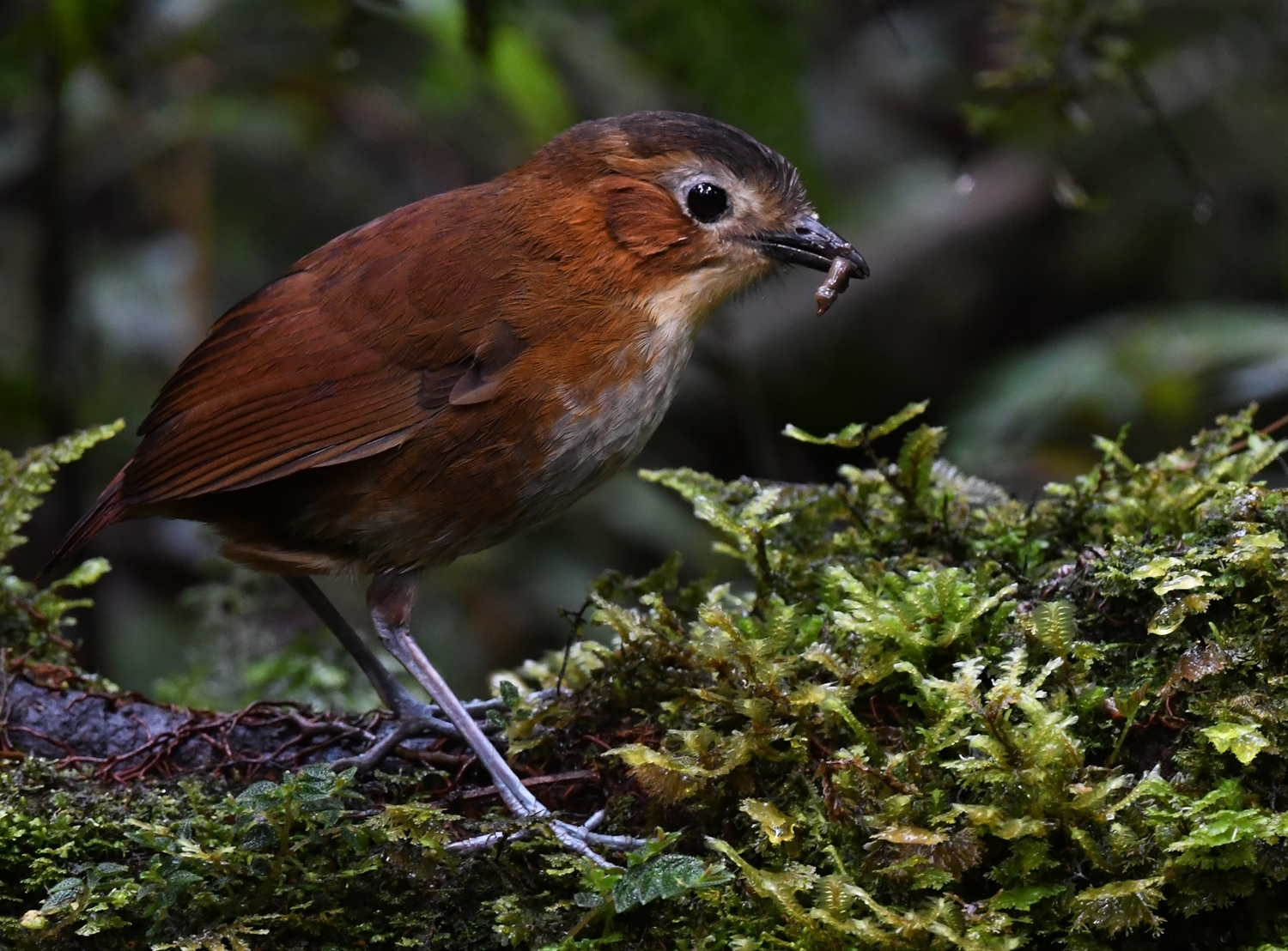
The rains continued through the night and by dawn, it was still spitting out. Regardless, we met up with Wilmer to walk into the forest and to search for two species of antpittas. Putting our umbrellas to good use, we set up at the first spot where the Rusty-tinged Antpitta is regularly fed worms. We didn't have to wait long as it was eager to get its breakfast.

Rusty-tinged Antpitta - Fundo Alto Nieva, Amazonas, Peru

We then moved down the trail to the area where the Ochre-fronted Antpittas are fed. Unfortunately, despite our best efforts, the Ochre-fronted remained heard-only. We tried at another area but were skunked there, too. Such is birding. 

We walked back towards the cabins as there was a slight gap in the weather. We tried playing tapes for the Bar-winged Wood-Wren and Cinnamon-vented Tody-Tyrant in the stunted forest, but nothing responded. At least the break in the weather meant that we could find a few species, even if they weren't our main targets. 

Mottle-cheeked Tyrannulet - Fundo Alto Nieva, Amazonas, Peru

Peruvian Racket-tail - Fundo Alto Nieva, Amazonas, Peru

However, the rains soon returned with greater urgency. Birding was hopeless in these conditions and so Laura and I retreated to our cabin to catch up on some sleep. It wasn't until the early afternoon that the rain abated and we could leave the cabin again. The rest was well-needed, anyways.

Forest trails at Fundo Alto Nieva, Amazonas, Peru

Though we were frustrated that we had lost most of our only full day here to poor weather, we weren't going to let that stop us. Laura and I checked in with Wilmer and he was cool with us birding the trails on our own, and so we headed out. As nice as it had been to catch up on sleep, it felt great to be back in a beautiful forest and not cooped up in a cabin.

Forest trails at Fundo Alto Nieva, Amazonas, Peru

Unidentified - Fundo Alto Nieva, Amazonas, Peru

During periods where the birding was slow, I focused on the abundance of bright, colourful plants including a nice variety of orchids. 

Trichopilia sp. - Fundo Alto Nieva, Amazonas, Peru

Epidendrum nocturnum - Fundo Alto Nieva, Amazonas, Peru

Maxillaria amesiana - Fundo Alto Nieva, Amazonas, Peru

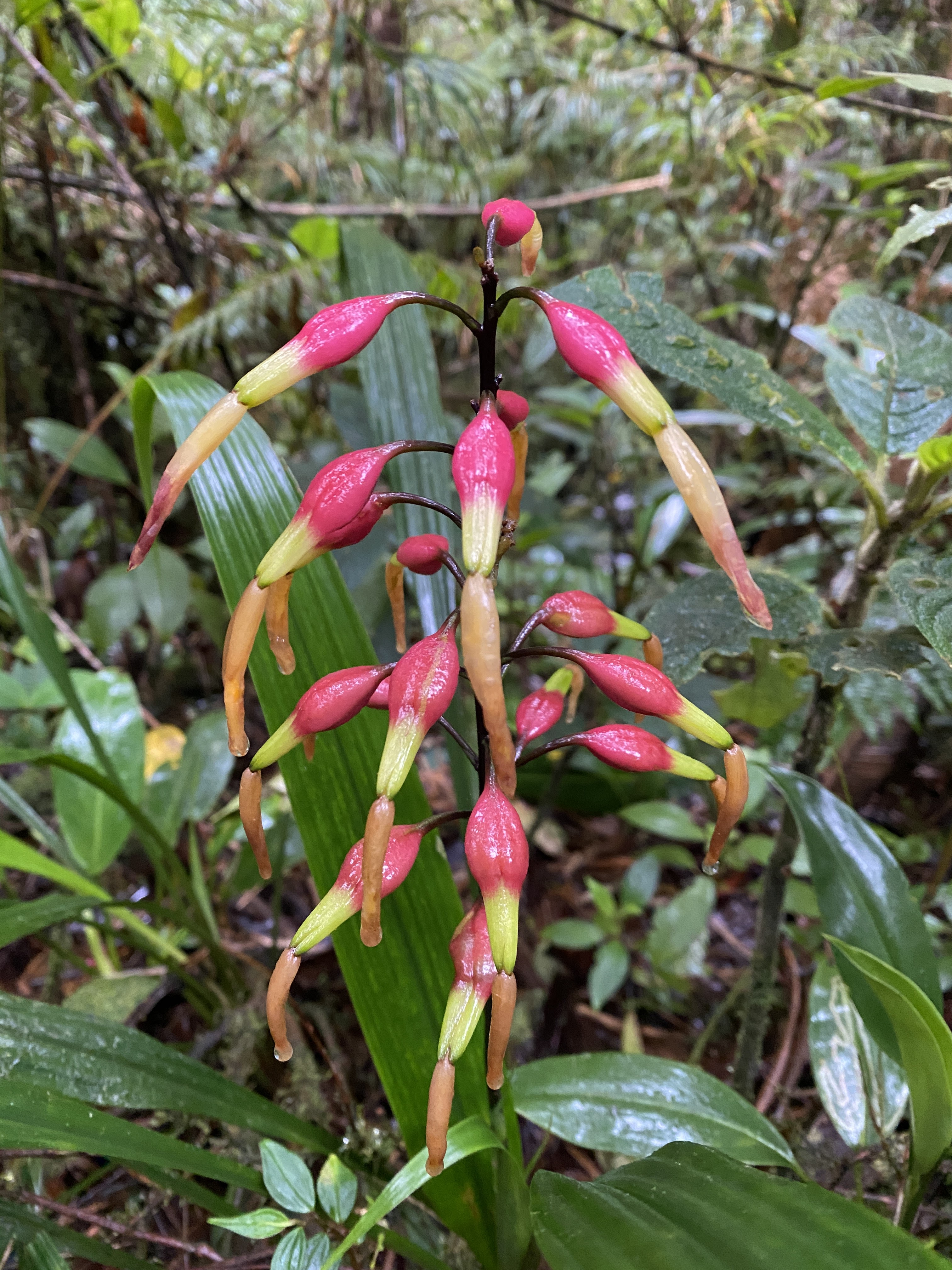
Ronnbergia veitchii

A smooth, linear, silvery-blue shape caught my eye in a flooded section of the trail. A caecilian!


Caecilians are poorly-known amphibians that spend most of their lives underground. They belong to the order Gymnophiona, one of three orders of amphibians along with Caudata (salamanders) and Anura (frogs and toads). Due to their fossorial habits they are rarely seen at the surface, and so much remains unknown about their ecology and diversity. This was only the fourth caecilian that I had seen in the wild. 


Like all amphibians, caecilians have semipermeable skin that is susceptible to toxins. Laura and I did not have any sunscreen or bug repellent on our hands, and we also made sure to keep our hands wet when we picked it up. 

Caecilians have shovel-shaped snouts and almost non-existent eyes, both being adaptations to a life underground. They eat mainly insect larvae and earthworms, with rows of sharp teeth helping to control their prey. 

Caecilia sp. - Fundo Alto Nieva, Amazonas, Peru

Laura and I certainly had a little extra pep in our step after the caecilian success. And our day seemed to have turned around. The birds became more active and we quickly succeeded with two of our main target species, the Bar-winged Wood-Wren and the Cinnamon-breasted Tody-Tyrant. Both of these birds inhabit stunted cloud forest on the east slope of the Andes; the same habitat and elevation preferred by the Long-whiskered Owlet. Unfortunately, the tody-tyrant slipped away before we could obtain proper views and photos. 

Bar-winged Wood-Wren - Fundo Alto Nieva, Amazonas, Peru

Bar-winged Wood-Wren - Fundo Alto Nieva, Amazonas, Peru

Next on the agenda was another stake-out of the hummingbird feeders, located a short walk from the cabins. Royal Sunangels come to the feeders at certain times of the year and we were hopeful, since some photographers had photographed a male here two days earlier. Our previous visits to the hummingbird feeders had not been successful, but the third time was the charm!

Royal Sunangel - Fundo Alto Nieva, Amazonas, Peru

We were treated to amazing encounters with both the male (above) and female (below) Royal Sunangel. What a gorgeous species.

Royal Sunangel - Fundo Alto Nieva, Amazonas, Peru

We reconvened with Wilmer and informed him of our success so far. Since we wanted to improve on our tody-tyrant experience, he took us back along the trail to try once again. This time, we were in luck and we enjoyed unobstructed views of one for a little bit, until it shot off into the dense understory, never to the seen again. 

Cinnamon-vented Tody-Tyrant - Fundo Alto Nieva, Amazonas, Peru

That evening, after setting up my moth trap beside the cabin, I set off with Laura and Wilmer into the forest. Our target species this evening was the Cinnamon Screech-Owl, another montane species that would be a lifer for Laura (I had heard this species previously in Colombia). Unfortunately, despite the good listening conditions, we struck out. 

Our walk was still productive as we found a few interesting insects, frogs and even an unidentified rodent. I did not have my macro lens with me so you will have to excuse the photo quality.  

Neotropical Leaf Katydid sp. - Fundo Alto Nieva, Amazonas, Peru

Unidentified treefrog - Fundo Alto Nieva, Amazonas, Peru

Unidentified rodent - Fundo Alto Nieva, Amazonas, Peru

Laura and I slept well and awoke to a beautiful morning. It was still rather overcast, but at least there was no rain! We joined Wilmer for another antpitta hunt as the Ochre-fronted still eluded us. 

Rusty-tinged Antpitta - Fundo Alto Nieva, Amazonas, Peru

Once again, the Rusty-fronted eagerly bounced onto its log to slurp up a few worms. But the Ochre-fronted did not; we didn't even hear it vocalize this time. 

Rusty-tinged Antpitta - Fundo Alto Nieva, Amazonas, Peru

We headed back to the cabins to pack up and leave Fundo Alto Nieva behind. One last surprise was waiting for us; a massive Hercules beetle! This particular species is Dynastes lichyi, a species limited to the Andes. 

Dynastes lichyi - Fundo Alto Nieva, Amazonas, Peru

Hercules beetles are the longest beetles in the world, and one of the largest flying insects. Neither Laura nor I had seen one before. 

Dynastes lichyi - Fundo Alto Nieva, Amazonas, Peru

Despite the heavy rain, our visit was a success and we loved our stay at Fundo Alto Nieva. We will just have to return one day for the Ochre-fronted Antpitta. 

But before I finish this post, I wanted to touch on the moths at Fundo Alto Nieva. On both nights, I set up my moth trap under the overhang of one of the cabins (in case of rain). During the second night, I had enough battery power to keep the light on all night.

Moth mayhem - Fundo Alto Nieva, Amazonas, Peru

Rainy, mountainous areas always seem to produce the best mothing conditions and so I had high hopes for Fundo Alto Nieva. But the results blew me away - it was insane how many moths appeared! So many of them were fancy silkworm moths and sphinxes as well. 

Bathyphlebia sp. - Fundo Alto Nieva, Amazonas, Peru

Below are a smattering of my favourite images over the course of the two nights. Easily the best mothing of the trip...

Mesothen nomia - Fundo Alto Nieva, Amazonas, Peru

Amaxia pulchra - Fundo Alto Nieva, Amazonas, Peru

Neidalia villacresi - Fundo Alto Nieva, Amazonas, Peru

Poecilochlora minor - Fundo Alto Nieva, Amazonas, Peru

Unidentified leafhopper (tribe Cicadellini) - Fundo Alto Nieva, Amazonas, Peru

Trosia roseipuncta - Fundo Alto Nieva, Amazonas, Peru

Automeris sp. - Fundo Alto Nieva, Amazonas, Peru

Epia vulnerata - Fundo Alto Nieva, Amazonas, Peru

Sisyracera sp. - Fundo Alto Nieva, Amazonas, Peru

Tricentra amibomena - Fundo Alto Nieva, Amazonas, Peru

Cisthene intacta - Fundo Alto Nieva, Amazonas, Peru

Phrictus xanthopterus - Fundo Alto Nieva, Amazonas, Peru

Miresa clarissa - Fundo Alto Nieva, Amazonas, Peru

Idalus herois - Fundo Alto Nieva, Amazonas, Peru

Glyphodes grandisalis - Fundo Alto Nieva, Amazonas, Peru

Herbita zarina - Fundo Alto Nieva, Amazonas, Peru

Desmoloma styracis - Fundo Alto Nieva, Amazonas, Peru

Xylophanes pyrrhus - Fundo Alto Nieva, Amazonas, Peru

Meragisa nicolasi - Fundo Alto Nieva, Amazonas, Peru

Psilacron luteovireons - Fundo Alto Nieva, Amazonas, Peru

Pantherodes sp. - Fundo Alto Nieva, Amazonas, Peru

Eumorpha fasciatus - Fundo Alto Nieva, Amazonas, Peru

Rachesa nisa - Fundo Alto Nieva, Amazonas, Peru

Marialma magicaria - Fundo Alto Nieva, Amazonas, Peru