Showing posts with label Red Phalarope. Show all posts

Saturday, 22 October 2011

October 22 - Port Stanley and area

Today, a large group of us from the University of Guelph wildlife club headed down to Port Stanley to spend a day at the hawkwatch.

As soon as we arrived it was obvious that there were large numbers of passerines. Among the highlights were 5 species of woodpeckers (including Pileated), Blue-headed Vireo, Fox Sparrows, and 5 species of warblers including 5 Orange-crowned and 1 Tennessee.

Orange-crowned Warbler - Hawk Cliff

After about an hour, the raptors really started moving and it was obvious that there would be a huge Turkey Vulture migration. Here is one fine individual:

Turkey Vulture - Hawk Cliff

Here is a huge TV next to a tiny Sharp-shinned Hawk (or a "shin" as the grizzled veteran hawkwatchers call them)

Turkey Vulture and Sharp-shinned Hawk - Hawk Cliff


I was happy to spot a two Common Loons circling high overhead. Not a species that I was expecting to see!

Common Loon - Hawk Cliff

Eventually, an eagle passed over, way overhead. Based on its proportions and its underwing pattern, we determined it was a Golden. The only one we saw today, though the official counters tallied several more throughout the day.

Golden Eagle - Hawk Cliff

Here is a normal Baldy for comparison. The head of Bald Eagles sticks out much farther than for Golden Eagles, especially when they are in a "tuck" such as the above Golden Eagle.

Bald Eagle - Hawk Cliff

There were quite a few Accipiters, flying over high and low. Among the many Sharpies, we picked out a few Cooper's Hawks.

Cooper`s Hawk - Hawk Cliff

The third species of Accipiter (Northern Goshawk) finally made an appearance in the mid afternoon. It was a juvenile bird and, despite the (lack of) quality photo, it passed over quite close and I had fantastic views in the scope. This was only the second Goshawk I have seen this year.

Northern Goshawk - Hawk Cliff

Turkey Vultures kept streaming over all day, and by the time we left the official counters had counted over 8,000 of them, smashing the all time high for one day! This is just an example of what the skies were filled with all day. If you squint, you can see hundreds of TVs.

Turkey Vultures - Hawk Cliff


After leaving the hawkwatch (Turkey Vultures were still streaming overhead), we headed down to the town of Port Stanley to check a few spots. I was hoping that after the strong west winds over the weekend, followed by the strong east winds on Wednesday, that something decent would be at the harbour. As I was scanning the east pier, I noticed a phalarope swimming close to the pier. After getting Andy's scope (mine did not have a zoom lens), we were able to determine it was a Red Phalarope. The bird was in basic plumage and had an unstreaked, grey back, relatively thick bill, and completely white underwing. I was pretty stoked as this was my first one that I have seen in Ontario. Here is the best photo I got (as you can see, all the photos in this post are Nat. Geo quality).

Red Phalarope - Port Stanley harbour

We quickly checked out the lagoons (scoring about 6 species of ducks, some Bonaparte's Gulls, a Horned Grebe, and about 8 Greater Yellowlegs), then headed on home. Not a bad day!!!

What a day

Just got in the door after an awesome day of birding in the Port Stanley area. I am short on time - full writeup coming tomorrow. Anyways the highlights included a Golden Eagle, a Northern Goshawk, and the all time single day record for Turkey Vultures at Hawk Cliff. The day ended with finding a Red Phalarope at the harbour. This was a new Ontario bird for me (#330). Quick photo:

Red Phalarope - Port Stanley (photo by Andrew Keaveney)

Thursday, 8 September 2011

More from the maritimes

My next post will detail my first day back in Ontario, which I spent at Van Wagner's Beach in Hamilton. But until now, here is the full account of the rest of my birding adventures in "Canada's Ocean Playground".

As I mentioned, the day in Brier Island was a success. All said and done, I finished with 4 life birds as well as great looks at other seabirds.

Laura and I drove from our bed and breakfast in Digby down to Brier Island, arriving at around 9:00 AM. Since our whale-watching trip wasn't scheduled to depart for another 3 hours, we drove to the north end of the island to check out a good spot for 2 species of seals.

Laura checking out the seals - Brier Island, Nova Scotia
Common Eiders - Brier Island, Nova Scotia

We did see both species but my photos are kind of crappy so I'll spare you.... I did however photograph some Common Eiders and I saw a Great Cormorant, some Black Guillemots, and a few common shorebirds. The entire time, chip notes from Wilson's Warblers and the calls of Eastern Phoebes could be heard in the shrubby area behind us.

I stopped briefly to photograph this fritillary (ID forthcoming once I check my resources)


Laura and I made our way onto the ferry and actually ran into the couple from B.C. that we had met earlier in the week with Blake Maybank in Cow Bay. Small world!
The pelagic trip started somewhat slow, but before long we were swimming in phalaropes. Red was the most numerous by far, and by the end of the trip we estimated that we had seen well over 10,000! What a way to get a life bird.

Red Phalaropes - Bay of Fundy

Despite their abundance, it was hard to get passable photos due to their small size and our continuous rocking on the water. An extra 100mm on my lens would certainly help!

Not long after, we were buzzed by the first of many Great Shearwaters. My only previous sighting was a poor look at a single bird 2 years prior near Lunenburg, Nova Scotia. It was great to study the intricacies of their plumages.

Great Shearwater - Bay of Fundy

Somewhat spotted some whales off in the distance, and I quickly fired off a couple photos of what would turn out to be our only Fin Whales for the day.

Fin Whale - Bay of Fundy

As the day wore on, a few more pelagic species showed up, as well as some that aren't pelagic. I saw a single adult Pomarine Jaeger, 2 Sooty Shearwaters, and many Wilson's Storm-petrels. In addition, a Ruby-throated Hummingbird and Pectoral Sandpiper made brief visits to the boat.

Wilson's Storm-petrel - Bay of Fundy

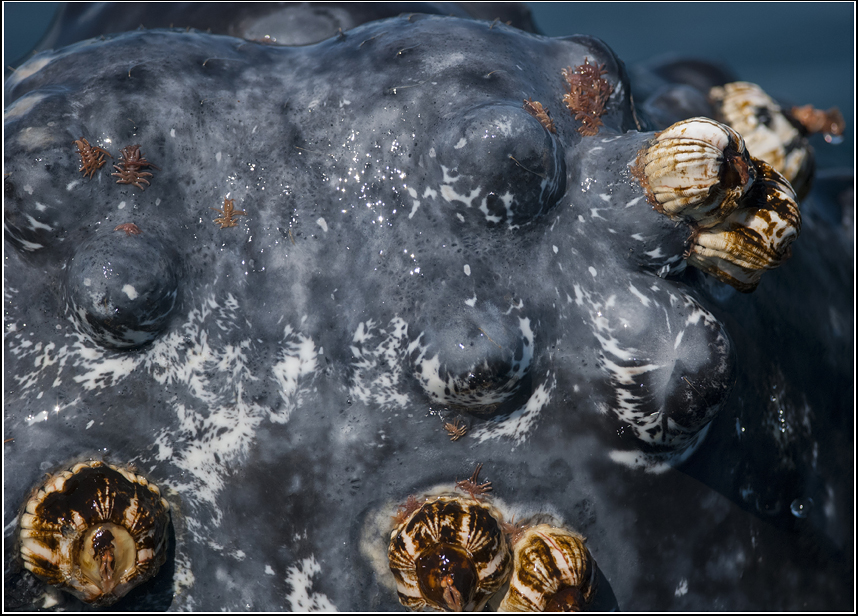
Not long after, we came across a mother and calf Humpback Whale that had been known to be in the area for some time. We were all treated to a great show, as the calf swam up to the boat and lifted its head out of the water. I was limited photographically because I only had my 300 mm lens, so I tried a couple close-ups of the barnacles. The whales stayed with the boat for the better part of an hour.

Humpback Whale barnacles - Bay of Fundy

My highlight came as we were watching the whales. One of the birders on the trip (Elizabeth Doull) alerted me to a Northern Fulmar whizzing past. This was a target species for me, though I didn't expect to get such good looks at one! It also hung around the boat, hoping for a handout, for quite some time.

Northern Fulmar - Bay of Fundy

Northern Fulmar - Bay of Fundy

Our last new seabird for the trip were a few small groups of Atlantic Puffins. Despite missing Manx Shearwater, South Polar Skua (seen a few days prior), and Leach's Storm-petrel, we did quite well with pelagic birds.

Atlantic Puffins - Bay of Fundy