Showing posts with label rarities. Show all posts

Monday, 16 April 2012

Report from April 15

Yesterday afternoon, after coming out of my second last exam of my undergrad, I checked my phone and saw that I had similar texts from 3 or 4 different people....all along the lines of "So are you gonna chase it?" I checked my email and saw that Terry Sprague had posted a Scissor-tailed Flycatcher that was present in Prince Edward County! This was kind of frustrating for me because I was supposed to be hosting a party that night, and I hadn't really planned to be away for the entire day on Sunday since I had my last exam on Wednesday morning. Brett let me know that evening at the party that he would be picking me up at 6 the next morning (I had no choice), so I guess that was settled.

I cursed a fair bit when the alarm went off the next morning, but Brett showed up on time and we were on our way! We arrived at the residence near Demorestville and the friendly homeowner informed us that it was last seen near the fence of the large field south of her house. She gave us permission to walk around back there, we promised not to sue her if we broke our ankles, and off we went. After 15 minutes or so I walked towards the back of the field, when I was surprised to look up and see this...

Scissor-tailed Flycatcher - Demorestville, ON

I called Brett over and we had excellent looks at the male Scissor-tailed Flycatcher as it hunted bees, flies, and grasshoppers. At times it flew over us, once only about 5 feet over our heads!

Scissor-tailed Flycatcher - Demorestville, ON

As of the 2009 OBRC report, there were 56 accepted records of Scissor-tailed Flycatcher for Ontario. 32 of these records were from late April through June, with most of the other records coming in October. Other than the Scissor-tailed in Thunder Bay on April 10 of this year, this is the earliest spring record for Ontario (April 14), surpassing the next earliest date of April 29, from Iroquois Falls in the Cochrane District. It is not that surprising that one would show up since we have had very strong south winds coming all the way up from Texas in the last few days.

Scissor-tailed Flycatcher - Demorestville, ON

This appears to be a male in alternate (breeding) plumage, due to the very long tail, red in the underwing, and notch on P10. What a stunning bird!

Scissor-tailed Flycatcher - Demorestville, ON

We also heard and saw a Brown Thrasher here, year bird #177 for me. After spending an hour and a half with this bird Brett and I continued on. We decided to check out Thickson's Woods in Whitby hoping that a large amount of migrants had dropped in due to the strong south winds and foggy conditions this morning. We were in luck as dozens of kinglets (both species), Brown Creepers, and Yellow-rumped Warblers were present. I grabbed a few crappy shots of a Ruby-crowned Kinglet, the first one I've photographed this year. Hopefully I can get a better shot to replace this one later this spring.

Ruby-crowned Kinglet - Thickson's Woods, ON

I added three new year birds at Thickson's - 4 vocal Pine Warblers, a Blue-gray Gnatcatcher buzzing in the shrubby field just north of the paved trail, and 2 House Wrens along the paved trail.

We continued on to the Whitby Mental Health Centre where two male Harlequin Ducks had been reported on the lake, as well as a single Brant. I already had both of these for the year, but my Harlequins were in the middle of the Niagara River, and since I'm not entirely sure where the Ontario/New York border is, there was the possibility that I had actually seen them in New York waters. Despite the heavy fog, the 2 harli ducks were easy to pick out close to shore! The Brant was nowhere to be seen, unfortunately. With a bit of post-processing I was able to eliminate most of the fogginess out of the photos.

Harlequin Duck - Whitby, ON

Brett and I then drove up north of Uxbridge to the town of Udora. The previous evening I had received an email from a lady from Udora who had seen a Swallow-tailed Kite gliding over a field here. She wasn't sure if it was possible for one to be in Ontario (which is why she emailed me) but her description was spot on and I'm sure that's what she saw! We met up with her and along with her two kids we checked out the field where they had seen the kite. As Brett and I expected we were unable to find it. More than half of the Swallow-tailed Kites in Ontario, of which there are 15 accepted records, are single day observations of birds flying overhead. They don't tend to hang around very long!  Regardless, it was a great area to explore and we had a few interesting sightings including a large flock of 40+ White-winged Crossbills, pretty good for this late in the season.

We slowly made our way back to Guelph, stopping at a decent looking marsh along Ravenshoe Road just east of Woodbine along the way. There were close to 200 ducks here of which the majority were Green-winged Teal. Most took off as we set up our scopes, so we were unable to pick out any vagrant Eurasian Green-winged Teals with the group. Several shorebirds were also present and I added Lesser Yellowlegs (#181) to the year list.

It was a great day in the field! Scissor-tailed Flycatcher is a code-4 species in Ontario and makes the 10th bird I have seen this year that is a code 4 or higher. Like I have mentioned previously, I will need to see about 20 of these super-rarities this year to have a chance at breaking the record, so I'm halfway there. It is an exciting time of year, and it will only get better as the month goes on!

Sunday, 15 April 2012

Scissor-tailed!

Almost as if on cue, I got my Scissor-tailed Flycatcher! I'm pretty sure Brandon predicted this one...

I'm going to make this post short since I'm working on 3 hours of sleep. I didn't get to bed til about 2:30 last night (hosting a party) and up at 5:30 this morning...full report from today coming tomorrow!

In short, Brett and I chased a Scissor-tailed Flycatcher in Prince Edward County this morning and were succesful after about 15 minutes of searching. We managed to get a ton of killer shots...here is an early edit.

Scissor-tailed Flycatcher - Demorestville

I added 6 more year birds today - the flycatcher, as well as Brown Thrasher, Pine Warbler, Blue-gray Gnatcatcher, House Wren, and Lesser Yellowlegs. It was a great day in the field, and I'm now up to 181 for the year!

Sunday, 1 April 2012

"EAGR"ly kicking off the month

I headed down to Long Point today with Brett, Barb Charlton, and Georg Hentsch. We didn't have any specific targets in mind, and we hoped to just bird the area. It was nice to do this for a change, as opposed to driving far away to "chase" a certain bird. The forecast called for intermittent showers, but we managed to stay dry for most of the day! At our first stop, Turkey Point, we scoped out some Little Gulls way out on the lake.

Scoping for LIGUs - Turkey Point

A few stops later, we ended up at the BSC headquarters. ALL the Tree Swallows were evidently back and checking out the nest boxes. This little guy wasn't too eager to move...

Tree Swallow - Long Point

There are a few belligerent cows in the Long Point area.

mooooooo

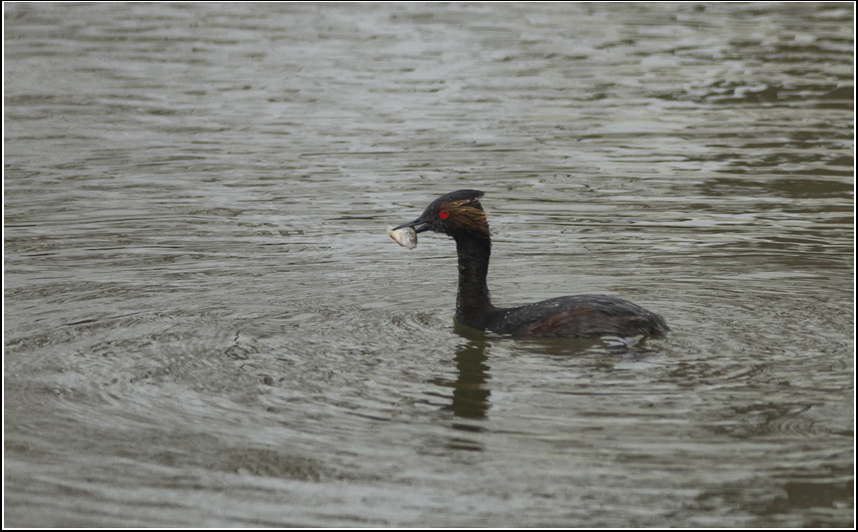
An unexpected surprise came as we stopped by at the viewing platform near the marina along the causeway to stop and chat with Ron Ridout, who was scoping the ducks on the bay. As we were about to leave, I took a look at a small black bird swimming in the channel (Brett had mentioned something about a coot there). Needless to say I was surprised when the "coot" turned out to be an Eared Grebe, in near breeding plumage! The rest of the day, anytime Brett saw a coot, we all double-checked ;)

Eared Grebe - Long Point

Despite Eared Grebes being labeled as a code-3 species in Ontario (uncommon but annual), I've had an abnormal amount of luck with this species, finding 5 individuals over the last 3 springs. On the other hand, I've only ever seen 2 Olive-sided Flycatchers, a species that migrates through southern Ontario regularly.By the way, for those who don't know, EAGR (from the title of this post) refers to the unique four-letter code that is used for every North American species.

Eared Grebe - Long Point

This was a year bird for all of us and we spent a bit of time taking photos of it diving for fish about 20 feet away. It was Ron's second for the Long Point birding area.

Eared Grebe catching a fish - Long Point

Spurred on by that success we headed over to Old Cut and then went for a walk in the Provincial Park. There were decent numbers of the typical spring migrants, including Fox Sparrows, Winter Wrens, both kinglets, Eastern Phoebes, and Brown Creepers. This banded individual thought he'd give the nets another shot.

Brown Creeper - Long Point

We all got our first Yellow-bellied Sapsuckers of the year, but the photos leave something to desire! Several Mockers were in the park.

Northern Mockingbird - Long Point

It's good to see these signs around. We need more of these around Ontario!


We ran into a large group of birders from London doing their annual Long Point trip, led by the Platts. They had missed the Eared Grebe, so we promised to let them know if we saw it on our way out. Surprisingly, the cute little bugger was still diving around, going after fish! Their group was able to view it, with many getting good photos.

Eared Grebe - one last time

After a few more relatively unproductive stops in the Long Point area and the Townsend lagoons, we headed back home. The Eared Grebe and Yellow-bellied Sapsucker bring my year list up to 169.

Sunday, 11 March 2012

A wild Smew chase, part 3 (a.k.a.: third time's the charm)

The title pretty much sums it up! After the Varied Thrush and Eurasian Wigeon success yesterday I raced back to Guelph last night. Since I had had a combined 7 hours of sleep during the previous 2 nights, I squashed my original plan of driving straight to Long Point and sleeping in my car once I got there, since I'm pretty sure I would fallen asleep en route.
Five hours after arriving in Guelph, I was on the road again to Long Point. As opposed to Friday, with sub-zero temperatures and gale-force winds as well as snow, today was sunny and calm.

I arrived at my preferred destination - the marina along the causeway - and set up shop hoping the Smew would come by. I was hopeful since it had been seen at this time the last 2 mornings. At 8:03 AM something scared all the ducks out of the bay. I scanned them with my binoculars and picked out one that looked exactly like my target bird! It had a white head with a small amount of black on the face, a white neck, a striking white and black back, and black wings with a large white window - the adult male Smew! It was flying with 5 or 6 Common Mergansers, which eventually joined up with the large swirling mass of scaup, Canvasback, wigeon, Redhead, and Bufflehead. The birds turned and headed away from me. It appeared that the Smew had landed way out in the middle of the bay, on the east side of a large cattail "island". Excitedly I called Brett and a few others - apparently no one else saw the bird in the swirling mass of ducks. I spent the next little while scanning the ducks with Barb Charlton, Rob Dobos, and Ron Ridout to no avail. We did get a flyby Snowy Owl (just about took out Brett, Dave, and Reuven!) and Eastern Meadowlark, a singing Eastern Towhee, as well as a White-winged Scoter, rare for this part of Long Point.

After that excitement and being thoroughly sick of ducks and waterfowl in general, I decided to take it easy and go for a stroll through the provincial park.

It was pretty quiet (except for the thousands of blackbirds) but I did come across a few flocks of American Tree and Song Sparrows with my first-of-year Fox Sparrows mixed in. 2 Common Redpolls flew over and close to 10 Killdeers were making a racket.

Common Grackle - Long Point

Song Sparrow - Long Point

I also photographed a few other common species that I had neglected to so far, giving me 86 total species photographed this year in Ontario. If I'm lucky I may reach 300. As you can see from the next photo, it doesn't have to be good quality to count!

Fox Sparrow - Long Point (take my word for it)

 Red-winged Blackbirds may be common, but they sure as heck are a good-looking bird and it takes me most of the spring before I'm sick of them. :)

Singing male Red-winged Blackbird - Long Point

After I was done in the park I sauntered over to Big Creek to spend a bit of time. The ducks were quite numerous - I counted over 800 Northern Pintails and 1200 Mallards, among other species.

Big Creek - Norfolk Co.

Northern Pintails - Big Creek

A meadowlark was flying around and I was happy to see my first Savannah Sparrow for the year here as well. Extremely early migrant? It was my earliest Sav for Ontario by nearly 3 weeks.

Savannah Sparrow - Big Creek

What's a trip to Long Point in the spring without Sandhill Cranes? Their bugling call is one of my favorite sounds of the early spring and Sandhill Crane is one of my favorite species that can be found in Ontario.

Sandhill Cranes - Long Point

Sandhill Cranes - Long Point

Sandhill Cranes - Long Point

It was a beautiful day in the field and I added 5 more year birds including my first code 6 of the year - the Smew. The other four year birds were Eastern Meadowlark, Eastern Towhee, Fox Sparrow, and Savannah Sparrow. Time to go to bed!

Saturday, 10 March 2012

Wigeon surprise

It seems every time I sit down to catch up on schoolwork and study for midterms, something more important comes up to make me abandon those plans. This time, I had just started to dig into some pathology at my sister's place in Kingston when I checked eBird and saw that a Eurasian Wigeon had been reported by Martin Roncetti at noon just north of Kingston.

I was there in 20 minutes and located the bird without much trouble. The bird was relatively close and I was able to get several IDable shots. It spent some time attempting to court a female American Wigeon, though its partner, a male American Wigeon, would have none of that.

Eurasian Wigeon - north of Kingston, ON

This was the last species of regular waterfowl I needed. The next most common waterfowl species I am missing is Common Eider.

Eurasian Wigeon - north of Kingston, ON
Cheers!

Persistence pays off

Seriously attempting a Big Year can be more about persistence then anything else. You could have all the money in the world, but unless you are willing to go back time and time again after missing a bird, you won't do as well as you hope. John Vanderpoel showed a lot of persistence last year when he attempted his North American wide Big Year. Half a dozen trips to Alaska are a good example, but the one I liked particularly was his Greylag Goose story. Essentially, a wild Greylag Goose showed up near Montreal, so he traveled there and spent 2 days scanning through "regular" geese unsuccessfully. Eventually he had to return home, but mustered up the energy to travel back to Montreal to spend another 2 days looking for "the plainest goose in the world" (as he puts it). He eventually got it.

I had already missed the Varied Thrush in Ottawa twice. Once, on January 10, I headed east with Andrew Keaveney and spent a good chunk of the day searching for the sneaky devil to no avail. It was sporadically still being seen, so when Barb and I traveled to the north, we took a rather looooong detour and tried for it again, since Ottawa is "on the way back" from Cochrane. It was 100 % my idea and fortunately for me, Barb didn't give me any $%#@ for this epic detour which cost us a couple of days and with no Varied Thrush seen. I swore I would never return to Ottawa after that little misadventure.

But, the thrush continued to be seen. After two weeks out of the province followed by some failed bird chases, I was anxious to get a new bird to my list that wasn't a super common spring migrant. That found me traveling back to Ottawa about an hour after I arrived in the door from the long day at Long Point.

I arrived in Kingston at around 11:30 PM and met up with my siblings, Lindsay and Isaac, to go to a pub for a drink. My brother had just turned 19 so this was our first ever chance for that! I didn't get to bed til late but was up first thing this morning to drive to Ottawa.

On the drive a flock of 400+ Greater Snow Geese flew over, but I was anxious to see this bird. As soon as I pulled up at the address, a flash of orange and black flew from the feeder! I didn't see it in my bins and while I was pretty sure it had to have been the thrush, I wasn't certain. I kept waiting, but it didn't show up! At this point I had some dangerous thoughts creep in. "Maybe I should just count that initial sighting as the thrush and move on....after all what else could it have been?"

I convinced myself to keep waiting and finally, around 9:45 AM, the flash of orange was back! I had great looks at the Varied Thrush in my scope, but by the time I ran back to the car to get my camera, it was gone. You see, I usually leave my camera in the car because it increases my chances of seeing anything rare. Actually.

After a tense 10 minutes of waiting it showed up again and I fired off a series of shots that show the thrush. I think I earned this one.

The back feeder setup - what's that lump on the feeder?

Varied Thrush - Limoges, ON

 Speaking of persistence, I may be heading back from Kingston to Long Point tonight (still haven't decided). This morning at 7:00 AM, Brett Fried saw the Smew fly out of the same bay where Stu had it yesterday at the same time. Hopefully it will stick to this routine for tomorrow. I don't think I'll leave my camera in the car for that, however.

Monday, 5 March 2012

Back to the Great White North

After a fantastic couple of weeks across the pond, I arrived last night in Toronto. While it sucks to be back home in a way, I am anxious to catch up on some homework as well as some birds.

In a previous post I mentioned why I had planned my trip for the last two weeks in February. Pertaining to doing a big year, that is traditionally one of the slowest time of the year for rarities. One particular individual predicted Ross's Gull, Brambling, and Fieldfare would show up while I was away, then disappear the day before I got back! Fortunately that didn't happen or I may have had an aneurysm. Despite some mega birds being seen while I was away, none were really chase-able so I lucked out by being gone for those two weeks. Here is a rundown of some of the species I missed, or that the other big year birders got, while I was gone:


Mew Gull (possible the European subspecies/species, Common Gull): One showed up for about half an hour at Cobourg harbour. If I was in Ontario, I probably would have left for Cobourg immediately after it was posted, but alas I would have arrived about an hour or more after it was last seen.

Slaty-backed Gull: one was reported near Owen Sound on February 28, though birders traveling up on March 1st were unsuccessful in relocating it. I saw some photos of the beast, and with no disrespect to the finder, it appears to be a hybrid Great Black-backed Gull x Herring Gull, which can look eerily similar. I had one such bird a year or two ago that just about made me cry wolf.


Heerman's Gull: This was the mega I was talking about! Heerman's Gull is a code-6 bird according to my rankings, the first code 6 to be reported in Ontario this year. It was found by Mark Gawn, of Ottawa Razorbill, Western Grebe, and Northern Gannet fame from last fall. Unfortunately for the crazed twitchers among us, it failed to hang around for more than the rest of the afternoon. If I was in the province at the time, I probably would have headed down that evening and searched for it (unsuccessfully) the following morning. Some very distant photos of the bird provide evidence that it may have been a Ring-billed Gull with some sort of weird staining of its plumage, making it appear dark. I am still holding out hope that it will be found and confirmed as a Heerman's.

Townsend's Solitaire: One was reported near Cobourg on February 24, though all subsequent searches have came up negative. I am still holding hope that it will be around and I may try my luck at this bird soon. Generally, solitaires hang around in the same area (or even the same tree) for months on end when they show up in the winter in Ontario.

Typically early spring migrants: Common Grackle, Rusty and Brewer's Blackbird, Great Blue Heron, Red-shouldered Hawk, Killdeer, American Woodcock, Sandhill Crane, and Snow Goose are all early migrants that have been reported which would be year birds. I got the grack yesterday, and the other ones I will pick up easily as the year goes on.

So what it boils down too....There were no code 4+ birds that I would haveadded if I had hung around in the province instead of visiting Scotland. The only things I missed were birds that I'll pick up easily as spring moves along!

----------------------------------------------------------------

What's next on the agenda? I have a ton of schoolwork to catch up on, but the Varied Thrush in the Soo is still calling my name. Maybe I'll do a Townsend's Solitaire search, and I'm sure I'll pick up a bunch of common spring migrants in the near future.

PS I'll try to get some Scotland/Spain pics up soon!!

Tuesday, 14 February 2012

Another drive to Muskoka (and beyond), another pigeon

Today was a very long day....and I got in the door about an hour and a half ago.

Long story short, a White-winged Dove has been sporadically coming to a feeder in North Bay and I've been keeping tabs on this bird for a few days. After several days where it wasn't seen, it magically re-appeared yesterday at the feeder! Barb Charlton, Brett Fried and I drove up to look for it today since there are only 32 accepted records of this species in Ontario. Additionally, it is only the 2nd winter record, with the first coming on December 14-19, 1975.

After the long drive from Guelph, we arrived in North Bay around 10:15 AM. The dove had been seen only on sunny afternoons and the gray skies didn't bode well!

In Guelph, squirrels roam the neighbourhoods. Apparently in North Bay, deer roam the neighbourhoods.

neighbourhood deer - North Bay

The friendly deer even came by the feeder we were stationed at to eat seeds. Yum.

neighbourhood deer - North Bay

After about 15 minutes of waiting, we decided that perhaps we should follow the deer's lead and also roam the neighbourhood in search of the dove. Reasonable, the thought seemed.

Turns out that was a good idea since I spotted the dove hanging out with some MODOs (Mourning Doves) in a tree just down the road. Well that was easy.

White-winged Dove - North Bay, ON

Here it is doing the crazy neck thing that pigeons/doves love to do.

White-winged Dove - North Bay, ON

After a few minutes of checking us out it followed its MODO friends into the backyard. This photo shows the diagnostic tail pattern that White-winged Doves possess.

White-winged Dove - North Bay

Hmmm....what to do, what to do? We could either drive the 4 hours back to Guelph, or perhaps go to Algonquin which was kind of on the way. Looking for Spruce Grouse at Algonquin ended up winning over the less desirable option of studying for my midterm tomorrow, so onward we went.

Algonquin was fantastic! The Spruce Grouse (grice?) eluded us, but everything else wasn't able to be so elusive. I tried to outdo a previous attempt (see here) at getting the world's worst shot of Red Crossbills and I think I succeeded! Check it out - you can hardly even tell they are birds! There were about 30 or so Reds flitting about the Spruce Bog area as well as a few others heard in other spots. This was really cool as you rarely get decent looks at so many Red Crossbills in Ontario (at least I don't). White-winged Crossbills, Pine Siskins, Pine Grosbeaks, and redpolls were flying over while we were here.

Red Crossbills - Spruce Bog, Algonquin

Of course, what is the Spruce Bog boardwalk without several Boreal Chickadees? These vocal little bastards were not as shy as usual.

Boreal Chickadee - Spruce Bog, Algonquin

The highlight of Algonquin for me was getting reacquainted with Marty, the brave little Pine Marten who likes stealing suet from the bird feeder at Spruce Bog. Marty likes granola bars too.

Pine Marten - Spruce Bog, Algonquin

 The visitor centre was somewhat birdy, as usual. Just one Evening Grosbeak this time, but this vocal Common Raven kept us company. Brett had a pretty extensive croaking "conversation" with the raven.

Common Raven - Algonquin visitor centre

A trip down Opeongo road was great - we spent some time feeding the Gray Jays and checking out a Black-backed Woodpecker.

Gray Jay - Opeongo Road, Algonquin

\
Gray Jay - Opeongo Road, Algonquin

Black-backed Woodpecker - Algonquin

A partially leucistic Black-capped Chickadee has been hanging out near the parking lot here, and it didn't take long before we had him in our sights! He was just as inquisitive as the "normal" chickadees, and though he thought about it, he didn't take food from our hands. Cool little guy though.

White-faced Chickadee

White-faced Chickadee

It was another great day in the field with even better company. The weather co-operated, we saw our main target bird (the code 4 White-winged Dove) and we saw a nice variety of wildlife in Algonquin. We didn't get our Sprucers, so that will have to wait until next time!

Thursday, 9 February 2012

Gulls and rarities at Niagara

I woke this morning to the sound of a robin singing outside my window as the sun rose and knew that I had picked a good day to spend birding. The Niagara River was my destination, first of all because there had been several interesting species that I "needed" for my big year being sporadically seen, and second of all because I love looking at gulls (actually!).

I pulled into Niagara-on-the-lake around 10:00 AM and immediately began scanning the waterbirds. Among the highlights were a number of White-winged Scoters and singles of Horned and Red-necked Grebe, both new for the year.

This was a good start and I was exited for what the day could have in store. Queenston was next, and after scanning through all the Bonaparte's Gulls (watching a couple of Little Gulls mixed in with them), I parked myself on the lookout to view Queenston, ON and Lewiston, NY. The day was warm and sunny and I was hoping I could find a Black Vulture. Even if I did, it would need to fly across the river for me to be able to count it towards my year list (those are the rules!). After 1/2 an hour, no vultures were in sight and I was getting a little restless. Noisy Tufted Titmice, a Red-bellied Woodpecker, and a Carolina Wren kept me company, however.

Finally, I noticed a vulture soaring low over the trees and it turned out to be a Turkey Vulture. Within the next 10 minutes, 4 more joined it. At one point 2 of the vultures briefly flew over to the Ontario side before heading back to New York. Then, after about 45 minutes of waiting, a Black Vulture flew through my scope view, about 1 kilometer away on the New York side. I watched it for a while as it circled around, refusing to cross the river so I could add it to the list. After about 15 minutes of this, it headed straight for the river! I grabbed my camera and took a series of photos as it floated over the river into Ontario airspace. Success! It slowly drifted out of sight towards the Adam Beck lookout.

Black Vulture - Queenston, ON

 Lev Frid soon pulled up, about 5 minutes after the vulture left. Not the greatest luck for him, but he's on his way to North Carolina for a few pelagic trips so it's hard to have sympathy!! ;)

At the Adam Beck lookout I scanned the gulls, coming up with a few interesting things. 2 Thayer's Gulls (1 juv., 1 2nd winter), a Glaucous Gull (2nd winter) and about a dozen Iceland Gulls of various ages were the main attractions until I spotted a slightly smaller gull sitting on the rocks. It was an adult, mostly alternate-plumaged California Gull, presumably the same bird that was seen here last weekend. I managed to grab some very poor shots through my scope.

This was my 5th year bird of the day for me and I added one more above Niagara Falls. After a considerable amount of scanning I was able to spot several dark lumps on a rock halfway across the river. The 3 lumps woke up, revealing themselves to be female Harlequin Ducks. Two of them went for a swim while the third went back to sleep.

Tundra Swans - Niagara River

After birding the rest of the Niagara River I made it over to Fort Erie in mid-afternoon. It didn't take long before I heard several Fish Crows calling! I was even able to get a photo of one, though not of the greatest quality. At least I can now say that I've seen a Fish Crow this year as my original sighting was heard only.

Fish Crow - Fort Erie, ON

A brief scan across from Rich's Marina in Buffalo only yielded a few Bonaparte's Gulls, so the Black-legged Kittiwake that had been accompanying them will have to wait.

Later in the afternoon, right before sunset, I tried Bayfront Park in Hamilton just to see what was around and to get out and stretch my legs. There was a good variety of waterfowl including several Canvasbacks.

Canvasback - Bayfront Park, Hamilton

Mourning Doves are actually quite beautiful when you see them up close.

Mourning Dove - Bayfront Park, Hamilton

Lots of geese around, though no rare geese mixed in with all the Canadas.

Canada Goose - Bayfront Park, Hamilton

I was surprised to see this 1st winter male King Eider hanging out with a bunch of Mallards. If I recall a King Eider had been reported here recently - this must be him!

King Eider - Bayfront Park, Hamilton

It was an extremely successful day at the river. I added another rarity for the tally with the Black Vulture (code 4), several locally uncommon birds in the California Gull (code 3) and Harlequin Ducks (code 3), as well as Tufted Titmouse (code 2), Red-necked Grebe (code 1) and Horned Grebe (code 1). I still need that darn kittiwake but that will have to wait til I get back from Scotland.


ADDENDUM: Looking back at my photos of the California Gull, it does not appear to be one after all. At this point in time four years later I can't recall if I just happened to photograph the wrong bird or if I mis-identified it, so to be safe I have removed California Gull from my year list.