Showing posts with label Eastern Gartersnake. Show all posts

Thursday, 15 March 2012

First snakes of the year

With the blazing hot weather yesterday, I couldn't resist spending the afternoon looking for some early season snakes at one of my favorite spots. I headed down with Pauline and Chris, first stopping at Mountsburg to see what waterfowl were in. Not a whole lot was around compared to yesterday, maybe 10 species of the common things, so we headed west to check out Puslinch. On the way we paused to watch the antics of a few Eastern Meadowlarks.

Eastern Meadowlark

I really like this shot for some reason...its a little bit different. What do you think? Being limited to a 300 mm lens, about equivalent to 6 or 8 x zoom, means I have a lot more of these types of photos and less of the full frame, close-ups of birds. Even the meadowlark shot above was cropped a fair bit.

Eastern Meadowlark

A few roadside ponds had turtles basking - all Midland Painted Turtles of course. 

Midland Painted Turtle

We eventually made it to our spot and started looking for snakes. As I was walking a hillside I heard Chris yell that he had a snake - the first Northern Ribbonsnake of the year. 

Northern Ribbonsnake

It was great to get reacquainted with this beautiful species as I've spent hundreds of hours with it in the past. Without a doubt it is my favorite Ontario snake, though the Massasauga and Queen Snake aren't far behind.

Early in the season ribbonsnakes are quite approachable as they bask quietly in the sun. With any quick movement they take off, but if one exercises a bit of stealth it is possible to get quite close. In the past I have had ribbonsnakes that I was photographing crawl over my hands or my camera. This photo I took yesterday was from a snake I had crept up to. Full-frame.

Northern Ribbonsnake 

As we walked through the woodland signs of spring were apparent. Skunk cabbage were well on they way through the wet soil, chickadees attempted to outdo each other with their "fee-beee" song, and four species of woodpeckers were making a racket as they chased each other around and drilled cavities into trees. By turning over a few stones we found our first Ambystoma of the year - a young Blue-spotted Salamander.
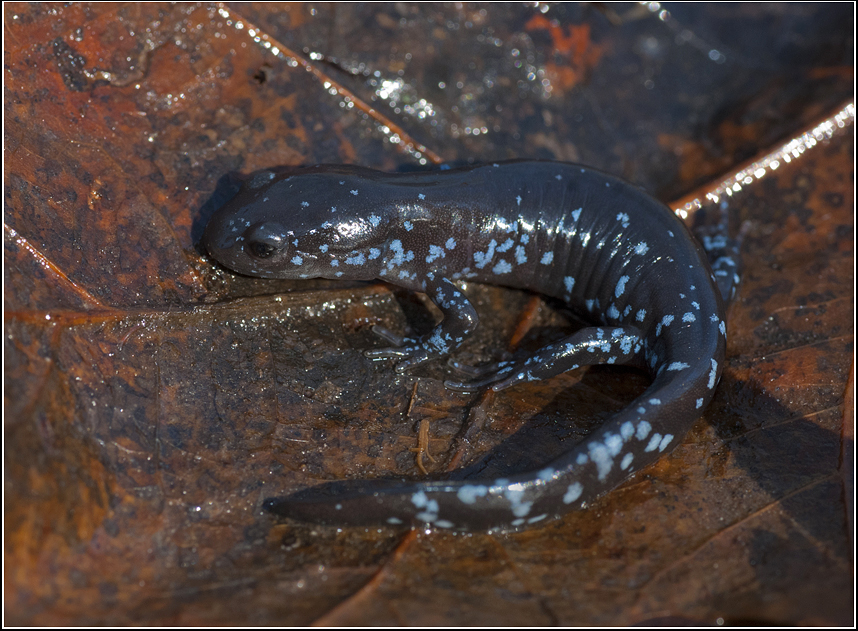
Blue-spotted Salamander

Eastern Redback Salamanders were also plentiful under every other stone. This species occurs in 2 general colour morphs, with the occasional intermediate individual. This one is of the more common "redback" form, while some individuals have no red strip and are a coal gray/black colour on their dorsum. Over the years at this location, 74.9%  of the Eastern Redback Salamanders I have classified as "red-backed", 25.1% have been "lead-backed" (n=606). 

"redback" phase Eastern Redback Salamander

We heard several choruses of Spring Peepers as well as one or two lone Western Chorus Frogs. W. Chorus Frogs have been decreasing steadily in Ontario over the past number of decades and they are a candidate to be a Species at Risk. This part of Ontario still has strong populations, but it was a little disconcerting to only hear a couple of them mixed in with the peepers. Normally they readily sing in the daytime early in the season while the peepers have their loudest choruses at night. Hopefully the lack of W. Chorus Frogs was due to the early date and not a decline in their numbers. Here is a photo of one from a previous spring...

Western Chorus Frog

Chris keeping a wary eye out for snakes

Pauline - herper extraordinaire

Anyways, as the afternoon wore on we kept seeing good numbers of both N. Ribbonsnakes (Thamnophis sauritus septentrionalis) as well as the slightly less numerous Eastern Gartersnake (T. sirtalis sirtalis). These are the two earliest snakes I see at this site, with my first snake of the year usually a N. Ribbonsnake. Within a week or two Northern Brownsnakes, followed shortly by Redbelly Snakes should appear. Northern Watersnakes will be out any day, and the remaining snakes at the site (Smooth Greensnake, Eastern Milksnake, N. Ringneck Snake) don't usually appear until mid or late April. Most of the gartersnakes and ribbonsnakes we saw on the day were very close to known hibernacula, and I didn't see any in areas where I suspect there are no hibernacula. To me this means that they had recently emerged and within a few days they will probably disperse over all the hillsides.

Northern Ribbonsnake

I would elaborate more on Northern Ribbonsnakes, their hibernacula, and other things, but I've already made this long-winded enough. They are a fascinating species though, and its good to see several populations in the Cambridge/Guelph area that are doing very strong as they are a Species of Special Concern in Ontario. 

Sunday, 5 June 2011

The snakes of Ontario -part 1

Part 1 - Eastern Gartersnake, Dekay's Brownsnake, Northern Redbelly Snake, Northern Ribbonsnake
Part 2 - Northern Watersnake, Lake Erie Watersnake, Queensnake
Part 3 - Eastern Milksnake, Eastern Foxsnake, Eastern Hog-nosed Snake
Part 4 - Northern Ring-necked Snake, Smooth Greensnake
Part 5 - Gray Ratsnake, Butler's Gartersnake
Part 6 - Blue Racer, Eastern Massasauga


The purpose of this post is exactly how the title says: I will showcase every species of snake that is currently found in Ontario. Especially before I got into birds, herps were my main interest and I have found and photographed each of the 15 species native to Ontario. This number is often surprising to most people - this is the Great White North after all! Without further ado, part one of the post...

Eastern Gartersnake (Thamnophis sirtalis)

This is the most common snake in Ontario, with records ranging all the way up to James Bay. I am pretty sure that just about any habitat can support them, from grassy fields to woodlands to alvars to parking lots. I once even found one in the grassy area of a highway interchange, surrounded by roads. 

Eastern Gartersnake - Waterloo Region

My records indicate that I have seen 1696 Eastern garter snakes in Ontario since I started keeping track in 2007.

Eastern Gartersnake - Waterloo Region

The melanistic form is quite common in some locations that are adjacent to Lake Erie or Lake Ontario. This genetic strain proliferates in relatively closed populations of the Leslie street spit, Long Point, Point Pelee, and Pelee Island. The Pelee Island population contains about 1/3 melanistic individuals.

melanistic Eastern Gartersnake - Essex County

melanistic Eastern Gartersnake - Essex County

Dekay's Brownsnake (Storeria dekayi)

Another super common snake in Ontario, but rarely seen due to their small size and brownish colorations. Biggest ID point is that they look like a worm. I like the little buggers though!

Dekay's Brownsnake - Essex County

Dekay's Brownsnake - Essex County

Dekay's Brownsnake - Essex County

Northern Redbelly Snake (Storeria occipitomaculata occipitomaculata)

Redbelly snakes are the cousins of the much more common Brown Snakes, and are typically found in edge habitats. They also have a large range and can be found as far north as Lake Superior. This is the smallest species of snake in Ontario, and most adults are about 10 inches long. The babies, on the other hand, weigh less than a gram.

Northern Redbelly Snake - Norfolk County

Northern Redbelly Snake - Muskoka District

This fine specimen was found under a board in the Norfolk area, an area with a very high diversity of snakes. She looks like she is about to drop about 15 babies. (Within one km of where this snake was found, my friend Jon and I have seen E. Garter, Northern Watersnake, Northern Redbelly, Brown, Eastern Fox, Eastern Hognose, Northern Ringneck, Smooth Green, and Eastern Milksnakes).  

Northern Redbelly Snake - Norfolk County

I don't find huge numbers of them, but in some areas they can be locally abundant. In our study site in Windsor, about 0.5 percent of the snakes we find are Redbelly snakes, to give you an idea of how sparse they can be in areas.

Northern Redbelly Snake - Muskoka District

Two main forms are found in Ontario - the above snake with slate gray dorsal color, and the below snake with brown dorsal coloration.

Northern Redbelly Snake - Norfolk County

Definitely a pretty species, and underrated.

Northern Redbelly Snake - Muskoka District

Northern Redbelly Snake - Muskoka District

Northern Ribbonsnake (Thamnophis sauritus septentrionalis)

Ribbonsnakes are closely related to Gartersnakes but are much more specific in their habitat requirements. I tend to find them in marshy fens/marshes that are immediately adjacent to hilly deciduous woodland in Southern Ontario. In central Ontario, any wetland that is close to an open area seems to do!


Northern Ribbonsnake - Waterloo Region

Northern Ribbonsnake - Waterloo Region

As obvious in the above photo, the white crescent anterior to the eye is diagnostic of this species. Also note the slender head, as well as the brown coloration just ventral of the yellowish stripe on the snake's side.

I am fortunate to have a large population of ribbonsnakes quite close to my parent's house in Cambridge, which allowed many opportunities to study this species while I was growing up. Here area  few of my favorite photos from over the years:

Northern Ribbonsnake - Waterloo Region

Northern Ribbonsnake - Waterloo Region

Northern Ribbonsnake - Waterloo Region

Northern Ribbonsnake - Waterloo Region

Northern Ribbonsnake - Waterloo Region

One last shot of my favorite snake species in Ontario, feeding on their favorite prey item - frogs.

Northern Ribbonsnake - Muskoka District

Stay tuned - the next post will cover Northern Watersnake, Lake Erie Watersnake (including some very strange individuals), and Queen Snake.