Monday, 21 September 2020

The Arenal Area


----------

We drove west from Guapiles, making decent time as we motored away from the Caribbean coast. Eventually the Arenal Volcano rose up from beyond the horizon, its shape taking a fuller form as we approached from the east. Arenal Volcano - a stratovolcano situated along the northern part of the Cordillera de Guanacaste (Guanacaste mountain range) - is one of the top 10 active volcanoes in the world. Many thousands of tourists venture to this part of the country each year and it was obvious that the nearby town of La Fortuna was set up almost entirely for gringo tourism. 

The throngs of tourists ensured that hotel rooms and restaurants would be expensive, but alas, that is the price to pay to explore the forests of Costa Rica. With only a few days remaining until Laura and I needed to bring the rental car back to San José we decided to spend out time here. Arenal held a few bird species that I was hoping to see, while it was also a good base to explore some of the vast swaths of Caribbean foothill forest located south of here.

Border Anole (Anolis limifrons) - Sendero Bogarín, La Fortuna, Alajuela, Costa Rica

Upon arrival in the early afternoon we dropped in to Sendero Bogarín located on the edge of La Fortuna. Sendero Bogarín is a small tract of protected forest with dirt footpaths snaking through the lush vegetation. Famous for its large population of Brown-throated Three-toed Sloths, Sendero Bogarín is also home to a variety of birdlife - surprising diversity given the small size of the woodlot. Our friend Victor recommended this location, a convenient spot since our hotel was only a few minutes away. 

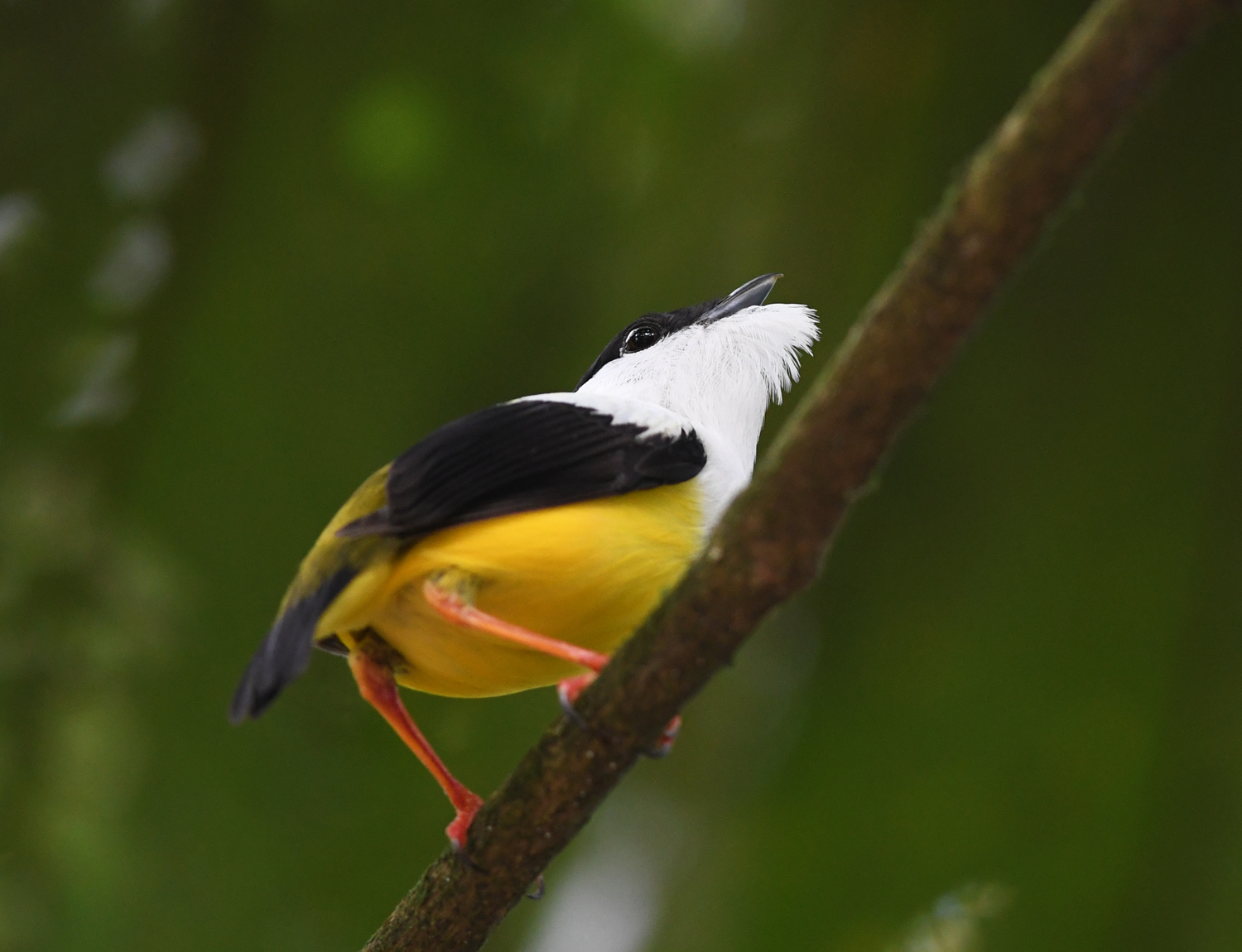
We paid our 10 USD per person entrance fees and began exploring. White-collared Manakin was one of the birds we were hoping to see here and they were far from difficult! Thanks to the distinctive popping sounds created by the lekking males, we easily tracked down a few individuals within minutes of our arrival.

White-collared Manakin - Sendero Bogarín, La Fortuna, Alajuela, Costa Rica

Like many manakin species White-collared Manakin males will gather in a small group known as a lek, where they will perform their dances in front of a female or two watching furtively from the sidelines. The strange popping sounds are non-vocal; rather, they are created by the wings. Different manakin species have evolved different mechanisms to create these popping or whirring sounds.  

White-collared Manakin - Sendero Bogarín, La Fortuna, Alajuela, Costa Rica

The birding was a little slow initially so we focused on scanning for sloths and lizards. Brown Basilisk was the default species but later in the afternoon we encountered a Green Basilisk. It was a new species for us, and my fourth and final representative of the genus Basiliscus. 

Brown Basilisk (Basiliscus vittatus) - Sendero Bogarín, La Fortuna, Alajuela, Costa Rica

Green Basilisk (Basiliscus plumifrons) - Sendero Bogarín, La Fortuna, Alajuela, Costa Rica

As I mentioned before, most tourists visit Sendero Bogarín for the sloths, of which there are many. We spotted three or four Brown-throated Three-toed Sloths during the course of the afternoon including one individual that came down out of the canopy - one of the best looks we have had of this species!

Brown-throated Three-toed Sloth - Sendero Bogarín, La Fortuna, Alajuela, Costa Rica

Brown-throated Three-toed Sloth - Sendero Bogarín, La Fortuna, Alajuela, Costa Rica

Speaking of mammals, a photogenic Variegated Squirrel...

Variegated Squirrel - Sendero Bogarín, La Fortuna, Alajuela, Costa Rica

One of the birds I was hoping to encounter at Sendero Bogarín was the shy and secretive Uniform Crake. This species prefers the dark understory of swampy broadleaf forest and a few individuals make their home here. I heard one individual vocalizing early in the walk but a couple of hours later, we turned a corner and I witnessed a dark shape scurry along the edge of a small creek bed. With some patience we were able to spot the culprit - a Uniform Crake! It fed only a few meters from us, allowing me to take a crack at some photos, a difficult proposition in the dark environment.

Uniform Crake - Sendero Bogarín, La Fortuna, Alajuela, Costa Rica

New bird species kept appearing such as Great Curassow, Yellow-crowned Night-Heron (roosting in a tree), Laughing Falcon, Black-throated Wren, Ovenbird, Scaly-breasted Hummingbird and more. The Great Curassow was quite the surprise. It was a male that flew down out of a tree and strutted across the path. 

Great Curassow - Sendero Bogarín, La Fortuna, Alajuela, Costa Rica

Laughing Falcon - Sendero Bogarín, La Fortuna, Alajuela, Costa Rica

One more obligatory sloth photo...

Brown-throated Three-toed Sloth - Sendero Bogarín, La Fortuna, Alajuela, Costa Rica

One of the last new birds for our eBird checklist was this Smoky-brown Woodpecker. We finished with an even 60 bird species, quite a surprising number considering how small the area was, and the time of day for our visit. 

Smoky-brown Woodpecker - Sendero Bogarín, La Fortuna, Alajuela, Costa Rica

The Caribbean slope of Costa Rica holds many of the most highly sought after bird species found in the country. There are countless fantastic places where one can explore these habitats from the Arenal area all the way south/east to the Panama border, including two great field stations found in this part of the country - San Gerardo and Pocosol. Unfortunately, Laura and I did not have time to visit these stations during our loop with the rental car. Besides, we were planning on exploring San Gerardo and several other areas in a few weeks anyways (little did we know that a global pandemic would mess up these plans). But with one full day available to us, we chose to visit the entrance road to the University of Costa Rica's Alberto Manuel Brenes Reserve. It was located just over an hour south of our hotel in La Fortuna.

Camino a la Reserva Alberto Manuel Brenes, Alajuela, Costa Rica

I had a relatively small hit list of target birds for Manuel Brenes. Among a few more common species (Thicket Antpitta, Black-headed Nightingale-Thrush, Crimson-collared Tanager) I was also hoping for Bare-necked Umbrellabird or Tawny-chested Flycatcher, two highly sought after species that have occurred here, but I struck out on both fronts. But really, we were just looking to spend the day walking among beautiful forest surrounded by wildlife and away from other people. In that case, the day was a complete success.  

Anolis sp. - Camino a la Reserva Alberto Manuel Brenes, Alajuela, Costa Rica

We left La Fortuna before 5 AM, arriving at the start of the road to the Manuel Brenes reserve by dawn. We parked our car a few hundred meters in and walked along the gravel road for a while, eventually tracking back to the car. We then drove quite a ways along the bumpy road until we were within shooting distance of the Manuel Brenes reserve, parked again, and walked over a bridge and up a steep hill to the reserve gate and back. This seemed to be a pretty good strategy since we encountered quite a few birds - over 100 species for the day. The weather was a bit iffy, with persistent light rain muting the birds for the first hour or so of the morning, but eventually the rain lifted and we enjoyed a fantastic day of exploration.

Early on it was a good day for raptors. A pair of Gray-headed Kites were consorting over the road and one perched long enough for some excellent views through the binoculars. A bit later, a photogenic White Hawk also obliged us by sitting out in the open. This was a lifer for Laura, and a pretty spectacular view of this beautiful species. 

Gray-headed Kite - Camino a la Reserva Alberto Manuel Brenes, Alajuela, Costa Rica

White Hawk - Camino a la Reserva Alberto Manuel Brenes, Alajuela, Costa Rica

Early on I encountered two new bird species (Thicket Antpitta, Black-headed Nightingale-Thrush) though unfortunately, both were heard only. The beginning stretches of the road passed through disturbed areas, full of cecropias and tangles. While these habitats are not ideal for some of the rare forest birds I was hoping to see, they can often be good for a high diversity of common species. The Thicket Antpittas were particularly common but we picked up many other species. These included Rufous-tailed Jacamar, Black-throated and Stripe-breasted Wrens, Dusky Antbird, Northern Bentbill, my "lifer" Rufous-winged Woodpecker and even a few migrants from the north (Golden-winged Warbler, Wilson's Warbler and Acadian Flycatcher). 

Northern Bentbill - Camino a la Reserva Alberto Manuel Brenes, Alajuela, Costa Rica

A few trucks passed us during the morning but mostly, we had the place to ourselves. It was glorious! Just us and the wildlife. 

Centropogon granulosus - Camino a la Reserva Alberto Manuel Brenes, Alajuela, Costa Rica

By late morning we hit a lull in the bird activity, and this lasted for several hours. We pressed on and slowly added new species here and there including this photogenic Montezuma Oropendola. 

Montezuma Oropendola - Camino a la Reserva Alberto Manuel Brenes, Alajuela, Costa Rica

We passed a small village and hiked down into a valley where a fast-flowing mountain stream coursed by. From the bridge we waited for a bit in hopes of spotting a Fasciated Tiger-Heron or a mixed flock of songbirds, though we were unsuccessful on both fronts. We then hiked up the road to the entrance gate for the reserve, before our grumbling stomachs were just cause to retrace our steps back to the car. 

Eurybia unxia - Camino a la Reserva Alberto Manuel Brenes, Alajuela, Costa Rica

Before passing through the small village close to where we had parked, a flash of red caught my attention by a small stream. It revealed itself as a stunning Crimson-collared Tanager. This uncommon species ranges from southern Mexico to western Panama in the Caribbean lowlands, and it was a new species for both of us. 

Crimson-collared Tanager - Camino a la Reserva Alberto Manuel Brenes, Alajuela, Costa Rica

Despite the success of the day we had not encountered a single mixed flock large enough to merit mention. This changed as we drove back out towards the highway. A few birds flew across the road which grabbed my attention. Fortunately, I stopped the car to investigate. We caught the tail end of a large mixed flock of bird species!

White-ruffed Manakin - Camino a la Reserva Alberto Manuel Brenes, Alajuela, Costa Rica

Without a doubt the highlight here was a single Blue-and-gold Tanager that hung around long enough for photos. This rare species is quite local in the foothills of Costa Rica and Panama and is one of the more highly sought species at Manuel Brenes. 
 
Blue-and-gold Tanager - Camino a la Reserva Alberto Manuel Brenes, Alajuela, Costa Rica

The mixed flock gave us a chance to pad our day list with species like Bay-headed and Emerald Tanagers, White-ruffed Manakin, White-throated Shrike-Tanager, Northern Barred-Woodcreeper and Plain Xenops, and it was a nice way to close out an excellent day at Manuel Brenes. 

For our final morning in the Arenal area we chose to explore a road that cuts through nice forest directly west of the Arenal Volcano - on eBird the hotspot is called "Arenal--Peninsula road (shortcut to dam)". If we had more time we would have explored the trails at the Arenal Observatory Lodge, but we figured it would only be worth it to spend the entrance fee if we could devote a full day there. Regardless, our morning along the peninsula road was well-worth it with some great birds!

Spotted Antbird - Arenal area, Alajuela, Costa Rica

Laura and I slept in since the previous morning had been an early one and it was after 9 AM when we finally rolled up to the area. While we had missed the dawn chorus at least the sky was cloudy. We hoped that this would prolong bird activity.

Keel-billed Toucan - Arenal area, Alajuela, Costa Rica

The first bit of excitement for me was caused by a Rufous-winged Woodpecker that flew into a roadside tree. I had seen this species ever so briefly the previous day; this experience felt a lot better for a life bird. 

Rufous-winged Woodpecker - Arenal area, Alajuela, Costa Rica

A little while later we heard an interesting bird call that sounded very similar to Broad-billed Motmot. This Arenal area is known to provide habitat for the Keel-billed Motmot, a rare species with a disjunct range in Caribbean lowlands of Central America. The two species sound very similar (I still can't confidently tell them apart) but the Keel-billed looks very different. Laura and I were in luck as we tracked down the bird. Indeed, it was a pair of Keel-billed Motmots (along with a pair of Broad-billed Motmots!). 

Keel-billed Motmot - Arenal area, Alajuela, Costa Rica

It had been a great morning but things kept getting better. We noticed an army ant swarm crossing the road and parked ourselves here for almost an hour as the birding was fantastic. As any birder who has visited the Neotropics can attest to, army ant swarms are an excellent way to see certain secretive species that are almost never seen away from these swarms. These obligate ant swarm birds do not feed on the ants; rather, they catch insects and small vertebrates that get disturbed by the wriggling mass of ants. 

Red-throated Ant-Tanager - Arenal area, Alajuela, Costa Rica

This particular swarm was attended by Bare-crowned and Spotted Antbirds, Tawny-throated Leaftosser, Northern Barred-Woodcreeper, Northern Schiffornis and Red-throated Ant-Tanager. A small mixed flock containing Russet Antshrike and others moved through the treetops while we were glassing the antbirds. Meanwhile, a pair of Slaty-tailed Trogons sat motionless on the other side of the road. Just super enjoyable birding!

Spotted Antbird - Arenal area, Alajuela, Costa Rica

Northern Barred-Woodcreeper - Arenal area, Alajuela, Costa Rica

Slaty-tailed Trogon - Arenal area, Alajuela, Costa Rica

Bare-crowned Antbird - Arenal area, Alajuela, Costa Rica

And with that, we hit the road back to San José. Our thirteen days with the rental car was coming to an end but we still had a lot of exploration to look forward to. My parents were flying in from Toronto for March Break and we were hoping to visit some other awesome places, including the famous La Selva Biological Station. Stay tuned!

Friday, 11 September 2020

Lake-watching season!

Autumn migration has been in full swing for the past month and it has really ratcheted up in recent days. With each passing cold front a new pulse of migrant birds appear, keeping us birders busy. Now that I am based in Niagara for a few months I have been trying to take advantage of the excellent local birding. Sea-watching is a favourite pastime of mine and while Lakes Erie and Ontario hardly count as "sea", they are the closest we have got in southern Ontario! 

September 7th looked like the perfect setup for some decent sea-watching...er....lake-watching at the source of the Niagara River in Fort Erie. Strong southwest winds blew out of the lake, something that in theory would congregate all the interesting birds into the northeast corner of the lake and thus, visible from Fort Erie. The previous couple of days had been good for migration, leading me to be hopeful that there were at least a few jaegers or interesting gulls out there. And with quite a few rarities being found in recent days, the chance was there that something really unusual would come by.

Bonaparte's Gulls - Fort Erie, Niagara Region

The lake-watching started off slow and over the first two hours I did not see too much of interest. There was, however, a good Common Tern and Bonaparte's Gull movement occurring. By mid-morning I walked back to my car and ran into a few local birders - Marcie Jacklin, Tim Seburn and the Farnans. While chatting and scoping the birds with them, Marcie received a call from Joe Fell on the New York side about a Black Tern by the Peace Bridge. Since the action was pretty slow where we were located, we all drove over there to have a peek. 

This ended up being a very good choice! When we arrived there were three Black Terns in sight, each of them mirroring the behaviour of the Bonaparte's Gulls. They would fly upriver, straight into the wind, hover over the water looking for morsels, and eventually loop back to the rear of the group. 

Black Tern and Bonaparte's Gulls - Fort Erie, Niagara Region

Black Terns - Fort Erie, Niagara Region

Three turned to four, then five, and then six. I noticed a small group of three shorebirds flying together with the gulls. Suspecting phalaropes, I ran back for my scope and confirmed that they were indeed Red-necked Phalaropes! The three individuals continued in the same area for well over an hour, allowing some local birders to "twitch" them. 

Red-necked Phalarope - Fort Erie, Niagara Region

Red-necked Phalaropes - Fort Erie, Niagara Region

The Black Tern numbers kept increasing and a couple of Little Gulls also joined the fray. It was popping off!

Black Terns, Bonaparte's Gulls and Little Gull - Fort Erie, Niagara Region

Black Tern - Fort Erie, Niagara Region

I pulled myself away around noon as I had other things to attend to. It was one of the more memorable mornings of birding that I have had in Niagara.

Bonaparte's Gull - Fort Erie, Niagara Region

Today I made the ten minute drive to the Port Weller east pier for a bit of lakewatching. Again, the conditions had been excellent for migration overnight and a wave of songbirds had arrived. The moderately strong northeast winds gave me hope that jaegers, Sabine's Gulls, or phalaropes would be on the agenda. 

I was in luck as I enjoyed a few nice birds. First up was an adult Long-tailed Jaeger that gracefully headed past, heading west. It was only the second one that I had seen in Niagara, and the first at Port Weller so I was pretty stoked. 

Next up was a Black Tern, flying with a large group of Common Terns that were feeding offshore. I later spotted a different individual, and during the entire lake-watch at least one of the birds was always in view (though sometimes quite distant). 

The most unexpected bird of the morning was a young Pomarine Jaeger that flew past the end of the pier at pretty close range, allowing me to have face-melting views in the scope! The photos, on the other hand, leave a lot to be desired....

Pomarine Jaeger - Port Weller east pier, Niagara Region

Pomarine Jaegers are normally later migrants so I was a bit surprised to see one today. It was another one that I had never seen at Port Weller before. 

Pomarine Jaeger - Port Weller east pier, Niagara Region

I had just returned home when I saw a message from Phil Downey about a Red Knot that he had found on Jones Beach, which is just beside the Port Weller east pier. I had checked the beach about an hour earlier and had seen all the other shorebirds he had reported, but there was no Knot! It must have arrived just after I had checked the beach. Darn! Since it too was a bird I needed for Port Weller, I drove down and easily re-found it among the mats of rotting vegetation that the northeast winds had brought in to shore.

Red Knot - Jones Beach, St. Catharines, Niagara Region

A dozen or so Sanderlings were taking advantage of the buffet as well. Some were quite territorial, chasing each other from, presumably, ideal patches of rotting vegetation. Sanderlings are a riot to watch sometimes!

Sanderling - Jones Beach, St. Catharines, Niagara Region

Sanderling - Jones Beach, St. Catharines, Niagara Region

Sanderling - Jones Beach, St. Catharines, Niagara Region

Four crisp juvenile Semipalmated Plovers were photogenic as well. Definitely one of the cutest shorebirds!

Semipalmated Plover - Jones Beach, St. Catharines, Niagara Region

The knot tolerated my presence, enabling me to snap a few photos that I was happy with. The rufa subspecies of Red Knot, of which this belongs, is Endangered and undergoing drastic population declines. It is always special to be able to share a few moments with this species. 

Red Knot - Jones Beach, St. Catharines, Niagara Region

Spotted Sandpipers can still be seen for now but they will vacate the Great Lakes region during the next couple of weeks. The crisp feathering on this individual means that it is a juvenile. 

Spotted Sandpiper - Jones Beach, St. Catharines, Niagara Region

And one more shot of the knot. 

Red Knot - Jones Beach, St. Catharines, Niagara Region

Before signing off, I suppose I should mention the celebrity bird at the moment that is gracing the Hamilton shoreline. An adult Brown Booby was first detected on Lake Ontario by Brendan Boyd on August 24 in Durham Region and it was seen by a few other lucky observers later that day. On September 8, an adult Brown Booby was detected as it flew into and landed on the wave tower offshore Van Wagner's Beach in Hamilton, first being spotted by Nathan Hood. Presumably this is the same bird as the one from Durham on August 24, but who knows! Several Brown Boobies have been seen this summer well north of their normal range in the Atlantic, and others have been found inland as well. 

There is only one accepted record of Brown Booby for Ontario - an individual that was seen at the east end of Lake Erie in 2013 for a few weeks. This is obviously the first record for the GTA, and the first record for Hamilton. I drove out and saw the bird on Tuesday shortly after it was discovered, and again yesterday with Laura. The views in the scope were alright, but taking photos at that distance was practically hopeless. In the photo below it is sitting on the upper yellow railing, the second bird left of the yellow pole.

Brown Booby - Van Wagner's Beach, Hamilton


It will be interesting to see how long an ocean-going bird like a Brown Booby can eke out a living on Lake Ontario. An awesome bird to see here, nonetheless!

Sunday, 6 September 2020

A Few Rare Birds

As is usually the. case, late August and early September saw a spate of rare birds appear in southern Ontario. Part of this is due to the heavy migration that occurs, now that we are in peak autumn migration, but it is also because there are more eyes scanning for birds. I, like many birders, take the summer months off from serious birding. But with reports of rare species coming in hot and heavy it has provided me some extra motivation to dust off the binoculars. 

On August 27 a local Niagara birder, Wally Parker, found a scruffy juvenile Laughing Gull along the Fort Erie waterfront. I jumped at the opportunity to see this rare species, one that is reported in Niagara Region only a couple of times per decade - it was a big hole on my Niagara gull list!

Laughing Gull - Fort Erie waterfront, Niagara, Ontario

I arrived at the parkette at the end of Beatrice Street and immediately spotted the Laughing Gull as Dustin, a Fort Erie birder, pulled up in his truck. An older man and presumably his granddaughter were throwing bread for the Ring-billed Gulls, causing quite a commotion among the local gull flock. The Laughing Gull was right there with the ringers, bullying its way to the best pieces of bread. Laughing Gulls are experienced in food-thievery along the sandy beaches of the Caribbean and Gulf Coast (among other places) - they fit right in with the local ringers!

Laughing Gull - Fort Erie waterfront, Niagara, Ontario

Dustin and I were treated to a few flybys of the Laughing Gull, though it was, at times, much too close for photos! In this picture you can nicely see the brown juvenile scapular feathers and wing coverts, along with some newer gray feathers coming in. 

Laughing Gull - Fort Erie waterfront, Niagara, Ontario

The broad white upper side of the tail and thick black tail band are good ID features for a Laughing Gull of this age. 

Laughing Gull - Fort Erie waterfront, Niagara, Ontario

Some other features easily visible in the next photo include the long, even-width black bill, an uneven white eye-ring, and black legs. 

Laughing Gull - Fort Erie waterfront, Niagara, Ontario

Laughing Gull - Fort Erie waterfront, Niagara, Ontario

Eventually, the laugher landed on the breakwall with the ringers. They obliged my request and each of them nicely faced the same way in the same pose. Thanks, guys!

Laughing Gull (left) - Fort Erie waterfront, Niagara, Ontario

Laughing Gull (left) - Fort Erie waterfront, Niagara, Ontario

Laughing Gull - Fort Erie waterfront, Niagara, Ontario

And because they do not get enough love, here is a scruffy young Ring-billed Gull that is around the same age as the Laughing Gull. 

Ring-billed Gull - Fort Erie waterfront, Niagara, Ontario

One more shot of the Laughing Gull - I couldn't resist! It was by far the best experience I have had with this species in Ontario!


Laughing Gull - Fort Erie waterfront, Niagara, Ontario

----------

Western Sandpipers are reported every year in southern Ontario but it is never more than a handful. Undoubtedly many more pass through our borders but this species can easily be confused with Semipalmated Sandpiper, an abundant migrant in both spring and autumn. Western Sandpiper is a bird that I had not seen well for a few years, so with James Lees discovering one at Christie Lake in Flamborough, it was one I was eager to "twitch". Additionally, this location is only 15 minutes from where I grew up in Cambridge. 

Western Sandpiper - Christie Lake, Hamilton, Ontario

I ran into Matt Mills and Simon Carter who were scoping the shorebirds from a small bridge. It took a few minutes of scanning but eventually we picked out the Western Sandpiper and enjoyed distant scope views. Matt and Simon mentioned that there was a small path heading through the forest towards the area frequented by the shorebirds and so we grabbed our scopes and made the short walk over. We were certainly glad we did as the views were much better than from the bridge.

Western Sandpiper (right) and Semipalmated Sandpiper - Christie Lake, Hamilton, Ontario

The above photo shows the Western Sandpiper on the right, with a Semipalmated Sandpiper. This Western Sandpiper was easily identifiable, unlike some of the "tweeners" that seem to be reported each year. Compared to the semi, the Western Sandpiper exhibits more gray/white tones (brownish on Semipalmated), has a row of contrasting reddish scapular feathers, a longer more curved bill, and longer legs giving it a lankier appearance. Western Sandpipers often appear thick-necked and they lean forward more when they feed. But these features are subtle. 

Western Sandpiper - Christie Lake, Hamilton, Ontario

The Western was clearly the star of the show but there were other shorebirds to study as well. The next two photos show a Semipalmated Sandpiper and a Semipalmated Plover. 

Semipalmated Sandpiper - Christie Lake, Hamilton, Ontario

Semipalmated Plover - Christie Lake, Hamilton, Ontario

By lying down in the dried mud, the shorebirds tolerated my presence and walked right past, only 20 feet from me. 

Shorebird photography (photo taken by Matt Mills)

Western Sandpiper - Christie Lake, Hamilton, Ontario

Western Sandpiper - Christie Lake, Hamilton, Ontario

----------

Early September is prime time for lake-watching on the lower Great Lakes. At this time of year it is not too unusual to find species such as Long-tailed and Parasitic Jaeger, Sabine's Gull, Black Tern, and various shorebirds including Red-necked Phalarope. Since I am living in Niagara for the time being I have lake-watching options for most wind-situations. If the wind has a north or east component, I head down to Port Weller or any other of the good spots in the Region - like the mouth of the Niagara River in Niagara-on-the-Lake, 50 Point Conservation Area or Port Dalhousie. If the winds have a south or west component, Fort Erie is a great spot to be. Birding the morning after a front seems to be most productive since usually that means that a new crop of birds has appeared on the lower Great Lakes following a long migration from James Bay. 

I have only managed to get out a few times in the last two weeks but I had a productive lake-watching session in Fort Erie on September 2. I arrived as a heavy band of rain passed through the area but the winds were strong and out of the southwest - great conditions to, in theory, concentrate pelagic birds to the far east end of Lake Erie (and visible from Fort Erie). 

The best activity occurred just after the rain passed through. I locked onto a crisp juvenile Long-tailed Jaeger not too far out in front of me, heading back out towards the lake from the upper Niagara River. For the next five minutes I kept an eye on the jaeger as it slowly cruised along the shoreline and disappeared to the west. Awesome! Despite many similar lake-watching sessions here, this was my first Long-tailed Jaeger in Niagara. 

The other highlight of my vigil was a juvenile Red-necked Phalarope following a very similar flight path as the Long-tailed. Other than a brief moment where it touched down on the water, it flew pretty steadily out into the lake. Another new one for my Niagara list. Sanderlings were also present in very good numbers with one small flock hanging out on the small sandy beach where I had parked myself. An excellent way to spend a windy afternoon!

----------

On August 25 Steve Charbonneau made an exciting find as he was birding the Blenheim sewage lagoons. He discovered a juvenile Purple Gallinule along the edge of one of the cells! In the days since, the gallinule has been a frequent member of the local lagoon avifauna. It can usually be found without too much trouble in the east corner of Cell #1 (the first one on the right). 

I finally bit the bullet and hit the road on September 5, hoping to see and photograph this rarity in Ontario. Dodging rainstorms on the drive down, I made decent time and lucked into a period without rain for the duration of my visit. 

I actually heard the gallinule before I saw it, as the bird was uttering a series of keek calls. Eventually I tracked it down and took my time to approach carefully for photos. 

Purple Gallinule - Blenheim Lagoons, Chatham-Kent, Ontario

The gallinule sat quietly amongst the Flowering Rush, looking around but generally ignoring me. 

Purple Gallinule - Blenheim Lagoons, Chatham-Kent, Ontario

Purple Gallinules are quite rare in Ontario, with perhaps one record every two or three years. So far, there have been 21 individuals that have been accepted by the Ontario Bird Records Committee, the first being a  juvenile that was reported by George North in the Dundas Marsh on October 7, 1967. Most records of this southern species occur in the autumn and they are almost always juvenile birds, like this one. 

Purple Gallinule - Blenheim Lagoons, Chatham-Kent, Ontario

Adult Purple Gallinules are unmistakeable with their royal blue head, neck and underparts, greenish back, and gaudy bill colour along with pale blue frontal shield. The juveniles, while lacking the bold colours of the adults, are still quite distinctive in their own right. The rich brown tones of this bird along with bright white undertail covers are a dead give-away for this species. While not as brightly coloured, the bill and frontal shield are reminiscent of the adults', just duller.

Purple Gallinule - Blenheim Lagoons, Chatham-Kent, Ontario

Purple Gallinule - Blenheim Lagoons, Chatham-Kent, Ontario 

As we move deeper into September, migration will continue and the days will (hopefully) be a little cooler, making birding more enjoyable. While I intend on doing lots of mothing/insecting in the upcoming months, it is nice to have birds back on the radar as well!