Monday, 18 March 2019

Guatemala 2019, Part 2 : Thorn forest in the Motagua Valley

Part 1: Introduction
Part 2: Thorn forest in the Motagua Valley (January 18-19, 2019)
Part 3: Los Rachitos del Quetzal (January 19-20, 2019)
Part 4: Sierra de Los Cuchumatanes (January 20-21, 2019)
Part 5: Reserva Natural Atitlán (January 21-22, 2019)
Part 6: Volcán San Pedro (January 23, 2019)
Part 7: Cerro Rostra Maya, Los Tarrales Natural Reserve (January 24, 2019)
Part 8: Los Tarrales Natural Reserve (January 25, 2019)
Part 9: Los Tarrales Natural Reserve (January 26-27, 2019)
Part 10: Parque Nacional Tikal (January 28, 2019)
Part 11: El Caoba former airstrip, Tikal former airstrip (January 29, 2019)
Part 12: Parque Nacional Tikal, Uaxactún (January 30, 2019)
Part 13: El Remate and Flores (January 31, 2019)

----------

January 18, 2019

Most of the day was spent in transit, beginning in Etobicoke, Ontario. Dan's parents, Garth and Nancy, graciously drove us to the airport early in the morning and allowed me to park my vehicle in their driveway for the entire trip. Thanks guys! Everything in Toronto went smoothly, as did our time in Mexico City where we had a brief layover prior to our flight to Guatemala City. As the sun began to set in the sky, volcanoes surrounding Guatemala City appeared on the horizon before we touched down.

Descent into Guatemala City

Everything at the airport went as well as possible and we soon picked up the rental vehicle. At the time we had booked an SUV with four wheel drive, but Enterprise for some reason did not have one available. They were willing to upgrade us to a pickup, a Toyota Hilux, instead. The only problem was that the Hilux was a manual transmission which meant that only I could drive it. Having a pickup with high clearance and 4WD ended up being fortuitous as there were several instances during our trip where an SUV would not have cut it! It all worked out in the end.

That evening we braved the rush-hour traffic in Guatemala City, eventually heading north towards the Motagua Valley. We made a couple of stops along the way to buy some supplies, while we also had to deal with an issue with the truck. We had no headlights. On further inspection, someone had unplugged the power supply to the headlights, which Dan noticed and was able to fix. It was close to midnight when we finally checked into our hotel (Hotel Pasabien in Rio Hondo) and we each crushed a couple of beers and went to bed, exhausted after a long day.

January 19, 2019

The Motagua Valley is surrounded by mountains on all side, receiving very little rainfall as a result. Due to the hot and dry conditions in the valley, an ecoregion called Motagua Valley thornscrub is found throughout. The Motagua Valley is one of the driest areas of Central America, receiving less than 500 mm of annual rainfall, which contrasts sharply with the surrounding mountainous areas. Acacias, Opuntia cacti and thorny shrubs dominate the landscape, while vastly different wildlife species compared to the surrounding mountains occupy the valley. A number of bird specialties are targeted by visiting birders to the valley; these include Russet-crowned Motmot, Buff-collared Nightjar, Yellow Grosbeak, White-lored Gnatcatcher, Lesser Ground-Cuckoo and others.

Motagua Valley - near Cabanas, El Progreso, Guatemala

We were up well before dawn and were soon bouncing along on a dirt road to our destination of high quality thorn forest along the roadside. One of our first birds of the day was one of our main targets - a calling Buff-collared Nightjar around dawn. Upon exiting the vehicle we began to pick up on new sights and sounds. The first morning in a new area is always exciting, but a little daunting!

Barely an hour had passed and Dan and I had already seen many new birds, including a few gorgeous Yellow Grosbeaks. New species were around every bend - White-fronted Parrots here, then Altamira and Streak-backed Orioles over there, a few Bushy-crested Jays up the hillside, and a flock of Orange-fronted Parakeets streaking past overhead.

White-fronted Parrot - south of Cabanas, El Progreso, Guatemala

Yellow Grosbeak - south of Cabanas, El Progreso, Guatemala

Yellow Grosbeak - south of Cabanas, El Progreso, Guatemala

Orange-fronted Parakeet - south of Cabanas, El Progreso, Guatemala

Rufous-naped Wren - south of Cabanas, El Progreso, Guatemala

A roadside Russet-crowned Motmot caused a lot of excitement for Dan and I as it was our most wanted bird species for the Motagua Valley. Even better was the fact that it sat still at eye level for a few minutes, allowing us to soak in its plumage details. Quite a few branches in the way made photography a challenge so we had to settle for "record shots".

Russet-crowned Motmot - south of Cabanas, El Progreso, Guatemala

Our first snake of the trip was unfortunately road-killed. It was a Central American Lyresnake, a common species throughout the valley. 

Central American Lyresnake - south of Cabanas, El Progreso, Guatemala

We soon loaded back into the truck to drive a short distance to a new area. We had hoped to visit the Heloderma Reserve - an area set up to protect habitat for the Mexican Beaded Lizard - but were unable to arrange access ahead of time. Instead, we explored some roadside areas in good looking habitat.

south of Cabanas, El Progreso, Guatemala

When researching Guatemala, many trip reports reference the company called Cayaya Birding, run by Knut Eiserman and Claudia Avendaño. Knut and Claudia are bird guides, but also assist birding groups in putting together itineraries, arranging transport and lodging, etc. I tried contacting Cayaya Birding numerous times in the weeks leading up to the trip, hoping that they could help arrange some aspects of the trip for us, but I never received a response. Fortunately we were able to sort almost everything out on our own, but if we were relying on Cayaya we would have been out of luck! One of the things which we hoped that Cayaya could organize for us was arranging permission to visit the Heloderma Reserve. Unfortunately we had to skip out on doing this, but we had a successful day in the Motagua Valley regardless.

Tezpi Dancer - south of Cabanas, El Progreso, Guatemala

Apart from birds, Dan and I always kept an eye out for any other critters. Above is a Tezpi Dancer, while below are a few butterflies from the genus Eunica.

Eunica sp. - south of Cabanas, El Progreso, Guatemala

Eunica sp. - south of Cabanas, El Progreso, Guatemala

We ventured on foot a ways up the road, finding new bird species periodically as we walked. Plain-capped Starthroat and White-lored Gnatcatcher provided good views, while a bit later a Canivet's Emerald landed on a twig right in front of us. A Nutting's Flycatcher appeared next, followed by a flock of Stripe-headed Sparrows in a nearby agricultural field. It was shaping up to be a productive morning!

Canivet's Emerald - south of Cabanas, El Progreso, Guatemala 

A few more roadside butterflies were noted, including this Ceraunus Blue.

Ceraunus Blue - south of Cabanas, El Progreso, Guatemala

It was now late morning and the day was becoming quite warm. We had seen most of our targets, though Lesser Ground-Cuckoo remained unaccounted for. Dan had seen this species before, but I had not, and so we tried one more area on our way out of the valley, near the town of Morazan.

Again we struck out with Lesser Ground-Cuckoo but did find a few birds, including a Ferruginous Pygmy-Owl by the river. Several lizards were scurrying in the undergrowth such as this Giant Whiptail, a specialist found in the Motagua Valley and a few other xeric regions in Mexico and Honduras.

Giant Whiptail - Morazán, El Progreso, Guatemala

It was close to noon when we left the hot, dry Motagua Valley behind. Our next destination would be the cool, lush mountains south of the Coban area. We were in for a big change of scenery, and resulting species!

----------

Part 1: Introduction
Part 2: Thorn forest in the Motagua Valley (January 18-19, 2019)
Part 3: Los Rachitos del Quetzal (January 19-20, 2019)
Part 4: Sierra de Los Cuchumatanes (January 20-21, 2019)
Part 5: Reserva Natural Atitlán (January 21-22, 2019)
Part 6: Volcán San Pedro (January 23, 2019)
Part 7: Cerro Rostra Maya, Los Tarrales Natural Reserve (January 24, 2019)
Part 8: Los Tarrales Natural Reserve (January 25, 2019)
Part 9: Los Tarrales Natural Reserve (January 26-27, 2019)
Part 10: Parque Nacional Tikal (January 28, 2019)
Part 11: El Caoba former airstrip, Tikal former airstrip (January 29, 2019)
Part 12: Parque Nacional Tikal, Uaxactún (January 30, 2019)
Part 13: El Remate and Flores (January 31, 2019)

Friday, 15 March 2019

Guatemala 2019, Part 1: Introduction

Part 1: Introduction
Part 2: Thorn forest in the Motagua Valley (January 18-19, 2019)
Part 3: Los Rachitos del Quetzal (January 19-20, 2019)
Part 4: Sierra de Los Cuchumatanes (January 20-21, 2019)
Part 5: Reserva Natural Atitlán (January 21-22, 2019)
Part 6: Volcán San Pedro (January 23, 2019)
Part 7: Cerro Rostra Maya, Los Tarrales Natural Reserve (January 24, 2019)
Part 8: Los Tarrales Natural Reserve (January 25, 2019)
Part 9: Los Tarrales Natural Reserve (January 26-27, 2019)
Part 10: Parque Nacional Tikal (January 28, 2019)
Part 11: El Caoba former airstrip, Tikal former airstrip (January 29, 2019)
Part 12: Parque Nacional Tikal, Uaxactún (January 30, 2019)
Part 13: El Remate and Flores (January 31, 2019)


----------

Sometime during the summer of 2018 Dan Riley and I began kicking around the idea of traveling somewhere during the upcoming winter. It had been a few years since we had done an international trip together, the last time being back in January 2015 when we visited Colombia with several others. Dan and I have very similar interests and travel well together, and we had talked about doing a trip with just the two of us but it had never came to fruition. We both set aside time in January 2019 and began tossing around ideas of where to travel.

Blunthead Tree Snake (Imantodes cenchoa) - Los Tarrales Natural Reserve, Suchitepéquez, Guatemala

It was tough picking the perfect destination that had novel species for both of us, but was not halfway around the world. Dan and I have both traveled a fair bit in Central and South America in recent years but there had not been a lot of overlap in these destinations. Therefore the countries that had the most potential for me were places he had already been to, and vice versa. But there were a few places that would be new for both of us. Peru was one of those destinations, and southern Mexico/Guatemala was another. January would be the rainy season in Peru so we began to focus on Guatemala and southern Mexico. We had set aside two weeks for this trip so decided it was in our best interest to limit ourselves to just one destination. There is only so much you can see in two weeks, anyways! Flights to Guatemala were quite cheap which made our decision easier.

Ocellated Turkey - Tikal, Petén, Guatemala

Guatemala is a diverse country with an interesting history and varied flora and fauna. At one time the land which is now Guatemala formed the core of the Mayan civilization, prior to the Spanish conquests in the 1500s. Mayan culture is still very prominent in Guatemala, partially due to the high percentage of people who identify as Maya (around 41% of Guatemalans) or mestizo (around 41.5%).   Guatemala is the most populated country in Central America with over 16 million inhabitants, and the country has experienced a significant amount of development and deforestation in recent years.  That being said, there are still some amazing natural areas remaining in Guatemala, from the vast lowland forests in the north, to the high elevation pine and oak forests in the central and southern mountains. Most of Guatemala is mountainous, other than the Pacific coast and the northern lowlands. These mountains create a number of ecological niches due to altitudinal gradients and the ensuing changes in moisture and temperature. Shared with southern Mexico; many of the species found in the Guatemalan highlands are restricted in range to southern Mexico and Guatemala. These include some of the most sought after birds in Central America: Horned Guan and Pink-headed Warbler topping the list.

Viewpoint near Chiantla, Huehuetenango, Guatemala

Dan and I decided that we would rent a vehicle for the first nine days of our trip, and complete a big loop that started and finished at Guatemala City. From there we would take a short domestic flight to the town of Flores, located in the humid lowlands of Guatemala. Flores is very close to the famous archaeological sites of Tikal and Uaxactún, which are surrounded by primary forest and a high diversity of species. The first nine days or so would be very busy with a lot of ground to cover, but the final four days in the Tikal area would be a nice change of pace and a relaxing way to finish off the trip.

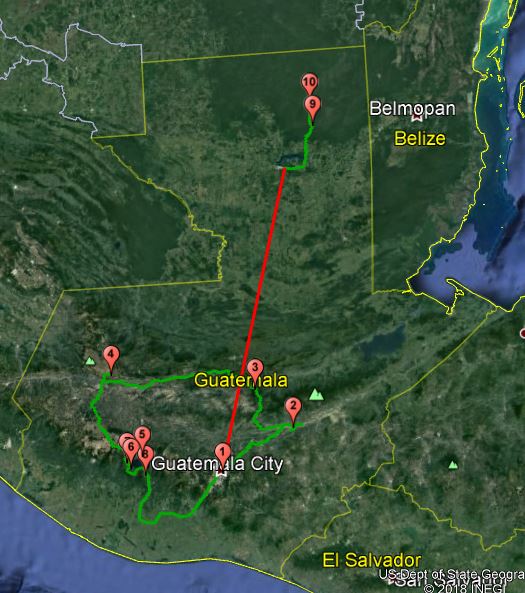
Below is a map showing our route. The green loop represents the nine-day circuit we completed with the rental truck, the red line denotes our domestic flight from Guatemala to Flores, and the north green line represents our route via rental car from Flores to Tikal and Uaxactún.


Lago de Atitlán, located in the middle of points #5-8 on the map, is one of the main birding hotspots in Guatemala due to the nice range of habitats and species found in the lake's immediate vicinity. We explored several locales near Lago de Atitlán including Reserva Natural Atitlán, Volcán San Pedro and Los Tarrales Nature Reserve, however there were several other locations that we were able to visit by completing a big loop with the rental truck. These included the dry thorn forest of the Motagua Valley (#2), the humid mountains south of Coban (#3), and the high-elevation oak and pine forest north of Huehuetenango, home to Goldman's Warbler (#4). We only spent one night at each at these locations and six nights around Lago de Atitlán. In hindsight, it would have been nice to have the extra time so we could spend two nights at each of the first three locations we visited. We were a little rushed and ended up missing a few species due to inclement weather, logistical mishaps, or lack of time. But I do not think I would be willing to take away any days from our time near Lago de Atitlán. A three week trip would have been perfect, and also could have afforded the opportunity for a more leisurely pace at the start of the trip, while also visiting a new area or two.


A quick word on travel in Guatemala. Most birders who visit Guatemala do it one of several ways. The most popular (though most expensive) is to organize everything through one of the tour operators. There are several companies in Guatemala that would be happy to sort out your lodging, transport and guides, though of course you will pay a premium for this service. On the other end of the spectrum is the option to do everything independently, stay in hostels, and travel via bus throughout the country. There are a number of areas that are popular on the "tourist trail". These include Lago de Atitlán and surrounding areas, the Antigua area, and of course, Tikal. It is relatively easy to organize everything if you stick to the popular areas, as there is already significant backpacker infrastructure in place.

We elected to choose a third option - that is, renting a private vehicle and exploring on our own. While the cost was a little bit more expensive than if we had elected to take public transport, the freedom offered by having our own vehicle more than made it worth our while. Additionally, the cost of the rental truck (including our gas) was not too bad, working out to less than 40$ per person per day. We were also able to visit a larger number of areas in a shorter amount of time without having the delays caused by waiting on public transportation. Additionally, the first three nights of our trip would have been very difficult to organize (and taken an extra day or two to complete), since we were way off the beaten tourist track.

our chariot
We also saved money on the trip by neglecting to hire guides for any portion of it. Dan and I have a fair bit of familiarity with traveling and birding throughout the Neotropics and we both enjoy the challenge of finding everything on our own, so we did not hire guides which also helped to keep the costs down. At Los Tarrales where we stayed for three nights, we were informed that in general, guests have to be with a guide to explore the full trail system. However, the lodge manager made an exception for us and let us explore at will.
Overall we did quite well on our own, finishing with 356 bird species, including most of our main targets. If we had had a guide, we probably would have seen Goldman's Warbler in the Huehuetenango area, a bird that was probably our biggest miss from the trip.

Pink-headed Warbler - Chiantla area, Huehuetenango, Guatemala

For those who wish to do a similar trip to us (that is, renting a private car and exploring independently), a few words of caution. Driving in Guatemala is certainly not for the faint of heart. Many of the roads are impassible without a high-clearance, 4WD vehicle. Other drivers are a little bit crazy as well - timidness is not a characteristic of Guatemalan drivers! Fortunately we were in a big truck so other drivers often yielded to us, especially if I drove with a bit more assertiveness than what is necessary back home. When traveling between towns, often the road will continue as the main thoroughfare through the downtown area. Navigating these stretches are often chaotic between the other drivers, motorbikes, and numerous pedestrians. On several occasions I had to squeeze the truck through a narrow gap with only a few inches on either side in a crowed downtown street. Speed bumps are spaced every 100 m or so throughout each and every one of the towns, and many of them were quite prominent as well. Most rental vehicles in Guatemala are manual transmission, so driving stick is an essential skill.

Additionally, some areas in Guatemala are not safe to explore on your own and we were warned of a few sketchy roads to avoid, for fear of being ambushed and robbed. While the likelihood of this happening is still relatively small, be sure to exercise caution when planning your route. We ended up driving one of the more dangerous roads at one point, though we only found that out after the fact. That being said, I would think that the odds of being targeted would be much higher if you were being transported in a tourist van, as opposed to driving a pickup truck (with heavily tinted windows). We experienced no issues during our trip, and everywhere we went the people were friendly. Perhaps we were just lucky, and it is hard to say with us only having spent two weeks in the country - obviously our experience provided just a brief snapshot of what Guatemala is like. But we had a great experience traveling independently in Guatemala.

Gartered Trogon - Tikal, Petén, Guatemala

As I mentioned before, Dan and I have very similar interests when it comes to travel. If I had to break it down, I would say that my interest is approximately 50% birds, 25% herps, and the remaining 25% split between mammals and invertebrates, especially butterflies and moths. Dan's interests are similar enough with perhaps a little tweaking of the numbers. Our trip was primarily driven by which birds we wanted to see, while also visiting areas that gave us a good chance to see a variety of herp species. Everything else would be "by-catch" while we were on our bird or herp quests. This strategy worked out very well. We were able to see more birds than we had estimated, only missing a few targets. Our herp list was quite solid considering we did not target species too much. And we encountered many other species of our tertiary targets (mammals, invertebrates, etc). Add in the amazing scenery and excellent food, and it was a pretty successful trip!

Orophus sp. - Los Ranchitos del Quetzal, Baja Verapaz, Guatemala

----------

Part 1: Introduction
Part 2: Thorn forest in the Motagua Valley (January 18-19, 2019)
Part 3: Los Rachitos del Quetzal (January 19-20, 2019)
Part 4: Sierra de Los Cuchumatanes (January 20-21, 2019)
Part 5: Reserva Natural Atitlán (January 21-22, 2019)
Part 6: Volcán San Pedro (January 23, 2019)
Part 7: Cerro Rostra Maya, Los Tarrales Natural Reserve (January 24, 2019)
Part 8: Los Tarrales Natural Reserve (January 25, 2019)
Part 9: Los Tarrales Natural Reserve (January 26-27, 2019)
Part 10: Parque Nacional Tikal (January 28, 2019)
Part 11: El Caoba former airstrip, Tikal former airstrip (January 29, 2019)
Part 12: Parque Nacional Tikal, Uaxactún (January 30, 2019)
Part 13: El Remate and Flores (January 31, 2019)

Wednesday, 13 March 2019

Best of Cuba, February 2019: Part 3 (Escambray Mountains, Cayo Las Brujas, Cayo Santa Maria)

Cuba Part 1: Western mountains and valleys (February 7-9, 2019)
Cuba Part 2: Cienega de Zapata (February 10-12, 2019)
Cuba Part 3: Escambray Mountains, Cayos Las Brujas + Santa Maria (February 13-17, 2019)

----------

We left Playa Larga on February 13, working our way east towards the town of Trinidad (a UNESCO World Heritage Site) and the Escambray Mountains.

On our first afternoon in the area we visited the Hanabanilla Reservoir, a man-made lake that was created for its hydroelectric potential. We took a boat across to a restaurant (Rio Negro) on the forested shoreline to have lunch. One of the highlights of visiting Hanabanilla is walking to the viewpoint above Rio Negro. The views are stunning, plus it is a good area to see a variety of wildlife including Cave Anoles.

Viewpoint above Rio Negro, Embalse Hanabanilla, Villa Clara, Cuba

Cave Anole - Embalse Hanabanilla, Villa Clara, Cuba (photo taken during 2017 tour)

The following day was spent in the mountains at Parque Natural Topes de Collantes. We loaded into a re-purposed Russian army truck along with our guide Gisele, and drove down a narrow lane that took us to a secluded restaurant surrounded by misty hills. Gisele led us on a walk through the forests and we marveled at the orchids and birds that we encountered. After our walk, we enjoyed an excellent meal of roast pig - one of the better meals of the whole trip. Among the birders, one of the highlights of the day was seeing three Black Swifts flying around above us, while visiting a coffee farm later in the afternoon. This species nests in the Escambray Mountains, but they are scarce here and hard to find, a common theme with Black Swift across its range. These were the first Black Swifts I had ever seen.

Russian army truck transport - PN Topes de Collantes, Sancti Spiritus, Cuba

La Codina, PN Topes de Collantes, Sancti Spiritus, Cuba

Chinese Ground Orchid - PN Topes de Collantes, Sancti Spiritus, Cuba

Towards the end of the trip, we journeyed north to Cayo Las Brujas. Located along a causeway, Cayo Las Brujas is about 30 km offshore but near to several other keys, including the larger Cayo Santa Maria. We had three nights at Cayo Las Brujas meaning we had two full days.

On our first day we boarded a private catamaran for the day. The catamaran is always one of the highlights of this tour for me: the food and drink is excellent, there are several snorkeling opportunities, and it is just a nice, relaxing day out on the water. Despite breaking my camera earlier in the trip, I still had my point-and-shoot underwater camera to make use of. I photographed about 32 species of fish during our two snorkeling opportunities (and missed several others). I can see how snorkeling and diving can be addicting! One day I will have to get my SCUBA certifications....

Common Lionfish - Cayo Las Brujas, Villa Clara, Cuba

Spotted Porcupinefish - Cayo Las Brujas, Villa Clara, Cuba

Gray Angelfish - Cayo Las Brujas, Villa Clara, Cuba
   
French Grunt - Cayo Las Brujas, Villa Clara, Cuba

Yellow Jack - Cayo Las Brujas, Villa Clara, Cuba
 
Red Cushion Sea Star - Cayo Las Brujas, Villa Clara, Cuba

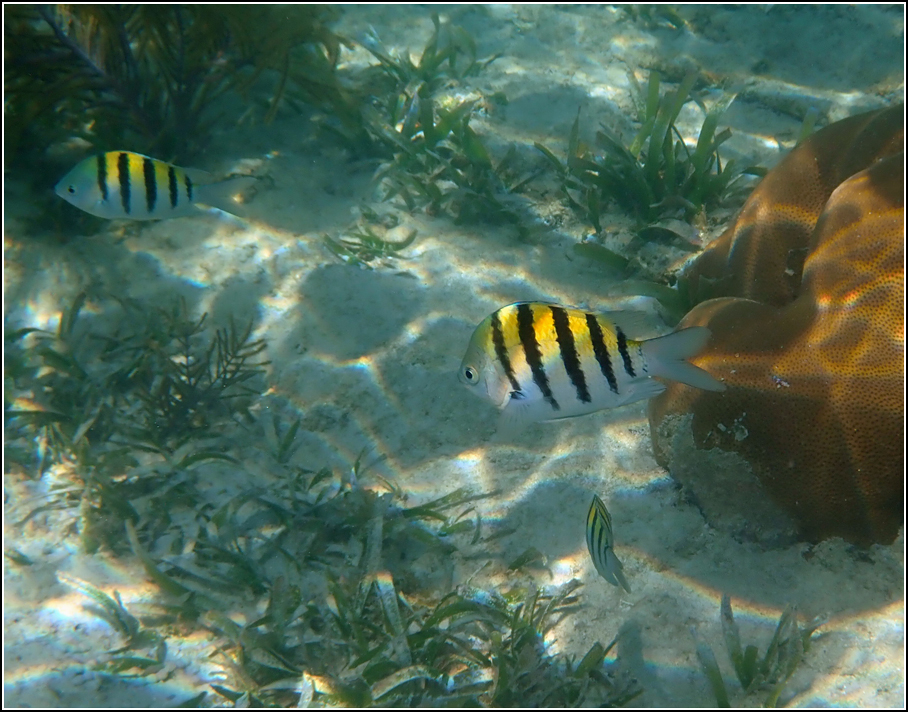
Atlantic Sergeant Major - Cayo Las Brujas, Villa Clara, Cuba

Yellowfin Majorra - Cayo Las Brujas, Villa Clara, Cuba

:Lunch on the catamaran consisted of spiny lobster, shrimp, fish, and much more!


A nice walk on a secluded beach gave us a chance to see several lizard species including Leiocephalus stictigator and Auber's Ameiva. Good numbers of Laughing Gulls, Brown Pelicans and Royal Terns hunted for fish just offshore, and we inspected some of the molluscs and chitons in the littoral zone.

Leiocephalus stictigaster - Cayo Frances, Villa Clara, Cuba

Bleeding Tooth Nerite - Cayo Frances, Villa Clara, Cuba

West Indian Fuzzy Chiton - Cayo Frances, Villa Clara, Cuba

Shell Mound Pricklypear - Cayo Frances, Villa Clara, Cuba

 On our second full day at Cayo Las Brujas we met with local guide Edwin Ruiz Rojas to explore nearby Cayo Santa Maria. Edwin is an excellent guide and I highly recommend him. He knows the fauna of Cayo Santa Maria better than anyone, speaks excellent English, and is an incredible guide. We explored three areas throughout the morning: Sendero Pelo de Oro, Sedero Laguna de la Jicotea, and the brackish lagoons found beside the main road (south of the Golden Tulip Aguas Claras Resort, when looking at Google Maps).

Caribbean Land Hermit Crab - Cayo Las Brujas, Villa Clara, Cuba

Overall it was a very productive morning. Our first White-eyed Vireos of the trip as well as the local subspecies of Florida Land Snail were viewed well at Sendero Pelo de Oro, while we also had our best views of Cuban Black Hawk (apologies for the photo quality - it was taken with my phone through my binoculars).

Cueva Pelo de Oro - Cayo Santa Maria, Villa Clara, Cuba (photo taken during the 2015 tour)

Florida Land Snail - Cayo Santa Maria, Villa Clara, Cuba

Cuban Black Hawk - Cayo Santa Maria, Villa Clara, Cuba

Viewing the brackish lagoons alongside the main road is always a highlight for me. These lagoons are a haven for American Flamingos, wading birds, ducks and shorebirds, and seem to act as a very productive vagrant trap. On my first trip to Cuba in 2015, we discovered a pair of American Avocets on the lagoon which represented the first (and only) records of that species for Cayo Santa Maria. We had a Pectoral Sandpiper on the same trip; a rare winter record for Cuba. Potential to find unusual birds is always high here, but even the usual species are fun to observe! Despite not having my big camera with me, I managed a few "record shots" with my phone through my spotting scope.

Greater Flamingo - Cayo Santa Maria, Villa Clara, Cuba

White-cheeked Pintail is a recent addition to the bird list of Cayo Las Brujas according to Edwin. The flock has grown in recent months to several dozen, and they can usually found at the brackish lagoons. We had fantastic views of several individuals.

White-cheeked Pintail - Cayo Santa Maria, Villa Clara, Cuba

The "best" bird of our time here was a Least Bittern that Jean Hampson spotted along the water's edge. Fortunately several others were nearby and we all managed to see the skulker before it slunk back out of view. I was fortunate to take a single record photo through my scope before it disappeared. While Least Bitterns are uncommon but regular winter visitors to mainland Cuba, this was the first record for Cayo Santa Maria according to Edwin.

Least Bittern - Cayo Santa Maria, Villa Clara, Cuba

The third location that Edwin took us to was the trail leading to Laguna de la Jicotea, located a fit further east on Cayo Santa Maria. 

Following Hurricane Irma which devastated the area in 2017, Edwin noticed a Black-faced Grassquit along this trail. In the time since the grassquit has been reliably found in the area, often accompanying a Cuban Bullfinch. It was late morning and the sun's intensity had increased but we gave it a try anyways. After some playback, a small flock of birds flew in that included several Cuban Bullfinches and our target, the Black-faced Grassquit. While widespread throughout much of the Caribbean, Black-faced Grassquit is a rarity in Cuba and not one we were expecting! It is the bird on the left in the photo below. Again, this photo was taken with my phone through my binoculars so the image quality is not great. 

Black-faced Grassquit (bottom left) - Cayo Santa Maria, Villa Clara, Cuba

We found a few other things on our walk, including a Cuban Racer that disappeared before I could get the rest of the group on it, a Cuban Treefrog and a nice variety of lizards.

Cuban Racer - Cayo Santa Maria, Villa Clara, Cuba (photo taken during the 2015 tour)

That afternoon we had some free time to relax on the beach. The following morning we made the long drive to Havana, where our trip would be concluding. We enjoyed a full day exploring Havana followed by our Farewell Dinner at the excellent Cafe del Oriente, located in old Havana. I would like to thank my group for being great travel companions. It was an excellent trip!

----------

Cuba Part 1: Western mountains and valleys (February 7-9, 2019)
Cuba Part 2: Cienega de Zapata (February 10-12, 2019)
Cuba Part 3: Escambray Mountains, Cayos Las Brujas + Santa Maria (February 13-17, 2019)