Monday, 15 July 2013

Dragons

I photographed the odd dragonfly here and there in northern Ontario as well. My dragonfly knowledge is close to zero, but I've been putting in about an hour per month of practice, so I should be an expert on Ontario dragonflies in about 200 years.

Feel free to correct me where I made ID mistakes! I still do not have a net or a really good dragonfly guide (I just have Dragonflies Through Binoculars), so that is my excuse.

The closest I can come up for this is a female Frosted Whiteface. Correction: It may be a Hudsonian Whiteface.


An easy one! Common Whitetail.


Horned Clubtail? Or Beaverpond Clubtail? Correction:

The first clubtail is a Horned Clubtail, and the next two are probably both Beaverpond Clubtails.


This huge dragonfly was chasing away other insects from the mouth of the creek he was patrolling. This is a Delta-spotted Spiketail.


And for a change of pace, an American Toad that was sitting on this log in the middle of the path. Luckily I looked down just in time! This was taken with my work phone.

Sunday, 14 July 2013

Insects in the north

July can be a slow time for birds. With the exception of a few shorebirds and some warblers/flycatchers, almost no migration is happening. Most species have stopped vocalizing as they are busy rearing their young. After the rush of spring migration followed by a few months of fieldwork I am usually pretty sick of birds by July! Fortunately, mid summer is the best time for insects, so that is what I have been turning my attention to lately. This post will cover some of the butterflies that I photographed up north in late June.

On some of the sites we were surveying, Silvery Checkerspots outnumbered the (usually abundant) Northern Crescent.

Silvery Checkerspot - Timmins, ON

Near our Timmins site I finally photographed a Dreamy Duskywing.

Dreamy Duskywing - Timmins, ON

Hobomok Skippers are unique in that they have a fairly rare dark form, called the "pocahontas" form. Near Sudbury I found a big patch of Hobos that contained this "pocahontas" individual.

"pocahontas" form Hobomok Skipper - Sudbury, ON

"pocahontas" form Hobomok Skipper - Sudbury, ON

This is what a "normal" Hobomok Skipper looks like.

Hobomok Skipper - Sudbury, ON

I finally saw my first ever Harris's Checkerspot on the Sudbury site as well. This species can be difficult to tell apart from a Silvery Checkerspot, though they usually are darker and the submarginal spots on the hindwing often touches the black border. They are much easier to ID when you can see the underside of the wings.

Harris's Checkerspot - Sudbury, ON

European Skippers, while abundant over much of their range, are often quite photogenic. I lucked out with this individual and managed a couple of photos which I am pleased with. First, here is one nectaring on some Orange Hawkweed. Both the nectarer and nectaree are native to Europe, though both have been introduced in North America and are widespread..

European Skipper - Sudbury, ON

I'm really happy with the following photo. When photographing it, I noticed the darker patch in the vegetation behind it. I lined up the butterfly so that it was centered in the dark patch, surrounded by the lighter green grass.

European Skipper - Sudbury, ON

Friday, 12 July 2013

Cute baby turtle photos.

Who doesn't like baby turtles? They are pretty damn cute, and I would wager that if you don't agree with me, you probably have no soul or something.

Way back on June 26th I was photographing dragonflies along the edge of a wetland near Mattawa. This bad-ass black and yellow dragonfly caught my eye (it ended up being a Dragonhunter), and as I was watching it chase after other dragonflies and trying to photograph it, the glint of a turtle shell made me look twice at the pile of sticks and debris along the edge of the stream connecting two larger wetlands.

It was a yearling Painted Turtle.

Midland Painted Turtle - Mattawa, ON (June 26, 2013)

Midland Painted Turtle - Mattawa, ON (June 26, 2013)

Turtles have very low recruitment rates mainly due to high nest predation. Dozens of eggs are laid each season by gravid females, yet some turtles will go their entire lives without producing any offspring. It's always a nice sign to see a baby turtle, even if it is a Painted Turtle, the only non Species at Risk turtle in Ontario.

Midland Painted Turtle - Mattawa, ON (June 26, 2013)

Monday, 8 July 2013

Southern Ontario shenanigans for Canada Day (part 4: Turtles)

On the last day of the long weekend I met up with Pauline Catling to help her with some turtle wrangling. She is working for the summer on both an Eastern Foxsnake telemetry project, as well as a nesting turtle project. The location where she is working from has nearly 100% nest predation (mostly raccoons and skunks), so they are collecting eggs from nesting turtles and artificially incubating them. Unfortunately the day was cool and rainy - not ideal conditions for most of the species. However, the rain kept the tourists off the beach which was a plus!

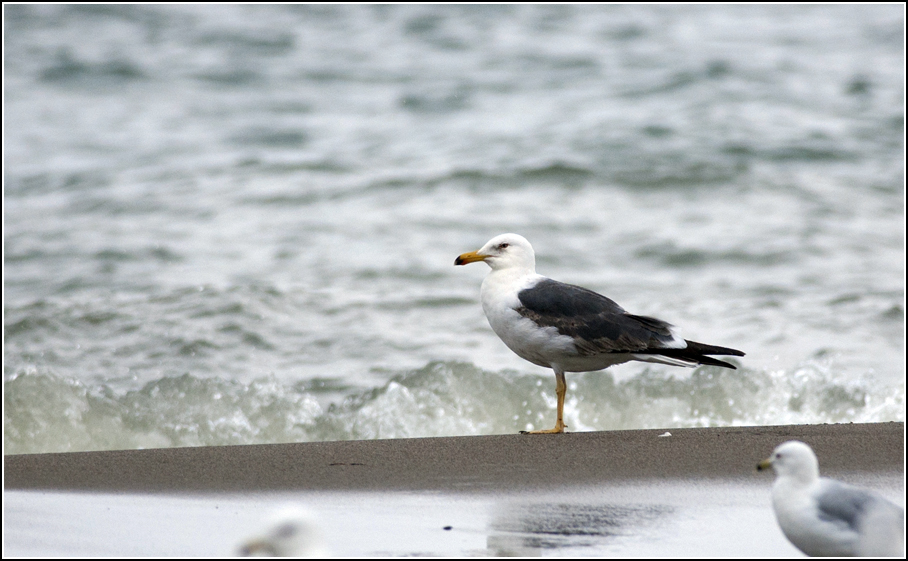
While we were walking, I kept an eye on the various flocks of gulls. One flock contained this Lesser Black-backed Gull which is either a 2nd cycle or 3rd cycle.

Lesser Black-backed Gull - July 1, 2013

Lesser Black-backed Gull - July 1, 2013

Turtles were nowhere to be seen but luckily a few snakes were oot and aboot. I stumbled upon a 750 gram Eastern Foxsnake out cruising around (it was pushing 5 feet in length). I must admit it was pretty exciting seeing it stretched out in the dunes. This was the best photo I could manage as he didn't want to sit still for long.

Eastern Foxsnake - July 1, 2013

The first few autumn migrants, 2 Lesser Yellowlegs and a Least Sandpiper, were along the water's edge. Now that fall migrants are showing up and the days are getting shorter, it is only a matter of time until the snow is flying!

Lesser Yellowlegs - July 1, 2013

Around mid afternoon we finally came across a turtle on the beach to lay her eggs. She was a massive Common Map Turtle, and she had a scar from what appears to be a boat propeler. It looks to be a fairly recent injury, though it was healing. She ended up being the only turtle of the day.

Common Map Turtle - July 1, 2013

Map turtles in general show strong sexual dimorphism, with the females being significantly larger than the males. In Common Map Turtles, adult females top out at 11 inches in carapace length, while males top out at around 6 inches.  Females have large powerful jaws; perfect for crushing molluscs and crayfish. Males on the other hand usually consume aquatic insects and smaller crustaceans.

Common Map Turtle - July 1, 2013

It was a pretty successful weekend overall with a lot of great sightings and slightly better weather than what I was expecting. I certainly miss living in southwestern Ontario where I was just "around the corner" from all of these great places.

Sunday, 7 July 2013

A few DICKs (with photos)

By the way, DICK is the banding code for Dickcissel. No, YOU grow up!


Anyways, last Saturday I was successful in acquiring my first decent Dickcissel photos. The male was very cooperative, singing his heart out virtually non-stop with the female lurking in the shrubs nearby.


Dickcissels are in the Cardinalidae family, along with species such as tanagers, cardinals, some buntings, etc. They used to be considered more closely related to Emberizidae sparrows, and in appearance essentially look like a colorful House Sparrow.


Dickcissels are not a annual breeding species in Ontario, though often by mid summer several males show up in the banana belt of Ontario. They seem to be strongly affected by drought, and last year's prolonged drought in the midwest of the United States pushed many Dickcissels farther north. They could be found in a variety of locations; basically anywhere there was a large weedy field. I was doing some fieldwork in Rainy River last summer and stumbled across maybe 4 Dickcissels. They are actually a "review species" for northern Ontario (meaning they are rare enough that sightings are reviewed by the Ontario Bird Records Committee), yet over a dozen were reported in the Rainy Rive District. This year they are much less common, but nonetheless sightings have occurred in multiple places in Essex and Chatham-Kent, and as far away as Sault Ste. Marie and Luther Marsh.


So there you go, a few nice closeup photos of a DICK.


Friday, 5 July 2013

Southern Ontario shenanigans for Canada Day (part 3: Point Pelee)

I arrived in the Pelee area late on Saturday night, though I had just enough light to check out Ridgetown and Blenheim on the way down. No one seems to check these lagoons this time of year, and for good reason. There was nothing interesting at either. It was in the first half of July last year that I found an American Avocet at Blenheim, but that was not the case this time!

I slept in my car Saturday night at my "usual spot", and despite an interesting interaction with a local police officer, I was not forced to relocate to a new area. Thanks for not making me leave! :)

I met up with some Lame Leamington Birders and we walked down the west beach to the tip. The birds were scarce, though we did find a few cool insects. Pauline pointed out this Giant Swallowtail caterpillar resting on a Hop Tree, one of its foodplants. Most people (including me) would just pass it off as bird shit.

Giant Swallowtail - Point Pelee (June 30, 2013)

We arrived at the tip around 10:00 AM, though unfortunately the tourists had flushed all of the gulls and terns off the tip by the time we had arrived. Ah, the joys of birding at a National Park on Canada Day weekend. Later at the Visitor's Center we heard about a probably ROYAL TERN that was reported at the tip first thing in the morning by some visiting birders from Quebec. If accepted, that would only be the 2nd ever record for Ontario. Oh well, that's how she goes sometimes...All what we could turn up was a few Lesser Black-backed Gulls.

We stopped at the Visitor's Center to check out the Book of Lies (a.k.a. sightings book). While we were standing outside, we heard a distant buzz which sounded like a Northern Parula. We followed the sound to behind the VC, and sure enough it was a Parula singing away! They don't breed in southwestern Ontario, however the odd individual is sometimes seen migration hotspots like Pelee. This is almost certainly an unmated male who did not make the trip far enough to reach the breeding grounds.

The Point Pelee Book of Lies (a.k.a. sightings book) has had some doozies over the years. Apparently some of the recent reptile and amphibian sightings in the park included a Queen Snake and Jesus. Which do you think is more likely to actually show up at Pelee? Under the "Jesus" entry, the comment put was "Majestic".

recent Jesus and Queen Snake sightings

A check of Towle Harbour produced over 200 Forster's Terns, certainly the most I've seen here before. An adult Great Black-backed Gull with a broken wing was looking slightly forlorn.

Great Black-backed Gull - Towle harbour (June 30, 2013)

After a great meal at the Big Red Bus across from Pelee Wings, we headed back into the park to drink refreshments and look for insects. I've been getting into dragonflies a bit lately, and even common species are new for me. I believe this is a female Eastern Pondhawk.

Eastern Pondhawk - Point Pelee (June 30, 2013)

Female Common Whitetail

Common Whitetail - Point Pelee (June 30, 2013)

Before I left the Pelee area, we checked the shorebird cell at Hillman Marsh where I had heard a few Dickcissels singing earlier in the day. Sure enough, one male was singing non-stop and his lady-friend was nearby. I'll post some more photos in a subsequent blog post, but here is one for now.

Dickcissel - Hillman Marsh (June 30, 2013)

Wednesday, 3 July 2013

Southern Ontario shenanigans for Canada Day (part 2: Eastern Hognose Snakes!!!)

After the success of finding the foxsnakes in a new area, we continued on and checked some "tried and true" areas, hoping to turn up an Eastern Hognose Snake. Some usually productive areas on the way failed to reveal the desired Smooth Greensnake, though we did see handfuls of Midland Brownsnakes. We hypothesized that the lack of Smooth Greensnakes was due to the abundance of Midland Brownsnakes. Brownsnakes seem to be common in areas where other species are not!

Brownsnake - June 29, 2013

Some of the snakes were basking several feet off of the ground in the vegetation. It was something that I had never seen before with what is normally considered a somewhat fossorial species. This is a common behaviour in the tropics where the forest floor rarely sees sunlight in some areas.

Brownsnake - June 29, 2013
Jon and I were walking a stretch of road that had been productive for hoggies in the past. I was scanning from left to right, my vision and hearing on high alert, hopeful to catch a glance of a coil or hear the quiet rustle of a snake moving slowly through the dead leaves and sand. It didn't take long before I glimpsed a sight which made my heart stop for a second - a coiled Eastern Hognose Snake beside the road!

Eastern Hognose Snake - June 29, 2013

Jon and I were pretty happy that we were able to predict an area where we might find one, and actually be right! It took less than 5 minutes, too. This was my first Eastern Hog in a few years, and I was super stoked to observe it for a while.

Eastern Hognose Snake - June 29, 2013

Eastern Hognose Snakes have evolved an interesting set of behaviours to deal with potential predators. The large "eye spots" and flared neck seem to give off the same appearance as a cobra, as you can see in the photo above. Admittedly I haven't researched why they have this apparent mimicry, but it sure seems pretty badass. This snake appeared only mildly annoyed with our presence, and so it only flared its neck and hissed briefly. But if one feels threatened, it may roll over and pretend to be dead. The act is made more believable by the snake defecating, regurgitating it's last meal, and hanging its tongue out of its mouth. The actor can be exposed by simply turning the snake back over - they will roll back onto their back immediately!

Eastern Hognose Snake - June 29, 2013

Eventually the snake slowly crossed back to the other side of the road and slowly disappeared into the vegetation.

Eastern Hognose Snake - June 29, 2013

We continued on along the road edge and Jon found the second hog not long after! We kept our distance from this one so as to not disturb it. Eastern Hognose Snakes are quite variable and can range in dorsal colour from pitch black to orange to olive like these individuals. Some have strong patterning while others are rather plain.

Eastern Hognose Snake - June 29, 2013

Not to be outdone by the hogs, several dozen Eastern Gartersnakes were also basking along the edge of the road and the woods. This is Ontario's most abundant species, likely due mostly to its cold tolerance, varied  and generalist diet, and wide variety of suitable habitat types that it will occupy.

Eastern Gartersnake - June 29, 2013

After walking the length of the road, we were happy to see that a 3rd hog had joined the 2nd! This one was a little younger, yet it also possessed the same pattern. Perhaps these snakes are related in some way.

Eastern Hognose Snake - June 29, 2013

Our snake totals at the end of the day were:
~ 30 Eastern Gartersnake
~25 Midland/Northern Brownsnake
3 Eastern Hognose Snake
2 Eastern Foxsnake
1 Northern Redbelly Snake

The diversity was a little low (Jon's had up to 9 species here in a day) but the quality certainly made up for it.

Tuesday, 2 July 2013

Southern Ontario shenanigans for Canada Day (part 1: foxsnakes!)

This past weekend I decided to check out some of my not-so-local haunts in southwestern Ontario. Less than 2 hours after arriving in the door after our 14-day work trip to the north, I had showered, shaved, done laundry, ate dinner, and was back on the road. My itinerary was to hang out with Jon, a fellow herper, on the Friday night and check out some spots in Norfolk County with him on the Saturday. Then Sunday I planned to meet up with some people to check out the birds, butterflies, and beers at Point Pelee (though unfortunately we had to provide our own beer). And finally on Monday I would help out my friend Pauline with some turtle surveys. It was bound to be a busy weekend!

By mid-morning Saturday, Jon and I were finally out the door. It was cool but the temperature was on the increase, and our first few stops produced several Eastern Gartersnakes, Northern Red-bellied Snakes, and Midland Brownsnakes. It was on our fourth or so stop that we struck gold, as Jon discovered two beautiful Eastern Foxsnakes hanging out together near an abandoned building. The younger snake, probably born late last summer, was what we refer to as "in shed". At this time, a few days prior to ecdysis, the eyes become cloudy and the skin loses its vibrancy. However the larger snake had a beautiful pattern, and so we snapped a few photos before sending her on her way.

Eastern Foxsnake - June 29, 2013

Eastern Foxsnake - June 29, 2013

Eastern Foxsnakes are about as close to an Ontario endemic that one will find with a species of snake. They are entirely a coastal Great Lakes species, being found in 3 small areas within Ontario, and a few counties of northwestern Ohio and eastern Michigan. About 70% of their range lies within Ontario, and even here they are Endangered. It is for that reason that I think the Eastern Foxnake deserves the distinction of being a national symbol - much more so than the Beaver, Moose, or Common Loon.

Eastern Foxsnake - June 29, 2013

I really love my Tamron macro lens that I bought back in 2008. The image quality is on par with the Nikon 105 mm f/2.8 macro, and it is about half the price due to the fact that it isn't a Nikon. The following image is "straight out of the camera", save for a slight crop. Unfortunately, re-sizing the image for the blog significantly decreases the image quality. This lens is sharp as a tack.

Eastern Foxsnake - June 29, 2015

Unfortunately, in Ontario Eastern Foxsnakes are found mostly in the build up, agricultural southwest. Roads criss-cross the landscape in a tide grid pattern, and many thousands of Eastern Foxsnakes lose their lives on these roads. Fortunately for the Norfolk County snakes, the Nature Conservancy of Canada is doing a great job buying up land and converting it into restored habitat. No doubt this benefits the Eastern Foxsnake as well as myriads of other species of flora and fauna!

Eastern Foxsnake - June 29, 2013

The next post will cover the rest of the finds from that day, as we lucked out with a bit of Eastern Hognose Snake action.