Sunday, 3 April 2016

Columbia - Day 1 (January 17, 2015): Isla de Salamanca, Minca, El Dorado

Introduction
January 17, 2015 - Isla de Salamanca, Minca, El Dorado lodge
January 18, 2015 - Cuchilla de San Lorenzo, El Dorado lodge
January 19, 2015 - Cuchilla de San Lorenzo, El Dorado lodge
January 20 and 21, 2015 - El Dorado lodge to Minca
January 22, 2015 - Minca, drive to La Guajira Desert
January 23, 2015 - La Guajira Desert
January 24, 2015 - PNN Tayrona, fly to Andes
January 25, 2015 - Bogotá area: PNN Chingaza, Siecha wetlands
January 26, 2015 - Laguna de Pedro Palo, Payande area
January 27, 2015 - Cañón del Río Combeima, SFF Otún Quimbaya
January 28, 2015 - SFF Otún Quimbaya, drive to Montezuma Road
January 29, 2015 - Montezuma Road
January 30, 2015 - Montezuma Road, drive to Jardín
January 31, 2015 - Jardín area, Cauca Valley
February 1, 2015 - Reserva Ecológica Río Blanco
February 2, 2015 - Páramo del Ruiz near PNN Los Nevados

--------------------------------------------------------------------------


I arrived in Colombia during the wee hours of January 17 after an uneventful flight from Toronto, making both of my short connections (Newark, NJ and Panama City) before landing in the city of Barranquilla near the Caribbean coast. I stepped outside and was met with the warmth of the tropics, a welcome change after the deep cold that had set in back home in Ontario. It was my first time in South America and I was pretty excited for what the next few weeks had in store! I grabbed a taxi to the hotel where the guys were staying and slept for a couple hours before our early alarms would go off. 

By 5:00 AM we were awake, the other guys eager to start this second week of their trip, now in a new location with a different suite of birds. I met Dan Wylie for the first time and reconnected with Daniel Riley and Steve Pike. We arrived at our destination for the morning, Isla de Salamanca, by 6:00 AM as dawn broke. 

This region of northern Colombia has a high number of bird species found nowhere else in the world, or shared with neighbouring Venezuela. The Sierra Nevada de Santa Marta hold at least 21 endemic species, with several more likely coming with future splits. The nearby dry, desert-like Guajira region of northeastern Colombia/northwestern Venezuela also has a number of endemic species. Our reason for visiting the mangroves of Isla de Salamanca was to search for a few specialties of this area including Chestnut-winged Chachalaca, Bare-eyed Pigeon, Russet-throated Puffbird, Chestnut Piculet, and the endemic Sapphire-bellied Hummingbird. 

birding the mangroves with (left to right): Daniel Riley, Steve Pike,  and Dan Wylie - Isla de Salamanca, Magdalena Province, Colombia

car in need of a few repairs - Isla de Salamanca, Magdalena Province, Colombia

It was fantastic to be birding and exploring again in a new country, where exciting things were seemingly around every bend. After paying our entrance fees at the gate we set out on foot towards the seasonally flooded forest at the edge of the mangroves. A flowering tree was popular with several hummingbirds and after a short vigil a male Sapphire-bellied Hummingbird landed and perched quietly on a lower branch! Endemic to a small stretch of mangroves along coastal northern Colombia, it is thought by some that this "species" may just be a colour variant of the very similar Sapphire-throated Hummingbird, which also occupies the same areas. Regardless of its status, we enjoyed views of this bird in comparison with the numerous Sapphire-throated Hummingbirds.

Sapphire-bellied Hummingbird - Isla de Salamanca, Colombia

female Sapphire-throated Hummingbird - Isla de Salamanca, Colombia

Brown-throated Parakeets were feeding on the blossoms, providing good photo opportunities, and one of the guys spotted this Lesser Nighthawk, perching quietly on a horizontal branch at the edge of the woodland.
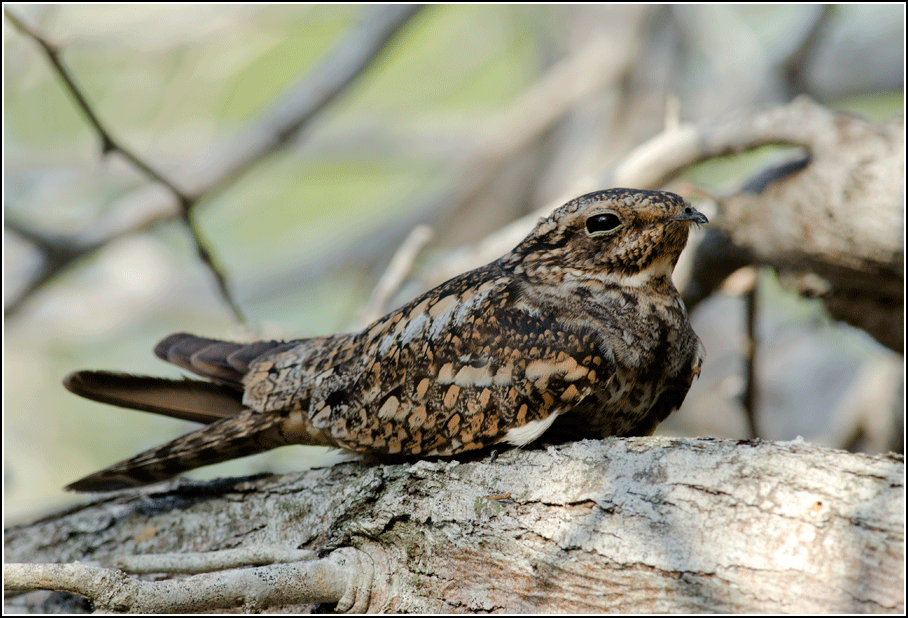
Lesser Nighthawk - Isla de Salamanca, Colombia

Brown-throated Parakeet - Isla de Salamanca, Colombia

We explored the woods at the edge of the mangroves, eventually spotting our first Chestnut Piculets, Russet-throated Puffbirds, various flycatchers and a Straight-billed Woodcreeper. The most common bird in this habitat type was Prothonotary Warbler. They winter here in large numbers and viewing them this well was quite different than what we are used to seeing in Ontario.

Eventually we ventured on a boardwalk through the mangroves to a small observation tower. It was now midmorning and the bird activity was going strong along the edges of the mangroves. Eventually a small flock of one of our targes, the Bicolored Conebill, appeared, allowing great looks before continuing onwards. Single Large-billed Terns flew over periodically, a species that I was really happy to see. Their striking wing-pattern is quite obvious at a distance. Both the conebills and the terns were a little too distant for good photos, so these heavily cropped ones are all I have.

Bicolored Conebill - Isla de Salamanca, Colombia

Large-billed Tern - Isla de Salamanca, Colombia

Some brief looks were had at Pale-eyed Pigeons winging by, and the day list climbed as quickly as the temperature, gradually slowing down bird activity. One last surprise was a small group of Chestnut-winged Chachalacas calling from the other side of the road, with at least a couple of the birds sticking around long enough for good, though distant views. A great start to the trip and by 8:30 we were on our way to the next destination.

We crossed the long causeway connecting Isla de Salamanca to Cienaga, adding our only White-cheeked Pintail for the trip along with some common terns, waterfowl, and Magnificent Frigatebird. By 10:00 AM we turned off the highway to begin our climb towards the Sierra Nevada de Santa Marta and El Dorado, our base for the next four nights where we hoped to see most of the endemic species this unique area has to offer.

view from Minca, Magdalena Province, Colombia

We added about 20 bird species (most of them common dry forest species) prior to our noon arrival at the town of Minca, where we were to meet our driver, Pedro. The plan was for Pedro to be our ride up the somewhat difficult road into the mountains.

birding at the Minca hotel, Magdalena Province, Colombia

While waiting for Pedro, we enjoyed lunch with several cold beers at the terrace of Hotel Minca. The hotel overlooks a scenic valley, but even better was that they had an extensive hummingbird feeder setup. Not only was it easy to add several new birds here, but the views and photographic opportunities were excellent. White-vented Plumeleteer, White-necked Jacobin, Steely-vented Hummingbird and Rufous-tailed Hummingbirds were the most common species, while we also saw Long-billed Starthroat, Red-billed Emerald, Rufous-breasted and Pale-bellied Hermit, and Black-throated Mango.

Steely-vented Hummingbird - Minca, Magdalena Province, Colombia

Rufous-tailed Hummingbird - Minca, Magdalena Province, Colombia

Rufous-tailed Hummingbird - Minca, Magdalena Province, Colombia

White-vented Plumeleteer - Minca, Magdalena Province, Colombia

White-necked Jacobin - Minca, Magdalena Province, Colombia

Pale-bellied Hermit - Minca, Magdalena Province, Colombia

Long-billed Starthroat - Minca, Magdalena Province, Colombia

Steely-vented Hummingbird - Minca, Magdalena Province, Colombia

Steely-vented Hummingbird - Minca, Magdalena Province, Colombia

Steely-vented Hummingbird - Minca, Magdalena Province, Colombia

Steely-vented Hummingbird - Minca, Magdalena Province, Colombia

Steely-vented Hummingbird - Minca, Magdalena Province, Colombia

Panama Flycatcher - Minca, Magdalena Province, Colombia

By early afternoon we had met Pedro and began the long drive up the mountain in his high clearance Toyota 4x4.


We made frequent stops as we slowly rumbled up the rapidly deteriorating road, occasionally adding new birds with each change in elevation. While the time of day was not ideal for productive birding, the road passed through various habitat types including dry forest near Minca, coffee plantations, and open scrubby areas mixed with wetter forests. I added 12 life birds just in the drive up, including this Golden-faced Tyrannulet.

Golden-faced Tyrannulet - road to El Dorado, Magdalena Province, Colombia

Our first few Santa Marta endemics appeared including a Santa Marta Foliage-Gleaner and a furtive Santa Marta Tapaculo that eventually gave good, if obscured, views. We were happy to spot a few more regional specialties in our first Golden-winged Sparrow of the trip and the only Scaled Piculet we would see.

road between Minca and El Dorado, Magdalena Province, Colombia

It was nearing dusk as we rolled up to the entrance to the El Dorado lodge, our base for the next four nights. A White-tipped Quetzal called shortly after arrival, and we also were acquainted with the local Band-tailed Guans that hang around the lodge - they were roosting in some trees above the road.

After settling in with our accommodations and eating dinner, we went out for a night-hike along the road leading to the lodge. Herps were our main priority and we were not disappointed as we found nearly a dozen frog species and several Savage's Salamanders (Bolitoglossa savagei), most found tucked inside the lower levels of the bromeliad fronds, waiting for insects to come to them.

Savage's Salamander (Bolitoglossa savagei) - El Dorado, Magdalena Province, Colombia


Ikakogi tayrona


Herps are definitely my top targets when night-hiking, simply because so many species can usually be readily found at this time, much more so than during the day. However, invertebrates also provide a fair bit of excitement and it is fascinating to study the wide variety of spiders, crickets, walking-sticks, beetles, ants and other invertebrates that are very visible when illuminated by the beam of a headlamp. These tarantulas were quite common, both out in the open presumably on the hunt for insects, or waiting back at the edge of the web tunnel.

*Update: The species is Kankuamo marquezi, part of a monotypic genus, and was only first described in 2016. It is restricted to areas on the northwest flank of the Sierra Nevada de Santa Marta, between 2000 and 2300 m in elevation.

Kankuamo marquezi

Kankuamo marquezi

The temperature cooled as the evening wore on, and reptiles remained hidden throughout our hike. It may have been a little too cold for snakes but the wide variety of frogs kept things interesting! We were hoping for owls too, as the undescribed form of Screech Owl is often heard and seen around the lodge and in the surrounding forest. We were pretty tired after a long day so we packed it in after an hour and a half, without having any luck finding calling owls.

Pristimantis ruthveni


Pristimantis sanctaemartae


Pristimantis sanctaemartae

Pristimantis sanctaemartae

At the end of the day we finished with a respectable 108 bird species, 29 of which were lifers for me. The plan for the next day was one that I had anticipated all winter - a drive to the San Lorenzo ridge at dawn, high up on the mountain. The views from the top were supposedly incredible, but more importantly, the majority of the endemic species of the Santa Marta range could be found there.

Sunday, 20 March 2016

Colombia: January 17 - February 2, 2015: Intro

Introduction
January 17, 2015 - Isla de Salamanca, Minca, El Dorado lodge
January 18, 2015 - Cuchilla de San Lorenzo, El Dorado lodge
January 19, 2015 - Cuchilla de San Lorenzo, El Dorado lodge
January 20 and 21, 2015 - El Dorado lodge to Minca
January 22, 2015 - Minca, drive to La Guajira Desert
January 23, 2015 - La Guajira Desert
January 24, 2015 - PNN Tayrona, fly to Andes
January 25, 2015 - Bogotá area: PNN Chingaza, Siecha wetlands
January 26, 2015 - Laguna de Pedro Palo, Payande area
January 27, 2015 - Cañón del Río Combeima, SFF Otún Quimbaya
January 28, 2015 - SFF Otún Quimbaya, drive to Montezuma Road
January 29, 2015 - Montezuma Road
January 30, 2015 - Montezuma Road, drive to Jardín
January 31, 2015 - Jardín area, Cauca Valley
February 1, 2015 - Reserva Ecológica Río Blanco
February 2, 2015 - Páramo del Ruiz near PNN Los Nevados

--------------------------------------------------------------------------


It has been a busy winter for me with lots of traveling. I am fortunate to have a job providing the opportunity to bank hours during the busy season, which I take as time off during the winter months. As I value traveling much more than having a large number in my bank account, this is the third winter that I have done a birding trip to Central or South America (this year it was Chile and Argentina for the month of January). Other trips this winter included Nova Scotia over Christmas, Cuba in February, and most recently a work trip to Alberta in early March to complete some raptor surveys. I am currently in Barcelona, Spain with Laura and we will be spending the next 12 or so days in eastern Spain. We will be renting a car tomorrow morning and checking out the plains, steppe, coastline and of course the Pyrenees. There are not a ton of potential life birds for me in this part of Spain as many of the species here I have seen in Portugal, Morocco, France and previously in Spain, but with a little luck I may see 15 or so new bird species. I don't have a huge target list but I am hoping to see a few particular species - Lammergeier, Wallcreeper and Black Woodpecker are on my most wanted list! Herps of course are also big targets for us - while the weather forecast is for relatively cool weather and it is still early spring, we are really hoping for some lizards or even a snake or two!

Greater Flamingos (and Great Cormorant) - Delta del Llobregat, Spain


In the meantime, I wanted to get started with posting some of my photos from the epic adventure I had in Colombia last winter.  Accompanied at various points by Daniel Riley, Steve Pike, Dan Wylie, David Bell and Adam Timpf, we explored a small fraction of the stunningly beautiful natural areas found throughout Colombia. It was perhaps the most fun I have had on a birding trip, and Colombia is a place I will certainly be returning to at some point. It just might be my favorite country that I have explored so far.

Colombia had always been on my radar as a potential travel destination simply for the fact that it has the highest bird list out of any country - well north of 1900 species currently, with more added every year. Some sources list Colombia as the second most biodiverse country in the world (behind Brazil), and most biodiverse country per square kilometer due to its relatively small size. A stunning 10-20% of the world's plant species can be found within its borders! It has the second highest amphibian list of any country, and third highest reptile list. Colombia has more endemic species (species not found anywhere else) than any other country.


Part of what makes Colombia so biodiverse is the wide range of ecological regions found throughout the country - up to 32 unique terrestrial biomes, per Wikipedia.. The Andes run through the center of the country, splitting into three ranges (each with its own unique species), and separated by hot, dry valleys. Covering the land east of the mountains is an area referred to as the pampas, essentially tropical grasslands and marshes. The Amazon Basin covers the southern and eastern extent of the country, while the Choco lowlands form the area west of the Andes along the Atlantic Coast, up through to Panama. Desert can be found in several areas including the extreme northeast of the country. The Sierra Nevada de Santa Marta are the world's highest coastal mountains, reaching an elevation of 5,700 m. This isolated mountain range is near the north coast of the country, completely surrounded by lands with elevations below 200 m. As a result, these mountains contain a vast number of endemic species that aren't shared with the nearby Andes, including over 20 endemic bird species (with more to come with future "splits"). In fact there are most bird species in this small mountain range than the entire continental United States!

White-tailed Starfrontlet - Sierra Nevada de Santa Marta

Dan Riley and I had talked about doing a trip during the early months of 2015 with Colombia being a potential destination. David Bell and Steve Pike, who I had traveled to Panama with the previous year, were interested as well; Dave in particular was hoping to travel in South America for much of the winter. Dan Wylie, a friend of Steve's, was able to join, while Adam Timpf was planning on being in South America as well.

Eventually a rough trip began coming together. Dave and Adam decided on traveling throughout Colombia for two months, while Steve and Dan Riley were able to devote about three weeks. I could do just 2.5 weeks and Dan Wylie just under two weeks.

Parque Natural Nacional Los Nevados

Dan, Dan and Steve spent the first 5 days or so at Mitu, located in the heart of the Colombian part of the Amazon. I met up with them in Barranquilla in the north of the country, and we birded the Sierra Nevada de Santa Marta as well as the desert to the northeast of here. We then flew to Bogota where we said goodbye to Dan Wylie and picked up David, while also birding with Adam periodically. We rented a car and driver and completed a big loop of the Andes, visiting all three ranges and the valleys in between. It was a whirlwind 10 days through the Andes and we might have bitten off more than we could chew as it often left us with half a day of birding followed by long 6-8 hour drives each day. Despite the hectic schedule we managed to see most of our target species including a large portion of the endemics. In the 2.5 weeks I ended up with almost 600 bird species, of which 362 were new for my life list - an average of over 21 lifers a day!

Chestnut-crowned Antpitta - Rio Blanco

I will try to make one blog post for each day of the trip, similar to my trip report from Panama in 2014. Stay tuned...

Saturday, 12 March 2016

2015-2016 Ontario winter bird list

As we are now well into the month of March with temperatures rising well above the freezing mark and new spring migrants arriving daily, the winter birding season is now firmly in the rearview mirror. The winter birding season stretches from the beginning of December through the end of February and keeping a winter list has become a pretty popular thing to do throughout Canada (and gaining traction in the States as well). I was approached by the late Blake Maybank several years ago to see if I had any interest in compiling the Ontario sightings; this is now my fifth winter keeping track of the official list. For those interested, I have created a spreadsheet visible here which includes the tallies from all the winters since 2007-2008, as well as the cumulative total of species that have records during the winter period in Ontario.

This most recent iteration of winter was one of the mildest I can recall, and perhaps one of the mildest all time not only in Ontario but throughout much of North America. As a result it is no great surprise that 221 species were reported, our second highest total ever behind the 224 during the winter of 2011-2012. In general, the vast majority of "good" winter birds are found during the first few weeks of December, as lingering birds that are normally well south of Ontario are discovered before the cold winter weather really sets in. Generally, few birds are added to the list in the latter half of January and throughout February.

An exceptionally warm December this winter allowed many unusual birds to persist in this province until their discovery, as extended periods of temperatures below the freezing mark never happened in the south of the province. This set the tone for the rest of the winter; even into January, word of new species for the list kept trickling in.


The birders in Eastern Ontario produced many of Ontario's highlights in 2015 and they did not slow down into December. Ontario's first ever, and long-awaited, Pink-footed Goose was discovered near Casselman in late October, eventually continuing until December where it became the first "winter" record for the province. A Northern Fulmar was also discovered along the Ottawa River, one of few chaseable individuals of this species ever to be seen in the province. Unfortunately it was just a one-day wonder so only local birders were able to view it. A Summer Tanager survived much of the winter in Ottawa, an extremely late Wood Thrush was discovered on the Ottawa-Gatineau C.B.C. on December 20, while a Smew spent several at least 10 days on the St. Lawrence River west of Cornwall. One of the highlights of the winter period was a female Bullock's Oriole found in Pakenham that entertained many birders during its stay of over a month. In early January it was taken in to a rehabilitation center by those concerned about its well-being as it was emaciated and in very poor health. While at the rehab center, genetic tests were run on the bird. While the oriole's mitochondrial DNA suggested that somewhere down the line it had Baltimore Oriole genes on its mother's side, a nuclear DNA marker suggested that both of its parent's were Bullock's Orioles. An informative post about its identification can be found here.  

While eastern Ontario produced many of this winter's highlights, many other interesting birds were discovered throughout the province. One highlight for many birders was a Vermilion Flycatcher that was quite reliable for several weeks in late December near Wallaceburg - only the sixth or so for the province. This southwestern rarity is quite unusual in Canada and many birders added it to their lists during its stay.

Vermilion Flycatcher - Wallaceburg (December 19, 2015)

Many lingering warblers were discovered in the province including several at famous Sedgewick Park in Oakville. Here a Palm Warbler appears to have successfully overwintered, while a total of 14 warbler species were reported throughout the province. Other warbler highlights included a Black-throated Green Warbler in Guelph and a Yellow-breasted Chat in Kingston.

Providing what is likely the first winter record for Ontario, two Bewick's Swans were found in a large flock near Shrewsbury in early February. Unusually, one of the birds appeared to be partially leucistic, while the other was "normal". I'm not sure what this means for the provenance of these individuals, and I'm not sure if we will ever know.

A Eurasian Tree Sparrow attended a feeder on the Bruce Peninsula from late November into at least early January, one of very few winter records for the province. In the last few years there have been quite a few records of this species in Ontario; a species native to Eurasia but introduced into the midwestern United States. It is presumed that the birds showing up in Ontario are natural vagrants from the Illinois/Iowa/Missouri population. The widely reported and long-staying individual in Niagara-on-the-Lake during the winter of 2014-2015 received much more fanfare as it was the first chaseable one during the winter.

Eurasian Tree Sparrow - Niagara-on-the-Lake (December 5, 2014)

February is often a slow month for birding during Ontario - few rarities are observed, and most birders are at that point where they are just waiting for spring to arrive. I am also guilty of this and do my very best to vacate the province in search of warmer climates during the later stages of winter However, one intrepid birder discovered an Audubon's Yellow-rumped Warbler at Point Pelee, while a Spotted Towhee appeared at a feeder in Thunder Bay on February 7.

Mountain Bluebird had a good showing in the eastern part of North America for the first time in several winters. Two separate individuals were discovered within Ontario's borders including one south of Ottawa and this bird which spent about two weeks in late November/early December at Hall's Road, Whitby.

Mountain Bluebird - Whiby (November 30, 2015)

One of the least expected birds from this past winter was an Empidonax flycatcher discovered west of Kingsville in Essex County during the Cedar Creek C.B.C. on December 19. Any Empid found late in the autumn raises alarms as more often than not it ends up being one of the southwestern species. Numerous excellent photos were obtained of this bird and opinions of its identification included Yellow-bellied, Acadian and Western (Pacific-slope/Cordilleran), with the consensus at this time being that the bird was in fact a Yellow-bellied Flycatcher. This is one of very few winter records of Yellow-bellied Flycatcher for North America; needless to say almost unheard of in Ontario and quite possibly the bird of the winter! I know that several birders were hoping that it would turn out to be a first provincial record Western Flycatcher, as quite a few of them were discovered in the northeast during late autumn and early winter, but Yellow-bellied was even more unexpected. Unfortunately the bird was not relocated on subsequent days.

Quite a few other rarities observed in the province during the winter included a flyby Great Cormorant in Stoney Creek, a Eurasian Collared-Dove attending a feeder in Earlton, Timiskaming District, and a Rufous Hummingbird at a residence near Rice Lake. Two separate Gray-crowned Rosy-Finches were observed in northern Ontario as well - one in Thunder Bay and the other in Atikokan. This western finch has become annual in recent winters. Providing one of few winter records for Ontario, a Sora was discovered in Toronto and observed sporadically over an eight day period.

Pine Grosbeak - White River (January 25, 2012)

While it was a fantastic winter for the number of rarities that were seen, many of the winter specialties such as owls and finches remaining mostly in the north. Moderate numbers of Snowy Owls appeared in the southern part of the province, but Boreal, Great Gray and Northern Hawk Owls were all but absent. Crossbills, Pine Grosbeaks and Evening Grosbeaks were also fairly scarce (though the two grosbeaks were regular in central and northern Ontario), but redpolls showed up in moderate numbers. Bohemian Waxwings were also fairly scarce though a few flocks could be found here and there. 

There were no really big misses last winter, but, as is always the case there were a handful of species that usually are seen at some point that failed to show last winter. Some of these misses include Blue-winged Teal (found in 6 of last 8 winters),  Slaty-backed Gull (found in 6 of last 8 winters), Pomarine Jaeger (found in 5 of last 8 winters), and "Hornemann's" Hoary Redpoll (found in 5 of last 8 winters).

It was a great winter of birding, but spring is well on its way with new migrants arriving daily, and we are only about six weeks away from the first neotropical migrants. Bring it on!

Sunday, 28 February 2016

Home from Cuba

I have just returned from another excellent trip to Cuba, guiding for Worldwide Quest Nature Tours. This was my first time as the solo guide for Worldwide Quest and I have to say that it was a success! Together with Esmerido, the local guide from Gaviota Tours who accompanied us the entire time, we traveled through much of western Cuba, experiencing the natural areas, wildlife and culture of Cuba. Esmerido and I were fortunate to have such a great group of clients join us. Amazing moments searching for wildlife are that much more rewarding when you can share it with others.

As there were a number of keen birders on this tour, birds were of course high on the list of target species. Given our route we managed to squeeze out every possible endemic, many which gave excellent prolonged views for the group!

Perhaps one of the best moments of the trip was watching about six Bee Hummingbirds feed, fight, and flit about mere inches from us. We all came away with excellent photographs of this species, the world’s smallest bird and a tough endemic to get in Cuba. I was particularly pleased to photograph some of the males with their gorgeous gorgets, as my lone previous sighting was of a less flamboyant female.

Bee Hummingbird

Another great moment was watching a pair of Blue-headed Quail-Doves feeding in the open only a few meters from us. This endemic species to Cuba, classified as Endangered globally, has recently become reliable at Cuevos los Peces, a restaurant and popular snorkeling spot east of the Zapata Swamp. We ate lunch here and were called over by the staff when the Blue-headed Quail-Doves appeared for their daily feeding(!). This was a species that we had missed last year on our tour.

Other bird highlights, which I’ll detail in future posts, included a flyover Gundlach’s Hawk, all four Quail-Doves, hundreds of American Flamingos, a baby and adult Stygian Owl (the baby was perched at eye-level!), great looks at Cuban Pygmy-Owl and Bare-legged Owl, and a whole host of other species including the colorful and spectacular Cuban Tody, Cuban Trogon, and Cuban Green Woodpecker. Additionally, with the assistance of local guides we came across two groups of the rapidly declining Cuban Grassquit, totaling almost 20 individuals.

Cuban Grassquits

While we did not discover any birds rare enough to match last year’s sighting of the Townsend’s Warbler (1st record for Cuba), we did come across some scarce birds for this time of year in Cuba including Orange-crowned Warbler Great Crested Flycatcher and Blue Grosbeak.

Birds were just part of the highlights on this tour – insects, reptiles, plants and marine life also provided their fair share of highlights. I was particularly thrilled to see two individual Antillophis andreae of two different subspecies, both spotted by clients on this tour. Having the extra pairs of eyes certainly helps with finding wildlife, as I am often scanning the treetops for birds! We also encountered a single Cuban Racer, about a dozen species of lizards, and quite a lot of marine life for those who ventured in the Caribbean with snorkels and masks. The plant life of Cuba was mentioned frequently in our numerous hikes and Esmerido and other local guides shared some of their vast knowledge of the flora of Cuba.

Zebra Longwing

Our tour also took in some of the history of Cuba as we visited Old Havana, Trinidad and Santa Clara. It was interesting to hear local perspectives on the Cuban Missile Crisis, the Revolution, individuals such as Jose Marti, Ernesto “Che” Guevera and Fidel Castro, as well as the current state of the country. Cuba is a country slowly but methodically experiencing change evident all around us during our tour, and we felt privileged to visit at the time that we did.

Once the tour concluded I flew east to the city of Camaguey with hopes of finding a few more of the specialty birds of eastern Cuba, birds that we were not able to target during our tour. I was unable to book neither a car nor accommodations ahead of time, but managed to hitch a ride to Rancho La Belen, located an hour and a half southeast of Camaguey. I stayed here for three nights to take in the birds of the area. Despite a bout of illness that put me out of commission for most of my time here, I did find all of the birds I was hoping to, including the endemic Cuban Palm Crow, Cuban Parakeet and Giant Kingbird, along with Plain Pigeon and the possible future split “Cuban” Meadowlark. Barn Owls and Cuban Nightjars were easy around the lodges during the night, along with the always present Cuban Pygmy-Owl.

Cuban Pygmy-Owl

I will have more posts about this trip appear on the blog sometime in the near future. Winter in southern Ontario is nearly over and the days are slowly growing longer, so hopefully I will have some local content for the blog soon as well!

Wednesday, 3 February 2016

Back from Chile and Argentina!

After an overnight flight from Buenos Aires to Santiago to Toronto, I am back home in Niagara-on-the-Lake, re-acclimating to southern Ontario winter (though the temperature has been equivalent to parts of Patagonia, reaching 15 degrees recently). The trip was a lot of fun, as Adam Timpf, David Bell and I explored the deserts, mountains, coast, steppe, grasslands and pampas of southern Chile and Argentina.

mountains near El Yeso, Chile

campsite under the stars near Torres del Paine, Chile 

On my previous two birding trips to the tropics (Panama in 2014 and Colombia in 2015) I was limited to two weeks. To pack in as much as possible we had a vehicle/driver with us for almost the entire tim for both those trips. Argentina and Chile can be expensive countries to travel in, especially for Canadians due to the current weak Canadian dollar. Combined with the long distances we traveled and somewhat longer itinerary than the Panama/Colombia trips, we tried to save costs when we could by using public transportation. Fortunately our longest stretches of travel occurred during the night, such as an internal flight from Puerto Montt to Punta Arenas, or with the myriad of overnight buses. This allowed us to wake up in a new place, ready to bird all day, but we learned several times that the bus schedules don't always line up and inevitable "travel days" occur. Relying on public transportation without booking accommodations in advance can be less expensive, but more time is needed when delays or mishaps occur. In several locations we rented vehicles for 1-4 days. This allowed us to thoroughly explore hard to access areas, as well as cover a lot of ground in a short amount of time.

Many-colored Rush-Tyrant - Maipo river mouth, Chile


Some of the allure that draws birders to this part of the world is the number of unique or iconic species found nowhere else in the world. What Patagonia lacks in diversity it makes up for with quality! We succeeded in finding most of our big targets, including all 8 (9?) Chilean tapaculos, Greater and Lesser Rhea, Magellanic Plover, Diademed Sandpiper-Plover, Chocolate-vented Tyrant, all five sheldgeese, Snowy Sheathbill, Humboldt Penguin and King Penguin, among many others.  

Diademed Sandpiper-Plover with jewelery - El Yeso, Chile


There are approximately 222 species which are restricted to the "Southern Cone" area of Chile, Argentina, Uruguay and parts of southeastern Brazil, southern Bolivia and Paraguay. Of these 222 species, 4 are limited to the Falkland Islands, 3 are only in northern Chile and/or southern Peru, 4 are only in the Juan Fernandez Islands, and 61 additional species we did not have a shot of, mainly because they are found further north in Argentina than where we would visit (while I only had just over a week in the southeast part of the country). This left 150 Southern Cone specialties that we had a shot at given our route. Of these, we came across 133, so a pretty decent ratio! Many of our misses are easier to find elsewhere in Argentina and beyond, though a few still sting (Pincoya Storm-Petrel, Creamy-rumped Miner and Rufous-tailed Hawk come to mind). Since Dave and Adam are still in Argentina they will pick up many of the additional species that I didn't have a shot at.

sunset in Tierra del Fuego, the Land of Fire

Seabirds, cormorants, penguins, etc were not in short supply on this trip and we were treated with birds more-or-less restricted to the Humboldt Current (Peruvian Diving-Petrel, Humboldt Penguin, Inca Tern, Peruvian Booby, etc), species found in the far south of Patagonia and beyond (King Penguin, Magellanic Diving-Petrel etc) and a wide variety of other interesting birds, such as Southern Giant-Petrel, Salvin's and Black-browed Albatrosses, and various shearwaters and other tubenoses. Our pelagic off of Quintero, located just north of Santiago, was relatively slow but still provided an abundance of awesome sightings including our first albatrosses. 

Salvin's Albatross - pelagic off Quintero, Chile

As far as its birdlife is concerned, tapaculos really help put Chile on the map. Eight species (or nine depending on your thoughts on Magellanic Tapaculo) grace Chile's borders, including some of the most interesting members of the tapaculo family. We managed to find all of them, though Chestnut-throated Huet-Huet remained "heard-only". While endemic to a small part of Chile, Moustached Turca proved to be reasonably common in the right habitat and instantly become one of my favorite birds!

Moustached Turca - Embalse El Yeso, Chile

Of course no trip to Patagonia is complete without visiting one of the many Magellanic Penguin colonies, some of which also contain small numbers of the similar-looking Humboldt Penguin. In recent years a King Penguin colony has grown in number down a long dusty road two hours south of Porvenir in Tierra del Fuego. We saw three species of penguins on this trip, and it would have been four if not for the inclement weather shutting down our boat trip to the Southern Rockhopper Penguin colony near Puerto Deseado, Argentina mid-journey. The King Penguins, located at the very furthest south location we visited, instantly became a favorite.

King Penguins - Tierra del Fuego, Chile

Reptiles and amphibians were in short supply during this trip, as it was a birding-centric adventure with most herps found incidentally while on the trail of a bird. Some of the most interesting species for me included Argentine Black-and-White Tegu in Buenos Aires, Jewel Lizards (Liolaemus tenuis) in central Chile, and this Chaco Tortoise in southeastern Argentina. 

Chaco Tortoise - Las Grutas, Argentina

The same caveats about reptiles and amphibians also apply to mammals. We were still able to observe some pretty interesting ones, including the world's largest animals - Blue Whales. While scoping the seabirds off Isla Chiloe in central Chile we were surprised to see some distant Blue Whales spouting from the horizon. This is a popular summering spot for Blue Whales and despite the distant views we were pretty excited to have glimpses of this enormous cetacean. One day I will have to get in a boat to view them from close range! 

We also identified three species of dolphins, including Commerson's, Chilean, and these Peale's Dolphins. Some of the other interesting mammals we came across include Patagonian Mara (think of a weird hybrid between a rabbit, antelope, capybara and kangaroo), Humboldt's Hog-nosed Skunk, Coruro, and of course the ubiquitous Guanaco (precursor to the domesticated Llama), common throughout southern Patagonia. 

Peale's Dolphin - Porvenir, Chile

Our last two days were spent in the hot, humid and busy environs of Buenos Aires before I said goodbye to the guys to catch my flight back home, while they continued northward in Argentina. We were finally at the edge of the forested areas after several weeks predominately in grassland and Patagonian steppe. The lifers came hot and heavy at Costanera del Sur near downtown Buenos Aires and we racked up close to forty in a day and a half. 

Guira Cuckoo - Buenos Aires, Argentina

After a short layover in Canada I am off to Cuba on Monday and I likely won't have internet access during that time, so additional photos from Chile/Argentina will have to wait until March. I hope to put out a series of posts detailing the trip sometime this spring.