Thursday, 22 December 2016

Expedition to Netitishi - Days 7 and 8

Weather: 2 to 4 to 2 degrees C, wind WNW to NW 15-25 km/h, mostly overcast, brief patches of sun, no precipitation
37 species

Anticipation was high this morning as we bundled up, ate our bacon and eggs for breakfast and walked out to the coast as the winds blew in from the west-northwest. Fortunately for us, the conditions were ripe for an excellent duck migration, and we were not disappointed!


Todd and I both stayed out by the coast for most of the day, watching the action from our shelter tucked in along the tree line. Occasionally one of us would head back to the cabin to stoke the fire and warm up, but the birding was too good for us to want to stay away for too long. Additionally, the wind direction meant that low tide was retracted in duration, as well as much closer than normal.

Balaclavas are a necessity at Netitishi during a cold northwest wind

Flocks of Brant and Northern Pintail dominated the day and we stayed busy trying to keep track of the numbers. Other species were mixed in and we soon had observed a flock of Snow Geese, some American Wigeons, and a single Surf Scoter - all new birds for the trip.

dabbling duck flock - Netitishi Point, Cochrane District

Around mid-morning I was peering through my scope when Todd excitedly got my attention and sprinted from his chair. A Gyrfalcon had just flown right over our heads! I ran out to join Todd, looking back over the spruces that we had been sitting under. The brown morph bird hovered, only 30 or 40 meters from us, buoyed in place by the strong winds. I ran back to grab my camera from beside my chair and I was able to crack off several backlit images before the Gyrfalcon continued westward down the coast. This was pretty exciting - it was a lifer for Todd, and a big target for us; James Bay is one of the only places where this huge, Arctic falcon can be found regularly in Ontario.

Gyrfalcon - Netitishi Point, Cochrane District

The ducks continued to stream by in large flocks all afternoon - thousands of Northern Pintail and Brant, hundreds of Mallard, and dozens of American Wigeon, Green-winged Teal and American Black Duck. At 4:00 PM our second big highlight of the day occurred. A flock containing approximately 400 birds suddenly appeared overhead, much too quickly for us to set up properly and thoroughly scan through each bird with our binoculars and spotting scopes. I resorted to grabbing my camera and firing off a series of photos of all the birds as they passed our location on the coast. Surprisingly, a male Eurasian Wigeon was hidden with a few American Wigeons and Mallards in one sub-flock! Only two frames from my camera show the bird, but the rich chestnut head, flank pattern, and underwing pattern was clearly visible.

Eurasian Wigeon (lower left) with American Wigeon - Netitishi Point, Cochrane District

Eurasian Wigeon (lower left) with American Wigeon - Netitishi Point, Cochrane District

I am only aware of two previous records for Eurasian Wigeon within the Lowlands Review area, including the following:

- One male at Ekwan Point, Kenora District 12-14 June, 1990 (Donald G. Cecile, Alan Wormington)
- One male at Moosonee, Cochrane District 5 May, 1991 (Mark Kubisz)

This was a very exciting find for us, even if it was identified after the fact by looking through the photos! The action kept on strong throughout the afternoon and until well past sunset - it was the most active migration that I had seen at Netitishi in quite some time and we enjoyed every minute of it. 


November 4, 2016
Weather: -2 to 3 to 2 degrees C, wind SW shiftting to WSW 10-20 km/h, mostly overcast with some periods of sun in aft, light hail/snow in aft
32 species

After an excellent day of migration the previous day, the winds shifted back to the southwest through the night and today's waterbird flight was much reduced. As expected, a phenomena that I have observed in the past at Netitishi given these conditions happened again today. Small flocks of Brant were seen "correcting" during the morning by flying west over the flats, along with a single flock of Northern Pintails and other dabbling ducks. Normal migration at Netitishi Point is from west to east and the waterfowl eventually congregate at the Harricana River mouth in Hannah Bay to the east. These west-flying Brant are usually very close to shore (or right over the flats) and without fail seem to show up on the day after a heavy migration, even if no other migrant waterbirds are moving.

flats at Netitishi Point, Cochrane District

Feeling bored, I wandered out to the low tide mark by mid-morning, hoping to photograph the Brant as they flew past. None obliged during my hour long vigil though I was able to approach reasonably close to a small group of 11 as they loafed on the rocks.

Brant - Netitishi Point, Cochrane District

Todd left for a long hike to Little Netitishi Point while I killed time at the cabins, interspersed with sitting by the coast. When the action by the coast is slow and not much of anything around, it is probably still more productive to sit out by the coast than partaking in most other activities as something could always fly past the coast. I lucked out this time when at 2:41 PM I noticed an odd brown lump perched on one of the larger rocks out on the flats as the tide slowly rolled in. A quick check with my scope revealed a Gyrfalcon! Who knows how long it had been sitting out there. I took some photos of the bird through my scope as it rested and preened. It was likely the same bird as yesterday - a brown morph, which is a morph commonly found in the Labrador population (no doubt a main source for the Gyrfalcons on James Bay). Eventually after ten minutes or so the Gyr lifted off across the flats, and in the transfer from my scope to my binoculars I lost the bird and was unable to re-find it again.

Gyrfalcon - Netitishi Point, Cochrane District

Todd returned from his hike having located and photographed the adult American Golden-Plover, along with some longspurs and a Merlin. The rest of the afternoon was spent manning our positions behind our scopes at the sea-watching shelter but few birds came on by. We called it quits early, however, as the flight had completely shut down. 

Wednesday, 21 December 2016

Expedition to Netitishi - Days 5 and 6

Introduction and drive up - October 27 and 28, 2016
Days 1 and 2 - October 28 and 29, 2016
Days 3 and 4 - October 30 and 31, 2016
Days 5 and 6 - November 1 and 2, 2016
Days 7 and 8 - November 3 and 4, 2016
Days 9 and 10 - November 5 and 6, 2016
Days 11 and 12 - November 7 and 8, 2016
Days 13 and 14 - November 9 and 10, 2016
Days 15 and 16 - November 11 and 12, 2016
Days 17 and 18 - November 13 and 14, 2016


November 1, 2016
Weather: 0 to 6 to 2 degrees C, wind SW 20 km/h shifting to SE 10 km/h, sun and clouds in AM and overcast in PM, scattered periods of light rain/mist, rain at dusk
26 species
eBird checklist here

The birding was slow today for a number of reasons. High tide was around 5 PM meaning that the majority of the day passed by when the tide was near its low water mark. The winds, what little there were, came out of the south or southeast. Finally, we also had to contend with light mist and occasional showers. Not much at all was migrating, though we did see higher than usual numbers of Boreal Chickadees (about six) and also a flock of seven Pine Grosbeaks. But it was very slim pickings in the way of waterbirds! At least a number of gulls were meandering back and forth over the flats including some 200 Ring-billed Gulls, providing something to look at. Herring Gulls were also well-represented and two immature Glaucous Gulls along with 3 Great Black-backed Gulls made appearances throughout the day. That was pretty much it - ducks were scarce and any other waterbirds were completely absent. I killed time during the day by finishing chopping down a tree I had started earlier to improve our sight lines down the coast, then made good progress on the second tree. By mid-afternoon it too had been felled, along with some of the dogwoods which were in the way. One has to be careful at Netitishi to ration the chores that need to be done - there is no need to be efficient as that will just mean that you will have nothing to do later in the day!

Creek west of the cabins - Netitishi Point, Cochrane District

Rain started to fall by 5:30 PM or so, just as we arrived back at the cabin as the sun was low on the horizon. I chopped some wood but mostly just relaxed beside the wood stove, glowing as the fire dried out the pair of boots I had soaked during the previous day's adventures. At this point we are a quarter of the way through the trip - four full days down, twelve to go. Once we receive the next bout of north winds I anticipate that water birds will be moving in big numbers, since it seems to be a bit late this autumn. Luckily our trip is long enough that we are bound to experience some excellent days of migration, and we are staying late enough into November to increase our odds of species like Black Guillemot, Dovekie, Gyrfalcon and Northern Fulmar, not to mention shearwaters or other wacky seabirds. The potential of the next twelve days is high, and we will be ready. 


November 2, 2016
Weather: 3 to 8 to 2 degrees C, wind S 10-20 km/h, SW 20 km/h by dusk, sun and clouds with periods of light rain early AM and at dusk
37 species
eBird checklist here

It was our fourth straight day of winds with a southerly component, though this was not entirely surprising since southwest seems to be the default wind direction at Netitishi Point in the autumn. It was frustrating nonetheless. As high tide was around 5:00 AM and 5;00 PM, the best part of the birding day occurred during the low tide, which was especially low for a second straight day. That being said, there usually appears to be some sort of push of waterbirds most days during the morning, even if the winds are from the wrong direction. Today the flight was lighter than usual but we eventually did see most of the common waterbird species including a few scoters and three Common Loons. Todd found the best birds of the day - two male Canvasbacks - that winged on by while I was back at the cabins. Canvasback is especially unusual in southern James Bay and there are around five total records for the region.

wolf prints in the sand - Netitishi Point, Cochrane District

That afternoon the tide had only just started to come in and so I left for an excursion to the east down the coast. It was a relatively comfortable afternoon (about 7 degrees C) and the sun occasionally peeked through the clouds as the moderate south winds blew. The meadows east of the point held a surprising number of birds, including 30+ Horned Larks and 55+ Lapland Longspurs, the latter being the first of the trip. I did not find much else other then a couple of American Tree Sparrows, and a hoped for Short-eared Owl did not flush from the meadow either.

shoreline at the meadows east of Netitishi Point, Cochrane District

After picking my way around the wetter sections of the meadow I reached the shoreline and continued hiking the remaining distance to the next point of land which we have been calling Little Netitishi Point, located about 3.5 km past Netitishi Point. After a short break I hiked back, feeling a little tired but rejuvenated as I returned.

looking west from Little Netitishi towards Netitishi Point, Cochrane District

In the evening I was able to get through to Laura, my parents, and Jeremy Bensette on the satellite phone that Kory Renaud had lent me prior to the trip. Jeremy provided a much needed weather forecast - while southwest winds will still dominate, two out of the next three days had forecasted northwest winds. Tomorrow should spur on migration!

Monday, 19 December 2016

Smith's Longspur near Long Point

While completing their section of the Long Point Christmas Bird Count on December 17th, a group of birders (Matt Timpf, Adam Timpf and Ron Ridout) discovered a Smith's Longspur feeding on some seeds scattered at the shoulder of Concession A, a rural road passing through farmland a few kilometers north of Long Point. This was the first record for the Long Point CBC and the third record for Long Point, and one of only a handful of records from southern Ontario of which three have been reviewed and accepted by the OBRC.

After completing our area during the St Catharine's CBC on Saturday, Dan Riley and I drove down to Long Point to look for the longspur. Rare any time of year, it is especially unusual during the winter - this is in fact the first December record for the province.

Smith's Longspur - Concession A near Long Point, Norfolk County

We made decent time on the back roads on the drive down, keeping an eye out for other interesting species on the drive. Two Turkey Vultures flew over the car when we were south of Smithville - a good winter bird, though one that has been increasing in number during the winter in southern Ontario in recent years.

Eventually we turned onto Concession A, the road where the longspur had been seen. It was not difficult to know where to go - three or four parked cars on the roadside and several birders were watching the longspur as we arrived!

Smith's Longspur - Concession A near Long Point, Norfolk County

The Smith's Longspur provided excellent looks as it foraged with a dozen or so Snow Buntings, content to feed on the plentiful seed supply only a few feet off of the roadside. The Smith's often called as it flew in to land with the Snow Buntings and was not all concerned with the presence of birders as it fed nearly continuously.

Smith's Longspur - Concession A near Long Point, Norfolk County


Smith's Longspur - Concession A near Long Point, Norfolk County


Smith's Longspur is a species associated with tundra grasslands, where it spends the summer months in a wide band just above the treeline from Alaska in the west to the Hudson Bay coast in northern Ontario. During the winter, the population can be found in the south-central United States, including Texas, Oklahoma, Kansas and Arkansas. Despite breeding in Ontario, Smith's Longspur migrates to the west of the province, which helps explain why it is so infrequently seen during migration.

Smith's Longspur - Concession A near Long Point, Norfolk County

It was unusual to view this Smith's Longpsur so well, as usually this species stays hidden in short grassy fields, rarely providing close views. However it is not surprising to see it act like this - presumably the bird is somewhat stressed since it is located well away from its usual wintering grounds, and the abundant seeds along the roadside provide an excellent food source that is difficult to resist. It did seem quite active and alert, feeding constantly and overall looking quite healthy.

Smith's Longspur - Concession A near Long Point, Norfolk County

Unlike the brightly plumaged males with their striking black and white head pattern over a light orange body with streaked, brown wings, the females at this time of year are quite drab looking. This individual is a first cycle female and can be told apart from a female Lapland Longspur of the same age by its buffy belly, thin whitish eye-ring, lack of bright rufous in the wings, and more muted facial pattern among other features.

Smith's Longspur - Concession A near Long Point, Norfolk County


Occasionally the Smith's Longpsur landed on the road for a moment or two, and against the cold blue/gray of the asphalt the buffy tones of the bird were quite apparent.

Smith's Longspur - Concession A near Long Point, Norfolk County

I did not manage any great photos showing the tail pattern, however it is partially visible in the following photo. Compared to Lapland Longpsur, Smith's Longspur has more extensive white along the edges of the tail.
Smith's Longspur - Concession A near Long Point, Norfolk County

With a number of birds other than the Smith's Longspur feeding along the roadside only a few meters from our lenses, we took advantage of the situation and photographed the rest of the lot. Snow Bunting is an attractive species that I don't study enough, but with views like this it was much easier to appreciate their subtle beauty. 

Snow Buntings - Concession A near Long Point, Norfolk County

Snow Buntings - Concession A near Long Point, Norfolk County

A couple of American Pipits were also located along the roadside at various locations. They looked a little cold in the snow but all seemed to be doing just fine.

American Pipit - Concession A near Long Point, Norfolk County


A Savannah Sparrow on the other hand did not appear to be in the greatest condition, as it kept lifting its left foot as it stood in the snow. While individuals can survive the winter given suitable food sources, I can't imagine that these frigid conditions are easy on a species such as this.

Savannah Sparrow - Concession A near Long Point, Norfolk County


The American Tree Sparrows however were much more at home - southern Ontario is a part of their core wintering range, and along with Dark-eyed Junco it is the most frequently encountered sparrow at this time of year.

American Tree Sparrow - Concession A near Long Point, Norfolk County

Despite all the other distractions, the real reason we had driven to Long Point was of course to observe the Smith's Longspur, so our attention kept returning to this bird. It was an excellent opportunity to study this species, much more so than my previous sightings of Smith's Longpsur in Ontario, which consisted mostly of distant or fleeting glimpses of the birds found north of Hillman Marsh several spring's ago. This bird was much more confiding!

Smith's Longspur - Concession A near Long Point, Norfolk County

It was a great find by Matt, Adam and Ron, the latest in a string of rarities that have been found across the province in the last month. Thanks, guys!

Smith's Longspur - Concession A near Long Point, Norfolk County

Thursday, 15 December 2016

Expedition to Netitishi - Days 3 and 4

Introduction and drive up - October 27 and 28, 2016
Days 1 and 2 - October 28 and 29, 2016
Days 3 and 4 - October 30 and 31, 2016
Days 5 and 6 - November 1 and 2, 2016
Days 7 and 8 - November 3 and 4, 2016
Days 9 and 10 - November 5 and 6, 2016
Days 11 and 12 - November 7 and 8, 2016
Days 13 and 14 - November 9 and 10, 2016
Days 15 and 16 - November 11 and 12, 2016
Days 17 and 18 - November 13 and 14, 2016


October 30, 2016
Weather: -2 to 5 to 1 degrees C, wind SW 10 km/h to WSW 15-20 km/hr, overcast, occasional light rain/snowflakes
38 species
eBird checklist here

Despite less than ideal weather conditions, some birds were flying past the coast including a dozen very distant Red-throated Loons, good numbers of scaup, and four flocks of Brant moving west along the coast. The day however will be remembered mostly for two bird sightings that came within a 15 minute period.

During the mid-afternoon, I was scanning the coast as the tide was receding, while Todd was walking around near the coast, collecting driftwood if I recall. Sitting back in my chair, I noticed three small, dark ducks flying to the east, right along the waterline which was only 100 m away from where I was sitting. I quickly got them in my scope and realized they were Harlequin Ducks, so I yelled at Todd to direct his attention to the coast. He noticed the birds and we watched them land only 50 m or so away from us, right along the shoreline! Waterbirds rarely land at Netitishi - what were the odds that the rarest birds of the trip so far happened to just sit there in the water, mere metres away!?

Harlequin Ducks - Netitishi Point, Cochrane District

We ran out with our scopes, but they were not necessary as the ducks were content to slowly swim close to shore, occasionally preening. I positioned myself a little further down the coast and crouched down at the water's edge. Luckily the ducks continued paddling towards me and I was able to take a few photos from a decently close distance.

Harlequin Ducks - Netitishi Point, Cochrane District

Harlequin Duck is currently on the Ontario Bird Records Committee review list for the Lowlands area, meaning that it is sufficiently rare enough that sightings should be documented and sent in to the committee. However, Harlequin Ducks do have a pattern of being seen in southern James Bay at this time of year - the only problem is that visits by birders are sporadic at best. Below are all of the Harlequin Duck sightings for the Lowlands area that have been accepted by the OBRC. As you can see, each of these records except the Hudson Bay record were from Netitishi Point.

1 at Netitishi Point on 17 October 1981 (R. Douglas McRae)
1 at Sutton River mouth, Kenora District, Hudson Bay on 26 September 1983
1 at Netitishi Point on 26 October 2012 (Alan Wormington, Josh Vandermeulen)
1 at Netitishi Point on 30 October 2012 (Alan Wormington, Josh Vandermeulen)
1 at Netitishi Point on 28 October 2013 (Josh Vandermeulen, Alan Wormington)

Harlequin Ducks - Netitishi Point, Cochrane District

Including this sighting, each of five observations in southern James Bay fall between the window of October 17 and October 30. These birds more than likely breed further north up the James or Hudson Bay coasts, nesting near one of the fast flowing streams in that area. In recent years Harlequin Ducks have been showing up more regularly in small numbers on the lower Great Lakes, and sightings at Thunder Cape on Lake Superior are also becoming more frequent. There is a possibility that the Hudson/James Bay breeding Harlequin Ducks overwinter on the Great Lakes.

Eventually after 10 or 12 minutes the Harlequin Ducks had had enough and took off down the coast, hugging the shoreline until they were out of sight. It was a great way to kick off the trip!

Harlequin Ducks - Netitishi Point, Cochrane District

The other highlight for the day occurred only 10 minutes after the Harlequin Ducks had flown off. Small flocks of Dunlins and Sanderlings had been flying back and forth along the mudflats, and with the tide most of the way in they were quite close and easy to get on with our scopes. While scanning one group of Dunlin flying to the left, I noticed a small, gray  "peep" was flying with them and I quickly cranked up my scope's magnification to 60x. The bird had a dark rump, while it had been easy to see the white rump of the White-rumped Sandpipers that we had scoped earlier in the day. The peep had a relatively long, decurved bill, that while shorter than the nearby Dunlin, had a similar (though less pronounced) curvature. Unfortunately the sighting was somewhat brief and the bird did not reappear, but I am reasonably confident that it was a Western Sandpiper.

In the early afternoon, we heard the distant sound of a boat engine and shortly afterwards noticed a freighter canoe heading towards us from far to the west. Eventually the two guys brought the boat up the river mouth to an area where they could stow it just about the high tide mark. It was Norman Rickard, one of the brothers who runs the camp, and a younger guy by the name of Raymond. They were visiting just for one night to drop off some supplies before taking the boat back during high tide the following day. It was great to meet them, especially since I had only ever talked to Norman over the phone.

Norman and Raymond approaching by freighter canoe - Netitishi Point, Cochrane District

A decent variety of passerines were around throughout the day, highlighted by 3 Bohemian Waxwings by the camp - these were my first ever Bohemians for Netitishi Point. We also found our first Purple Finch of the trip, while several Golden-crowned Kinglets and an American Pipit were still present.


October 31, 2016
Weather:  0 to 6 to 3 degrees C, wind S 5 km/h to SE 10 km/h, mostly clear skies and overcast by early evening, no precipitation
33 species
eBird checklist here

The tide had been shifting later by an hour each passing day and today it was scheduled for 4 PM or so. Therefore when we set out for the coast at dawn, with a slight breeze from the south, the sea was most of the way receded to the low tide mark.
The last day of October was certainly the most pleasant day of the trip so far. The morning was sunny and calm, and despite the slight chill in the air it felt great to be standing in the open landscape of the James Bay coast. I passed the time by scanning the flats from the sea-watching shelter, now reinforced with spruce boughs to block the wind and with the shrubbery in front of the shelter neatly trimmed down, enabling clean sight lines down the coast.

A few small flocks of shorebirds were present on the flats nicely illuminated by the low angle of sunlight provided at this time of year. Some gulls were also loafing and I eventually focused on a group of 70 plus Herring Gulls that had landed on a gravel bar near the low tide mark. One dark-mantled gull demanded further study. Despite the distance, I was reasonably confident of the identification of adult Lesser Black-backed Gull as the still, clean air led to great viewing conditions without any haze. I could make out the mantle colour and some streaking on the head, and was afforded with a nice size comparison with nearby Herring Gulls. As Todd returned and I got him on the bird, he agreed with my ID. We set off on foot - partly to try to get closer for better looks and photos, but also as for me it was an excuse to walk for a few kilometres and experience the vastness of the land from way out on the flats.

looking back at Netitishi Point, Cochrane District

looking back at Netitishi Point, Cochrane District

It was a worthwhile walk, even as the Lesser Black-backed Gull flushed and seemingly vanished once we were 2/3 of the way to where it had been resting. We were fortunate in having some better views since we stopped several times along the walk to study the bird. It was a great decision regardless to walk out to where the gull was, even though I flooded one of my boots in the creek on the walk out, and flooded the other boot on the return trip! Todd and I scoped out the shorebirds feeding on the flats and were pleased to see at least 2 American Golden-Plovers with the 40+ Black-bellied Plovers. Certainly not unusual numbers for the time of year at Netitishi, though 40 Black-bellied and 2 American Golden-Plovers in southern Ontario at this time of year would be quite noteworthy. In addition to the shorebirds, I also scoped out a raptor perched on a snag way out on the flats to the west, which after some discussion we decided that it was a Merlin. Raptor identification is not always easy from 3 km away!

Todd scoping the coast - Netitishi Point, Cochrane District

The birding during the rest of the day was relatively unremarkable; the wind stayed southerly and not much was migrating out over the bay. By the afternoon the temperature had risen to a balmy 6 degrees Celsius with very light, warm south winds and clear skies. However, as birders know well, beautiful days often are not the best days for finding birds, especially at a location like Netitishi which is dependent on strong winds, often associated with cold weather to bring the most interesting species. Todd and I patiently and dutifully kept watch, this time from the closest dune ridge by the high tide mark. Even on slow days some great birds have been seen at Netitishi - I think each of my three Northern Gannet sightings have come on relatively slow days, and the second Dovekie that Alan Wormington and Brandon Holden found in 2010 was on a day with southwest winds. You just never know when something preposterous will fly by, and it is worth it to keep watch as much as possible.

It felt inevitable that eventually we would see a Gyrfalcon or some other raptor species make the rounds, and while that did not happen, we did have a Northern Shrike come flying in and landing right beside us on some driftwood before realizing who or what we were. By the time I had my camera ready it was already a ways down the coast. The shrike was the only noteworthy sighting from the seawatch, however!


Northern Shrike - Netitishi Point, Cochrane District

Raymond and Norman planned to leave at high tide, but by 4:00 PM or so the tide had not reached their boat. Surely the south wind did not assist, as it had pushed the water back and as a result the sea was still 40-50 yards short of their boat. Norman approached to ask for out assistance, which Todd and I obliged. With Raymond's instruction,we laid out some "rollers" (round driftwood logs) spaced every 2 or 3 metres, to be used exactly how they sound. With all the gear unloaded from the boat, we each grabbed a corner and heaved the heavy wooden vessel toward the rollers. As Raymond remarked to Norman afterwards, it worked exactly as he said - he had some experience with this technique apparently! After two more rounds of this the boat was in the water, not before both Todd and I had flooded our boots. We hauled the rest of their gear out to the boat, including the spare outboard that Todd and I lugged, and by 4:45 PM they were on their way.

Loading up the canoe - Netitishi Point, Cochrane District (photo by Todd Hagedorn)

The birding had shut down for the day and it was late in the afternoon so we closed up shop and headed in for the night. We started a big fire in the wood stove and Todd lit a garbage fire while I cooked up dinner. We chopped some wood, had a whiskey drink or two and hit the hay after doing our notes.

Monday, 12 December 2016

Expedition to Netitishi - Days 1 and 2

Introduction and drive up - October 27 and 28, 2016
Days 1 and 2 - October 28 and 29, 2016
Days 3 and 4 - October 30 and 31, 2016
Days 5 and 6 - November 1 and 2, 2016
Days 7 and 8 - November 3 and 4, 2016
Days 9 and 10 - November 5 and 6, 2016
Days 11 and 12 - November 7 and 8, 2016
Days 13 and 14 - November 9 and 10, 2016
Days 15 and 16 - November 11 and 12, 2016
Days 17 and 18 - November 13 and 14, 2016


October 28, 2016
Weather:  3 to -2 degrees C, wind SW 10-20 km/h, overcast, light rain late afternoon through evening
5 species
eBird checklist here

Fifteen minutes after leaving Moosonee by helicopter we could see the tall spruces of Netitishi Point and the surrounding ridge looming in the distance, and several minutes later we had landed, unloaded, and bid farewell to the pilot. We watched the helicopter lift off, and within seconds our only evidence of the outside world was the distant whirr of the blades as the helicopter continued back to Moosonee. We had made it!

As you can see our bird list was rather sparse for the day. Other activities took priority today - namely, choosing and cleaning one of the cabins. Apparently a young Black Bear was wreaking havoc along this part of the James Bay coast, breaking into some of the cabins and creating a huge mess in each one. Every cabin at Netitishi Point had been pillaged by the rogue bear.


We cleaned out one of the newer cabins - large, insulated with a proper roof - burning much of the garbage in one of the barrels around the camp. Luckily I brought a bunch of cleaning supplies and by the time that the daylight began to fade the cabin was in perfect condition.

The only birds worth mentioning for today were a pair of Black-backed Woodpeckers just south of the camp. In my experience, Black-backed is the more unusual of the two boreal woodpeckers at Netitishi - American Three-toed is much easier to come by.

October 29, 2016
Weather: 1 to 5 to 5 degrees C, wind ENE to NNE 15-20 km/h, overcast most of day and clear by dusk, light rain/mist in AM
42 species
eBird checklist here

When looking at the weather forecast for the first few days of the trip October 29 stood out, as moderate northeast winds had been predicted. Fortunately the forecast held, and though the birding started out slow, eventually flocks of ducks and other waterfowl began moving past.

Todd and I counted nine flocks of Brant totaling 801 individuals, as well as 2050 Long-tailed Ducks, 140 Black Scoters and 69 White-winged Scoters among 12 total waterfowl species. The winds were not ideal for large numbers of Northern Pintails and other dabbling ducks however; they tend to migrate mostly on north or west winds.

Brant - Netitishi Point, Cochrane District

Gulls and shorebirds are often well-represented this time of year at Netitishi during suitable weather conditions, and today was no exception. Among the migrating Herring Gulls we picked up singles of Iceland and Glaucous Gulls and nine Great Black-backed Gulls - the first of many to come as autumn transitions to winter. Dunlin and Sanderling numbers were down with only 50 and 110 of each, respectively, though plovers were well-represented as 74 Black-bellied and 6 American-Golden Plovers migrated past. We located a single White-rumped Sandpiper and Greater Yellowlegs as well.

Black-bellied Plovers - Netitishi Point, Cochrane District

During the early afternoon I went for a walk around the cabins and was pleasantly surprised to encounter two kinglets - one of each species - with a little flock of chickadees. The Ruby-crowned was getting quite late for the location. Two Brown Creepers were also seen, as well as a single American Robin, American Pipit and American Tree Sparrow. We were happy to observe several Pine Grosbeaks at close range as well.

It was a great introduction to James Bay birding and we finished with 42 species - it would end up being the highest single day species total of the trip.

Saturday, 10 December 2016

Expedition to Netitishi - from Niagara Falls to Moosonee

Introduction and drive up - October 27 and 28, 2016
Days 1 and 2 - October 28 and 29, 2016
Days 3 and 4 - October 30 and 31, 2016
Days 5 and 6 - November 1 and 2, 2016
Days 7 and 8 - November 3 and 4, 2016
Days 9 and 10 - November 5 and 6, 2016
Days 11 and 12 - November 7 and 8, 2016
Days 13 and 14 - November 9 and 10, 2016
Days 15 and 16 - November 11 and 12, 2016
Days 17 and 18 - November 13 and 14, 2016


October 27, 2017

Getting to Netitishi Point is always a bit of an adventure, and it is an unusual situation when each leg of the journey goes by without incident, in my experience. However, this time the cards aligned and Todd and I made it to the coast as quickly as possible by means of car, train, taxi and helicopter.. Before I get into the details on our time on the coast, I will briefly mention our drive up and the sightings that we had.

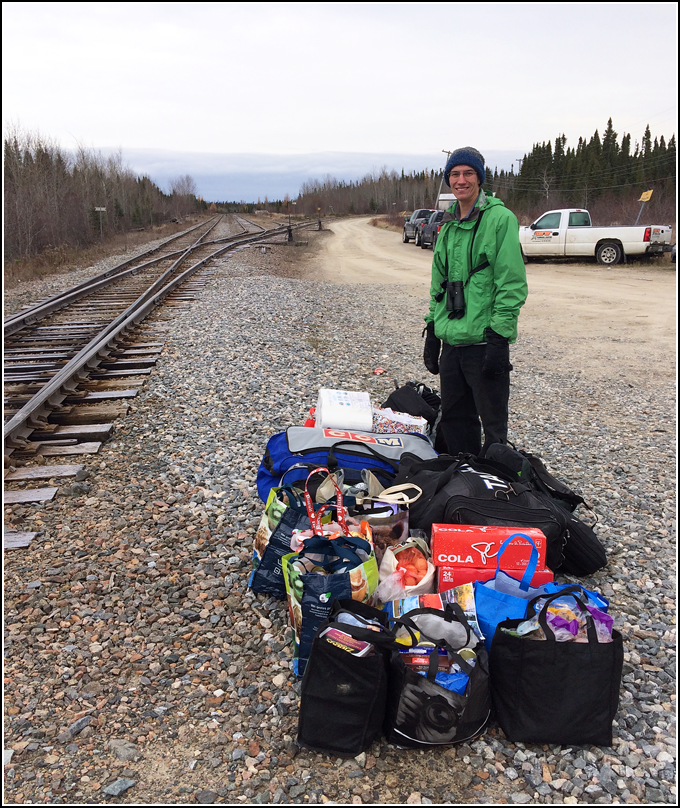
My phone's alarm clock signaled the beginning of the trip during the wee hours of October 27. I usually have a hard time sleeping the night before a trip and this was no exception, though I was fortunate in at least catching 2-3 hours of shut-eye. By 4:30 AM I had arrived at Todd's place in Ayr. It was cold with a bit of sleet coming down as we played the tetris game, loading up his car with all our gear. I may have gone a little overboard with grocery shopping and it was a bit of a struggle to fit everything in! Better to be safe than sorry...

We made good time through Toronto, though decided to skip on birding the Barrie waterfront at dawn since the windy and snowy conditions were not conducive to searching for waterbirds, plus sunrise was still an hour away at this point. So northward we drove, our first birds of the day being some Snow Buntings that flushed from the roadside somewhere near Bracebridge (my bet was on Common Raven for bird #1 of the day). Eventually the ravens did show as the day brightened, and we even had a flyover Gray Jay somewhere in southern Parry Sound District. Surprisingly, this was a year bird for me!

Our first stop was the Powassan lagoons, one of my favorite stops along this stretch of highway since the sewage lagoons seem to ooze with potential and it is easily accessible off of Highway 11. Not much was happening during this visit however, just the usual Sewage Lagoon Ducks. One of the lagoons even exhibited a thin layer of ice, a stark reminder that autumn was nearly in the rear-view mirror.

After a brief, largely unsuccessful stop at a landfill north of North Bay we continued onward, stopping at the New Liskeard lagoons by early afternoon. We ran into local birder Serge Gendron here, and he showed us photos of a couple of shorebirds he had found in one of the cells - a White-rumped Sandpiper with some Pectoral Sandpipers. After bidding goodbye to Serge, we found and studied the shorebirds, encountering a few other odds and ends here including an unexpected female Long-tailed Duck. Even more surprising was who we ran into while leaving the lagoons. As two female figures approached us, we mentioned that the one almost looked like Barb Charlton. Sure enough, as they approached closer we realized it actually was Barb, along with Nicole Richardson. Funny running into them way up here in New Liskeard! Barb and Nicole had had a successful evening of owl banding at Hilliardton Marsh the previous night and showed Todd and I some pictures of Boreal, Northern Saw-whet and Long-eared Owls. Pretty cool!

Barb took a photo of Todd and I as well - thanks Barb.

Josh (left) and Todd (right) at New Liskeard lagoons - photo by Barb Charlton

Todd and I were eager to get to our hotel in Smooth Rock Falls before it was too late in the evening, so that was it for our birding stops. We pulled into the hotel by sunset, enjoyed our last hot showers for some time, and completed the last minute packing and organizing. Our hope was that we would be on the coast of James Bay by the following afternoon!

October 28, 2016

Most birders who visit Moosonee take the train up from Cochrane, but lately I have been happy getting on at Fraserdale. Fraserdale is a tiny settlement about 2 hours northwest of Cochrane, accessed by driving on Highway 11 for an hour west towards Smooth Rock Falls, followed by an hour north along a well-maintained road through the boreal forest up to Fraserdale. The drive from Cochrane to Fraserdale takes the same amount of time as the train, plus the road to Fraserdale has been, in my experience, excellent for finding grouse (my "best" grouse day was September 27, 2013 where Jeremy Bensette, Alan Wormington and I saw 13 Spruce and 4 Ruffed Grouse). Catching the train at Fraserdale also allows one to bird nearby Abitibi Dam, a massive hydroelectric dam that also has quite a bit of surrounding open land around the work camp, a magnet for unusual birds. Alan Wormington discovered two Northern Wheatears here, one in 1972 with Mark Jennings, and another in 1989 on his own. I can only imagine what would turn up here if it was birded regularly!

Spruce Grouse - road to Abitibi Canyon (September 27, 2013)

Back to this year's trip. Todd and I left Smooth Rock Falls before sunrise on October 28, making good progress up the road towards Fraserdale as the sun broke over the black spruces - one of my favorite sights. The grousing was a bit slow today (it is usually better early in the autumn) but we still managed to turn up one Spruce Grouse feeding quietly on the road shoulder.

Our check of Abitibi Dam was quite productive given the late date and frozen landscape. We observed our first "northern" finches of the trip including both Pine and Evening Grosbeaks, Common Redpolls, and Purple Finches. Todd spotted a sparrow feeding along the edge of one of the buildings adjacent to the dam - we were surprised to see it was an immature White-crowned Sparrow. This was unusual as most birds had already cleared out - even Dark-eyed Juncos were nowhere to be seen by this date, and American Tree Sparrows nearly so.

Walking around the work camp and some of the open fields, we encountered a few more interesting birds including a Northern Shrike that attacked two American Tree Sparrows, right after we had "pished" them up out of the grasses. Clever bird, using the distraction to make an attempt at the sparrows, though it was unsuccessful this time! We also flushed a Wilson's Snipe out of a frozen ditch - it is getting somewhat late for them as well. Eventually we had to get going to catch the train but it had been a good walk with some interesting sightings.


The train to Moosonee is one of the most reliable ways to find Sharp-tailed Grouse in northeastern Ontario - I have seen them from the train on nearly every trip to Moosonee. Todd was eager to spot some, as they would be a lifer for him. Views aren't the greatest in this setting - usually, they consist of watching a small group flushed by the train, flying away from us over the bog, but occasionally views are quite good if the birds are close.

Needless to say Todd was a little upset when I saw 5 Sharp-tailed Grouse during the literally two minutes that he had suspended his watch to use the facilities! Fortunately however, we would see two more flocks in the large boggy areas, finishing with 27 total individuals. We also spotted a flock of twelve Bohemian Waxwings as well as four Rough-legged Hawks, both year-birds for me, and by 2:00 PM we rolled into Moosonee.

Our helicopter was booked for 2:00 PM so it was a bit of a mad rush to collect all of our gear, flag down a taxi, and get to the airport. The roads were in the best condition that I have ever seen them in Moosonee so the taxi ride went smoothly, and by 2:30 we were boarding the chopper!


 The subsequent posts will cover our time at Netitishi Point.

Friday, 2 December 2016

2016-2017 Ontario winter bird list

Yesterday marked the first day of winter listing, the period of time running from December 1 until February 28/29 (this season: December 1, 2016 to February 28, 2017). I will be compiling the winter bird list in Ontario again this year, the results of which can be viewed at here. I will also post regular updates on my blog periodically, and will link to the winter list from the "Ontario Winter Bird List" tab (found in the top column above the title of my most recent blog post).

Gray-crowned Rosy-Finch at MacDiarmid, Thunder Bay District, Ontario (January 27, 2012)

Approximately 346 species of birds have been recorded in Ontario during the winter period, with usually between 195 and 220 species recorded in a given winter. Last winter 221 species were recorded - our second highest total after the 224 species reported in 2011-2012. Some of the highlights from last winter included Pink-footed Goose, Smew, Northern Fulmar, Great Cormorant,  Rufous Hummingbird, Yellow-bellied Flycatcher, Vermilion Flycatcher, Cave Swallow, Bullock's Oriole and Eurasian Tree Sparrow.

Vermilion Flycatcher - Wallaceburg, Chatham-Kent, Ontario (December 19, 2015)

Just post your sightings to Ontbirds (if sufficiently rare), ebird.org or send me an email, and I will update the list accordingly and provide an update to Ontbirds every two weeks or so. That way you can check the list and inform me of any species that have been seen but are not present on the list.

We are off to a great start with the Crested Caracara in Michipicoten providing the first winter record for Ontario. Given the mild weather to start the period I think we have a really great chance of setting a new standard this winter.

Crested Caracara at Michipicoten, Algoma District, Ontario (November 30, 2016)

Thursday, 1 December 2016

Crested Caracara in Wawa(!)

Crested Caracara is a species that for many years few Ontario birders seriously expected to see at some point in their lives. You could count on one hand the number of birders who had seen one in the province - heck, you would only need 3 or 4 fingers.

But in recent years there have been more and more extralimital records of Crested Caracara, particularly north along the eastern seaboard, as well as west into California and up the Pacific coast all the way to southern British Colombia. Numerous states and provinces have added Crested Caracara to their respective lists in recent years, including New Jersey (2012), Nova Scotia (2013) Delaware (2013), Maine (2014), West Virginia (2014), Alberta (2015) and Georgia (2016). I'm sure there are more than a few states/provinces that I have missed. There are a number of old records of Crested Caracara north of their range in North America, however many of those had been rejected on questions of provenance (concern about whether they were wild birds). Crested Caracara seems to have an established trend of vagrancy and perhaps some of these old records should be re-examined. It has been surmised that vagrant Crested Caracaras likely originate from the more numerous Texas populations, though a relatively small population is found in central Florida and could be the origin of some of the records from southeastern states.

Crested Caracara - Michipicoten, Algoma District, Ontario (November 30, 2016)

Ontario even has three prior records, though unfortunately none of these birds were very chase-able. All three records occurred in July, what is typically one of the slowest months of the year for rarities in Ontario. The first was a dead bird found by a lighthouse keeper at Victoria Island, Thunder Bay in 1892; the second, a one-day-wonder only seen by a lucky few on Pelee Island in 1994; and the third, a bird that was observed in the remote First Nations community of Fort Albany for 10 days in 2002.  So when a fellow by the name of Chris Eagles posted a photo of an unknown bird visiting his work site in Wawa, Ontario on November 28, and the photo was seen by a friend (Joanne Redwood, a Hamilton-area birder), identified as a Crested Caracara and posted to the Ontario Birds Facebook group, more than a little excitement was created. Unfortunately the site where Chris had seen the bird was off limits to the public, but the following day he observed it again at the aggregate pit and later it was seen on the lawn of a nearby restaurant. Despite the fact that the bird was not "pinned down" to one location, I quickly began making plans to chase the bird with several other people including Jeremy Bensette, Henrique Pacheco and Steve Charbonneau.

Steve and Jeremy met me at a carpool lot near Guelph late on Tuesday evening, then we picked up Henrique and prepared for a long night of driving. Steve drove most of the way, even though all three of the co-pilots were sound asleep at various points! By 5:00 AM I took over in Sault Ste Marie, and dawn was just breaking as we approached Wawa to begin our search.

We briefly examined the entrance to the aggregate pit, followed by a check of the restaurant property where the bird had also been viewed. We were without luck here, though a Northern Shrike was fun to see. I decided that driving the streets of the small community of Michipicoten would be a good bet, and set off down the familiar road to one of my favorite birding spots of the area. Not five minutes later I was pretty shocked to see a long-legged, black and tan bird with a dark cap walking on a lawn. I guess I was a little casual in pointing out the bird and it took a few seconds for the other guys to clue in that I was serious and indeed the caracara was no more than 50 feet from us!
first views of the Crested Caracara - Michipicoten, Algoma District, Ontario (November 30, 2016)

We frantically took our first few photos of the beast (such as the above photo), attempted to get a hold of the other carload of birders in the area, and posted a quick message to Ontbirds. Finally I was able to call David Pryor, and in minutes Tyler Hoar, Barb Charlton, and David roared up. At this point the caracara was roosting in a tree (digesting the multitude of earthworms it had pulled out of the ground, no doubt), but provided great looks for everyone. We were more than a little excited.

from left to right: Steve Charbonneau, Henrique Pacheco, David Pryor, Barb Charlton

Crested Caracara - Michipicoten, Algoma District, Ontario (November 30, 2016)

Tyler attempted to entice the bird out of the tree first with a road-killed Gray Squirrel, and then by offering up himself to the carrion-loving bird. It did not seem interested!

Tyler Hoar baiting the Crested Caracara

Eventually the caracara decided to resume its feeding, preferring to slurp down the numerous earthworms found in the lawns and on the driveways. It tolerated our approach by vehicle, allowing us a minute or two of point blank photos.

Crested Caracara - Michipicoten, Algoma District, Ontario (November 30, 2016)

Crested Caracara - Michipicoten, Algoma District, Ontario (November 30, 2016)

While David, Tyler and Barb soon left to embark on their long journey home, the four of us (Steve, Jeremy, Henrique and I) stayed for another half hour or so, as the photographic opportunities were just too incredible to pass up. Using the car as a blind, the caracara paid us no mind as it continued to pull out earthworms from the nearby lawns.

Crested Caracara - Michipicoten, Algoma District, Ontario (November 30, 2016)

A Crested Caracara had been present in Michigan for the last few months and there is speculation that this may be that very bird. Like many out of range Crested Caracaras, the Michigan bird was first spotted in mid-summer, and was seen by many birders as it frequented the town of Munising from July 1 to November 12, 2016. Looking at photos of the Munising bird from November 12, it appears to have very similar feather wear on the wing coverts and sure looks like the same bird.

Crested Caracara - Michipicoten, Algoma District, Ontario (November 30, 2016)

It was a very successful chase for us, and I wish good luck for everyone driving up to look for this bird. Crested Caracaras, despite being a species more associated with Central and South America, can be very hearty and have been known to survive extreme cold. If it wishes to continue to eke out an existence in Wawa it will have to make its way over to the nearby landfill where there will be a constant "food" supply all winter. The bird seemed healthy enough during our visit - maybe it will finally figure out which way is south and move to a more hospitable climate before winter really arrives in Wawa.