Sunday, 8 July 2012

Rainy River butterflies

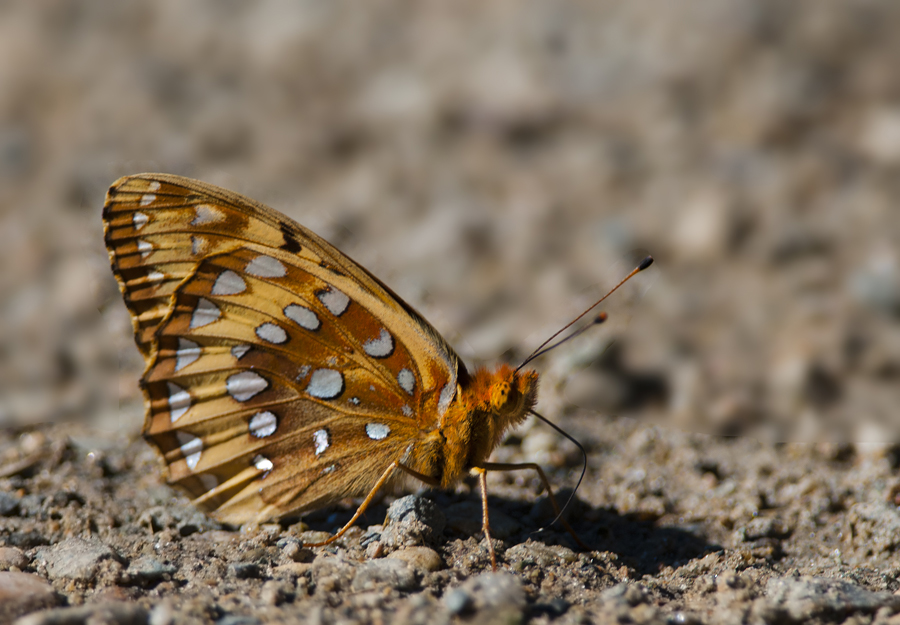
Butterflies really came out in numbers this past week so I spent some time one morning photographing some of them. I was really impressed with the diversity of fritillaries and along one road over about 45 minutes I observed Great Spangled, Atlantis, Silver-bordered, Meadow, and Variegated.

Great Spangled Fritillary

Silver-bordered Fritillary

Meadow Fritillary

Silver-bordered Fritillary

Great Spangled Fritillary

Variegated Fritillary

Meadow Fritillary

Great Spangled Fritillary

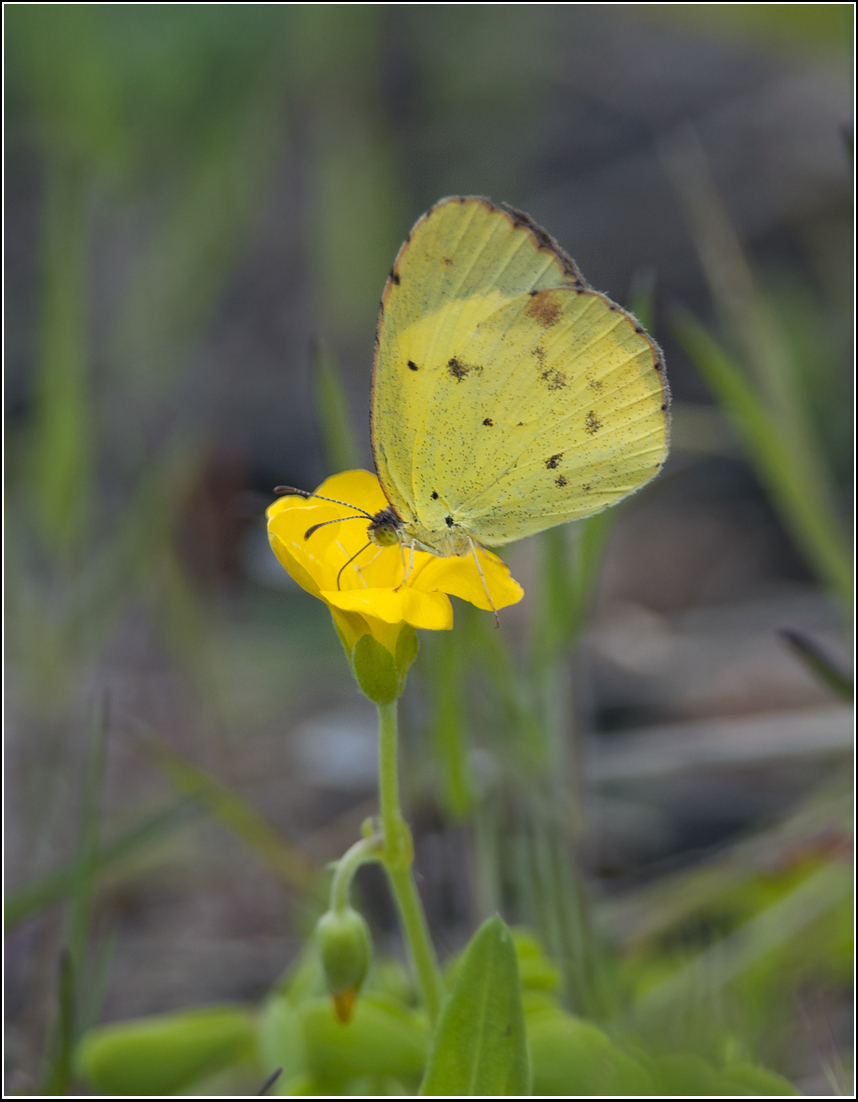
There were more than just fritillaries out of course. While up north I saw quite a few Pink-edged Sulfur, a new species for me, though I never had my camera with me for those sightings. This is the similar Common Sulfur, a species we get in the south.

Common Sulfur

At one point I saw a butterfly which looked somewhat like a crescent in flight, except with a much more erratic flight style. I followed it for several minutes until it landed, revealing itself as a Harvester, another new species for me (kind of blew the photo though)

Harvester

This Northern Crescent landed just perfectly on a well lit flower. I kind of like the effect this photo has.

Northern Crescent

I picked up two new species of anglewings - Gray Comma and Hoary Comma.

Gray Comma

Gray Comma

At one point during the morning a doe and fawn walked right in front of me on the path. A common sighting in the Rainy River area, one that would happen several times a day!

White-tailed Deer

Among the more common species of skippers were European, Black Dash, and Tawny-edged (below).

Tawny-edged Skipper

And to close it off, one more photo of a Great Spangled Fritillary. I didn't see any really rare butterflies this time around but it was fun to spend some time photographing the common ones of the north, especially since so many of them were new for me.

Great Spangled Fritillary

Friday, 6 July 2012

5,000 Franklin's Gulls

Another work week at Rainy River has come and gone again. We finish up our fieldwork tomorrow morning before catching a plane back to Toronto. I wasn't able to get out and look around as much this week as on our trip two weeks ago, but nonetheless there were still many good birds, butterflies, mammals, and herps to be seen!

My main target for this trip was Western Kingbird. A few days before our first trip to Rainy River, Michael Dawber found a Western Kingbird hanging out just southeast of the town of Rainy River. We struck out, though we did see the Dickcissels that were there. A few days prior to this trip, Tyler Hoar found a Western Kingbird at the Rainy River cemetery. We checked it out three times, but unfortunately couldn't find it! We were hoping to bump into one somewhere in our travels but that was not to be. While Rainy River was my best chance at this species I still have a chance at it in the autumn. Just about every year one or more of them show up in southern Ontario, usually in October or November.

One highlight for us this trip was seeing a Marbled Godwit on territory. As soon as we stopped the truck it started flying around and yelling at us, so we didn't hang around too long! I've only ever seen a small handful of this species in Ontario previously, usually a bird on migration at a sewage lagoon, so to get one where they breed was awesome!

Marbled Godwit

This was a new Ontario bird for Dominic as well.

Marbled Godwit

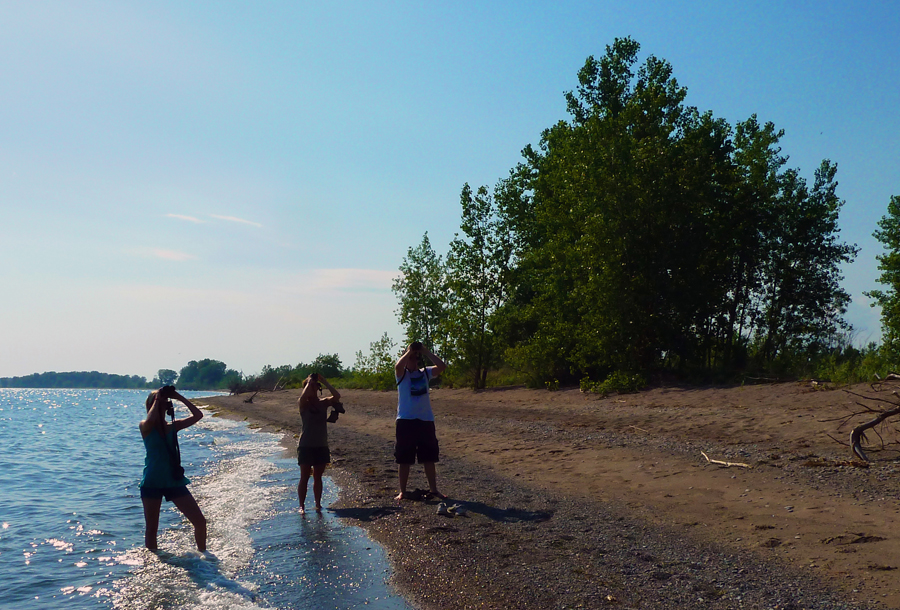
Yesterday afternoon Jon, Dominic and I did a trip to Windy Point to look for Franklin's Gulls, Piping Plovers, and Yellow-headed Blackbirds. Windy Point is only accessible by boat so we paid the owner of the Harris Hill Resort our 8$ each and he took us across, agreeing to pick us up in a few hours.

birding Windy Point

In no time at all we were viewing hundreds of Franklin's Gulls as they rested on the sandspits and flew around above us. This one almost got us...

Franklin's Gull - Windy Point

As we waded through some phragmites and came out at the north end, we were surprised to see thousands of Franklin's Gulls on the north sandspit! For a southern Ontario guy who had seen a total of 3 Franklin's Gulls prior to this year, it was an experience I won't forget anytime soon!

Franklin's Gulls - Windy Point

Franklin's Gulls - Windy Point

Our estimate of 5,000 birds was conservative and it was likely that closer to 10,000 were present. These birds don't breed in Ontario. Rather, they breed in the prairies to the south and west of Rainy River and show up in Ontario after the breeding season. The numbers build throughout the summer but I wasn't aware that there would be this many of them.

Franklin's Gull - Windy Point

Many of the birds, such as the above one, were experiencing heavy wing molt. With all the birds flying around I spent quite a bit of time enjoying the experience and photographing them.

Franklin's Gull - Windy Point


Despite walking around the entire island, we were unable to turn up the Piping Plovers which sometimes nest here. Maybe the thousands of gulls had something to do with that.

Franklin's Gulls - Windy Point

For the remaining hour or so we jumped in the lake and enjoyed the first beach day of the season while American White Pelicans wheeled by, Franklin's Gulls circled, and the occasional Yellow-headed Blackbird flew by. Living the life!

birding Windy Point

Common Terns- Windy Point

The afternoon came to an end much too quickly and we headed back to the mainland. While I didn't get Western Kingbirds in Rainy River, we did get almost all of the other target birds. Out of the 158 species I have seen between these two trips, some of the highlight species are:

Marbled Godwit
Upland Sandpiper
Dickcissel
Green Heron
Yellow-billed Cuckoo
Spruce Grouse
Sharp-tailed Grouse
Yellow-headed Blackbird
Franklin's Gull
White-winged Crossbill
Clay-colored Sparrow
Brewer's Blackbird
Northern Hawk-owl
Western Meadowlark
Black-billed Magpie
Le Conte's Sparrow
Sedge Wren
21 species of warblers including Connecticut and many Golden-winged
Gray Jay
Boreal Chickadee
Red-bellied Woodpecker
Red-headed Woodpecker
Evening Grosbeak
Three-toed Woodpecker
Black-backed Woodpecker

The only Rainy River specialties we missed were Yellow Rail, Nelson's Sparrow, Piping Plover, and Western Kingbird. You can't get em all I suppose.

Monday, 2 July 2012

Magnificent day at the beach

Wow, what a day!!!

This morning, Laura and I were just hanging out after breakfast when I checked my email and saw that a frigatebird, possibly a Magnificent Frigatebird, had been found by Dave Martin and Linda Wladarski just east of Rondeau. We had planned to spend the day at the beach, but this sighting changed everything and we raced down to the area!

Frigatebirds are tropical, pelagic species that rarely come ashore - usually just to nest. What every the case, they are never expected as far north as Ontario, especially sitting in a tree on the shore of Lake Erie! In fact, looking at the OBRC data there have been only 2 accepted records of Magnificent Frigatebird before in Ontario (plus several that were accepted as frigatebird sp., since they can be notoriously difficult to ID in certain plumages). Needless to say this was a bird I needed to get, and a code 6 rarity for my big year!

Laura unfortunately wasn't feeling very well, but despite me asking her numerously if she wanted to abort the mission and head back, she was a trooper and insisted that we continue on. The afternoon was hot and sticky by the time we pulled into the Clearville "harbour" to look for the bird. Unfortunately, however, the bird had moved on and was no longer being seen. Dejected, I scanned for a while than decided the effort was futile and started to drive back.

On the way back we took the scenic route through Port Stanley and up to St. Thomas. Just then I received another email - the frigatebird was now being seen at Rondeau!! I cursed my luck and decided then and there that I wasn't going to go all the way back to Rondeau, especially since it would probably be gone by the time we got there. Laura, still feeling quite under the weather, convinced me that yes, I was turning the car around and we were going to see the bird no matter what!

We raced down to Rondeau (figuratively of course, in case my car insurance company is reading this :P ) and I called Barb Charlton who was with Rob Dobos looking for the bird. Miraculously they were looking at it perched in a tree!! The location was way down towards the end of the beach near Erieau, but Laura and I started the long hike. We met up with Kory and Sarah Renaud of Kingsville and an hour later in 33 degree heat with no water and blisters on our feet, we were almost at the spot. Suddenly Laura found the bird and we all looked up to see this!

Magnificent Frigatebird - Rondeau Provincial Park

Wow, what a relief, especially after driving all day, striking out, driving for another few hours and walking for a few too many miles. The four of us savored the moment - from left to right here is Laura, Sarah, and Kory. I stupidly forgot to pack my camera but luckily Laura had my mom's point and shoot camera so we were able to document the bird.

enjoying the bird

We spent about half an hour standing under the tree it was roosting it and just soaking up the sight of this extremely rare species in Ontario. It calmly sat there the whole time, watching us and probably trying to think of the quickest route to the Caribbean.

Magnificent Frigatebird - Rondeau Provincial Park

We were soon on our way back, but not before Laura and I got Kory to take a photo of us in front of the bird. You can see a black speck sitting in the top right part of the tree when you view the photo full size that is the frigatebird.

Laura, Josh, and Magnificent Frigatebird

Tired, hot, and thirsty, the four of us made the long walk back to our cars and from there Laura and I drove straight back. This was a huge bird for my big year and I was happy to be able to share the moment with Laura, especially since it was possibly the rarest bird that I have seen yet this year. Laura was great in convincing me to retrace our steps and drive back to Rondeau when I was ready to go home, and then for joining me on the long uncomfortable walk out to see it, despite her feeling quite sick the whole time. Thank you :)

I haven't had the time to look up frigatebird ID, nor do I have the references for it, so I'm not sure what species it is though most likely it is a Magnificent Frigatebird. Regardless of what species it is, it will be a new one for my year even if I can only call it a frigatebird sp.

I leave in about 12 hours for Rainy River again, the last week of my intense fieldwork for now. If you have sent me an email and I haven't responded, not to worry - I will try to get through some of the backlog of emails as soon as possible!!

****EDIT*****

I saw a flight shot taken by Sandra Leys when the bird was initially found, and it appears to be IDable to species as Magnificent Frigatebird! This would be the 3rd record for Ontario :)

Sunday, 1 July 2012

Recap after 6 months

Below you will find an analysis of how my big year is shaping up so far, but first I'll mention the recent highlights from my last week of fieldwork near Thunder Bay.Unfortunately I didn't have time to break out my camera for this trip, but I did have a few neat sightings which I will mention. One thing for sure - I love birding in the north WAY more than in the south. Yeah, there isn't as much rarity potential when you're miles away from anywhere in the middle of the bush, but there's something to be said about not seeing a single vehicle, person, piece of garbage, etc when out birding! The diversity of breeding birds is great too, though the sheer numbers of biting insects can be a tad annoying at times. And how often do you get to see multiple Moose, Black Bears, etc when birding in southern Ontario? The megafauna in the north always keep things interesting.

Highlights:
-21 species of breeding warblers....I actually had more Connecticut Warblers than Yellow Warblers (another nice thing about the north)
-breeding Greater Yellowlegs and Solitary Sandpipers. When I first heard the GRYE call I had a hell of a time figuring it out what it was until I saw it. I'm sure if I was at a sewage lagoon in southern Ontario (compared to Black Spruce/Muskeg in northern Ontario) I would have had no trouble IDing it! This was the first time that I had seen a Greater Yellowlegs perch on the top of a Black Spruce, which I thought was pretty cool
-male Scarlet Tanager way up north...not sure why it was up there
-lots of the typical northern fare....Olive-sided and Yellow-bellied Flycatchers; Winter Wrens, both kinglets,and Blue-headed Vireos everywhere; Boreal Chickadees; over 50 Lincoln's Sparrows; Black-backed Woodpecker, etc
-Northern Goshawk acting territorial (though I didn't stick around to find the nest)


Black-throated Green Warbler (to break up the text)

Big Year review and analysis (after 6 months)

It is now July 1 which means that my Big Year is officially 1/2 over. I am sitting at 317 species for the province, meaning that I have 21 more to go for me to tie the record. But tying the record isn't my goal, therefore I need 22 more to beat the record! With a big year the difficulty level certainly increases as the year goes on and adding more species is an event that happens very infrequently! Am I still on pace to break the record? Read on to find out...

One quick and dirty way to see how well a big year birder is doing is to look at their number of rarities. I already figured out earlier in the year that to break the record I would need to see well over 20 rarities. There are 276 species I have classified as codes 1 and 2 (meaning virtually guaranteed), 41 species classified as code 3 (very difficult but I'll have a shot at each one this year) and 165 classified as codes 4 through 6 (rarities that only occasionally show up in the province). If I saw all 317 codes 1, 2, and 3 birds then I would need to see an additional 22 rarities on top of that. At the start of the year it seemed unlikely that I would get all the code 3 birds so I figured that I would need to get about 30 of the rarities (codes 4-6) to break the record.

Back in early spring when I wrote my first Quarterly review (click here) I had seen 9 codes 4-6 rarities. Since then I have added an additional 9 birds! All of the rarities I have seen this year are as follows:

Mountain Bluebird (4) 
Black-headed Gull (4)
Fish Crow (4)
Gray-crowned Rosy-finch (5)
Spotted Towhee (4)
Band-tailed Pigeon (5)
Black Vulture (4)
White-winged Dove (4)
Smew (6) 

Scissor-tailed Flycatcher (4)
Bell's Vireo (5)
Western Tanager (4) 
Western Grebe (4)
Chuck-wills-widow (4)
Blue Grosbeak (4)
Curlew Sandpiper (4)
Kirtland's Warbler (4)
Northern Bobwhite (4)

As you can see I am still on a great pace for rarities! I have 18 so far. However I think the pace of rarities will drop off. Most of the "easier" rarities I have already seen - birds like Kirtland's Warbler, Black-headed Gull, Black Vulture, Western Grebe, Blue Grosbeak, and Northern Bobwhite. These were all birds that were on the cusp of being a code-3 instead of a code-4. As you can see there aren't a lot of code 5 and 6 birds in my list! Let's take a look at the birds I have coded as 1, 2, and 3.

Code 1
I have seen 213 out of the 214 code 1 birds, with the only one missing being Stilt Sandpiper. I could have chased several of those so far this year but opted not to since they are much more common in fall migration. I anticipate adding this one to my list before the month is over.

Code 2
I have seen 55 out of the 62 code 2 birds. The remaining 7 are:

Red Knot
Purple Sandpiper
Buff-breasted Sandpiper
Red-necked Phalarope
Parasitic Jaeger
Arctic Tern
Nelson's Sparrow

Red Knot is easy since I'll be studying them for 2 weeks in August. Purple Sandpipers show up regularly along Lake Ontario and even up in James Bay every November. Buff-breasted Sandpipers are regular on sod farms, sewage lagoons, and even shorelines in late summer/early autumn. Red-necked Phalaropes are fairly regular autumn migrants. Parasitic Jaegers are guaranteed for anyone who spends some time lakewatching in autumn at one of the hotspots. Nelson's Sparrow I should get in James Bay in August, but if I somehow miss them I should find some fairly easily during migration in October in southern Ontario. Arctic Tern is the one I am worried about since I only have one more legitimate shot at it this year (James Bay for two weeks in August). I should get it in James Bay but it is very possible that I will miss it. The chances of it showing up somewhere else this year are very very slim!

Code 3
I have really been concentrating on these birds this year and as a result I have seen 31 out of the 41 code 3 birds. The remaining 10 are:

Pacific Loon
Glossy Ibis
Gyrfalcon
Red Phalarope
Long-tailed Jaeger
Black-legged Kittiwake
Sabine's Gull
Black Guillemot
Western Kingbird
Cave Swallow

I am hoping to get 7 of these birds. I think I have a very good chance (around 75%) of seeing Gyrfalcon, Long-tailed Jaeger, Black-legged Kittiwake, and Sabine's Gull. This adds up to getting 3 of those 4. My odds of getting the rest (Pacific Loon, Glossy Ibis, Red Phalarope, Black Guillemot, Western Kingbird and Cave Swallow) are maybe 50% so I'll hopefully see 3 of those 6. Maybe I'll .uck out and actually see 7 or 8 of these 10 species instead of 5 or 6!

If my planned trip to Netitishi Point on James Bay in the late autumn falls through these odds will change considerably...let's just hope the trip goes through since it is my best shot for getting Pacific Loon, Red Phalarope, Gyrfalcon, and Black Guillemot.

-----------------------------------------------------------------------------

Out of the 18 remaining codes 1-3 birds I am hoping to get at least 13, but hopefully 15 or 16. If I get 13 of them my yearlist will be 330, meaning that I'll need to see an additional 9 rarities to break the record. I have seen 18 rarities in the first half of the year, so hopefully 9 in the remaining six months is doable!

Like I mentioned, all of this is dependent on if I can do the remaining trips I have planned. Additionally, rare birds are just that (RARE!) so there is no guarantee that I can get another 9 this year. It will be interesting to see how the remainder of the year plays out!

Wednesday, 27 June 2012

Crappy photos of Pelee rarities from this spring

I have a few moments before bed (waking up at 3 to work/bird) so I thought I would finally post some of the rarer birds I had at Pelee this spring. Hopefully most of these I hadn't posted yet!

I'll start off with an Olive-sided Flycather from waaaay  back on May 3. Andrew Keaveney found it north of Wheatley, and since I was driving past the spot at the time I dropped in to take a look! He took me back to the spot, and sure enough, the OSFL was hanging out doing some flycatching. This is the earliest one I have seen in Ontario by over a week.


On May 6th I was just returning from my morning of reverse-migration monitoring at the tip when word got out about a Lark Sparrow that Michael Biro had found at the Northwest Beach parking lot. Not only would it be a new Pelee bird for me, but Lark Sparrow was a code 3, and a tough one at that. I made it to the parking lot in record time (fortunately without hitting any turkeys...this time), and it didn't take long before it was re-found. I took a few distant record shots, than waited for the crowds to disperse. As I was leaving the parking lot a bird flew up into a tree right beside me. It was the Lark Sparrow and I had my camera at the ready! Getting this bird so easily at Pelee was great since I was worried that I would have had to chase one in Ottawa or Rainy River or something later in the year.


Previously that morning while I was at the tip, two very silent crows flew over. Any crows at the tip immediately warrant attention since they are not that common and the potential for Fish Crows is there. I managed to photograph one of them, but after scrutinizing them I am still unsure of the species. Let me know if anyone has any thoughts on what species they are...


That very same day I was lucky to see 2 Summer Tanagers. The first was with Steve Pike as we were walking along the west beach near Dunes I believe. I was up ahead, then Steve came running to inform me of a male Summer Tanager he had just found. It was very distant at the top of a tree (good spot, Steve!) so this is the only photo I managed. The second bird was a brilliant adult male that I saw along the beach at the very north end of the park while looking for butterflies with Steve and Alan Wormington. Unfortunately neither of us had our cameras ready for that one!


Oh yeah, Steve and I also saw a Sleepy Orange Sulfur, one of only a few Canadian records of this southern species at the time. Several more showed up throughout the week, providing many with a new Ontario butterfly for their list! It was a pretty good day on May 6...


Speaking of butterflies, Dainty Sulfurs were also in the news. A crappy photo, and regrettably the best one I took of this species. Hopefully I'll have another opportunity to photograph one in the near future!


A flock of American Avocets is always nice to see...


One of the highlights of the spring was a beautiful adult Blue Grosbeak that I was very fortunate to see. A fellow birder from Goderich found it coming to his feeder. He did not really want hoards of birders coming to see it understandably, but knew that I was doing a big year and allowed me to drive up to see it! If you are reading this, thank you :)  


There were some rumours swirling at one point that I didn't actually see this bird...The photo below is probably the best "proof" I can provide! Yep, that's my dusty old car in the same photo as the Blue Grosbeak...


And just for fun, here's a photo of the Eared Grebe that Pete Read and I found on April 29th. It eventually hung around for 4 days, but the best photos I took of it were from that first morning! I think I posted the photo previously, but oh well you have to see it again!


I have a few more photos from Pelee that still need to be posted, but that can wait until a later date. Time for bed!

Sunday, 24 June 2012

Still alive!

Update - photos posted! See below...

I have been kind of MIA in recent days, but I have good reasons! First of all, it is the time of year when those of us who go birding for a living (...err.I mean do environmental impact assessments) are working all the time getting as much work in as possible. After being on a whirlwind 6 day trip to Rainy River, I arrived for about a day and a half, and now I find myself at my hotel in Goderich. Tomorrow morning I do some surveys then race to Toronto to catch a flight to Thunder Bay, and drive to Marathon to spend the week doing some surveys out there.
Laura, as some of you know, is in Ontario for the summer, working in Cambridge and staying at my folks place there, so whenever I am home for a few days between surveys I obviously have my priorities straight and spend as much time as I can with her!
Needless to say, the blog gets neglected every now and then.

I thought that I would post a few more Rainy River highlights from last week. Unfortunately I don't have my photos with me on this computer, but I will add them on Tuesday.

Mob of angry cows

 I can't talk too much about work-related stuff, but can talk about some of the bird highlights. I finished with 144 species for the district (plus a few more on the drive from Thunder Bay). I managed to get all 3 species of grouse while doing surveys, including a family of Sharp-tailed Grouse, a beautiful male Spruce Grouse, and a family of Ruffed Grouse! The only problem is that I am often hiking several kms from the nearest road in the middle of the bush so I don't often bring my camera with me.

Savannah Sparrow - western Rainy River District

Nonetheless, I did snap some shots of a confiding Brewer's Blackbird on a fence post. I caught myself a couple of times seeing a blackbird on a wire/post and saying "just another Red-winged or Grackle" before thinking "wait a minute, a Brewer's!". It is kind of cool to see them being a default species that is found in any open area since they are incredibly uncommon in the south.

Brewer' Blackbird - western Rainy River District

One of the major highlights was finding a Green Heron with Dominic Cormier (my coworker, and long time friend and crazy birder). There are only a handful of Green Heron records accepted by the OBRC för Northern Ontario, maybe 5 or 6 (I don't have the records with me at the moment). Jon Pleizier had seen a Green Heron on several occasions nearby while working here last spring. I wouldn't be surprised if there is a pair or two breeding here! While this was a fun find, unfortunately Green Herons are common in the south and so it wasn't a new year bird.

Some other random highlights:
-several Black Bears, moose, and a wolf howling
-watching a Red-headed Woodpecker packing a hole in a fencepost with horse flies it was catching
-several lifer butterflies, all common northern species, but it was my first time looking at butterflies in the north!

Canadian Tiger Swallowtail - western Rainy River District

-getting a Le Conte's sparrow singing its little heart out at 11:56 PM while we were owl surveying
-seeing yet another Dickcissel as well as several Upland Sandpipers

Dickcissel - western Rainy River District

-21 species of warblers, with the only local breeders I missed being Pine and Tennessee
-adding a few new Ontario herps...Boreal Chorus Frog and Western Painted Turtle (though the turtle is "just"a new subspecies for me)

Western Painted Turtle - western Rainy River District

-our first fall migrants...Lesser Yellowlegs at the Rainy River lagoons on June 19
-seeing soaring flocks of pelicans everywhere we went

American White Pelican - western Rainy River District

Anyways, that's all for now. I'll try to get the photos posted soon. I am at 317 birds for the year and I wouldn't be surprised if I don't get a new yearbird for a while! Unless a rarity shows up and conveniently stays for a weekend, I won't add anything new. But with fall migrants just starting to come through I'll hopefully get a few new birds before I leave for James Bay in early August (more on that later). I still need quite a few shorebirds such as Stilt Sandpiper, Buff-breasted Sandpiper, Red Knot, Purple Sandpiper, Red Phalarope, and Red-necked Phalarope, all usually out of that group only Stilt Sandpiper shows up before August.. I still need Nelson's Sparrow and Western Kingbird as well so I'll put in a good effort for them when I am in Rainy River in 10 days. Plus, this is a good time of year for something like a Eurasian Collared-Dove, rare heron/egret/ibis, Ruff, etc to show up. It wouldn't be that surprising if a rare midwestern grassland species follows all the Dickcissels that have influxed into Ontario..maybe something like a Chestnut-collared Longspur or Sprague's Pipit. One can only hope!

Question Mark - western Rainy River District