Tuesday, 14 January 2014

Quest for 400

I stole this idea from Brandon's blog. It's a fun way to kill time at work...

In the Ontario birding scene, reaching 400 total species for your all-time Ontario list is a lofty achievement. A total of ~490 species have been recorded in Ontario all time and each year between roughly 350 and 360 species are reported throughout the province. The birder with the highest Ontario list is Alan Wormington with 443 species - the next highest is somewhere in the low 430s. I am not sure how many birders are in the exclusive "400 club", but probably two dozen or so.

My Ontario list is currently sitting at 364 species. What I will attempt to do is predict the species I will add until I hit 400! I should mention that I doubt I'll actually ever hit 400 since I do not plan on living in Ontario the rest of my life (heck, I would be surprised if I was still here in 5 years), but you never know.

First up, the birds that would be nearly a guaranteed lock to add before I reach 400, roughly ranked from easiest to toughest:

1. Ruff - this species isn't even rare enough to be on the review list! There used to be 4 or 5 a year, but in recent years that number has dwindled. There have been several I could have chased, and several more which I "dipped" on
2. Swainson's Hawk - some hawkwatch stations report half a dozen each autumn. There are about 60 provincial records. Enough said.
3. Tufted Duck- they show up every couple years and have a history of hanging around. Heck, there's one on the Niagara River right now!
4. Eurasian Collared-Dove - this stupid invasive species was supposed to be common in Ontario by now but it's not. One day we'll curse their existence. Maybe.
5. Rufous Hummingbird - one of my biggest misses! These cheeky wee bastards show up nearly every year at bird feeders in Ontario in the fall
6. Ivory Gull - over 30 records, with more than half of those being birds that hang around for several days
7. Lark Bunting - another big miss. Close to 30 provincial records! I bet if I spent a summer living in Rainy River I would find one.
8. Tricolored Heron - used to be pretty much annual - now there hasn't been one in 7 straight years
9. Northern Wheatear - according to some there is a 50/50 chance of seeing them on the coast of James Bay in the autumn...I'm 0 for too many
10. Cinnamon Teal
11. Willow Ptarmigan - I didn't go on the guided bus tour to the Darlington nuclear plant back in summer, 2011. One day I'll make it up north and see them on the breeding grounds.
12. Snowy Plover - 6 records in the last 13 years. All but one hung around for multiple days

Snowy Plover - Los Angeles, CA

13. Ash-throated Flycatcher - these are becoming pretty close to annual in recent years.
14. Say's Phoebe - I've chased two unsuccessfully in the last two years, maybe the third time will be the charm?
15. Black-necked Stilt 
16. Ross's Gull - one of my most wanted birds - 11 provincial records, with half of those chaseable
17. Smith's Longspur - they even breed in Ontario! Trouble is, I probably won't get up there in the near future
18. Least Tern - I think a rare tern will be added to my list before 400, and Least is not the least likely
19. Dovekie - I feel like Netitishi owes me one after four weeks of cold and wind in late autumn.
20. Sage Thrasher - 17 provincial records
21. Swallow-tailed Kite
22. Fork-tailed Flycatcher 
23. Black-headed Grosbeak - will be an easy tick, coming to someone's feeder in November or December
24. Gray Kingbird 
25. Vermillion Flycatcher - maybe this is wishful thinking since there are only 5 provincial records, but I WANT IT

If I get all 25, that means I only need 11 more species...here are my guesses - I would be surprised if I get more than 3 or 4 of them right.

rare hummingbird - could be 15 candidate species. Anna's is probably the most likely

Anna's Hummingbird - Arizona

Bewick's Wren - I better get one soon because they are not doing too well in the midwest. Hard to believe they used to be an occasional but regular breeding species!
Glaucous-winged Gull - this is a hugely overdue bird for Ontario. It seems like it will be any year now that we will all add it to our lists...
MacGillivray's Warbler - someone will find one in November or early December and it will be seen for several weeks.
Ancient Murrelet - because why not?
Pink-footed Goose - more and more showing up further away from the Atlantic every year - just a matter of time until Ontario gets one
Black-capped Petrel - 26 records. All were associated with hurricanes in 1893, 1955, 1996, and 2003. If we get another hurricane at the right time of year, BCPE will be almost too easy!
shearwater sp. - if I put in more time at Netitishi Point in the autumn, a shearwater is imminent. Probably Manx, Sooty, or Great!
Cassin's Sparrow - most don't stick around (8 records) but I think I'll find one some day
Garganey - only four provincial records, but I have a good feeling about it
Green-tailed Towhee - 7 provincial records, and they often hang around


So anyways, there you go! There is also the possibility of species splits. Two species that might be split and therefore countable someday include Vega Gull and Harlan's Hawk.

Harlan's Hawk - Moosonee, Ontario

There are a wide range of other species that I might add which wouldn't be entirely unexpected. Following are some of the more likely ones. Who knows!

Bullock's Oriole
Western Wood-pewee 
Rock Wren
Lewis's Woodpecker
rare alcid - Thick-billed Murre, Atlantic Puffin, 
Burrowing Owl
Clark's Nutcracker
Ferruginous Hawk
Fulvous Whistling-Duck
Great-tailed Grackle
Hermit Warbler
Lazuli Bunting
Sharp-tailed Sandpiper
Swainson's Warbler
Virginia's Warbler
White Ibis
Wood Stork
Yellow-billed Loon

-------------------------------------------------------

Looking back at the last five years (basically when I started birding seriously), the following species I added to my Ontario list which I would have considered nearly impossible to predict. Essentially, species with only a few prior, or no prior, records for Ontario. They are:

Black-throated Sparrow (2009)
Black-tailed Gull (2009)
Phainopepla (2009)
Black-bellied Whistling-Duck (2010)
Neotropic Cormorant (2011)
Smew (2011)
Magnificent Frigatebird (2012)
Thick-billed Kingbird (2012)
Brown Booby (2013)
Elegant Tern (2013)

Thick-billed Kingbird - Presqu'ile PP - Ontario

That averages out to two a year.

Let's say that I average 3 birds a year on top of the unpredictable ones, so about 5 birds a year. Purely a guess, but I would say not an unreasonable guess. At that rate I should hit 400 in about 7.5 years, or when I turn 31. Obviously with each passing year (and consequently less bird species you "need") it is tough to add to your growing list. Alan Wormington once told me he averages 1.5 new birds a year, and has been averaging this for quite some time. But it will likely take me quite some time to reach that point! Regardless, I don't feel like trying to figure out how the rate of new birds/year will change with time, so I'll just add an extra year to the predicted age I'll be when I see #400. My prediction is that I will be 32, if I spend the majority of the next 8.5 years in Ontario (a huge caveat!).

  It makes me wonder - what is the youngest age that someone has hit 400 for Ontario? There are a few other young(ish) birders who are on pace to break 400 at a young age. Ken Burrell is already at 380. Brandon predicts he will be 30 or 31 when he hits the milestone! But both of them also started birding at a younger age than me... ;)        

Wednesday, 8 January 2014

Hypothetical 2013 big year

The other day I was going through the Ebird Top 100 and noticed that 352 species had been reported in Ontario in 2013, compared to 363 the previous year. It got me thinking - what would be the upper limit if someone had attempted a serious big year attempt last year? Would the record of 344 species from 2012 stand?

In 2012 when I attempted my big year, quite a few things lined up nicely and with a lot of luck I was able to rack up 344 species. Was I just incredibly lucky in picking the right year, or is the total number of species seen annually in the province increasing enough that a total like that could be reached nearly every year?

I'm not sure. I suspect the latter, though it would be quite time consuming to provide strong evidence in support of that point. Instead, I'm going to see what the upper limit would be if someone had attempted a big year in 2013!

To investigate this, I will break down the candidate species by their abundance, starting with the common birds and finishing with the rarities.

Code 1 - the guaranteed birds
There are 214 species that I considered Code 1 species, ranging from abundant (European Starling, Mallard) to common in a relatively small area in the province (Forster's Tern, Blue-gray Gnatcatcher, ) to moderately common (Black-backed Woodpecker, Sanderling, Wilson's Warbler). Every one of these birds would be guaranteed if someone attempted a serious Ontario big year in 2013.
Running total = 214

Barn Swallow - a code 1

Code 2 - the uncommon or local species
These 62 species would be all but guaranteed on a serious big year attempt. They include species that are somewhat common but range-restricted in Ontario (Yellow-headed Blackbird, Hooded Warbler), common but very difficult to detect (Northern Saw-whet Owl, American Three-toed Woodpecker), species that only sporadically show up during certain times of the year (Hoary Redpoll, King Eider), and rare but regular migrants/breeding species (Golden Eagle, Acadian Flycatcher, Prairie Warbler). This also includes fairly common birds that are seen infrequently enough by most birders to not make the Code 1 category (Mourning Warbler, Thayer's Gull, etc).
Running Total = 276

Hudsonian Godwit - a code 2

Code 3 - the tough ones
This is where things start to get interesting. These 41 species include regular spring overshoots (Worm-eating Warbler, Summer Tanager), rare breeding birds (King Rail, Henslow's Sparrow), some difficult to detect owls (Boreal Owl, Northern Hawk Owl), rare migrants (Black-legged Kittiwake, Pomarine Jaeger) and species that are common some years but absent in others (Cave Swallow, Dickcissel). In 2012, I was able to see 40 out of the 41 Code 3 birds, only missing Glossy Ibis. Last year, the following Code 3 species would have been very tough to get:

King Rail
Black Guillemot
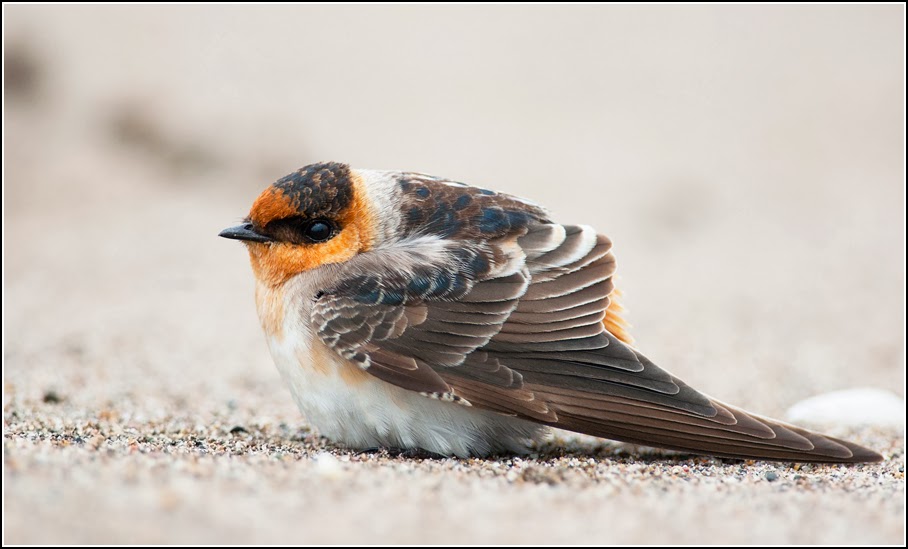
Cave Swallow

King Rails went unreported by birders in 2013; however, very small numbers do breed in the province and a big year birder who devoted quite a bit of time to searching for this species might have been lucky. No Black Guillemots were reported that I am aware of. They are supposedly rare but regular in southern James Bay during the autumn, but neither Netitishi Point expedition during late autumn recorded them. Cave Swallows were nearly unreported in 2013 - the only sighting was a one-day wonder at Long Point. A big year birder would almost certainly miss this species.

Cave Swallow - a tough code 3 in 2013

The remaining 38 Code 3 species would have been possible for someone attempting a big year. For each one of those species there was at least one sighting of a very chaseable bird; however, there is a good chance they would have missed one or two.

Let's say that a big year birder would have seen 38 out of the 41 Code 3 species.
Running total = 314

Dickcissel - an easy code 3 in 2013

Codes 4 through 6 - the rarities
None of these species can be expected during a given year. Code 4 species usually have 2-5 annual records, Code 5 species usually have less than 20 records all time for Ontario, and Code 6 species are the mega rarities with three or fewer Ontario records. In 2012, I observed 28 species that were either Codes 4, 5, or 6. In 2013, the following rarities were observed by someone at some point in Ontario. First, the "chaseable" ones:

Chaseable:
Brown Booby - insane rarity! spent a few weeks entertaining birders in Fort Erie (and briefly Long Point and points in between)
Brown Pelican - sat on the Wheatley harbour breakwall for four days in August, also found during the OFO conference in September

Brown Pelican - a code 5
Western Grebe - easy bird for several weeks on Toronto waterfront in winter/spring, one early summer bird from Rondeau that hung around for multiple days
Black Vulture - fairly regular now along Niagara River, several other scattered records
Common Eider - breeding on Ontario's Hudson Bay coast, several records in the south including a long-staying Hamilton bird

Common Eider - a code 4

Black-necked Stilt - two birds spent the better part of a week at Hillman Marsh in May
Black-headed Gull - several reports
Elegant Tern - cosmic rarity! spent 5 days in Fort Erie area
Thick-billed Murre - mega rare! Seen on two consecutive days in a harbour in Kingston in early Dec
White-winged Dove - one sat at the Rondeau Visitor Center's feeders for almost two weeks in Jan/Feb
Chuck-wills-widow - several records at Pelee/Rondeau/Long Point/Prince Edward Point in spring
Rufous Hummingbird - coming to a feeder in Timiskaming District for a few days in early Nov
Fish Crow - chaseable pair in Bronte during the spring, continuing birds in Fort Erie
Townsend's Solitaire - long-staying winter bird in Durham Region
Kirtland's Warbler - two chaseable KIWAs at Point Pelee in May
Blue Grosbeak - several birds in the spring that hung around for several days
Painted Bunting - coming to a feeder for two days near Point Pelee in spring

Painted Bunting - a code 5

A big year birder should have been able to nab at least 15 of the 17 species mentioned above.
Running total = 329

Maybe:
Northern Gannet - one was seen sporadically on Lake Ontario in autumn - was briefly chaseable in Toronto
Swainson's Hawk - several reported at autumn hawkwatches, though none stuck around
Northern Bobwhite - apparently some are still hanging on at Walpole Island
Snowy Plover - one day wonder at Pelee in November, however several birders successfully chased it
Barn Owl - a lot of effort/knowing the right people might have helped locate one of the few remaining breeding birds in Ontario
Say's Phoebe - one day wonder at Toronto Islands. Briefly chaseable. I missed it by 20 minutes.
Violet-green Swallow - very tough bird in Ottawa in April, however some southwestern Ontario birders successfully nabbed it
Swallow-tailed Kite - exceptionally well reported bird that was followed from Port Alma all the way to the Point Pelee Visitor's Center! Occurred during May, so was seen by about 75 birders, but not seen on following days
Western Tanager - one was seen twice (separated by about a week) on Manitoulin Island in August

Western Tanager (from 2012)

Neotropic Cormorant - an awesome record from a condo in Hamilton. Was seen several times flying past in the morning during August, and in theory could have been chased.
White-faced Ibis - in spring one was seen for a few days way up in Oxdrift, Kenora District during late April. In theory it could have been chased by someone crazy enough.
Eurasian Collared-Dove - several sporadic sightings in the Pelee area spring through fall
Slaty-backed Gull - continuing bird(s) seen occasionally along the Niagara River in winter. Also, one at the TBay landfill in late fall.
Anna's Hummingbird - crazy crazy bird! At least one southern Ontario birder successfully chased it, but some of us weren't so lucky...
Smith's Longspur - they breed on Hudson's Bay. Just a question of getting up there.
Willow Ptarmigan - they breed on Hudson's Bay. Just a question of getting up there.

Most of the above species would have been very tough. They require dropping everything! As you can see, all 16 species would need to have been seen by the big year birder to break the record. To me, it looks like the upper limit of these birds is maybe 10-12.
Running total = 339

Not chaseable:

The following species were not chaseable because they were either one-day (or even one-minute) wonders that weren't seen by additional birders, or they were found in inaccessible places for short periods of time. Damn you, tip of Long Point!

Ruff
Ash-throated Flycatcher
Black-throated Gray Warbler
Brown-chested Martin
Prairie Falcon
Western Wood-pewee
Mississippi Kite


Lets say our big year birder gets incredibly lucky/is in the right place at the right time, and sees one of these species.
Running total = 340

So there you have it! It doesn't matter how skilled, determined, and with unlimited finances a big year birder could have been - it probably would not have been possible to break the record last year. Not all years are created equal!

EDIT - Paul Hunter, an excellent birder from England who visits Point Pelee with his wife Liz every spring (and who many of you who frequent Pelee would recognize) pointed out one thing I neglected. His message went:

"It seems to me, however, that you have made the assumption that our imaginary lister would not have been able to locate any species for himself. He or she would only have had to find five species of their own to eclipse your very impressive total. Given 365 days hard birding and unlimited funds, that doesn't sound impossible."

That is a very valid point and not something I considered. Who knows, maybe the record would have been reachable in 2013? At any rate, it would take an extreme amount of skill, time, dedication - and dare I say it - luck, to have reached 344 last year. Much more so than what was required in 2012 in what was clearly a superior year for attempting a big year.

Sunday, 5 January 2014

Foxy times on James Bay

Back in October of last year Alan and I traveled to Netitishi Point, of which I blogged about extensively already. I was going through my photos and realized that I had neglected to post all of my photos of the most charismatic species we observed there. That being of course, the creatively named Foxy.


Foxy first made a visit several days into the trip as we were sitting out by the coast for hours at a time, scanning for birds on the horizon. It quickly got accustomed to us, and within 24 hours it was our new pet!


Just look at how darn cute Foxy is!


Foxes, along with most mammals, are extremely photogenic (if you can get close to them). I think it is due to the wide range of "emotions" they can appear to have, since we as humans tend to anthropomorphize with expressions that other mammal species can make. 


Being continually curious, Foxy would frequently check out our gear when we weren't immediately beside it. Inspecting my coffee mug...


And sniffing Alan's camera, seconds before attempting to make off with it.Foxy was unsuccessful, but later on it the trip took off with one of Alan's gloves in tow! Several days later, Alan recovered the glove - unfortunately it was missing several fingers...


Hope to see you on this year's trip, Foxy!

Friday, 3 January 2014

2013 Year in Review, part 3

Laura arrived to stay with me for the month of August as my field work was all wrapped up for another season. Since I was stuck working in the office throughout the week, we were limited to weekends to travel throughout Ontario. We made the most of these opportunities, however! On two occasions we made it down to Point Pelee, and both trips were loaded with amazing wildlife experiences with good friends.

Common Map Turtle - Point Pelee NP, Ontario

kayaking - Point Pelee NP, Ontario

Brown Pelican - Wheatley, Ontario

Laura and I share a love for all things reptile and amphibian so we planned a few weekend trips to see what we could turn up. Some of the "lifers" Laura found included Queen Snake, Five-lined Skink, Common Map Turtle, and Northern Two-lined Salamander.

Gray Treefrog - Cambridge, Ontario

Queen Snake - Brant County, Ontario

Laura and her first "self-caught" Snapping Turtle

Eastern Massasauga - Muskoka District, Ontario

salamandering!

N. Two-lined Salamander - Algonquin PP, Ontario

N. Two-lined Salamander - Algonquin PP, Ontario

As the calendar turned to September, Laura and I enjoyed a week in Nova Scotia before she flew back to Scotland for another year of vet school. After that trip, I spent my weekends kayaking in the Pelee marsh and doing some local-ish birding, with a highlight being finding a Long-tailed Jaeger with Kory Renaud and David Szmyr at Rattray Marsh in Mississauga (a first county record for Peel).

Short-billed Dowitcher - Point Pelee NP, Ontario

Wilson's Warbler - Point Pelee NP, Ontario

Semipalmated Sandpiper - Point Pelee NP, Ontario

Caspian Tern - Point Pelee NP, Ontario

Short-billed Dowitchers - Point Pelee NP, Ontario

Short-billed Dowitcher - Point Pelee NP, Ontario
Least Bittern - Point Pelee NP, Ontario

Least Sandpiper - Point Pelee NP, Ontario

Semipalmated Plover - Point Pelee NP, Ontario

Greater Yellowlegs - Point Pelee NP, Ontario

Western Kingbird - Hamilton, Ontario

In late September I went on a rarity-hunting trip to the Moosonee area with Alan Wormington and Jeremy Bensette. While we did not find any "megas", we had quite a few fun finds including some Dickcissels and a Lesser Black-backed Gull, both review species in the north. And of course, northern chickens...

Spruce Grouse - Fraserdale, Ontario

Spruce Grouses - Fraserdale, Ontario

Spruce Grouse - Fraserdale, Ontario

Striped Skunk - Moosonee, Ontario

\
Common Raven - Moosonee, Ontario

American Golden-Plover - Moosonee, Ontario

White-winged Crossbill - Moosonee, Ontario

Thayer's Gull - Hearst, Ontario

October and November are often two exceptional rarity months for Ontario, and this year did not disappoint. The Niagara River was the place to be with two provincial firsts there this fall - a Brown Booby in October, and an Elegant Tern in November. I was fortunate enough to skip work to see both rarities, though they were too far for good photos! Here is the best I could do with the booby...

Brown Booby - Niagara River, Ontario/New York

The main highlight of the autumn for me was a two-week long excursion to Netitishi Point on the south coast of James Bay in late October/early November. Once again the location did not disappoint, with dynamic weather, stunning scenery, a feeling of true wilderness, and of course some awesome wildlife sightings. I can't wait to go back.

Barn Swallow - Moosonee, Ontario

Red Fox - Netitishi Point, Ontario

Gyrfalcon - Netitishi Point, Ontario

Townsend's Solitaire - Netitishi Point, Ontario

Upon my return to civilization, I did not get out as much as I would have liked to due to limited daylight. Of course, two Point Pelee visits were in the cards and were highlighted by 4 Eared Grebes, late Pectoral and Baird's Sandpipers, 2 Black-legged Kittiwakes, an Evening Grosbeak, a Bohemian Waxwing, a Purple Sandpiper, and a dead Franklin's Gull.

Purple Sandpiper - Point Pelee NP, Ontario

Eastern Pipestrelle - Point Pelee NP, Ontario

Long-eared Owl - Hillman Marsh, Ontario

One of the most interesting birds I laid eyes on this year was this gull that I located at Niagara Falls along with several others. It has been studied and commented on by various gull experts across North America and Europe, and the consensus is still split between a hybrid Lesser Black-backed x Herring Gull, or a lusitanius Yellow-legged Gull which would be a first provincial record. While its identity will likely never be determined with certainty, it was a great experience and a lot of fun to research.

gull sp. - Niagara River, Ontario

My last trip of the year was the one I am currently on - a nine-day excursion to visit Laura and her family in Nova Scotia. Taking them out looking for Snowy Owls was a fantastic way to close out 2013.

Snowy Owl - Dartmouth, Nova Scotia

Thanks to all who followed along on the blog throughout the year. I'm excited to see what 2014 has in store!