Tuesday, 19 January 2016

Panama - Day 12 (March 11, 2014)


----------------------------------------------------

Today was one of my most highly anticipated days of the trip - we were planning on hiking to the top of the mountain - Cerro Pirre - and clean up all the endemic species found at the summit!

We were up by dawn, and while waiting for everyone to get ready for the hike, Dave and I birded around the campsite. We had several new sightings around camp such as Russet-winged Schiffornis and Speckled Mourner (both heard only) as well as calling Wing-banded Antbird, Tody Motmot, and Black-faced Antthrush. A few more Lemon-spectacled Tanagers were nice to see as well!

We finally were on our way by 8:00 AM - a little later than we had anticipated. We were hoping to make decent time on the ascent as we planned on returning to Rancho Plastico later in the day.

The hike started off with a major highlight not fifteen minutes into it. I was walking near Isaac at the front of the group, with Dave several dozen meters behind and Steve somewhere further back. A small hummingbird flew past Dave and landed right in front of Isaac and I. Holy **** - it was a White-whiskered Hermit!! This species is found on the Pacific slope and Chocó lowlands of western Colombia and Ecuador, with very few (if any?) records for Panama. Our looks were decent, though my attempts at photography in the dark understorey failed (stupid autofocus...). I wouldn't be surprised if there is a decent population in the Darién - it is just so difficult to access most of it.

hiking to Cerro Pirre, Parque Nacional Darién, Panama (photo by Steve Pike)

There are four species of birds that are endemic to Cerro Pirre and surrounding mountain range, and all of them can only be seen once you reach the higher elevations. This of course involves boating in to El Real and making the two day hike up the mountain while camping in the jungle. It is not a journey for the faint of heart, and even for a group of relatively fit young birders it is no easy feat.

These endemics include the three "Pirre" birds - the Pirre Chlorospingus, Hummingbird, and Warbler, as well as the Green-naped Tanager. The Beautiful Treerunner is found mainly on Cerro Pirre, though there is also a population in the nearly inaccessible Tacarcuna range as well as further west at Cerro Chucanti.

As we began the steep ascent of the mountain (600+ m in elevation gain over a distance of 1 km!) we added lifers fast and furiously. Our first Pirre endemic provided a spate of excitement - a small group of Pirre Chlorospingus (Pirre Bush-Tanagers)! Photos are always difficult in this habitat type, especially when the bird is backlit against a bright white sky. 

Pirre Chlorospingus -  Cerro Pirre, Parque Nacional Darién, Panama

We occasionally found small groups of tanagers and at one point Isaac located a pair of Green-naped Tanagers! We could hear them calling but they disappeared before the rest of us could lay eyes on them unfortunately. These would be the only Green-naped Tanagers we would encounter.

Other lifers I can recall from this hike up to the mountain summit included Gray-and-gold Tanager, Collared Trogon, Brown Violetear and Orange-bellied Euphonia. We occasionally heard the distant calls of Great Green Macaws, though they remained out of sight.

The trail kept getting steeper, while the vines and trees were seemingly covered with denser and longer spikes and the moss was much more slippery as we ascended. It was tough slogging with frequent rest breaks but we made steady progress. The ethereal notes of the practically endemic to Panama Varied Solitaire accompanied us, tantalizing us as a "heard-only" species until Isaac finally spotted one perched quietly. My photos are terrible so I'll leave them out.

Finally, after several hours of some of the most difficult hiking I have ever done, the four of us reached the summit! We rested for a few minutes, then set out along the ridge to find as many of the specialties as possible.

Pirre Hummingbirds were quite common along the ridge, and we came across several Pirre Warblers as well. We were especially happy with the latter as this endemic is easily missed here!

Green-crowned Brilliant was yet another life bird for me, and one that I actually managed a photo of.

Green-crowned Brilliant -  Cerro Pirre, Parque Nacional Darién, Panama

More interesting to us was a good look at a Tooth-billed Hummingbird. This is another "Chocó" species, ranging from the Darién east and southwards along the Pacific lowlands and foothills to northwest Ecuador. When viewed in profile, the small hooked "teeth" at the end of the bill can be seen, an adaptation which may have to do with sexual selection (it is not found on females) or to assist with a specialized foraging strategy.

Tooth-billed Hummingbird -  Cerro Pirre, Parque Nacional Darién, Panama

Birding along the ridge was fantastic, even though we were limited to a few short hours up there. We heard a calling Dusky Pigeon at one point; like the White-whiskered Hermit earlier, this species is virtually unknown from Panama as it ranges further east and south in the Chocó of Colombia and Ecuador.

Several other target species quickly feel into place. Choco Tapaculos were quite common, and with a bit of effort excellent looks were had at one skulking! Yellow-green Grosbeaks have a very limited range in North America (just a small part of the Darién) but they do extend throughout parts of Amazonia, northern South America and coastal Brazil.

Yellow-green Grosbeak -  Cerro Pirre, Parque Nacional Darién, Panama

Yellow-collared Chlorophonia is another target species that can be found at Cerro Pirre. These small, finch-like birds are a Chocó endemic, their Panama range only including parts of the Darién. We spent quite a bit of time watching a small group of them and their antics in the trees above us.
Yellow-collared Chlorophonia -  Cerro Pirre, Parque Nacional Darién, Panama


Sooty-headed Wren is more easily seen in Colombia, but in North America they are only found in these mountains of the Darién. Several were singing and eventually we had good looks at one.

Sooty-headed Wren -  Cerro Pirre, Parque Nacional Darién, Panama

We searched for our last remaining target bird along the ridge, Beautiful Treerunner, but came up empty. I'm sure if we had decided to stay the night and search the following morning we would have had much better odds. Eventually we were forced to pull ourselves away from the fantastic birding, since we wanted to reach Rancho Plastico was it was still light out.

The walk down the mountain was not quite as tiring as the walk up, but it was still not very easy. We all spent portions of the walk sliding down the trail on our behinds, (not on purpose!) and I almost fell off the mountain at one point (I hope you're not reading this, Mom....)! The hike down was a good thigh workout, and I think I can speak for the other guys when I say that my legs felt like jelly afterwards.

The walk back down was more about making progress and so we stopped less for birds. Many of them were repeats from the morning, anyways. One big highlight however was this Sapayoa that Isaac picked out as it perched quietly. This species is currently listed by some as the only member of its family, with its closest relatives likely the broadbills of Africa and Asia, or the asities of Madagascar. It can be a difficult bird to find as it is easily overlooked and does not vocalize too much.

Sapayoa -  Cerro Pirre, Parque Nacional Darién, Panama

Exhausted, we arrived back at Rancho Plastico with some daylight left. We decided that we would try for one more specialty bird found in the area - a Sharp-tailed Streamcreeper. Accessing the bird's stream involved another steep, slippery walk down the side of the ridge, but at the bottom was a beautiful crystal-clear mountain stream. We successfully found the target bird, along with bonus Dull-mantled and Zeledon's Antbirds, after cooling off in the stream. And right at dusk we were successful in hearing a Black-crowned Antpitta. Some of us had brief views of the bird, and at one point I had a fantastic look as it walked along a log.

That evening the rains came down quickly - our first significant rainfall during the trip. Unfortunately I had some issues with setting up my hammock and was caught in the downpour, with my sleeping bag completely soaked (and me as well) within seconds. Luckily I was able to stow my pack and camera in Isaac's tent, where it was nice and dry. It was not the most comfortable sleep, needless to say, but I eventually fell asleep at some point due to exhaustion.

The next day our plans were to hike all the back to Rancho Frio, hopefully picking up a few new birds as we went.

Total bird species so far: 453

Sunday, 17 January 2016

Panama - Day 11 (March 10, 2014)


----------------------------------------------------

As we woke up on our first morning in the Darién the first few birds had already began singing. As I stepped outside the cabin the surrounding forest slowly became alive with song from the species found in the lowland mature forest. Right away we encountered a few new birds, such as Red-throated Caracaras which were calling off in the distance, a Stripe-throated Wren and a Slate-throated Gnatcatcher. After a quick breakfast we headed out on the trails, with the goal of searching for a Crested Eagle near a recently used nest. Isaac led us to the tree where the nest was located, and we looked and listened for the birds. We ended up spending over an hour in the vicinity of the nest, but unfortunately the bird was a no-show for the day. 

Crested Eagle nest - near Rancho Frio, Darién, Panama

We slowly wandered our way back to Rancho Frio through the forest, picking up new birds here and there, though with few sightings of small mixed species flocks. Another target bird was the Crimson-bellied Woodpecker, but it too remained out of sight. 

The ranger station (Rancho Frio) is located at about 100 m above sea level, while the Pirre specialites are found higher up in the pre-montane forest. We had now seen most of the lowland birds (with a few holes to fill in later) and were excited to journey towards the ridge near the summit of Cerro Pirre. Eventually we arrived back at the station, where a little bit of birding was in order as we packed up our gear, had a bite to eat and prepared to hike to our next destination. I went to cool off in the stream - always a good choice when in the tropics!

photo taken by Steve Pike

The drone of cicadas increased in volume as we began walking, and we soon felt the effects of the late-morning tropical heat and humidity combined with having to carry a large pack. The ground was mostly level for the first section, and there were frequent distractions as we walked. This Dendrobates auratus was one of several seen that morning. This is one of the more frequently encountered dart frog in Central America, ranging in the forested lowlands and sub-montane areas from Nicaragua southeast to northwest Colombia. 

Dendrobates auratus (Black-and-green Dart Frog) -  Rancho Frio, Darién, Panama

Birding while carrying a full pack with all your food, water, optical equipment and camping gear is a bit of a challenge, but we made do. My camera's strap is actually quite conducive to this as it allows me to swing my camera up from my hip. That way it would not get caught on the shoulder strap of the pack. Many birders who make the trek to Cerro Pirre hire locals from El Real to carry their packs up for them, but as birders on a budget and with relatively limited gear we had no problem with the idea of carrying all of our own stuff.

Another welcome distraction was this pair of Great Jacamars, keenly spotted by Isaac.

Great Jacamar - between Rnacho Frio and Rancho Plastico, Darién, Panama

Great Jacamars - between Rnacho Frio and Rancho Plastico, Darién, Panama

Great Jacamar - between Rnacho Frio and Rancho Plastico, Darién, Panama

The trail started ascending the foothills of Cerro Pirre, and ever so slowly the birdlife changed with the elevation. We encountered some small mixed flocks of tanagers, while new sightings slowly appeared. Lemon-spectacled Tanager in particular was exciting to encounter, as it is limited to the Chocó region, from the Darién south along the Pacific coast to northern Ecuador.

After climbing a particular steep section that required hauling oneself up a 45 degree muddy slope by means of a rope, we were briefly entertained by our first Yellow-eared Toucanet of the trip, providing excellent looks at relatively close range. Unfortunately, I was in the middle of climbing the steep section and it was all I could do to brace myself and look at it through my bins, much less attempt a photo.

Not two minutes later I caught a flurry of wings out of my peripheral vision and turned to see a large raptor land in the dark understory. It was an Ornate Hawk-Eagle! We all grabbed our cameras and fired off some shots with this rare opportunity. I can certainly say that I wasn't expecting to see any hawk-eagle landing 15 feet away from me on this trip!

Ornate Hawk-Eagle - between Rnacho Frio and Rancho Plastico, Darién, Panama

Ornate Hawk-Eagle - between Rnacho Frio and Rancho Plastico, Darién, Panama

Isaac's keen eyes spotted another gem against the dappled forest understory. This time it was a tiny Central American Pygmy-Owl, perched quietly on a horizontal branch.

Central American Pygmy-Owl - between Rnacho Frio and Rancho Plastico, Darién, Panama

Pygmy-owls are diurnal, unusual among many species of owls. They can be quite active hunters, going after small mammals, birds, reptiles and large insects.

Central American Pygmy-Owl - between Rnacho Frio and Rancho Plastico, Darién, Panama

We continued onwards, pressing through the steep sections while taking frequent water breaks. All three of us had our shirts off eventually in the oppressive heat, while Isaac hardly broke a sweat! At several locations along the trail the forest gave way to a stunning vista. In all directions there was virtually nothing but forest, with the occasional reminder of civilization mixed in on the horizon.

looking back to the west - Darién, Panama

We were standing at one such vista when we spotted what could be mistaken for a Bay-headed Tanager, but the mostly green underparts identified it as a Rufous-winged Tanager, another life bird for me.

As we were walking, someone found another target bird. I was lagging behind but caught up quickly with the excitement of the Sharpbill, up high in the canopy! It eventually perched on an open snag, providing great unobstructed views. We ended up hearing another Sharpbill later on - they have a pretty distinctive descending song (check it out!).

The Sharpbill is a unique little bird, with drab plumage, an orange crest, a straight, pointed beak, and scaling on the upper breast, neck and head. It doesn't appear very similar to any other bird species. Some consider it the sole member of the family Oxyruncidae, while others think it is a better fit in Tityridae, a family consisting of the tityras, mourners, schiffornises, purpletufts, and becards among a few others. Sharpbills are widespread but uncommon, preferring dense forest and rarely venturing to the understorey.

Sharpbill - between Rnacho Frio and Rancho Plastico, Darién, Panama

At one bend in the trail, we looked up to see a White-headed Wren working away in a tangle near the top of a small tree. We also heard some Red-and-green Macaws calling from somewhere off in the distance, while a Barred Hawk flew low over the canopy, providing brief, obstructed views. It was a great day of birding, especially considering that our primary goal was reaching the next camp, known as "Rancho Plastico".
By late afternoon we finally saw evidence of the camp, up ahead along a ridge. It had been a long, hot day of hiking, but worth it with a good variety of target Darién birds!

Rancho Plastico (photo taken by Steve Pike)

Rancho Plastico consisted of a clearing along a wide part of the ridge, with several makeshift benches and a table made from local wood. There were quite a few empty plastic bottles here to fetch water from the nearby creek, hence its name.

The birding did not end even as we had arrived at our camp for the night. There was still plenty of daylight and the birds were still active. A big surprise was a calling Choco Tinamou off in the forest, yet another target species for the Darién. We wandered off in search of it, and after a quiet twenty minutes stalking the bird several of us had quick but decent glimpses of the bird walking and running through the understorey. Awesome!!

As we returned back to the camp, a Wing-banded Antbird was spotted. It took some patience, but eventually we were all treated to great views of this skulky species that is very sparsely distributed in north Nicaragua, Panama, northeast Ecuador and Amazonia. After a while the bird provided excellent looks and even allowed us the opportunity for photos in the dying light.

Wing-banded Antbird - Rancho Plastico, Darién, Panama

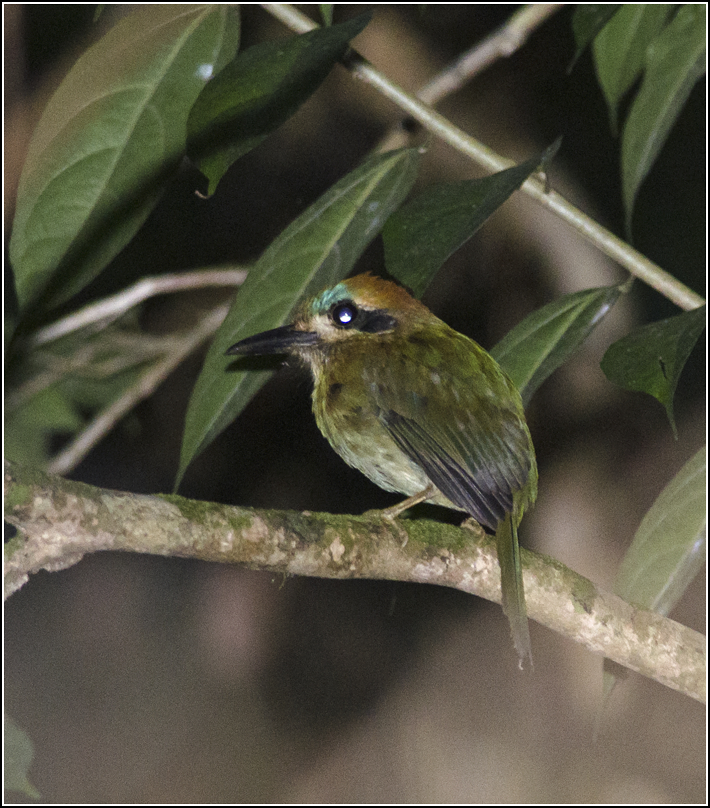
Yet another target bird appeared. This time it was a Tody Motmot! Dave and I were pretty sure that we had one fly by just as we had arrived at the ridge and were walking towards the camp. Not long after, a Tody Motmot was discovered around the camp! The light was quite low at this point, but I was happy just to have some record shots of this tough species in Panama.

Tody Motmot - Rancho Plastico, Darién, Panama

We were firmly in the low foothills at this point, at around an elevation of 600 m. Our plan for the next day was to get up early, hike to a ridge near the summit of Cerro Pirre, bird the ridge for half the day, and descent back to Rancho Plastico. It would be an exhausting day, but hopefully worth it as several endemic species awaited us. 

Total bird species so far: 424

Friday, 15 January 2016

Panama - Day 10 (March 9, 2014)


----------------------------------------------------

It was bound to be another hot, sunny day in central America as we drove east towards the town of Yaviza. Yaviza is located at the terminus of the Pan-American Highway, which spans south from Alaska through to Panama. After the Darién Gap, it picks up again in Turbo, Colombia, continuing south to a few spots in southern South America. The drive to Yaviza was not bad for the first few hours, but as we approached the number of potholes and gravel sections increased. We passed through numerous security checkpoints along our route, and were prepared with documents filled out by Isaac (to register in the national park) as well as copies of our passports. Luckily, these checkpoints were relatively easy to pass through. 

The drive passed through countryside consisting of agricultural fields, pastures, small towns and patches of forest. As we approached Yaviza, we came across some more forest and a greater percentage of wild land. A calling Pale-breasted Spinetail while still a ways out of town was a new bird for us, while a Gray-necked Wood-Rail calling as we entered Yavisa was new for me. 

Yaviza was crowded, as all frontier towns often are. We drove the narrow streets looking for Isaac, eventually finding him near the waterfront. Isaac joined us as we drove to a government building to register for access in the National Park. That taken care of, we bought a few supplies and headed down to the docks. 

We hopped in a long, narrow canoe with an outboard motor and prepared for our 90 minute journey down the Rio Chucunaque.

enjoying the river - Rio Chucunaque, Darién, Panama

fishing - Rio Chucunaque, Darién, Panama

It was interesting watching the bird life from a boat, especially one that is going at a pretty good clip. Our driver knew that we were interested in birds, so if we saw something interesting he tried to manouver the boat into a good location. Wading birds such as most of the regular herons were seen, while a Black Oropendola was perched near the top of a riverside tree.

Snowy Egret - Rio Chucunaque, Darién, Panama

Snowy Egret - Rio Chucunaque, Darién, Panama

 We passed several similar looking boats to ours during the trip, each loaded down with plantains that were harvested in nearby plantations.

plantain transport - Rio Chucunaque, Darién, Panama

An adult Collared Forest-Falcon flew across the river in front of our boat at one point, providing an excellent highlight! It would get even better as we turned down a quiet tributary of the Rio Chucunaque. In quick succession we had a flyover of a rare Black-collared Hawk, followed by an excellent look at a male Blue Cotinga. It was my second ever look at a cotinga and first good look at a bright male Blue Cotinga - what a smart-looking bird!

Black-collared Hawk - Rio Chucunaque, Darién, Panama

Blue Cotinga - Rio Chucunaque, Darién, Panama

We arrived in the town of El Real, Isaac's hometown, only accessible by boat. We filled up at a nearby restaurant on chicken, beans and rice, then set off on foot through the town while Isaac tried to arrange transport for us. We had a long walk into the forest to reach Rancho Frio, the ranger station at the edge of Parque Nacional Darién. From here we had a long hike upwards to Cerro Pirre, where we hoped to find all our target birds along a narrow ridge. We would be camping in the forest for two nights at a makeshift campsite known as "Rancho Plastico".

We walked to the other end of town and were picked up by a large bus already with a few locals inside. Once inside they drove back into town as apparently a few more people wanted to come along for the ride, while blasting the Reggaeton. We also stopped at a small convenience store to pick up a few six packs of beer for the ride! It was a pretty awesome trip in this party bus, and we were all feeling it a little by the time we arrived at our destination down the road to the forest edge.

Pale-bellied Hermit - hike to Racho Frio, Darién, Panama

Bats found on an old shed - hike to Racho Frio, Darién, Panama

We hiked down a trail leading towards the national park, making one last detour to stop at a small farm, where we picked up some papaya, pineapple and bananas for our trip.

As we continued hiking, Isaac picked out quite a few birds by sight, including some difficult to spot birds such as the above Pale-bellied Hermit. A few other of our Darién target birds were found despite the mid-day heat including good looks at a Black Oropendola. This Roadside Hawk provided an excellent photo subject as it perched at the edge of the trail.

Roadside Hawk - hike to Racho Frio, Darién, Panama

Roadside Hawk - hike to Racho Frio, Darién, Panama

As we walked deeper into our forest towards the National Park, it slowly began to feel like we were entering a larger area of mature forest. The vegetation reflected this, as did the bird species .Even the cicadas appeared to be a much louder drone. We came across across a few more interesting species, such as this White-fronted Nunbird, a Choco Sirystes and a pair of Scarlet-browed Tanagers, the latter two species restricted to eastern Panama and south along the Pacific lowlands in the Chocó to northern Ecuador.

White-fronted Nunbird - hike to Racho Frio, Darién, Panama

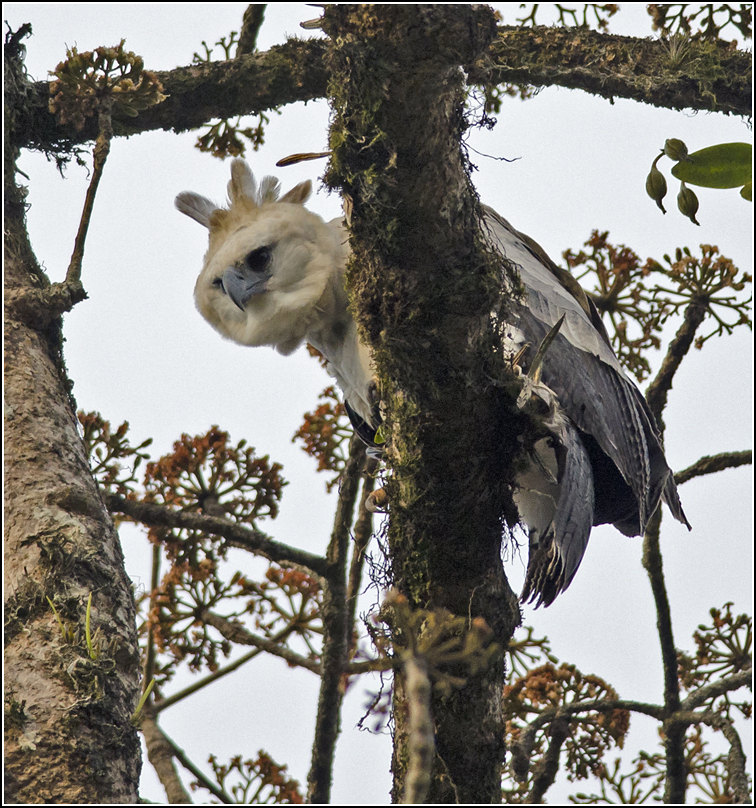
We hiked for several more hours, making good time whenever we were not interrupted by birds. Finally, in late afternoon, Isaac took us down a side trail to where he had a special bird staked-out. We stood under the massive tree and after a few seconds spotted the target bird, a Harpy Eagle. Harpy Eagles are one of the world's largest eagle species, living in large tropical forests and feeding on monkeys and sloths that it catches in the canopy.  Individuals have large home ranges, and so they are never found in a high density, even in high-quality forest. Making this species even more difficult to encounter, Harpy Eagles spend large amounts of the day perching quietly in the canopy, looking for prey items. They rarely soar, though that wouldn't help much in locating them either, given the habitat they occupy. Few suitable forests remain in Central America, meaning the Darién is the last stronghold in this part of the world for Harpy Eagles. They are a bit more common in South America, particularly in forests in Venezuela, Brazil, Ecuador and Peru.

This individual Harpy Eagle is a subadult that hatched from a particular nest that Isaac has been monitoring for a while. The adults were not present at the time and were not currently nesting. Isaac knows these birds really well and is usually quite successful in showing the few birders that show up here these Harpy Eagles. The Harpy Eagle was my 400th trip bird, according to eBird!

Harpy Eagle - hike to Racho Frio, Darién, Panama

Harpy Eagle - hike to Racho Frio, Darién, Panama

Steve was particularly thrilled with the Harpy Eagle!

stolen from Facebook

With one of our main Darién targets in the bag, we had a bit more spring in our step as we continued on for the last hour to the park headquarters.

We arrived with the last hour of light and met the ranger who ran the station here. He was the only one present, and the station considered of a larger main building and a handful of small cabins around the periphery of the mostly cleared area. Several tall trees stood amongst the buildings, and it was located next to the clear water of a stream.

After digging into some of the food we brought, we picked out our sleeping quarters. I roomed with Dave in a small building with two sets of bunkbeds and an old desk with some books on it, including a reference guide (in Spanish) to the mammals of this part of the world. A pretty interesting read, and I believe we even identified the bats from earlier in the day, though I can't find where I wrote down the species.

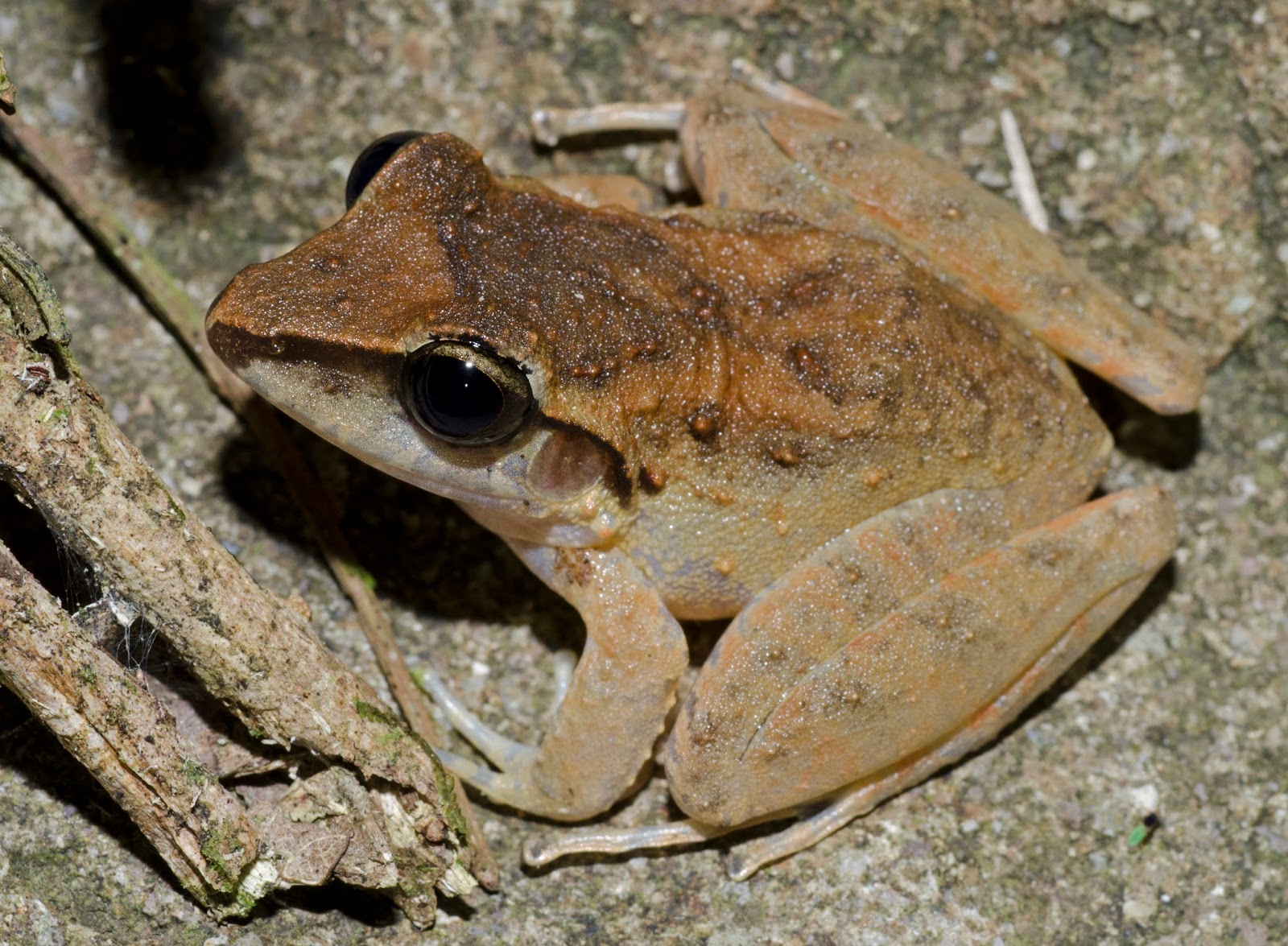
That evening we strapped on our headlamps, grabbed our flashlights and cameras, and headed to the creek to do some herping! I was excited to finally get a chance to see some Darién herps, though unfortunately I did not have a field guide with me (there is no good Panama herp guide yet). We did quite well on frogs, though it was fairly dry and most reptiles eluded us. Below is a selection of photos from that evening's nighthike. The elastic bands restraining my wonky camera flash in place did enough of a job to be useful.

 - Racho Frio, Parque Nacional Darién, Panama

Basiliscus vittatus (Brown Basilisk) - Racho Frio, Parque Nacional Darién, Panama

 - Racho Frio, Parque Nacional Darién, Panama

Rhinella margaritifera - Racho Frio, Parque Nacional Darién, Panama

Rhinella margaritiferaRacho Frio, Parque Nacional Darién, Panama

Smilisca silaRacho Frio, Parque Nacional Darién, Panama

 - Racho Frio, Parque Nacional Darién, Panama

 - Racho Frio, Parque Nacional Darién, Panama

Hyalinobatrachium aureoguttatum (Atrato Glass Frog) - Racho Frio, Parque Nacional Darién, Panama

 - Racho Frio, Parque Nacional Darién, Panama

Hypsiboas rosenbergi (Rosenberg's Gladiator Treefrog) - Racho Frio, Parque Nacional Darién, Panama

 - Racho Frio, Parque Nacional Darién, Panama

 - Racho Frio, Parque Nacional Darién, Panama

Rhaebo haematicusRacho Frio, Parque Nacional Darién, Panama

We fell asleep by 10:00 o'clock or so, excited to bird the pristine forest surrounding the ranger station the following morning, before beginning the hike up Cerro Pirre. It was bound to be an exciting day!

Total bird species so far: 400