Friday, 18 May 2018

Second Annual Point Pelee Family Weekend (Part 1)

This past weekend was the second installment of what I hope will continue to be an annual tradition at Point Pelee. My parents were able to make it down for two nights, while Laura and I also drove down to meet them there. Our inaugural Pelee weekend last May was slightly hampered by cold temperatures and frequent rain, but we made the most of it and had a good time anyways (even though only 9 warbler species were seen!).

My parents drove down to their bed and breakfast in Leamington on Friday after my mom finished work, while Laura and I were not far behind them, arriving in Leamington by 10:00 PM or so. The Riley's were generously hosting Laura and I again this year. Though heavy rain was once again forecast for the whole weekend, we were determined to make the most of it.

From left to right: Dave, Josh and Fran Vandermeulen, Laura Bond, David Szmyr, Steve Pike, Josh Mandell (photo courtesy of Steve Pike)

One of the first birds I laid eyes on after arriving at the Visitor's Center on Saturday morning was a Eurasian Tree Sparrow, flying past us through the parking lot as we were getting organized in the morning, and appearing to land somewhere around the Visitor's Center. This bird was almost certainly the individual that had been seen at several locations in the southern part of the park over the previous two days.  I spent a few minutes searching for the bird with Dan Riley near the Visitor's Center but eventually gave us as the tram arrived.

Despite the cool, gloomy conditions with a threat of rain the birding was actually quite good near the Tip. I spotted an Acadian Flycatcher around the new clearing that will be the location for the proposed observation tower and within a minute or two the entire clearing was lined with birders! Word travels quickly at the Tip. We slipped away from the crowd to keep birding, being entertained by our first few warbler species, Scarlet Tanagers, and great looks at two Philadelphia Vireos, including this one which was resting on a trail-side branch with its eyes closed for a few minutes.

Philadelphia Vireo - Point Pelee National Park

Philadelphia Vireo - Point Pelee National Park

Many of the warblers were feeding down low, often walking right on the ground and occasionally popping up onto a visible twig, and we soon added Orange-crowned, Tennessee, Nashville, Cape May and Blackburnian to our lists.

Tennessee Warbler - Point Pelee National Park

Birding at Pelee during May is almost as much about the social side of things as it is about the birds. It was great to run into quite a few familiar faces, many of the them I only see once a year at Point Pelee, and also to introduce Laura and my parents to so many of my friends in the birding community.

With Steve Pike (center) and Bob Curry (right) - Point Pelee National Park (photo courtesy of Steve Pike)

Three legends of the Ontario birding community - Tom Hince, Paul Pratt and Bruce Di Labio - were chosen as this year's Celebrity Birders to represent the Ontario Field Ornithologists and complete a Big Day, to help raise funds for several different causes. Tom, Paul and Bruce have been birding together for decades and have established all sorts of Big Day records. At various times they have set the Big Day records for North America, the United States, Canada, Texas, New Jersey, 7 Canadian provinces (including Ontario) and 2 territories.  The team has also won the esteemed World Series of Birding in New Jersey, the Great Texas Classic Birding competition, and the Spacecoast Flyway birding competition in Florida. Instead of completing a regular Big Day, Tom, Paul and Bruce would be completing a Big Sit, where they would be confined to a small circle for the entire day, counting whichever birds pass near the circle. We ran into the guys around 8 AM by which they had already identified over 90 species. They finished with an incredible 110 species, highlighted by a flyover Smith's Longspur!

From left to right: Paul Pratt, Tom Hince, Bruce Di Labio and Steve Pike (photo courtesy of Steve Pike)

After our morning at the tip, we hopped back on the tram which would take us back to the Visitor's Center as refreshments were overdue. Feeling satiated, we decided to go for a walk down the Redbud Trail along with Steve Pike and Victor Serrano, looping back along the Woodland Nature Trail despite the rain which had picked up in intensity. We were dressed for the weather so that would not stop us!

The birding was excellent in the rain and we found a string of good birds, one after another, which initiated a stampede of people on several occasions once I posted the sighting to the Whatsapp group. First up was a female Hooded Warbler at our feet along the Botham Trail, followed by a very cooperative male Mourning Warbler a few minutes later, then a White-eyed Vireo at the north end of Redbud, a female Mourning Warbler halfway along Redbud (that later was reported as a Connecticut for some time until photos were taken), and another White-eyed Vireo at the south end of Redbud. The birding was awesome!

White-eyed Vireo - Redbud Trail, Point Pelee National Park

This American Robin was posing on a branch with a nice background so I could not help myself with a few photos. It's a species that I do not focus on often enough.

American Robin - Point Pelee National Park

Our pace on the Woodland Nature Trail was directly correlated to the frequency by which the rain fell; indeed, we breezed through the last few hundred meters to reach the comfort of the warm and dry Visitor's Center. We decided that we would have a picnic lunch at Sleepy Hollow, where a pavilion would keep us dry. Even here the birding was excellent as about 10 different warbler species flitted low in the Prickly Gooseberry, drinking the nectar from the flowers. When insects are in short supply, nectar will do in a pinch.

Cape May Warbler - Point Pelee National Park

This Cape May Warbler had a strange growth of some sort on top of its bill. Does anyone know what's going on with this?

Cape May Warbler - Point Pelee National Park

Birding at Sleepy Hollow, Point Pelee National Park (photo courtesy of Steve Pike)

Fortunately the rains tapered off and though the skies threatened, our afternoon was relatively dry. We focused on a few of the trails on the west side of the park including Pioneer, Sleepy Hollow and Northwest Beach. I have to say it was some of the best birding that I have ever had along these trails. A huge number of warblers, orioles and other songbirds were feeding down low in the gooseberry. There were rarely moments without a few warblers to look at, and Ruby-throated Hummingbirds were present in huge numbers. It was a great experience for my parents and Laura, and it made my job easier! Explaining the differences between sparrows, vireos and warblers is a lot easier when the birds in question are foraging at eye level only a few meters away.

Rose-breasted Grosbeak - Sleepy Hollow, Point Pelee National Park

We thoroughly enjoyed the walk, highlights being an adult Great Horned Owl, a singing Cerulean Warbler, and our first Yellow-throated Vireo and Wilson's Warbler of the spring. We even watched a flying Common Nighthawk at Northwest Beach land in a trailside tree, its cryptic plumage rendering it very difficult to see once it had landed. A Clay-colored Sparrow that Garth, Nancy and Dan Riley had discovered earlier was also easily seen, along with large numbers of Lincoln's Sparrows.

Common Nighthawk - Northwest Beach, Point Pelee National Park

Clay-colored Sparrow - Northwest Beach, Point Pelee National Park

My parents and Laura called it a day at this point, with my parents only 8 species shy of 100 species despite having never left the park. One hundred species appeared to be virtually guaranteed for the weekend, compared to last year which saw us desperately searching for a Swamp Sparrow along the windy Marsh Boardwalk with less an hour until my parents needed to leave. We were successful last year, but it came down to the wire!

I birded the last hour of daylight on my own and then eventually meeting up with Dan, Garth and Nancy, since I was not quite ready to call it a day, given the large numbers of birds around. In the Sanctuary parking lot I discovered this orange-variant Scarlet Tanager, happily feeding on earthworms at the edge of the parking lot. I'm not entirely sure what causes some individuals to display an orange base colour as opposed to brilliant scarlet. Perhaps it is diet related or caused by nutritional deficiencies. At any rate it was a fun bird to finish the day wish!

orange variant Scarlet Tanager - Sanctuary, Point Pelee National Park

orange variant Scarlet Tanager - Sanctuary, Point Pelee National Park

Thursday, 10 May 2018

Port Weller pulls through in a big way

Despite strong winds and periods of rain in the forecast, I decided to drive down to Port Weller to walk the east pier once again. I had been putting in my time at the pier this spring and in general had been quite impressed with the variety and numbers of migrant bird species. We are right in the heart of spring migration and every day brings surprises, so I was excited to see what new species had dropped in. I had a full day ahead of me with no commitments and big plans to bird many of the migrant traps I frequently visit in Niagara.

Black-throated Green Warbler - Port Weller east pier, Niagara Region

My first stop was the Avondale (Parmalat) ponds, located off of Stewart Road and west of the Niagara-on-the-Lake airport. During the previous morning, local St. Catharine's birder Philip Downey discovered a Cattle Egret around the ponds. It had continued to be seen on and off during the day; though I dipped on my 3:00 PM check. My 7:00 AM check this morning was also fruitless, apart from some great looks at Bobolinks, Eastern Meadowlarks, and this Northern Mockingbird.

Northern Mockingbird - Avondale ponds, Niagara-on-the-Lake, Niagara Region

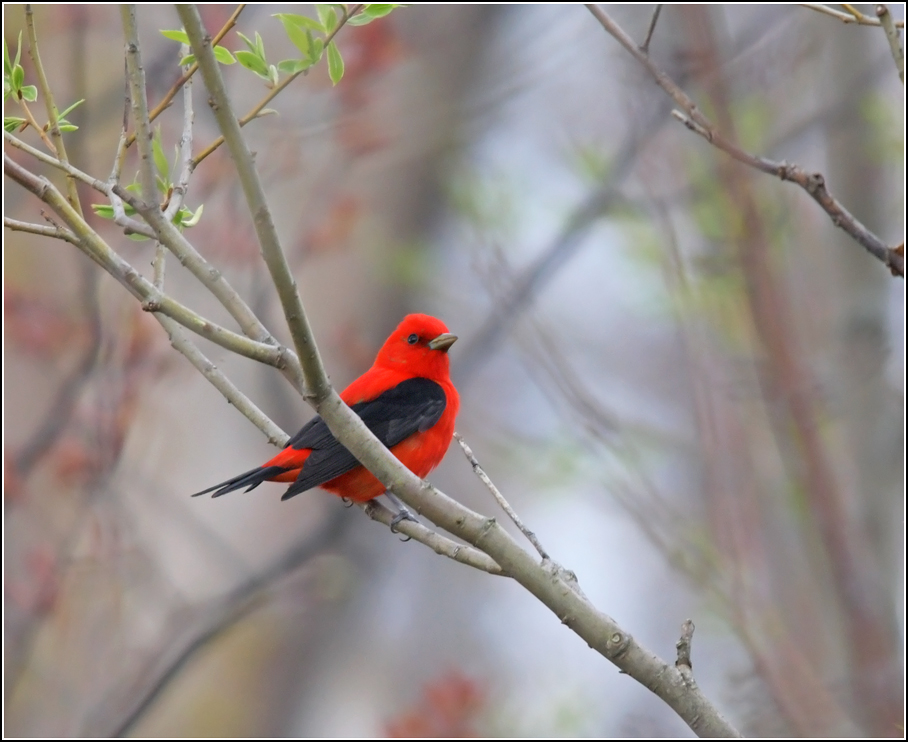
Even before arriving at the pier it was clear that moderate to high numbers of songbirds were around. In a few minutes of roadside birding at a woodlot flanking the Welland Canal I quickly began ticking off warbler species, followed by Warbling Vireos, Baltimore Orioles and an Indigo Bunting, glistening after the light rain a few minutes earlier. A Bay-breasted Warbler was a feast for the eyes, as were sharp-looking Blackburnian and Black-throated Blue Warblers, but especially a male Scarlet Tanager.

Scarlet Tanager - Port Weller east pier, Niagara Region

Continuing up the pier it was clear that it would be a good day of birding; the songs of warblers pierced through the southwest breeze, which was blowing the storm clouds past. All along the trail I encountered birds, including two Orchard Orioles, a Red-eyed Vireo, some Least Flycatchers, a Ruby-throated Hummingbird and a Magnolia Warbler - all of which were Niagara year birds. The warbler tally crept up as I added Black-throated Green, American Redstart, Blue-winged, Chestnut-sided and Northern Parula, and even a Fish Crow flew over for good measure. The pier was hopping!

Chestnut-sided Warbler - Port Weller east pier, Niagara Region

I cut across to the east trail running along the shoreline, and as I walked I heard a snippet of a different bird song through the dominant tones of the American Goldfinches, Yellow Warblers and House Wrens which were constantly singing. Immediately I thought it sounded like a Bell's Vireo but it had been just a fragment of song and I thought I might have been hearing things. The bird sang a few more times at which point I was pretty confident that a Bell's Vireo was involved and I started to get excited. I frantically pulled out my phone to begin recording a video, though by the time that I hit Play, the bird had stopped singing. It chattered out a few more rounds of its song about five minutes later, at which point I changed my position to obtain a better angle. Finally on the third round of singing I spotted a drab greenish-yellow bird low in a shrub, only 30 cm or so off the ground. I believe I said out loud "That's a f****** Bell's Vireo!" to myself and rapidly tried to take some photos, though in the excitement it was difficult to have a steady hand. After my camera struggled for a moment I locked onto the bird and fired off six frames; each frame nearly identical and showing the same features on the bird, though unfortunately it was looking away from the camera.

Bell's Vireo - Port Weller east pier, Niagara Region

The bird dropped back down into the undergrowth after a few seconds, but was still visible, partially obscured in the vegetation.  I took a good long look through my binoculars for the next 30 seconds, soaking up the views, until I lost the bird skulking deep within a tangle. Some of the main features used to identify this bird include:

-a small and slim vireo, acting skulky
-overall greenish-olive in color, with yellow along the flanks
-grayish head with weak spectacles
-a bold lower wingbar, and a weak upper wingbar
-distinctive song: a very fast scratchy song that goes up and down in rapid succession - like taking a Sharpie marker and moving it quickly on a whiteboard

Bell's Vireo - Port Weller east pier, Niagara Region

I tried to get the word out as quickly as possible while trying to stay on the bird, but unfortunately it refused to sing anymore and I could not detect any movement in the shrubbery where it had last been seen. Soon birders started arriving. Some local birders first, followed by several Hamilton and GTA birders, but none of us had any luck. Eventually I continued onward up the pier as I was itching to see what else had come in.

Another brilliant male Scarlet Tanager appeared on the trail, a Bobolink was singing in the field south of the Big Pond (my first for the pier!), while by the Big Pond I inadvertently flushed a roosting Black-crowned Night-Heron. Even an American Pipit flew over, my first of the year. The new birds for the day kept coming - Swamp Sparrow, Redhead, Cape May Warbler, Brown Thrasher. It was birding at its finest!

Bay-breasted Warbler - Port Weller east pier, Niagara Region

Brown Thrasher - Port Weller east pier, Niagara Region

I returned to the scene of the crime, meeting up with Frank Pinilla and Judy Robins along the way when we had a Fish Crow fly over us (ho hum). Frank and I continued to walk back to the spot and we had barely arrived when the Bell's Vireo belted out its characteristic song twice. Again, that was all he would give us - despite frantically waving over the other birders, the vireo would not sing again.

Eventually I left the pier, as my phone was dead, my stomach was growling and the time of day was approaching 2:00 PM. In my six hours I had tallied 88 total bird species on the pier, smashing my previous personal best of 81 (from Tuesday). A morning of birding at Port Weller during the peak of migration can rival Point Pelee with the number and diversity of birds, just on a smaller scale. But I seem to have fewer "slow days" on Port Weller than what I experience at Point Pelee- though of course because of Point Pelee's coverage, there are usually a couple of rare species around worth chasing. The great reverse migrations that occur some mornings at Point Pelee as well as nearby Hillman Marsh, the onion fields and Wheatley harbour add greatly to Point Pelee's appeal. But as far as "bush birding" goes, Port Weller is often excellent during the peak of migration.

Chestnut-sided Warbler - Port Weller east pier, Niagara Region

On the way out I ran into Josh Mandell and Dave Szmyr, hoping to bag the Bell's before their Point Pelee weekend. I later heard from them that they were successful along with Judy Robins, as the bird popped back out and gave brief views.

Bell's Vireo is a rare vagrant to Ontario with 18 OBRC accepted records as of the end of 2017. The vast majority of these records are of spring overshoots in late April and May: in fact 16 of the 18 records fall between the dates of April 21 and May 27. Bell's Vireo has appeared more frequently in recent years with seven accepted records from the last seven years. Bell's Vireo has occurred in Niagara Region once before - one of the two autumn records for Ontario - a bird found by Rob Dobos at Fifty Point Conservation Area in Grimsby on 18 October 1994. Pending acceptance by the OBRC this will be a second record for Niagara Region.

Chimney Swift - Morgan's Point CA, Niagara Region

I made a quick stop at the Avondale Ponds near the airport at Niagara-on-the-Lake for my third visit in 24 hours to see if I could turn up the Cattle Egret. I was finally in luck, as the bird was present in the cow paddock at the farm to the north, and viewable from the ponds. I also made stops at the Niagara-on-the-Lake Outlet Collection Ponds off of Glendale Avenue, and also birded Morgan's Point Conservation Area for an hour and a half. The Cerulean Warbler from two days ago was not present, and it must have taken all of its fellow warblers with him since the park was pretty quiet (the increasing cloud cover did not help). It was an enjoyable spin through the woods, highlighted by watching a quartet of Orchard Orioles, as well as point-blank looks at a Rose-breasted Grosbeak deep in the understorey.

Rose-breasted Grosbeak - Port Weller east pier, Niagara Region

It appears that some birders this evening were successful in observing the Bell's Vireo, as Mark Field posted with good news around 6:00 PM. Good luck to anybody else looking for the bird!

I will be back at the pier tomorrow morning and will update if the bird is still present.

Bell's Vireo - Port Weller east pier, St. Catharines

I've got a singing male Bell's Vireo at the Port Weller east pier in St Catharines. Just wanted to get the word out!


Here are two screenshots showing my location. 


Wednesday, 9 May 2018

Rare warblers and other spring sights in Niagara

I haven't posted much lately, but that can be blamed mainly on the calendar month. We are into what is obviously the most wonderful time of year and as a result the ratio of time spent outside versus on the computer has dramatically increased for me. Between field surveys for work, weekends at Point Pelee and birding locally in Niagara there is barely enough time to edit photos in the evening, let alone work up the energy to create a blog post.

Warbling Vireo - Port Weller east pier, Niagara Region

Yesterday I took off from work and birded some of my favorite hotspots in Niagara. After sleeping for a combined fifteen hours over three nights this past weekend (I was at, you guessed it, Point Pelee), I slept in until 7:45 AM. Feeling refreshed and with the sunny morning holding untold amounts of promise, I drove down to the Port Weller east pier. This was a good choice since I experienced one of my better birding days along the pier.

House Wren - Port Weller east pier, Niagara Region

House Wren - Port Weller east pier, Niagara Region

It started with a Hooded Warbler that was calling near the start of the trail in some thick undergrowth. I wasn't able to obtain a visual but Hooded Warblers have one of the most distinctive call notes among wood-warblers. While I would have loved to have viewed the bird, hearing it was enough to count as my 200th species that I have encountered at Port Weller. It only took 72 visits to get there!

The birding continued to be excellent and I picked up many species. The only wind was a light breeze coming in off of the lake, and the air temperatures were ideal, beginning in the low teens and finishing around twenty degrees. Just perfect conditions to be on the trails looking at birds.

Great Crested Flycatcher - Port Weller east pier, Niagara Region

The next bird that caused a bit of excitement was a gorgeous male Scarlet Tanager flitting in the trees flanking then north edge of the big pond. While much of the pier is vegetated with scrub and young trees, some larger trees around the pond create the best habitat on the pier for Scarlet Tanagers during migration. This forest species is at home in large woodlands and I had never seen one on the pier before. It is a species that I always enjoy observing, especially if the tanager is down low and in good light. The red just glows! While watching  the tanager, a Northern Waterthrush produced its emphatic song from somewhere unseen along the edge of the pond. My first Least Flycatcher of the spring in Niagara also flitted nearby.

Scarlet Tanager - Port Weller east pier, Niagara Region

Moving along I was surprised to hear a Marsh Wren chattering away continuously from the reeds along the north edge of the small pond. This species is an infrequent migrant on the pier - in fact it was only the second one I had viewed there. It was too furtive for photos, but I did enjoy taking some photos of an attractive Northern Parula which was nearby. This species passes through Niagara to reach the breeding grounds and is always a treat to find.

Northern Parula - Port Weller east pier, Niagara Region

Northern Parula - Port Weller east pier, Niagara Region

Northern Parula - Port Weller east pier, Niagara Region

I ran into a quartet of local birders near the small pond, including John Black, Kayo Roy, Philip Downey and Brian Ahara, and we exchanged sightings before going our separate ways. Luck was on my side and I kept running into pockets of birds - Veery, Cape May Warbler, Black-throated Blue Warbler, a flyover Indigo Bunting even a singing Brown Thrasher. Each of these species are only seen as transients on Port Weller.

Brown Thrasher - Port Weller east pier, Niagara Region

While walking down the centre path I stopped dead in my tracks after hearing a Golden-winged Warbler sing! It continued to vocalize on and off over the next half hours, though try as I might I just could not get a visual on the bird, which would be helpful to rule out any hybrids with Blue-winged Warbler. Below is a video of the bird singing - it sings at 0:03 and 0:19 of the video. I only have one previous record of Golden-winged Warbler in Niagara, a bird I found in migration at Wainfleet Bog in May of 2011.


By the time I finished at Port Weller almost 4.5 hours had passed and I had 81 species under my belt. This was my highest single day total ever at the pier, besting my previous high of 71. The numbers of birds were not overwhelming but diversity was high and birds were continuously found all along.

Eastern Cottontail - Port Weller east pier, Niagara Region

Eastern Cottontail - Port Weller east pier, Niagara Region

Eastern Cottontail - Port Weller east pier, Niagara Region

In the afternoon I decided to try the Lake Erie shoreline. My favorite spot on the north shore of Lake Erie in Niagara is Morgan's Point Conservation Area, which is located just west of Port Colborne. The mature trees, dunes, and scrub habitats are attractive to migrant songbirds with many notable birds having been found there over the years. This area also receives less foot traffic than some of the other migrant traps along the shoreline including Waverly Beach in Fort Erie, and the quietness and tranquility add to my enjoyment of the area. As I drove down Morgan's Point Road with my car windows open, a blast of birdsong met my ears. It was mostly American Goldfinches, House Finches, Yellow Warblers and House Wrens but one interesting song grabbed my attention as I drove past. Could it have been a Cerulean Warbler? Several species have songs that can approach that of Cerulean, including Northern Parula and Black-throated Blue Warbler, but this sounded really interesting. After parking I grabbed my camera and immediately marched back to the spot. It took a few minutes but then the bird sang again. The sun was in the wrong spot but after waiting patiently I spotted the bird tucked in against a branch in a nearby tree. It was in fact a male Cerulean!

Cerulean Warbler - Morgan's Point CA, Niagara Region

The next 30 minutes were pure bliss as I watched the rare songster belt out his distinctive song and forage among the trees and sumacs. A Fish Crow and Red-headed Woodpecker calling frequently from somewhere behind me but I paid them no heed.

Cerulean Warbler - Morgan's Point CA, Niagara Region

Cerulean Warbler - Morgan's Point CA, Niagara Region

Cerulean Warbler is one of my favorite warblers due to their dapper plumage, interesting song, rarity in southern Ontario, and penchant for beatiful maple-beech-oak forests. While the species was formerly a fairly common breeder in high quality Carolinian woodlands, in recent decades the populations have plummeted in most areas. For instance even here in Niagara, located squarely within the Carolinian zone, the Cerulean Warbler appears to be extirpated. Populations in Ontario are still hanging on in the Frontenac Axis area, near Georgian Bay and scattered additional localities in southwestern Ontario, but it is a species that has become quite rare, sadly.

Cerulean Warbler - Morgan's Point CA, Niagara Region

On the breeding grounds Cerulean Warblers are often found way up in the canopy, proving to be difficult to observe as they may be obscured by foliage. It was such a treat to experience an individual as cooperative as this one. He sang and foraged in the same general area for the half an hour I watched him, moving lower and lower in the trees until he was at eye level on several occasions. It was an incredible experience and I came away with a few decent photos as well.

Cerulean Warbler - Morgan's Point CA, Niagara Region

After walking away from the Cerulean I spotted a few more things as I wandered through the park under the towering spruces and oaks. The relatively late arrival to the spring season has helped to delay the growth of warbler-obscuring leaves on all of the trees. Normally by now leaf-out is occurring, making it a bit trickier to find birds high up in the trees. I guess the endless winter did have one side benefit. In my wanders I found a male Orchard Oriole singing, a handful of warblers including a male Blue-winged, more sightings of the Fish Crow and a skulking Brown Thrasher. At one point I watched a standoff between two male Northern Flickers. Hormones run high during the spring.

Northern Flicker - Morgan's Point CA, Niagara Region

During migration periods birds are occasionally seen in places where they are not expected. Marsh Wrens are normally at home deep within cattail marshes, though in migration they occasional turn up in less ideal habitat types. I was caught a bit off guard hearing this Marsh Wren singing from a brush pile in the woods, not far from where the Cerulean was.With a bit of patience I was able to snap off a few photographs.

Marsh Wren - Morgan's Point CA, Niagara Region

Returning home after my successful outing, I picked up Laura and we drove to Niagara Shores Conservation Area west of Niagara-on-the-Lake for an evening stroll. The evening was perfectly calm, the air was cool but comfortable, and we even saw a few warblers in our wanderings. I did not take my camera with me, but some of the highlights from our walk were five species of thrush, great looks at Rose-breasted Grosbeak and Black-throated Blue Warbler, and the beautiful sunset. It had been a great day!

Wednesday, 25 April 2018

More spring sightings in Niagara

Last week was a bit of a write-off for me as I came down with a nasty stomach bug that knocked me out of commission on Tuesday and Wednesday. Thursday and Friday morning were busy as I tried to catch up on all my work but by Friday afternoon I was free, with a serious urge to get down to the lakefront and look for birds.

Port Weller was my destination as it so often is, and it was a good choice. While my species total was relatively modest (42), there were a few new migrants in. While the Golden-crowned Kinglets had disappeared I was happy to see my first migrant Winter Wren of the spring, numerous Horned Grebes (many in pristine breeding plumage), and a few Purple Martins mixed in with all the Tree Swallows.

Purple Martin - Port Weller east pier, Niagara Region

The "best" bird of the day was a total surprise, as they often are. I had approached "the big pond" along the east side of the pier and quickly scanned the ducks that dotted its surface; Northern Shovelers, Ring-necked Ducks, Buffleheads, etc. Suddenly I noticed a small dark bird swimming away from me; it had evidently been out of view in the aquatic vegetation along the near shore. A Common Gallinule!

Common Gallinule - Port Weller east pier, Niagara Region

While Common Gallinules are an uncommon but regular marsh bird that breeds in large wetlands in southern Ontario, they are unusual in Niagara with only a few reliable places, such as Mud Lake Conservation Area, hosting breeding individuals. Occasionally they are seen in migration and they have occurred at Port Weller in the past (according to ebird the last individual was in 2004). This was my second gallinule species for the big pond, after "twitching" the Purple Gallinule back in 2011, a bird which is much rarer in Ontario!

Common Gallinule - Port Weller east pier, Niagara Region

The lighting on the Common Gallinule was absolutely terrible but I was able to take some poor quality record shots to document the find. The Common Gallinule was my 196th species for the Port Weller pier.

Later on in the walk I encountered one of the Eastern Cottontails that frequent the pier.

Eastern Cottontail - Port Weller east pier, Niagara Region

On Saturday Laura and I took advantage of the sunny, warm conditions (finally!!) and drove down to Wainfleet Bog. The temperatures could have been a few degrees higher to entice a greater amount of reptile activity; though we still had some success.

Laura and I at Wainfleet Bog, Niagara Region

It felt great to be wearing the waders, exploring one of the few natural gems remaining in Niagara Region, even though Wainfleet Bog is just a shell of its former glory due to extensive peat farming that had taken place. Several Mourning Cloaks and Eastern Commas flitted on by, a sight for sore eyes after a long winter. From all around us the calls of Spring Peepers and Western Chorus Frogs emanated from the wetlands, with the low snore of Northern Leopard Frogs and the chuckles of Wood Frogs providing the bass and tenor notes. Egg masses had already began to appear - these frogs don't waste any time - and I snapped a few photos of a Western Chorus Frog egg mass.

Western Chorus Frog eggs - Wainfleet Bog, Niagara Region

Laura and I set off to a part of the bog that I had not been to in years, crossing several deep canals to reach the area. Evidently it had been a while since people had been down that way since we had two excellent bird sightings. The first was an American Bittern that we inadvertently flushed. It circled around us once, providing a spectacular view before settling down in a distant part of the bog. American Bittern is surprisingly rare in Niagara; this was only the second I had ever seen.

The second great bird was a Long-eared Owl that we surprised in an alder stand in the middle of the bog without a tree in sight. It settled in a different bush at a same distance from us, allowing us to soak in the views. I only had my macro lens with me and there were many branches in the way, but at least I managed an identifiable photo. I am not sure why the owl was in such a location that does not seem "typical" for the species. My guess is that the owl was hunting frogs - the buffet has quite the spread at this time of year with many different flavors.

Long-eared Owl - Wainfleet Bog, Niagara Region

Other recent arrivals that we encountered on our walk included Eastern Towhee, Field Sparrow, Tree Swallow and Swamp Sparrow.

The temperatures were in double digits but a bit of cloud cover and a light breeze hampered reptile activity. The only snake species we could find was Eastern Gartersnake. Despite its abundance, Eastern Gartersnake is one of my favorite species due to its variability and the frequency in which I encounter them. The individuals at Wainfleet Bog often are browner than normal, possibly due to the tannins from the peat staining their skin.

Eastern Gartersnake - Wainfleet Bog, Niagara Region

Eastern Gartersnake - Wainfleet Bog, Niagara Region

Eastern Gartersnake - Wainfleet Bog, Niagara Region

With a few hours to kill on Sunday I took advantage of the beautiful day and explored a new area in Niagara for me - Niagara Shores Conservation Area. Located on the Lake Ontario shoreline just west of Niagara-on-the-Lake, the park consists of some mature Carolinian Woodland (with some really nice, mature examples of Sassafras and Tulip Tree), some scrubby areas, and Four Mile Pond along the western boundary. The potential for migrant birds is excellent and I look forward to visiting throughout the spring!

During my cursory walk on Sunday I found over 40 species, several which I photographed for the first time in Niagara (Fox Sparrow, Hermit Thrush, Pine Siskin). Two pairs of Belted Kingfishers were present. They likely nest in the embankment along the shoreline.

Pine Siskin - Niagara Shores CA, Niagara Region

Belted Kingfisher - Niagara Shores CA, Niagara Region

Belted Kingfisher - Niagara Shores CA, Niagara Region

While the duck diversity has decreased in recent weeks with the onset of more seasonal weather, several species are still commonly seen (for now). The Long-tailed Ducks are in their spiffy spring plumage, looking quite different than a few short weeks ago. Red-breasted Mergansers are still frequently noted as well, but they too will be heading up north in a few weeks.

Red-breasted Merganser - Niagara Shores CA, Niagara Region

While walking along Four Mile Pond I spotted two Snapping Turtle "in the act". Unfortunately they noticed me too and sunk back into the water!

Snapping Turtle - Niagara Shores CA, Niagara Region

A third Snapping Turtle was catching some rays in a sheltered corner of the wetland. This is a common sight in April, but by the time the warm weather is here to stay in late May, Snapping Turtles are rarely seen basking.
Snapping Turtle - Niagara Shores CA, Niagara Region

Hermit Thrushes rarely cooperate for photos for me. This one did, though of course it was on a shaded branch with a backlit background!

Hermit Thrush - Niagara Shores CA, Niagara Region

And a photo of a Cooper's Hawk that was intently keeping an eye on some sparrows flitting at the edge of the marsh.

Cooper's Hawk - Niagara Shores CA, Niagara Region

On Monday I returned to Port Weller, hoping that the continued warm weather had pushed a few new birds onto the pier. I was also hoping to catch up with the Virginia Rails that Ryan Griffiths had found on Sunday in the small pond near the end of the pier.

Fox Sparrow - Port Weller east pier, Niagara Region


Monday ended up being one of the better days I have had on the pier in recent days. Sparrows in particular stole the show. Field, Fox, Song, Swamp, White-throated, Dark-eyed Junco, American Tree, Chipping, and Savannah Sparrows were all accounted for and I enjoyed sifting through a few flocks. The Savannah Sparrows (3 in total) were actually new Port Weller birds for me, number 197. Savannah Sparrow was definitely a low hanging fruit but it was nice to finally see some at Port Weller! Some of the other "easy" species I need for my Port Weller list include Green Heron, Great Egret, Broad-winged Hawk, Sora, Solitary Sandpiper, American Woodcock, Great Horned Owl, Eastern Screech -Owl, Common Nighthawk, Horned Lark, Eastern Bluebird, Blue-winged Warbler, Scarlet Tanager and Bobolink. Later in the walk I heard one of the Virginia Rails ticking away - number 198.

Savannah Sparrow - Port Weller east pier, Niagara Region

One of the bigger surprises of the day was a Common Raven that flew over the parking lot as I arrived. This was only my second ever sighting of Common Raven at Port Weller. The species appears to be expanding in Niagara Region; now three black corvids are possible anywhere in the region (Common Raven, American Crow, Fish Crow). The Common Raven was a little distant when I finally got my camera on it.

Common Raven - Port Weller east pier, Niagara Region

It was a very birdy walk. Good numbers of both kinglet species were in, while Hermit Thrush, Eastern Phoebe, Winter Wren, Brown Creeper and Yellow-rumped Warbler numbers had increased significantly. I finished with 56 species; a solid showing for the date.

Eastern Phoebe - Port Weller east pier, Niagara Region

We are now into the best time of year as far as I am concerned and I am excited for what the next few weeks have in store. Spring is always over much too quickly so make the most of every day!