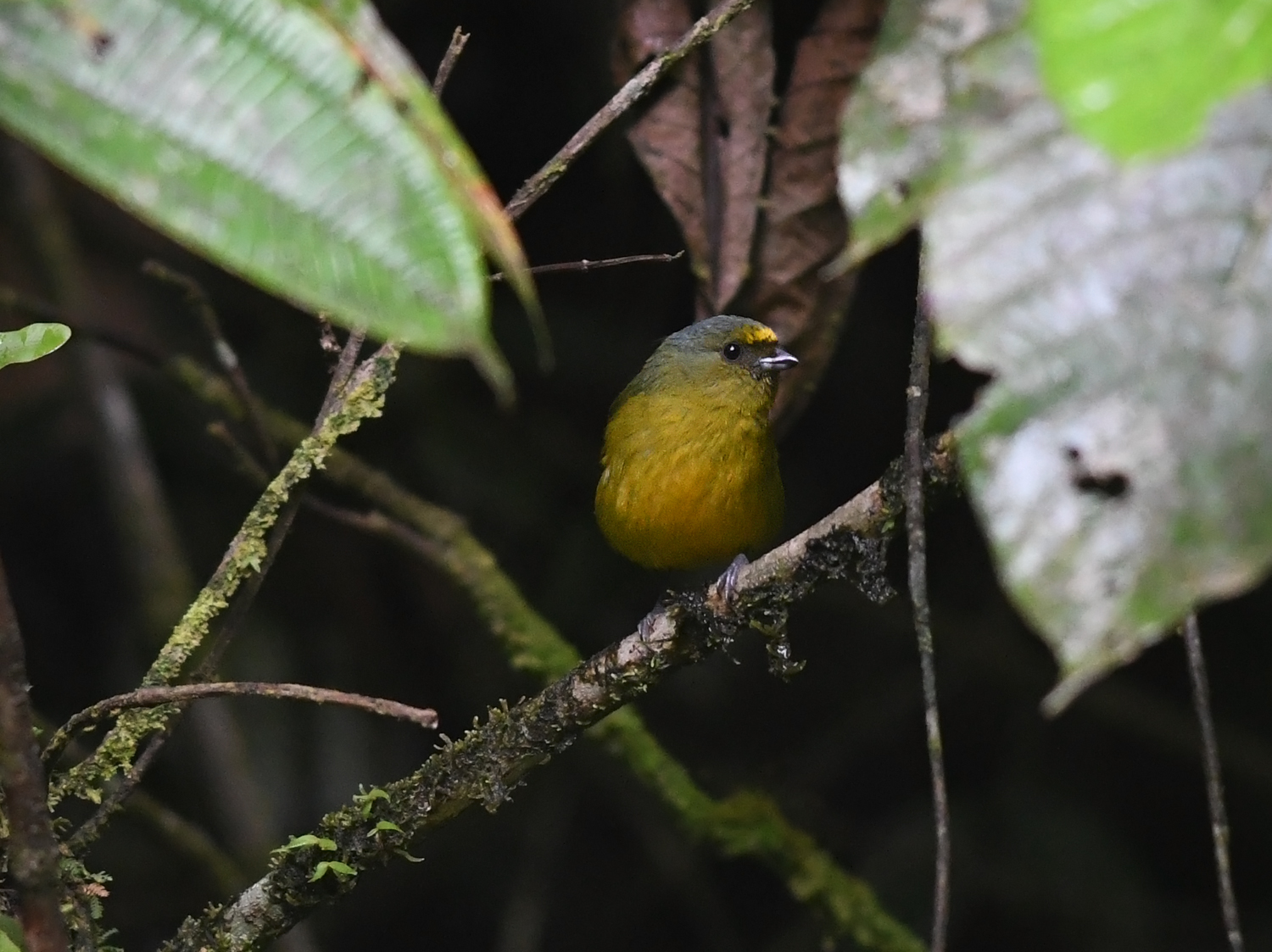
When most people think about the geography of Colombia, the Amazon does not usually come to mind immediately. However, the areas east of the Andes comprise around 60% of the country's landmass of which more than half is considered Amazonia. The locations that we visited in southern Colombia were all very close to each other (relatively speaking), yet we were able to visit Amazonia as well since it just reaches the Mocoa area. We were based in Mocoa for four nights after exploring the Magdalena River Valley and we took two days to visit landscapes that are considered Amazonian, with many of the representative bird species present.
Our first day in this part of Colombia was spent exploring an area of secondary forest that was about a 1.5 hour drive from Mocoa. While formerly consisting primarily of fields used for cattle ranching, the conservation-minded owner decided to let most of his property go back to nature, with supplemental plantings of trees augmenting the forest. The birdlife here was quite diverse and we racked up a nice list in a casual morning of birding from a dirt track that sliced through the property.
Since we were in a new biogeographical area many of the species were new for our "trip list". It was good to reacquaint myself with some of the common Amazonian birds in this area including White-throated Toucan, Violaceous Jay, Black-fronted Nunbird and the spectacular (if a little ridiculous-looking) Bare-necked Fruitcrow, a type of cotinga.
 |
| Violaceous Jay - El Escondite, Nariño Province, Colombia |
 |
| Black-fronted Nunbird - El Escondite, Nariño Province, Colombia |
 |
| White-throated Toucan - El Escondite, Nariño Province, Colombia |
 |
| Bare-necked Fruitcrow - El Escondite, Nariño Province, Colombia |
A pair of White-chinned Jacamars put on quite a show from along the roadside, catching and eating numerous small insects.
 |
| White-chinned Jacamar - El Escondite, Nariño Province, Colombia |
 |
| White-chinned Jacamar - El Escondite, Nariño Province, Colombia |
 |
| White-chinned Jacamar - El Escondite, Nariño Province, Colombia |
 |
| White-chinned Jacamar - El Escondite, Nariño Province, Colombia |
Any day that you see an owl is a good day! I spotted this Ferruginous Pygmy-Owl peering down on us from the treetops early in the morning.
 |
| Ferruginous Pygmy Owl - El Escondite, Nariño Province, Colombia |
The forests of Amazonia are some of the most diverse in the world. Even though I had spent time in somewhat similar habits (though in different countries - Guyana and Ecuador) and we were not in pristine forest, there were a few bird species that were new for me. They included Blue-winged Parrotlet, Chestnut-bellied Seed-Finch, Scarlet-crowned Barbet, Yellow-bellied Dacnis, Gray-chinned Hermit and Orange-eyed Flycatcher.
 |
| Blue-winged Parrotlet - El Escondite, Nariño Province, Colombia |
The Orange-eyed Flycatcher was probably the rarest bird we saw, though it was also a strong contender for "most boring". Who doesn't love small drab flycatchers in the canopy? :)
 |
| Orange-eyed Flycatcher - El Escondite, Nariño Province, Colombia |
Speaking of "drab but (somewhat) rare" - we spent some time watching some Orange-fronted Plushcrowns building a stick nest. One would be forgiven thinking that this is a species of warbler or finch, given its size and colouration. It is actually a Furnariid; being more closely related to spinetails, foliage-gleaners, canesteros and other generally skulky, brown streaky things.
 |
| Orange-fronted Plushcrown - El Escondite, Nariño Province, Colombia |
Of course, a pile of tin was too much for Laura and I to pass up and we carefully dug through it in hopes of finding ectothermic surprises underneath. While the pile was disappointingly snake-less, a nice variety of frogs were great to see.
 |
| Pristimantis sp. - El Escondite, Nariño Province, Colombia |
 |
| Common Big-headed Frog (Oreobates quixensis) - El Escondite, Nariño Province, Colombia |
 |
| Painted Antnest Frog (Lithodytes lineatus) - El Escondite, Nariño Province, Colombia |
Some crashing in the trees drew our attention to a few Saddle-back Tamarins. These tiny monkeys were hilarious to watch as they foraged for whatever invertebrates they could find under the bark of the trees and in the bromeliads.
 |
| Lesson's Saddle-back Tamarin - El Escondite, Nariño Province, Colombia |
 |
| Lesson's Saddle-back Tamarin - El Escondite, Nariño Province, Colombia |
 |
| Lesson's Saddle-back Tamarin - El Escondite, Nariño Province, Colombia |
Green Ibis is a bird that I have seen on only a few occasions; usually, dark shapes flying past at dusk. It was enjoyable to have extending looks at one foraging in a wet grassy area.
 |
| Green Ibis - El Escondite, Nariño Province, Colombia |
No visit to the Amazon is complete without admiring some insects. This Leaf-footed Bug (
Anisoscelis sp.) was something I had never even heard of before this trip. Pretty wild!!
 |
| Anisoscelis sp. - El Escondite, Nariño Province, Colombia |
 |
| Caligo sp. - El Escondite, Nariño Province, Colombia |
 |
| Julia Heliconian (Dryas iulia) - El Escondite, Nariño Province, Colombia |
For our second day in Amazonia we ventured a little further afield to the town of Puerto Asís. From here we contracted several long canoes to escort us down a waterway to the Rio Putumayo - a main tributary of the Amazon River.
Upon arrival at the docks we spotted a relatively rare species, though one firmly in the drab category - a Mottle-backed Elaenia. Elaenias rival tyrannulets for their drabness and sameness! But soon we were on the water, observing some of the more prototypical Amazonian species - Hoatzins, shorebirds, kingfishers, aracaris, myriad herons and more.
 |
| Chestnut-eared Aracari - Rio Putumayo, Nariño Province, Colombia |
 |
| Capped Heron - Rio Putumayo, Nariño Province, Colombia |
 |
| Great Black Hawk - Rio Putumayo, Nariño Province, Colombia |
 |
| Green Kingfisher - Rio Putumayo, Nariño Province, Colombia |
 |
| Pectoral Sandpipers - Rio Putumayo, Nariño Province, Colombia |
Cruising down waterways is a great way to spot wildlife. Laura and I kept our eyes peeled for "drapers" (snakes) or other reptiles, though to no avail, unfortunately. Birdlife was ever prevalent, with many colourful and interesting species for us to point our binoculars and cameras at.
 |
| White-eared Jacamar - Rio Putumayo, Nariño Province, Colombia |
 |
| Laughing Falcon - Rio Putumayo, Nariño Province, Colombia |
We spent some time around late morning checking out a section of secondary forest near to the river. As expected, the day had grown to be quite hot and humid which stifled not only us, but the birds as well. But with some effort we turned up a nice variety. The Plum-throated Cotingas and Dusky-headed Parakeets were certainly crown-pleasers, though I was just as happy with the two "lifers" that appeared - Golden-bellied Euphonia and a colourful Lettered Aracari.
 |
| Lettered Aracari - Rio Putumayo, Nariño Province, Colombia |
Even better was a pair of spectacular Long-billed Woodcreepers. While Greater Scythebill gives it a run for its money, I think that this species is definitely the coolest woodcreeper! Not only is it a huge bird (with an equally impressive bill), but it has a beautifully haunting song that carries through the forest.
 |
| Long-billed Woodcreeper - Rio Putumayo, Nariño Province, Colombia |
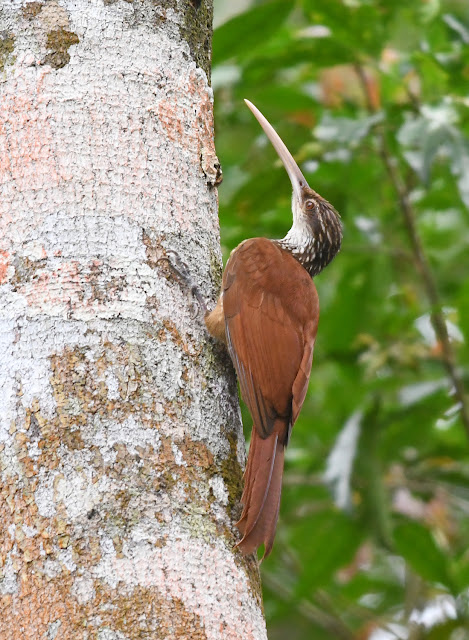 |
| Long-billed Woodcreeper - Rio Putumayo, Nariño Province, Colombia |
We stopped in at a restaurant outside of Puerto Asís for a late lunch before heading back to Mocoa. This place is well known for its semi-habituated primates including Squirrel Monkeys and Saddle-backed Tamarins which were causing trouble at lunchtime. But we were much more interested in the Spix's Night Monkeys that roost in a tree cavity on a nearby trail. We walked down the designated path - seeing a White-fronted Nunbird on the way - and peered up into the chosen tree.
 |
| Common Squirrel Monkey - Puerto Asís area, Nariño Province, Colombia |
 |
| White-fronted Nunbird - Puerto Asís area, Nariño Province, Colombia |
From the roosting spot, three pairs of huge eyes peered down on us and we enjoyed every minute with these unusual primates. A nice way to cap off our taste of Amazonia.
 |
| Spix's Night Monkeys - Puerto Asís area, Nariño Province, Colombia |
 |
| Spix's Night Monkeys - Puerto Asís area, Nariño Province, Colombia |