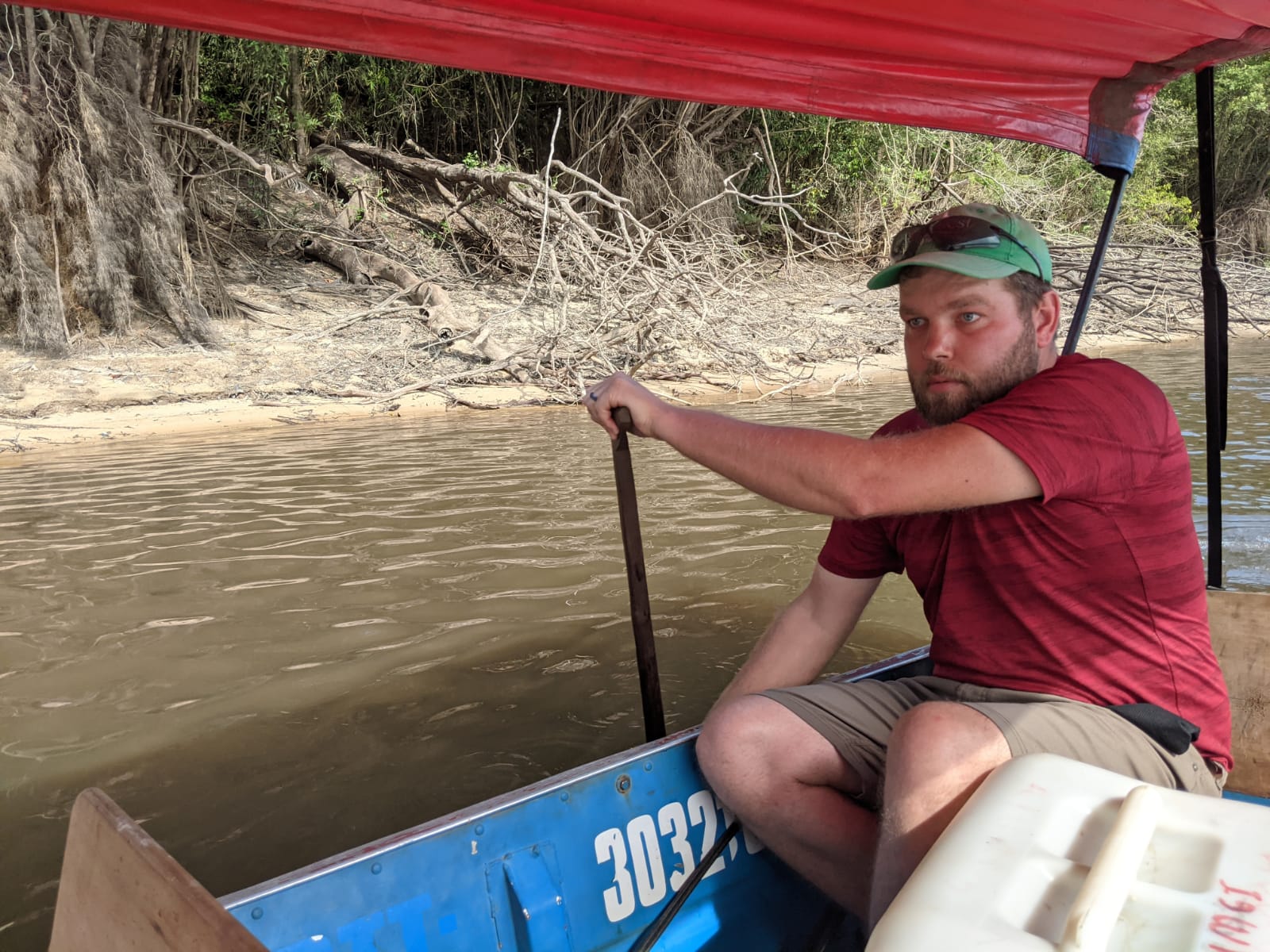
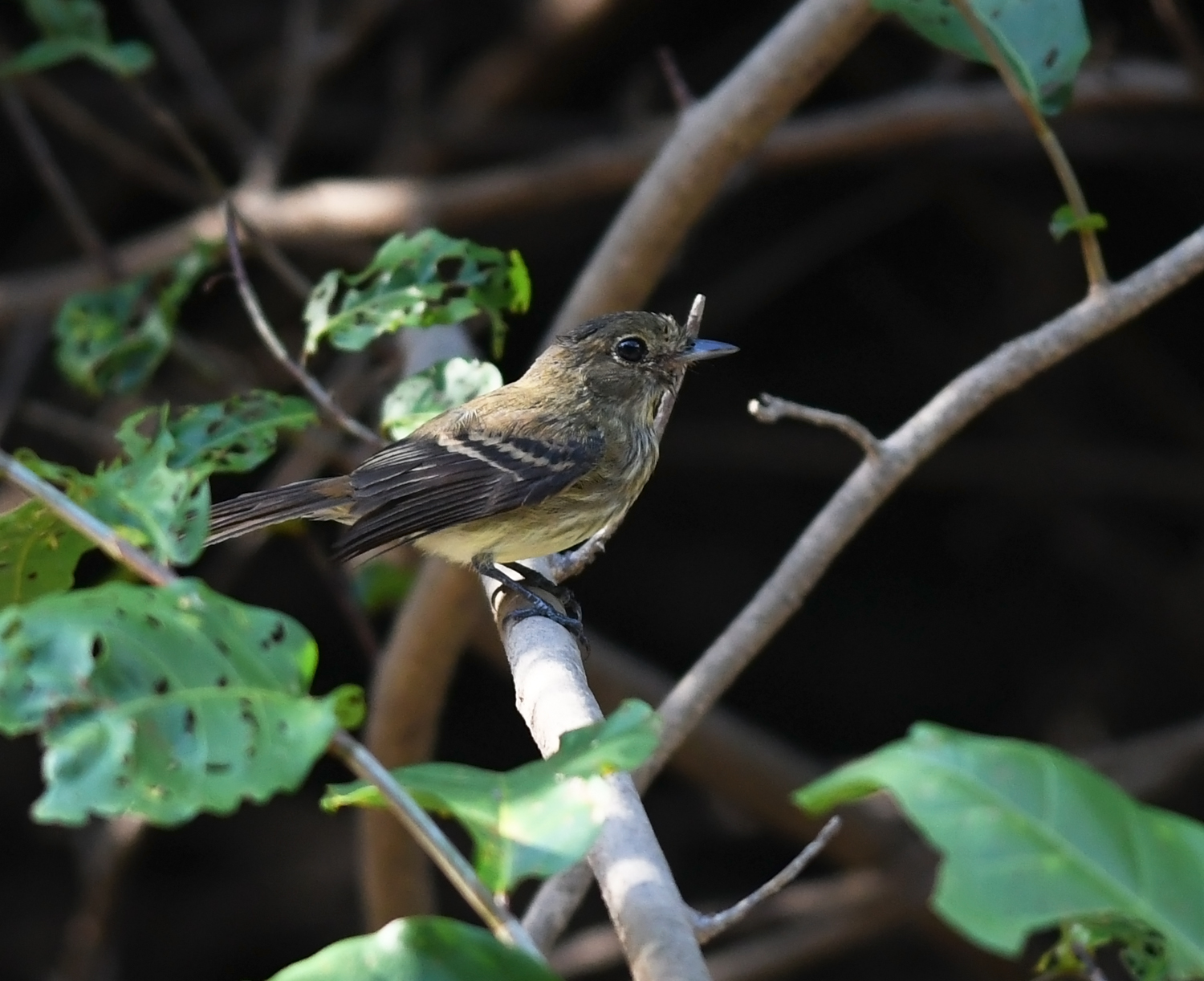
The ecology of the Amazon basin is heavily dependant on seasonal fluctuations of rain which affects the volume of water that enters the main tributaries and, eventually, the Amazon River. For the driest part of the year the water levels are relatively low, but during the rainy season, water inputs are much greater and many rivers overflow their banks and flood vast swaths of forest and grassland.
 |
| Río Inírida, Guainía, Colombia |
I had always assumed that the term várzea refers to all seasonally flooded forests found in Amazonia, but upon doing some research, this is not entirely true. According to some sources, varzea refers to forests that are seasonally inundated by whitewater sources, such as those near the main stem of the Amazon, along with some major tributaries like the Purus, Madeira and Juruá rivers. If the forests are flooded by blackwater, such as in the Río Negro floodplain or other areas with a white-sand substrate, the term for these forests is technically igapó.
 |
| Black-fronted Nunbird - Matraca, Inírida, Guainía, Colombia |
Inírida is located within the blackwater floodplain of the Río Orinoco and is strongly affected by this seasonal flooding cycle. While we had spent the first few days of our trip visiting savannah and scrub habitats, on our third full day we ventured to a site that is an excellent example of mature igapó forest. Known as Matraca, the trail begins at the west bank of the Río Inírida, only a few kilometers by boat south of town. It leads westwards towards an Indigenous community. During part of the year the trail in impassible due to the high water levels (see below photo - the dark portion of the tree trunks represents the high water mark) and the community can only be reached by boat. Since our visit coincided with the dry season we were able to walk along the Matraca trail.
 |
| Matraca, Inírida, Guainía, Colombia |
Matraca is one of the most popular birding sites near Inírida and for good reason. It boasts a current list of 430 species (according to eBird), mainly because it consists of high quality forest ecotypes. Inírida is the go-to location for the extremely range-restricted Orinoco Softtail, an Inírida specialty, and so almost every birder who visits this region spends some time at Matraca.
Laura and I had eight days in Inírida which afforded us the luxury of visiting Matraca twice. Spending multiple days at a site is always a good idea, especially in mega-diverse forests such as this.
February 1, 2022
We arrived just before dawn and slowly started our walk down the trail. The forest was just beginning to come alive with birdsong. Some were familiar, but others were entirely new. A vocalizing Collared Forest-Falcon was, surprisingly, a new species for the Matraca eBird hotspot, while I also heard my first Helmeted Pygmy-Tyrant and Slender-billed Xenops. A small understory flock grabbed our attention and we locked onto several Black-chinned Antbirds.
 |
| Black-chinned Antbird - Matraca, Inírida, Guainía, Colombia |
Distinctive chattering calls clued us in to the fact that our main target was traveling with this mixed flock: Orinico Softtails!
 |
| Orinoco Softtail - Matraca, Inírida, Guainía, Colombia |
Though photography was difficult in the dense tangles and with the low light levels, the views of this distinctive ovenbird were pretty good.
 |
| Orinoco Softtail - Matraca, Inírida, Guainía, Colombia |
The previous day, Laura and I had found a Tiny Hawk at Caño Vitina, our third observation in just a few months. Our lucky streak continued today. We spotted not one but two Tiny Hawks perched up high in a trailside tree. In a situation like this I was glad that I had asked Mario to carry my scope for the morning since the scope views were amazing.
 |
| Tiny Hawk - Matraca, Inírida, Guainía, Colombia |
The scope was put to good use a little while later. This time, it was for a Slate-colored Hawk perched in the mid-story of the forest. During our time in Inírida we found Slate-colored Hawks to be reasonably common, but it was a species that we had little experience with prior to this trip.
 |
| Slate-colored Hawk - Matraca, Inírida, Guainía, Colombia |
Excellent photo opportunities are in relatively short supply in the shaded understory of mature tropical forest, and today was no different. But the birding was excellent and the lifers kept coming, though some were the dreaded heard-only. Varzea Schiffornis. Cocoa Thrush. Amazonian Grosbeak. Black Bushbird.
 |
| Matraca, Inírida, Guainía, Colombia |
Treefalls and other small clearings in mature forest are often home to a different set of species. As we passed one area we noticed the song of a Green-tailed Jacamar. Upon investigation, four individuals were present!
 |
| Green-tailed Jacamar - Matraca, Inírida, Guainía, Colombia |
The female pictured above has a tawny throat, while the male (below) has a white throat. I've always loved jacamars. They sort of remind me of a three-way cross between a hummingbird, kingfisher and flycatcher.
 |
| Green-tailed Jacamar - Matraca, Inírida, Guainía, Colombia |
Birding in a mature tropical rainforest can be disheartening at times, as you may go through long dry spells without seeing many (or any) birds. Quite a few species travel in mixed flocks and with enough time, you will eventually stumble across one of these flocks. Laura and I lucked out with several great flocks at Matraca which contained a variety of interesting species.
 |
| Blackish-gray Antshrike - Matraca, Inírida, Guainía, Colombia |
Antshrikes, antvireos, antwrens, antbirds and other ant-things are often well represented in these flocks. Our haul included four species of antbirds, two antwrens, one antpitta and five antshrikes including our first Cinereous Antshrikes.
 |
| Cinereous Antshrike - Matraca, Inírida, Guainía, Colombia |
 |
| White-browed Antbird - Matraca, Inírida, Guainía, Colombia |
 |
| Plain Antvireo - Matraca, Inírida, Guainía, Colombia |
Woodcreepers and woodpeckers are quite diverse in the Amazonian lowlands. This makes sense of course, since in a mature forest there are a lot of tree trunks, branches and twigs of various sizes to creep and peck. We noted six species of woodcreepers and four species of woodpeckers this morning.
 |
| Striped Woodcreeper - Matraca, Inírida, Guainía, Colombia |
 |
| Cream-colored Woodpecker - Matraca, Inírida, Guainía, Colombia |
The lifers kept coming - first, a cooperative Euler's Flycatcher and later, a Blue-chinned Sapphire.
 |
| Euler's Flycatcher - Matraca, Inírida, Guainía, Colombia |
We reached a small bridge around 2.5 kilometres from the trail's entrance and turned around. The walk back was a little less birdy - though we still found a few mixed flocks - and so I focused my photographic efforts on butterflies, spiders and lizards.
 |
| Fantastic Ruby-Eye (Lycas argentea) - Matraca, Inírida, Guainía, Colombia |
 |
| Dubiepeira sp. - Matraca, Inírida, Guainía, Colombia |
 |
| Mabuya sp. (subfamily Mabuyinae) - Matraca, Inírida, Guainía, Colombia |
When it was all said and done we had tallied 86 bird species during our morning walk, including 11 species which were new for me. Birding in tropical lowlands never disappoints!
That afternoon, following a brief siesta in town, we headed back out on the boat to visit a different site. A small creek located a little further upstream from Matraca drains into the Río Inírida. This watercourse is called Caño Cunubén, and it is an excellent place to spend a late afternoon and evening searching for wildlife along the water's edge.
 |
| Caño Cunubén, Inírida, Guainía, Colombia |
The afternoon was still a scorcher when we arrived. The water levels in the creek were quite low and required a deft touch by our boatman to prevent the outboard motor from getting entangled in one of the many downed trees hidden beneath the blackwater's surface. The strategy was to fire up the engine in safe sections of the creek, and lift the outboard out of the water as we cruised past dodgy sections. This results in a lot of revving of the engine and a less than tranquil boat trip, but it was the best strategy to reach a point far enough up the creek. From there, we turned around and slowly drifted back down to the main river with the engine off.
We quickly added a lifer once we reached the turnaround site. A pair of Rusty-backed Spinetails chattered away from the shrubby edges of the watercourse, eventually popping out for good views.
 |
| Rusty-backed Spinetail - Caño Cunubén, Inírida, Guanía, Colombia |
 |
| Rusty-backed Spinetail - Caño Cunubén, Inírida, Guanía, Colombia |
The wildlife was abundant along the creek and generally not very skittish as we quietly floated past. Dozens of kingfishers hunted from exposed perches, several species of parrots and macaws flew past and at least five species of hawk were noted.
 |
| Black-collared Hawk - Caño Cunubén, Inírida, Guanía, Colombia |
 |
| Scarlet Macaw - Caño Cunubén, Inírida, Guanía, Colombia |
We noted two White-banded Swallows with the flocks of White-winged Swallows. Laura and I had only seen this attractive species a few times before, in the Ecuadorian Amazon in 2019.
 |
| White-banded Swallow - Caño Cunubén, Inírida, Guanía, Colombia |
One of the trickier birds that I hoped to see in Inírida is called the Amazonian Black Tyrant. They are sparsely distributed and infrequently encountered, but the habitat at Caño Cunubén seemed perfect. And we were in luck, finding a female along the creek's bank!
 |
| Amazonian Black-Tyrant (female) - Caño Cunubén, Inírida, Guanía, Colombia |
The other new species that Laura and I found at Caño Cunubén was the Amazonian Streaked-Antwren, of which we found two pairs. One of the pairs was busily constructing a nest beside the creek.
 |
| Amazonian Streaked-Antwren (male) - Caño Cunubén, Inírida, Guanía, Colombia |
 |
| Amazonian Streaked-Antwren (female) - Caño Cunubén, Inírida, Guanía, Colombia |
Oropendolas are fascinating birds to observe. They construct their huge hanging nests communally in large trees and these "oro trees" are impossible to miss. A colony of Olive Oropendolas had picked a tree beside Caño Cunubén and on our way back, we stopped for twenty minutes to watch the antics of the birds. Several males were displaying and it was a sight to behold. The males begin their bubbly, creaky song while perched on a horizontal branch, but extend their wings and dip their heads downwards as the song progresses. During the crescendo, they tilt forward and completely flip upside down, swinging from the branch like a gymnast on the uneven bars. Here is a sequence of photos showing the entire routine.
 |
| Olive Oropendola - Caño Cunubén, Inírida, Guanía, Colombia |
 |
| Olive Oropendola - Caño Cunubén, Inírida, Guanía, Colombia |
 |
| Olive Oropendola - Caño Cunubén, Inírida, Guanía, Colombia |
 |
| Olive Oropendola - Caño Cunubén, Inírida, Guanía, Colombia |
 |
| Olive Oropendola - Caño Cunubén, Inírida, Guanía, Colombia |
 |
| Olive Oropendola - Caño Cunubén, Inírida, Guanía, Colombia |
 |
| Olive Oropendola - Caño Cunubén, Inírida, Guanía, Colombia |
 |
| Olive Oropendola - Caño Cunubén, Inírida, Guanía, Colombia |
We watched the oropendolas do their thing until the sun set, and then made our way back to town. However, there was one final stop to make - a small oxbow lake, where Amazonian River Dolphins often hang out. As the nighthawks began to circle above us, their jerky flight signalling the end of the day, we watched two river dolphins swim around the boat and cresting the calm water to take deep breaths. There was not enough light for good photos, but it was a magical way to end the day.
 |
| Río Inírida, Guanía, Colombia |