January 17, 2015 - Isla de Salamanca, Minca, El Dorado lodge
January 18, 2015 - Cuchilla de San Lorenzo, El Dorado lodge
January 19, 2015 - Cuchilla de San Lorenzo, El Dorado lodge
January 20 and 21, 2015 - El Dorado lodge to Minca
January 22, 2015 - Minca, drive to La Guajira Desert
January 23, 2015 - La Guajira Desert
January 24, 2015 - PNN Tayrona, fly to Andes
January 25, 2015 - Bogotá area: PNN Chingaza, Siecha wetlands
January 26, 2015 - Laguna de Pedro Palo, Payande area
January 27, 2015 - Cañón del Río Combeima, SFF Otún Quimbaya
January 28, 2015 - SFF Otún Quimbaya, drive to Montezuma Road
January 29, 2015 - Montezuma Road
January 30, 2015 - Montezuma Road, drive to Jardín
January 31, 2015 - Jardín area, Cauca Valley
February 1, 2015 - Reserva Ecológica Río Blanco
February 2, 2015 - Páramo del Ruiz near PNN Los Nevados
--------------------------------------------------------------------------
Páramo is a name given to a variety of high alpine ecosystems but the term usually refers to tropical, montane vegetation above the treeline but below the continuous snowline, particularly that which is present in the northern Andes of South America and adjacent Central America. Páramo del Ruiz is a large expanse of páramo located within and surrounding Parque National Natural Los Nevados, and it was to be our destination. It would be the last full day in Colombia for Steve, Daniel and I, while Dave and Adam would be continuing on for another month and a half in this beautiful country.
Leaving in the dark, William drove us towards PNN Los Nevados, named due to the snow-capped volcanoes found in this protected area within the central Andes. Eight volcanoes can be found within PNN Los Nevados, including Nevado del Ruiz, looming 5,300 m above sea level. As dawn broke we were well on our way towards the park, stopping periodically to photograph our first volcanoes of the day!
Páramo del Ruiz is home to a number of interesting species, the most interesting to us being the endemic Buffy Helmetcrest. This is a plump little hummingbird that survives year round in the cold temperatures of the páramo, feeding on a few species of flowering plants that bloom at different times of the year. The Buffy Helmetcrest has a population estimate of less than 1000 individuals, found almost entirely within PNN Los Nevados and the surrounding area. Coming into the trip the Buffy Helmetcrest was one of my most wanted species; partly due to its rarity, but also its unique habitat requirements and unmistakable appearance, complete with a large crest and colourful "beard".
We arrived at the entrance gate to PNN Los Nevados not long after sunrise and began to explore the páramo while the car's thermometer read in the low single digits. I was doing the trip with just a single carry-on bag - my 38L pack - and thus had to pack judiciously. For this part of the trip, easily the coldest, I was wearing practically all my clothes - long johns, long-sleeved shirt, fleece, field pants, and rain coat, along with a toque and gloves. This was just enough to cut down some of the cold, especially during brief periods of sun whenever the low, misty clouds cleared out.
It is possible to see all the bird specialties of the area without accessing the park. The gates are only open from 8:00 AM to 2:00 PM, a guide is mandatory for your visit and combined with the entrance fees we decided that it was not worth it. The only really interesting bird to us that is located within the park boundaries but not outside is Andean Condor - a widespread species throughout the entire length of the Andes, particularly in the higher elevations and in the southern part of the mountain range.
We were at an elevation of 4,100 m which was the highest that I had ever been. Due to the low oxygen levels it did not take much walking to be out of breath, even when walking on even terrain or heading downhill.
We slowly discovered the birds of this habitat, watching our first Stout-billed Cinclodes, Plain-colored Seedeaters and Plumbeous Sierra-Finches, while Sedge Wrens sang away from all around us (somehow this alpine subspecies is considered the same species as our marsh and field-dwelling Sedge Wrens from Ontario). Tawny Antpittas are common in this habitat, and unlike most species in this family Tawny Antpittas readily perch out in the open and are generally not very shy. It was very strange observing these antpittas in this habitat as opposed to the dense, lush tropical forests from the previous day in Río Blanco.
We staked out a nice patch of flowers, hoping for our target species. It wasn't a particularly long search until a chunky hummingbird buzzed by, eventually perching on some nearby bushes. Even when backlit the silhouette was unmistakable - Buffy Helmetcrest!
We had a lot of fun with them over the next twenty minutes or so as at least six individuals made the rounds.
It was an unforgettable experience with an iconic species, one that I will certainly never forget!
Continuing on, we slowly walked down the road to search for other specialty birds, as the fog rolled back in. It was a hauntingly beautiful habitat with the tall frailejones (Espeletia sp.) dominating the landscape.
We slowly added a few new species, finding several seedeaters along the roadside (including Páramo Seedeaters), while a Páramo Pipit was heard as it flew over in the fog. A few Andean Tit-Spinetails flew across the road, but that was it for new bird species. Our checklist from the Páramo del Ruiz held only 13 species, though almost all of them were new to us!
Having seen our main target species we continued down towards the lower elevations, hoping to come across Rufous-fronted Parakeets, another endemic parrot found in Colombia and limited to just the central Andes. Unfortunately this would be a big miss for us. Guess you can't get them all.
Our next stop was a set of hot springs known as Termales del Ruiz, a hotel undergoing renovations that also happens to have an excellent hummingbird feeder setup. We paid our entrance fees (about 10$ CAD each) and quickly walked towards the hummingbird feeders, as this held more interest to us than the hot springs. Quite a diversity of hummingbirds can be regularly found here, most which would be new to us.
It was a very productive couple of hours for us and we turned up 8 hummingbirds including five new ones for us.
Male Rainbow-bearded Thornbills rival the Buffy Helmetcrests in appearance, but unfortunately we were only able to find one of the less-vivid females. Trust me, its worth the few seconds to see a google image search of the males...
Viridian Metaltail was a common species in the area - in fact they were the only hummingbird species in addition to Buffy Helmetcrest that we encountered in the páramo near the entrance gates to PNN Los Nevados. The feeders at Termales del Ruiz also attracted a bunch of them, providing a nice study of this species limited to the Andes of Ecuador and south central Colombia.
Mountain Velvetbreast is a fairly widespread Andean species, but easily identifiable with a slightly downcurved bill and dark front.
Both Golden-breasted and Black-thighed Pufflegs were coming to the feeders. We had observed our first Golden-breasted Puffleg on the previous day at Río Blanco, but this was our first chance at extended views and photos.
Black-thighed Puffleg is practically a Colombian endemic, though there are small numbers in extreme northern Ecuador. Termales del Ruiz is one of the best places to find this species and we observed at least three making the rounds of the feeders.
Hummingbirds really do have the best names, and one of my favorite hummingbird names is Shining Sunbeam of which several were at the feeders. While not as brightly colored as some of the others they are still almost completely orange, somewhat of a rarity in the hummingbird world.
\
Starfrontlets are one of my favorite genera of hummingbirds, and here we were treated to our first Buff-winged Starfrontlets, an Andean species ranging from central Colombia to extreme northern Peru.
Great Sapphirewing is a large and distinctive hummingbird species that when perching on the feeders would flash the fluorescent blue colour of their wings - unfortunately I never captured that in the photos, however! The hummingbird diversity in Colombia is just incredible and at this point we had observed 64 species in the country. It sure beats our one, lonely species that is native to Ontario.
We stopped in to have breakfast at the restaurant, then birded the area for another hour or so before we had to depart. Our last new birds were Gray-breasted Mountain-Toucan and Black-chested Mountain-Tanager before we dropped Dave and Adam off on the side of the road, said our goodbyes, and made the long drive back to Bogotá. It was a little sad to say goodbye to this country, but I am sure that it will not be my last trip. There is just so much more to see, and two and a half weeks barely even scratches the surface. Til next time...
Leaving in the dark, William drove us towards PNN Los Nevados, named due to the snow-capped volcanoes found in this protected area within the central Andes. Eight volcanoes can be found within PNN Los Nevados, including Nevado del Ruiz, looming 5,300 m above sea level. As dawn broke we were well on our way towards the park, stopping periodically to photograph our first volcanoes of the day!
 |
| Páramo del Ruiz, Caldas Province, Colombia |
Páramo del Ruiz is home to a number of interesting species, the most interesting to us being the endemic Buffy Helmetcrest. This is a plump little hummingbird that survives year round in the cold temperatures of the páramo, feeding on a few species of flowering plants that bloom at different times of the year. The Buffy Helmetcrest has a population estimate of less than 1000 individuals, found almost entirely within PNN Los Nevados and the surrounding area. Coming into the trip the Buffy Helmetcrest was one of my most wanted species; partly due to its rarity, but also its unique habitat requirements and unmistakable appearance, complete with a large crest and colourful "beard".
 |
| Dan (left) and Steve exploring the Páramo del Ruiz, Caldas Province, Colombia |
We arrived at the entrance gate to PNN Los Nevados not long after sunrise and began to explore the páramo while the car's thermometer read in the low single digits. I was doing the trip with just a single carry-on bag - my 38L pack - and thus had to pack judiciously. For this part of the trip, easily the coldest, I was wearing practically all my clothes - long johns, long-sleeved shirt, fleece, field pants, and rain coat, along with a toque and gloves. This was just enough to cut down some of the cold, especially during brief periods of sun whenever the low, misty clouds cleared out.
 |
| Páramo del Ruiz, Caldas Province, Colombia |
It is possible to see all the bird specialties of the area without accessing the park. The gates are only open from 8:00 AM to 2:00 PM, a guide is mandatory for your visit and combined with the entrance fees we decided that it was not worth it. The only really interesting bird to us that is located within the park boundaries but not outside is Andean Condor - a widespread species throughout the entire length of the Andes, particularly in the higher elevations and in the southern part of the mountain range.
We were at an elevation of 4,100 m which was the highest that I had ever been. Due to the low oxygen levels it did not take much walking to be out of breath, even when walking on even terrain or heading downhill.
We slowly discovered the birds of this habitat, watching our first Stout-billed Cinclodes, Plain-colored Seedeaters and Plumbeous Sierra-Finches, while Sedge Wrens sang away from all around us (somehow this alpine subspecies is considered the same species as our marsh and field-dwelling Sedge Wrens from Ontario). Tawny Antpittas are common in this habitat, and unlike most species in this family Tawny Antpittas readily perch out in the open and are generally not very shy. It was very strange observing these antpittas in this habitat as opposed to the dense, lush tropical forests from the previous day in Río Blanco.
 |
| Tawny Antpitta - Páramo del Ruiz, Caldas Province, Colombia |
We staked out a nice patch of flowers, hoping for our target species. It wasn't a particularly long search until a chunky hummingbird buzzed by, eventually perching on some nearby bushes. Even when backlit the silhouette was unmistakable - Buffy Helmetcrest!
 |
| Buffy Helmetcrest - Páramo del Ruiz, Caldas Province, Colombia |
We had a lot of fun with them over the next twenty minutes or so as at least six individuals made the rounds.
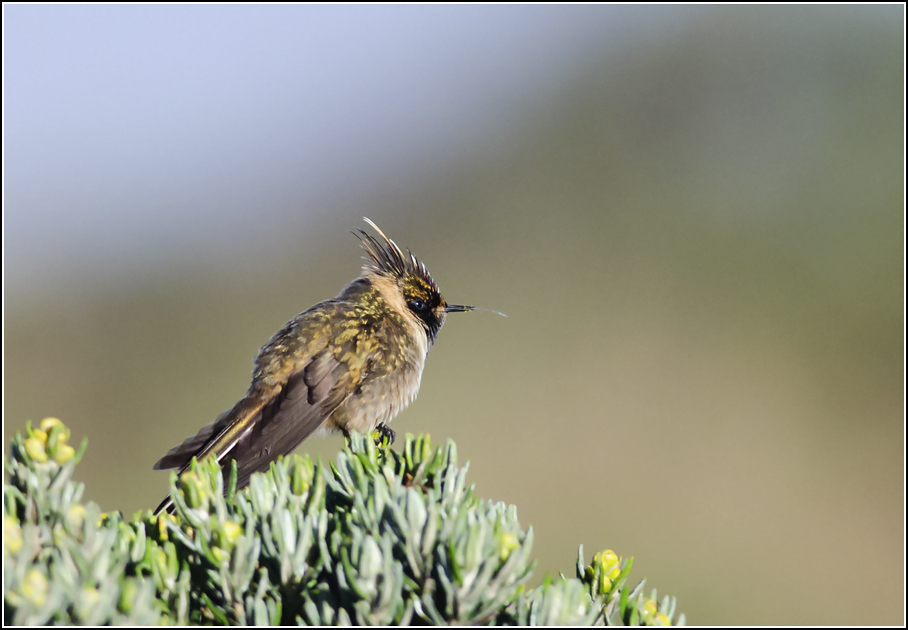 |
| Buffy Helmetcrest - Páramo del Ruiz, Caldas Province, Colombia |
 |
| Buffy Helmetcrest - Páramo del Ruiz, Caldas Province, Colombia |
 |
| Buffy Helmetcrest - Páramo del Ruiz, Caldas Province, Colombia |
It was an unforgettable experience with an iconic species, one that I will certainly never forget!
Continuing on, we slowly walked down the road to search for other specialty birds, as the fog rolled back in. It was a hauntingly beautiful habitat with the tall frailejones (Espeletia sp.) dominating the landscape.
 |
| Páramo del Ruiz, Caldas Province, Colombia |
We slowly added a few new species, finding several seedeaters along the roadside (including Páramo Seedeaters), while a Páramo Pipit was heard as it flew over in the fog. A few Andean Tit-Spinetails flew across the road, but that was it for new bird species. Our checklist from the Páramo del Ruiz held only 13 species, though almost all of them were new to us!
 |
| Páramo del Ruiz, Caldas Province, Colombia |
Having seen our main target species we continued down towards the lower elevations, hoping to come across Rufous-fronted Parakeets, another endemic parrot found in Colombia and limited to just the central Andes. Unfortunately this would be a big miss for us. Guess you can't get them all.
 |
| Páramo del Ruiz, Caldas Province, Colombia |
 |
| William taking in the landscape |
Our next stop was a set of hot springs known as Termales del Ruiz, a hotel undergoing renovations that also happens to have an excellent hummingbird feeder setup. We paid our entrance fees (about 10$ CAD each) and quickly walked towards the hummingbird feeders, as this held more interest to us than the hot springs. Quite a diversity of hummingbirds can be regularly found here, most which would be new to us.
It was a very productive couple of hours for us and we turned up 8 hummingbirds including five new ones for us.
Male Rainbow-bearded Thornbills rival the Buffy Helmetcrests in appearance, but unfortunately we were only able to find one of the less-vivid females. Trust me, its worth the few seconds to see a google image search of the males...
 |
| Rainbow-bearded Thornbill - Termales del Ruiz, Caldas Province, Colombia |
Viridian Metaltail was a common species in the area - in fact they were the only hummingbird species in addition to Buffy Helmetcrest that we encountered in the páramo near the entrance gates to PNN Los Nevados. The feeders at Termales del Ruiz also attracted a bunch of them, providing a nice study of this species limited to the Andes of Ecuador and south central Colombia.
 |
| Viridian Metaltail - Termales del Ruiz, Caldas Province, Colombia |
Mountain Velvetbreast is a fairly widespread Andean species, but easily identifiable with a slightly downcurved bill and dark front.
 |
| Mountain Velvetbreast - Termales del Ruiz, Caldas Province, Colombia |
Both Golden-breasted and Black-thighed Pufflegs were coming to the feeders. We had observed our first Golden-breasted Puffleg on the previous day at Río Blanco, but this was our first chance at extended views and photos.
 |
| Golden-breasted Puffleg - Termales del Ruiz, Caldas Province, Colombia |
Black-thighed Puffleg is practically a Colombian endemic, though there are small numbers in extreme northern Ecuador. Termales del Ruiz is one of the best places to find this species and we observed at least three making the rounds of the feeders.
 |
| Black-thighed Puffleg - Termales del Ruiz, Caldas Province, Colombia |
Hummingbirds really do have the best names, and one of my favorite hummingbird names is Shining Sunbeam of which several were at the feeders. While not as brightly colored as some of the others they are still almost completely orange, somewhat of a rarity in the hummingbird world.
\
 |
| Shining Sunbeam - Termales del Ruiz, Caldas Province, Colombia |
Starfrontlets are one of my favorite genera of hummingbirds, and here we were treated to our first Buff-winged Starfrontlets, an Andean species ranging from central Colombia to extreme northern Peru.
 |
| Buff-winged Starfrontlet - Termales del Ruiz, Caldas Province, Colombia |
 |
| Buff-winged Starfrontlet - Termales del Ruiz, Caldas Province, Colombia |
Great Sapphirewing is a large and distinctive hummingbird species that when perching on the feeders would flash the fluorescent blue colour of their wings - unfortunately I never captured that in the photos, however! The hummingbird diversity in Colombia is just incredible and at this point we had observed 64 species in the country. It sure beats our one, lonely species that is native to Ontario.
 |
| Great Sapphirewing - Termales del Ruiz, Caldas Province, Colombia |
We stopped in to have breakfast at the restaurant, then birded the area for another hour or so before we had to depart. Our last new birds were Gray-breasted Mountain-Toucan and Black-chested Mountain-Tanager before we dropped Dave and Adam off on the side of the road, said our goodbyes, and made the long drive back to Bogotá. It was a little sad to say goodbye to this country, but I am sure that it will not be my last trip. There is just so much more to see, and two and a half weeks barely even scratches the surface. Til next time...
 |
| Frailejones (Espeletia sp.) - Páramo del Ruiz, Caldas Province, Colombia |