Wednesday, 15 April 2020

An Update (From Canada)

Now that I have finally finished my posts about our time in Colombia, I thought I would provide an update as to what Laura and I have been up to for the last month and a half.

On February 28th we left Medellín and flew to San José, Costa Rica for the next leg of our trip. Our idea was to travel in Costa Rica together for six weeks, upon which Laura and I had plans apart from each other. My intention would be to fly to Ontario in mid April, lead a tour in Spain for two weeks in late April for Quest Nature Tours, and return home to Ontario to spend the bulk of the spring/early summer. Laura meanwhile had organized a few volunteer placements - one, for six weeks, at a wildlife rehab center in Costa Rica, and another with a vet clinic in Grenada where she would spend the first half of June. She hoped to return back to Canada and reconvene with me for the rest of June and the first half of July. 

Helmeted Iguana (Corytophanes cristatus)

The Costa Rica trip started out very well. Laura and I rented a car from San José and explored some areas on both slopes within a few hours of the capital. We stayed at a hostel in the Osa Peninsula for three nights - a definite highlight for both of us - and visited some other iconic areas including a few national parks such as Los Quetzales, Tapanti and Braulio Carillo. We concluded the route with a few nights in the Arenal area before returning to San José to return the rental car and switch it out for a Toyota Rav4. That evening my parents landed in the capital, and for the next week and half, we explored Costa Rica with them. 

Red-capped Manakin

Around the time that my parents were boarding the plane in Toronto, the travel restrictions were just beginning and shortly after, recommendations were made by the Canadian government that all Canadians should return home as soon as possible. The four of us kept a close eye on the situation. We looked into bumping my parents' return trip up, but it would either cost several thousand dollars, or involve a layover in the States (which they were trying to avoid). In the end, they kept their seats on the March 23 flight and Laura and I also booked tickets on that same flight. By March 24, all four of us were back in Canada.  

Collared Redstart

Needless to say, our travel plans have changed considerably due to the Covid-19 pandemic. 

However, we are thankful for what we have at the moment and we realize that there are many other people out there who are experiencing real suffering. Our plans may have had to change, but we have a place to stay, food on the table, and our health, so life is good for us. Hopefully, we can collectively get this virus under control in the upcoming months and life can move towards some semblance of normalcy.

In the meantime, Laura and I have been trying to get outside for some hikes locally here in Cambridge, Ontario. Luckily, I know of lots of great places to check out that are devoid of people, even though many of the conservation areas, provincial and municipal parks, etc are closed. One location, which we have dubbed Covid Woods, is only a five minute walk from our house in Cambridge. It is situated near an area slated for upcoming development and involves a muddy walk down an ATV track, meaning that we never see any other people while we are hiking. The birding and herping possibilities seem quite good at Covid Woods, with scrubby second growth, a nice Sugar Maple/Beech/Red Oak stand, and a hydro utility corridor as well as fallow fields. Below are a few photos from the last couple of weeks, both at Covid Woods and a few other local areas. Spring is definitely here, with new signs of the changing seasons appearing daily.

Northern Ribbonsnakes - Waterloo Regional Municipality, Ontario

Mourning Cloak - Waterloo Regional Municipality, Ontario

Eastern Gartersnake - Waterloo Regional Municipality, Ontario

Covid Woods - Waterloo Regional Municipality, Ontario

Ruffed Grouse - Waterloo Regional Municipality, Ontario

Northern Ribbonsnakes - Waterloo Regional Municipality, Ontario

Round-lobed Hepatica - Waterloo Regional Municipality, Ontario

Dekay's Brownsnake - Waterloo Regional Municipality, Ontario

Ruffed Grouse - Waterloo Regional Municipality, Ontario

Northern Ribbonsnake - Waterloo Regional Municipality, Ontario

Ruffed Grouse - Waterloo Regional Municipality, Ontario

Eastern Gartersnake - Waterloo Regional Municipality, Ontario

Ruffed Grouse - Waterloo Regional Municipality, Ontario

In the next month or so I will try to post all of the material that I have from our three weeks in Costa Rica. The never ending quest to keep my blog up to date continues!

Friday, 10 April 2020

Finca Hotel Portón de las Palmas

Laura and I had enjoyed the wildlife of Río Claro but we were looking forward to some of the comforts of civilization again - namely, the chance to do laundry, experience reasonable temperatures, and have a wifi connection to plan the next part of our trip. We ended up finding a place near the Medellín airport that could accommodate our needs. Called Finca Hotel Portón de las Palmas, it is situated less than 10 minutes from the airport but the property is gorgeous, set on a few hectares of green space. We were given a wing of the building which included a spacious bedroom with bathroom on the main floor, and an upstairs room and balcony that functioned as a sort of canopy tower for birdwatching, complete with a hammock.

We ate all our meals here (which were fantastic and very reasonably priced), and we were even given full use of the washing machine and clothesline. It is amazing how the simple things can seem so luxurious when backpacking!

The birding was excellent on the grounds as well and we tallied over 50 species in a few hours of watching in the afternoon and morning. Acorn Woodpeckers are some of the more obvious birds since at least four individuals were regularly patrolling some of the trees on the property.

Acorn Woodpecker - Finca Hotel Portón de las Palmas, Rionegro, Antioquia, Colombia

Acorn Woodpecker - Finca Hotel Portón de las Palmas, Rionegro, Antioquia, Colombia

One of the highlights was when a flock of twenty or so Red-bellied Grackles flew in, noisily chattering from the trees along the driveway. This species is endemic to Colombia and is quite striking in appearance. Unfortunately, by the time that I had fetched my camera, they were in a less favourable location for photos.

Flycatchers were well-represented in the yard. In addition to the common ones a pair of Torrent Tyrannulets patrolled the small creek, while a few Pale-edged Flycatchers made the rounds. I finally managed to take a good photo of a Golden-faced Tyrannulet as well.

Pale-edged Flycatcher - Finca Hotel Portón de las Palmas, Rionegro, Antioquia, Colombia

Torrent Tyrannulet - Finca Hotel Portón de las Palmas, Rionegro, Antioquia, Colombia

Golden-faced Tyrannulet - Finca Hotel Portón de las Palmas, Rionegro, Antioquia, Colombia

Quite the surprise for us was observing two pairs of White-faced Whistling-Ducks beside a pond on the neighbouring property. This species is supposedly reasonably common in the Medellín area but it is one that I had never seen before in Colombia, and was a new one for Laura. Later in the evening we enjoyed the interesting calls they made as they flew around.

White-faced Whistling-Duck - Finca Hotel Portón de las Palmas, Rionegro, Antioquia, Colombia

An Andean Motmot was not shy in the least and on a few occasions we watched it at the edge of the property.

Andean Motmot - Finca Hotel Portón de las Palmas, Rionegro, Antioquia, Colombia

Andean Motmot - Finca Hotel Portón de las Palmas, Rionegro, Antioquia, Colombia

One last surprise was in store about an hour or two before we had to depart for the airport. Laura spotted and called out this handsome Prothonotary Warbler in some of the bushes. This species is much more common further north in Colombia, though they are around in the Medellín area in small numbers. Soon, it will be on its way north into the United States, or perhaps even into southern Canada.

Prothonotary Warbler - Finca Hotel Portón de las Palmas, Rionegro, Antioquia, Colombia

We thoroughly enjoyed our time at Finca Hotel Portón de las Palmas and would enthusiastically recommend it to anyone who needs somewhere to stay near the Medellín airport.

Wednesday, 8 April 2020

A Week at Río Claro - The Night Life

I will finish this series of posts from Reserva Natural Cañon del Río Claro with some photos of the "night life". We did not get out for as many night hikes as we normally do, and we never set up the moth sheet, limiting some of the photographic opportunities at night.

During our first evening, a young couple ahead of us on the path between the restaurant and our accommodations had bent over to look at something on the stone walkway. We investigated - they had found a snake! I believe it is a Northern Cat-eyed Snake (Leptodeira septentrionalis).

Northern Cat-eyed Snake (Leptodeira septentrionalis) - RN Cañon del Río Claro, Antioquia, Colombia


We also found a huge tarantula outside its burrow along this pathway during the first evening. This individual, in the genus Xenesthis, was present in the same location each evening and we checked in with it on our way to or from dinner.

Xenesthis sp. - RN Cañon del Río Claro, Antioquia, Colombia


We did not see a huge diversity of frogs, mainly due to lack of effort on our part. Below are a few of the ones that I photographed.

Pristimantis gaigei - RN Cañon del Río Claro, Antioquia, Colombia

Craugastor raniformis - RN Cañon del Río Claro, Antioquia, Colombia

Pristimantis gaigei - RN Cañon del Río Claro, Antioquia, Colombia


Diasporus sp. - RN Cañon del Río Claro, Antioquia, Colombia


Craugastor sp. - RN Cañon del Río Claro, Antioquia, Colombia


Leaf Litter Toad (Rhaebo haematiticus) - RN Cañon del Río Claro, Antioquia, Colombia


Laura spotted this incredible caterpillar crossing the trail one evening. It certainly is not a species we have either seen before (at least, in the larval form). I have no idea what its identification is!

Unidentified Lepidopteran - RN Cañon del Río Claro, Antioquia, Colombia

Tailless Whipscorpions were abundant along rock walls and tree trunks beside the main path between the restaurant and our accommodations. While appearing quite fearsome, they are actually harmless (which is one reason why they are a popular pet among arachnid enthusiasts). This species has been identified by an iNaturalist user as Heterophrynus armiger. 

Heterophrynus armiger - RN Cañon del Río Claro, Antioquia, Colombia

While we are on the theme of arachnids, below are two interesting spiders that I snapped photos of. 

Unidentified Dipluridae (Curtain-web Spider)  - RN Cañon del Río Claro, Antioquia, Colombia

Ancylometes sp. - RN Cañon del Río Claro, Antioquia, Colombia

We saw many interesting stick insects and katydids but I did not take photos of most. I will finish this post with a really cool, massive Anolis that I found sleeping on a large leaf. I am still searching for an ID for this one. 

Anolis sp. - RN Cañon del Río Claro, Antioquia, Colombia

Anolis sp. - RN Cañon del Río Claro, Antioquia, Colombia

Anolis sp. - RN Cañon del Río Claro, Antioquia, Colombia

Tuesday, 7 April 2020

A Week at Río Claro - The River, Oilbird Cave and Entrance Road

While the Mulata Trail was the only real hiking trail worth checking out at RN Cañon del Río Claro, the actual entrance road into the reserve proved worthwhile. It passed through a mix of habitat types, meaning that a solid diversity of species could be found here. Walking the road provided another outlet to search for birds away from the Mulata Trail.

The entrance to the reserve provided an opportunity to search for open country species that were otherwise difficult to find within the reserve - a good way to pad our day lists! Some flowers in bloom provided a chance to observe species like White-vented Plumeleteers, Bronze-tailed Plumeleteers and Blue-chested Hummingbirds. We also found a group of Silvery-brown Tamarins in the trees near the entrance gate, though that was during a hike where I did not have my camera with me.

Blue-chested Hummingbird - RN Cañon del Río Claro, Antioquia, Colombia

Blue-chested Hummingbird - RN Cañon del Río Claro, Antioquia, Colombia

The road terminated at the restaurant but a footpath followed the same contour of the river valley to the Refugio cabins where Laura and I stayed, and beyond.

Río Claro - RN Cañon del Río Claro, Antioquia, Colombia

Río Claro - RN Cañon del Río Claro, Antioquia, Colombia

We found a nice variety of species along this trail, though it was most productive early in the morning before all the other tourists were awake.

Bay Wren (and begging Shiny Cowbird) - RN Cañon del Río Claro, Antioquia, Colombia

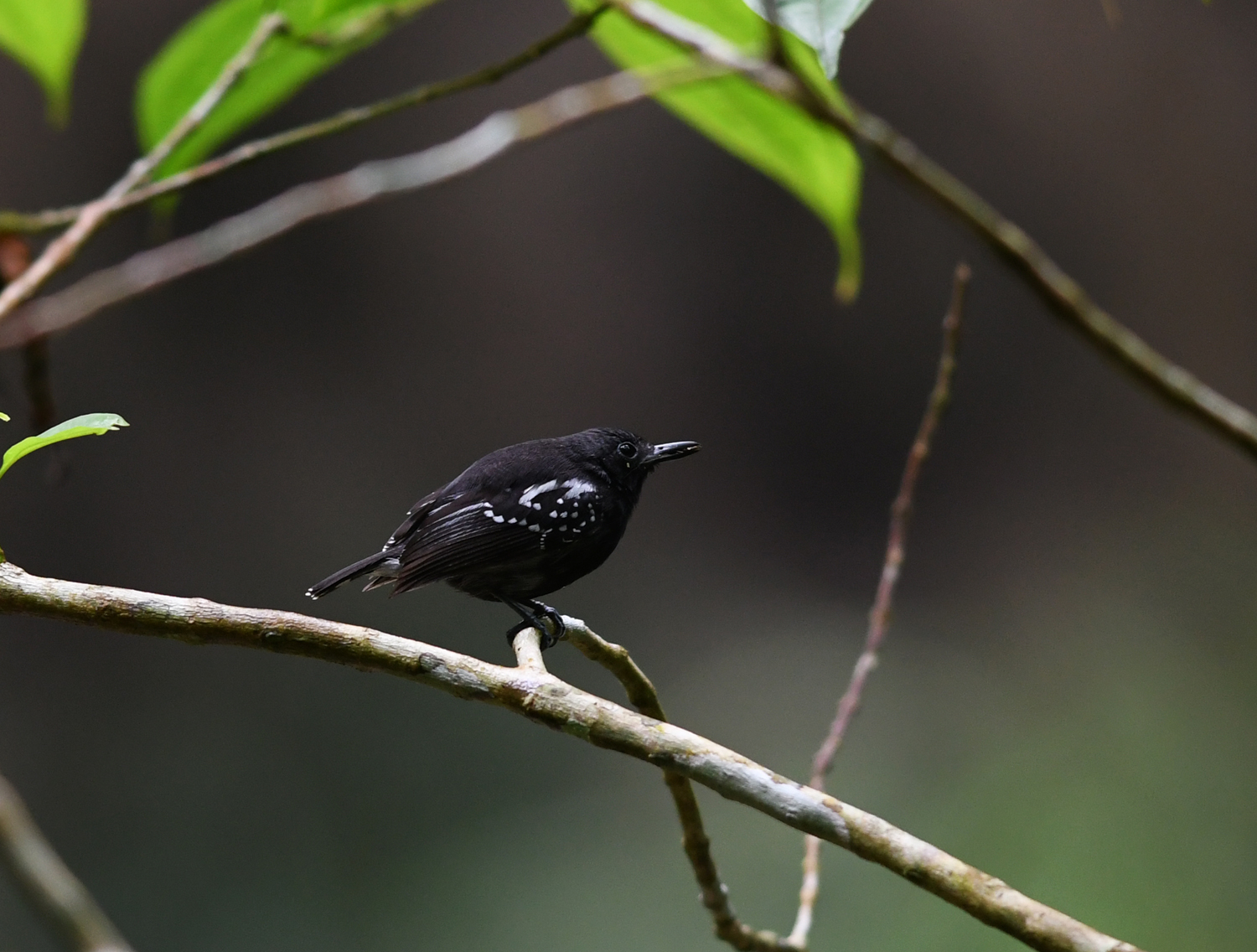
The dark understorey proved productive on a few occasions for antbirds, antwrens, flycatchers and other denizens of these habitats. Our only views of Magdalena Antbird and White-flanked Antwren were along here, as well as others like Black-tailed Flycatcher and Olivaceous Flatbill. 

White-flanked Antwren - RN Cañon del Río Claro, Antioquia, Colombia

Micrathena schreibersi - RN Cañon del Río Claro, Antioquia, Colombia

Turkey Vulture - RN Cañon del Río Claro, Antioquia, Colombia

One of my favourite sightings during the week was that of a Fasciated Tiger-Heron, a sort of nemesis species for Laura and I. We just could not find one anywhere! But at Río Claro, we observed a/the Fasciated Tiger-Heron on most days somewhere along the river. Usually it was found between our cabins and the restaurant.

Fasciated Tiger-Heron - RN Cañon del Río Claro, Antioquia, Colombia

This was the third and final species of Tiger-Heron that I have now seen, the others being the Rufescent and Bare-throated Tiger-Herons. The Fasciated Tiger-Heron is always found near rivers and streams, preferring water courses with rocky substrates and a moderate current.

Fasciated Tiger-Heron - RN Cañon del Río Claro, Antioquia, Colombia

Fasciated Tiger-Heron - RN Cañon del Río Claro, Antioquia, Colombia

An Oilbird cave is located perhaps half a kilometre beyond the El Refugio accommodations along the trail flanking the river. This is something that Laura and I had never experienced before. Our only previous Oilbird sightings were of lone individuals hunting at night along the trails of Yellow House in Mindo, Ecuador.

The Oilbird is one of the strangest birds out there. Its appearance is like a bizarre hybrid between a nightjar, potoo, owl and hawk, and it is the world's only nocturnal frugivorous bird. Oilbirds communally roost in caves during the day and "hunt" for oily fruits such as those produced by palms throughout the night. Oilbirds utilize a primitive form of echolocation to help with navigating, though given the rudimentary quality of the echolocation, it is theorized that it is utilized to assist with maneuvering within their caves, as opposed to finding fruit to eat.

Laura and I positioned ourselves on the opposite of the cave one evening, hoping to see the spectacle of hundreds of Oilbirds exiting the cave to hunt for the night. As dusk fell the primal screams created by the masses of Oilbirds inside the cave increased in volume. It was nearly pitch black when the first individual left the cave.

Oilbirds - RN Cañon del Río Claro, Antioquia, Colombia

Within minutes, dozens of Oilbirds were streaming out of the cave. It was quite the scene; the birds appearing like giant bats flying around. We watched for around half an hour until all the birds had left, with just a few stragglers still flying over the river. What an experience, though my photos do not begin to do it justice!

Oilbirds - RN Cañon del Río Claro, Antioquia, Colombia

A few days later we swam across the river in the afternoon with the Colorado birder we had befriended - Doug - to see the Oilbirds while they were roosting. We packed our cameras and flashlights in my dry bag and floated it across with us.

We entered the cave as the vocalizations echoed and reverberated around. A chilling sound. Soon, we were face to face with dozens of the creatures.

Oilbird - RN Cañon del Río Claro, Antioquia, Colombia

Oilbirds - RN Cañon del Río Claro, Antioquia, Colombia

Oilbirds - RN Cañon del Río Claro, Antioquia, Colombia

The area around our accommodations provided excellent wildlife watching opportunities as well. The stone walls along the stairs were sometimes frequented by various lizards and geckos, while insects of many different species were also not hard to find.

Anolis sp. - RN Cañon del Río Claro, Antioquia, Colombia

Macromantis sp. - RN Cañon del Río Claro, Antioquia, Colombia

Yellow-headed Gecko (Gonatodes albogularis) - RN Cañon del Río Claro, Antioquia, Colombia

Ischnocodia annulus - RN Cañon del Río Claro, Antioquia, Colombia

Yellow-headed Gecko (Gonatodes albogularis) - RN Cañon del Río Claro, Antioquia, Colombia

Weevil sp. - RN Cañon del Río Claro, Antioquia, Colombia

It was inside our room where we had the best opportunities to see a variety of birds. Our room overlooked the river and was located on the third storey. This resembled a canopy tower of sorts. I spent a few hours during the middle part of each day sitting by the window with my camera within reach.

Big Sit birding - RN Cañon del Río Claro, Antioquia, Colombia

We enjoyed quite a few species from our balcony, many of them in the trees beside our balcony at eye level. Below is a sample of some of the more photogenic ones!

Blue Dacnis - RN Cañon del Río Claro, Antioquia, Colombia

Gartered Trogon - RN Cañon del Río Claro, Antioquia, Colombia

Cinnamon Becard - RN Cañon del Río Claro, Antioquia, Colombia

Panama Flycatcher - RN Cañon del Río Claro, Antioquia, Colombia

Rusty-margined Flycatcher - RN Cañon del Río Claro, Antioquia, Colombia

Golden-hooded Tanager - RN Cañon del Río Claro, Antioquia, Colombia

Some of the birds we saw from here are more frequently observed high in the canopy. It is not too often that a Yellow-crowned Tyrannulet, for example, can be shot at eye-level.

Yellow-crowned Tyrannulet - RN Cañon del Río Claro, Antioquia, Colombia

Ochre-bellied Flycatcher - RN Cañon del Río Claro, Antioquia, Colombia

A family group of Colombian Red Howler monkeys were frequently visible on the far side of the valley, sleeping or foraging in the trees. We also heard many species of birds from our balcony, including Gray-cheeked Nunlet, Little and Great Tinamous and Crested Owls. At one point a mixed flock moved through that contained this Yellow-green Vireo, an unusual species at Río Claro.

Yellow-green Vireo - RN Cañon del Río Claro, Antioquia, Colombia

And just a few more photos taken from the balcony during one of our many mid-day "Big Sits".

Purple-crowned Fairy - RN Cañon del Río Claro, Antioquia, Colombia

Thick-billed Euphonia - RN Cañon del Río Claro, Antioquia, Colombia

Thick-billed Euphonia - RN Cañon del Río Claro, Antioquia, Colombia

Double-toothed Kite - RN Cañon del Río Claro, Antioquia, Colombia

Shiny Cowbird - RN Cañon del Río Claro, Antioquia, Colombia

Yellow-backed Tanager - RN Cañon del Río Claro, Antioquia, Colombia