Saturday, 25 September 2021

Panama!

On March 23, 2020, Laura and I boarded a flight from San José, Costa Rica back to Toronto, Canada, along with my parents, who had spent the previous ten days exploring with us during the Canadian "March Break". Our intention was to spend another month or more in Costa Rica, but the presence of a global pandemic forced us to return home. At the time, I thought that we would be back to our travels in a few months, or perhaps that autumn, but the timeline kept getting pushed back. Eventually Laura and I resigned ourselves to the fact that we would not be traveling for quite some time and so we picked up work contracts and passed the time in Canada.

After exactly 18 months, Laura and I are back at it. On September 22 we boarded a flight from Toronto back to Central America, though this time our destination was Panama. It feels great to be back in the tropics!

White-nosed Coatimundi - Canopy Tower, Panama

Many readers of this blog may be wondering about the safety of traveling now. Laura and I feel very safe in Panama so far. Vaccination rates are quite high, and masking is very prevalent everywhere we have been. Of course, Laura and I are taking every precaution to be safe, and we are spending most of our waking hours on our own, exploring outside. 

What will our plan be for the next little while? We have a flight booked home in late December, though we will not be spending the entirety the next three months in Panama. If all goes to plan we will explore Panama for around six weeks, and perhaps elsewhere in Central America for the rest. 

Our first week will be based in the Gamboa area; lowland rainforest not far from Panama City. Following that we will explore the western highlands and Caribbean region for a few weeks, and we have a plan in the works to visit the easternmost province in Panama: Darién. I will try to blog about our adventures when time (and internet) allow. 

Species wise, I do not have very many bird targets at all in Panama - perhaps 20 species - due to a successful trip in 2014, along with some exploration in the two adjacent countries, Costa Rica and Colombia. This is Laura's first visit to Panama, so many birds will be new for her (though she has seen quite a few of them in Colombia and Costa Rica as well). Of course we are interested in much more than just birds and Panama has so much to offer in that regard.

On September 23, we took a taxi from our accommodations in Panama City and arrived at the famous Canopy Tower - an old radar tower that has been converted into a birding lodge. Our friend Carlos Bethancourt works here and it has been great to spend some time with him, catching up and birding. We birded mostly from the top of the canopy tower for the morning. As time went on our species list slowly grew, and included great birds such as Black-breasted Puffbird, King Vulture, Green Shrike-Vireo, Gartered Trogon and a pair of Black-headed Tody-Flycatchers. 

Black-headed Tody-Flycatcher - Canopy Tower, Panama

Black-breasted Puffbird - Canopy Tower, Panama

Cinnamon Woodpecker - Canopy Tower, Panama

Gartered Trogon - Canopy Tower, Panama

This crazy cockroach was hanging out on the side of the tower. 

Paratropes bilunata - Canopy Tower, Panama

The butterfly diversity from the tower was just ridiculous. Most were a little too far for my 300 mm lens.

Archaeoprepona demophon - Canopy Tower, Panama

At the time, I thought that this was some sort of longwing butterfly, in the tribe Ithomiini. It is actually a type of moth called Prometheus zagraea. The Neotropical representatives in this family (Castniidae) are often referred to as Giant Butterfly-Moths. This was actually the first observation of this species on iNaturalist. 

Prometheus zagraea - Canopy Tower, Panama

I added a few migrant species to my Panama list including Purple Martin and Red-eyed Vireo. My personal highlight was the sheer number of raptors, specifically, Mississippi Kites. A flock of around 400 birds were roosting on the tops of the trees and they soon took to the sky, heading eastwards towards the Darién and then South America. In this photo, the skyline of Panama City provides a backdrop to the kites. 

Mississippi Kites - Canopy Tower, Panama

Swallow-tailed Kite - Canopy Tower, Panama

Swallow-tailed Kites - Canopy Power, Panama

It took some time, but slowly the soundscape of the Central American lowlands began coming back to me. Species which were once familiar by ear I had temporarily forgotten, but with time I began to remember the vocalizations of birds like Black-faced Antthrush, Brown-capped Tyrannulet, Bicolored Antbird, Lesser Greenlet and Broad-billed Motmot. 

Broad-billed Motmot - Semaphore Hill, Panama

Laura and I ventured down the entrance road (Semaphore Hill) for a brief pre-lunch walk. A nice mixed flock passed through the trees (making us wish we were up on the tower!), and we also enjoyed numerous insects and herps. A pair of Speckled Mourners vocalized, and a Broad-billed Motmot (pictured above) provided incredible views. 

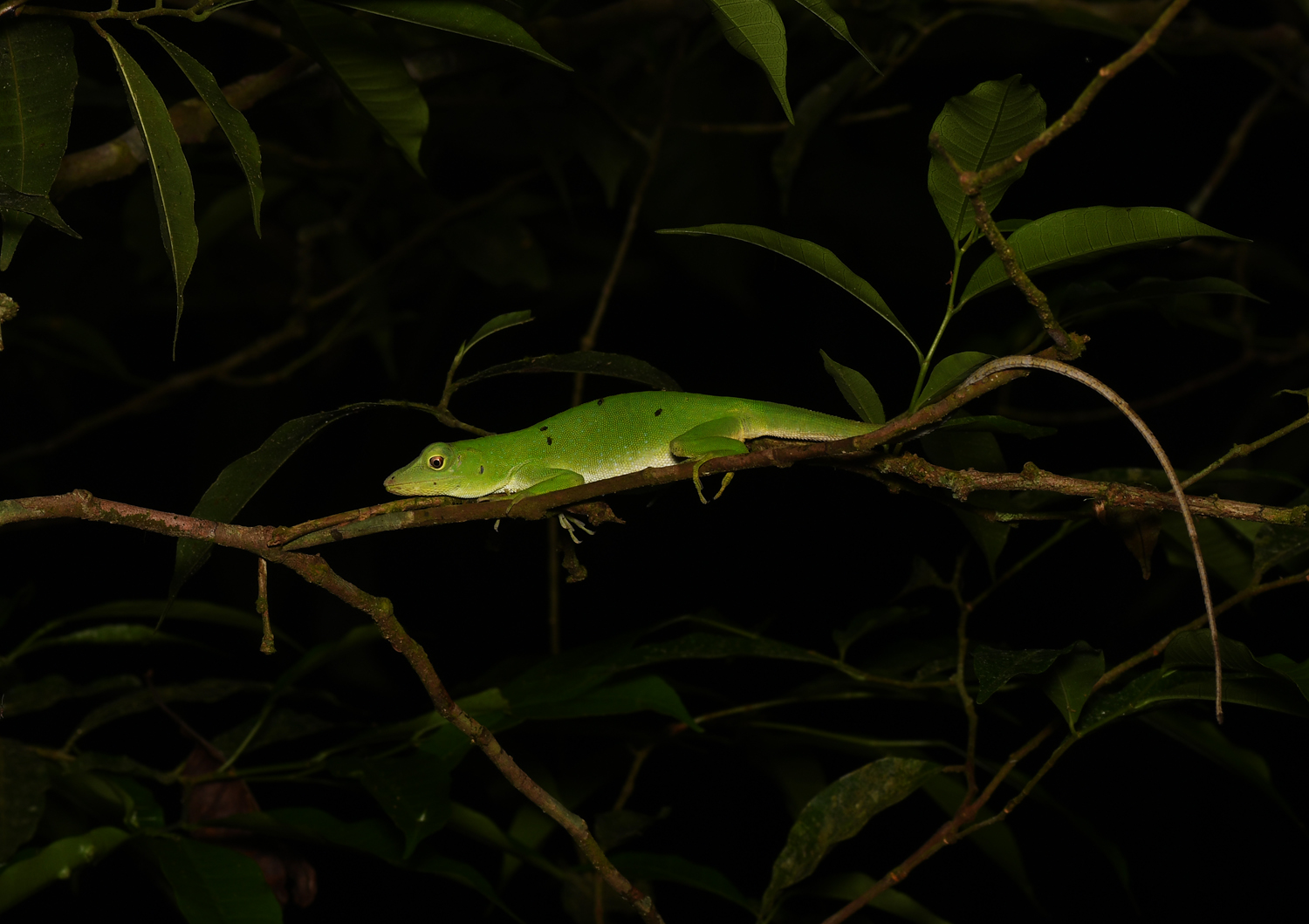
Neotropical Green Anole (Anolis biporcatus) - Semaphore Hill, Panama

It is not too difficult to find crazy looking caterpillars in the tropical lowlands. This one has been christened with the common name of the Shag Carpet Caterpillar Moth. 

Prothysana felderi - Semaphore Hill, Panama

White-breasted Wood-Wren - Semaphore Hill, Panama

Panama City Anole (Anolis apletophallus) - Semaphore Hill, Panama

Euptychia jesia - Semaphore Hill, Panama

Just as we returned to the lodge, Laura and I simultaneously noticed the familiar shape of a snake shooting off across the grass towards the lodge. I made a lunge and came up with the beautiful animal. I believe this is Mastigodryas alternatus, a type of racer.  

Mastigodryas alternatus - Canopy Tower, Panama

That afternoon saw us back on the tower where we stayed until dusk. Vismig (visible migration) was in effect, with more raptors as well as some flocks of Common Nighthawks winging it towards the Darién. 

Common Nighthawk - Canopy Tower, Panama

Green Honeycreeper - Canopy Tower, Panama

Scarlet-rumped Cacique - Canopy Tower, Panama

The local gang of howler monkeys were feeding on fresh cecropia leaves and flowers, only metres from where we were standing. 

Mantled Howler Monkey - Canopy Tower, Panama

Mantled Howler Monkey - Canopy Tower, Panama

Mantled Howler Monkey - Canopy Tower, Panama

Prior to a delicious dinner, I set up my moth light and sheet, eager for what would arrive. September is one of the rainiest months of the year in this region of Panama, and high rainfall levels often correspond with excellent moth diversity. The Canopy Tower also sets up a blacklight each evening. 

After dinner, Laura and I grabbed our flashlights to check out the action on the sheet. We were not disappointed! The moth diversity was just incredible. Here is just a small selection of the highlights. At some point I will go through and actually figure out what species these all are. But it is hard to find the time at the moment!


We left the sheets to percolate some more and headed out on foot down the road away from the lodge. We only stayed out for an hour or so (it had been a long day), but, even in that time, we had quite a few highlights. 

Three snakes made appearances: two Common Blunt-headed Treesnakes and a single Cat-eyed Snake. Not bad at all for only an hour!

Northern Cat-eyed Snake (Leptodeira septentrionalis) - Semaphore Hill, Panama

Common Blunt-headed Treesnake (Imantodes cenchoa) - Semaphore Hill, Panama

This beautiful treefrog was breeding near an old water-filled cistern partway down the entrance road. I believe that this is Cruziohyla sylviae, a rarely encountered species. One of the local guides had earlier shown us some eggs that had been produced by this species at the cistern. 

Cruziohyla sylviae - Semaphore Hill, Panama

Cruziohyla sylviae eggs - Semaphore Hill, Panama

We photographed a few frogs, lizards and insects as well. 

Pristimantis taeniatus - Canopy Tower, Panama

Harpactorinae sp. - Canopy Tower, Panama

Anolis sp. - Canopy Tower, Panama

Straight-snouted Weevil sp. (Brentidae) - Semaphore Hill, Panama

Neotropical Green Anole (Anolis biporcatus) - Semaphore Hill, Panama

Upon returning back to the lodge, one more check of the sheets was in order, followed by a much-needed rest. It had been quite the day!


Tuesday, 11 May 2021

Early May Birding At Rock Point

It is finally here. May is, without a doubt, my favourite time of year to be a naturalist in Ontario. Signs of life are everywhere, but the main draw for me is the rush of bird migration. The spring of 2021 has turned out much differently than I had planned. Originally, I was scheduled to spend much of the month on Pelee Island, in the Point Pelee area, and in Prince Edward County leading bird tours, with plenty of time built into my schedule for some non-tour birding (and mothing!) as well.

Carolina Wren - Rock Point Provincial Park

But, like just about every other plan that I have made in the last fifteen months, it fell through. The timing of Ontario's latest lockdown has coincided exactly with the peak of spring bird migration, and I haven't been able to lead any tours due to the current restrictions in place. 

Unfortunately, Point Pelee is not in the cards for me this spring as I have been staying closer to home. Laura and I are currently residing in Fonthill, located in about the exact middle of the Niagara Peninsula, and great birding areas can be found just a short drive away.

To continue reading, click here.

Tuesday, 4 May 2021

A Trio Of Rarities In The H.S.A.

The Hamilton Study Area is a circle with a radius of 25 miles (~40.2 km) that is centred on Dundurn Castle in Hamilton, Ontario. It is the official area of study for the Hamilton Naturalists Club, and many local birders keep an HSA list. For some, this is their most revered bird list. For me, it is a few rungs lower (following my World List, Canada List, Ontario List, World Photographed List, Ontario Photographed List, and a few others), but I always jump at the chance to add a new species to my HSA list. I grew up in south Cambridge, which is situated within the western boundary of the HSA. My formative years as a birder took place predominately in the HSA; not only in south Cambridge, but also in south Guelph where I attended university. In the years since, I have lived elsewhere, though the HSA has always been just a short drive away. 


In recent weeks the HSA has produced several fantastic rare birds; the crown jewel being the Yellow-browed Warbler (Canada's 2nd ever record), but more on that bird in a minute. All told, I have added three species to my HSA list recently, bringing it up to 309. A good start.


California Gull (foreground) - Brantford, Brant County

To continue reading, click here.

Sunday, 18 April 2021

Catching Up: March Birds and Bugs

My last post covered some of my mothing excursions from early this spring. I have been getting out during the day as well, and have taken my camera with me some of the time. Below are some of the diurnal spring highlights so far from the second half of March. 

Barred Owl - Amherst Island, Lennox and Addington County

Laura and I ran a very successful Amherst Island tour on March 18. Of course the owls were the show-stoppers, but we encountered many other species of birds. My eBird checklist for the day tallied nearly 50 species, including some first of year migrants such as Eastern Meadowlarks and Wilson's Snipes. A flyover Red Crossbill in Owl Woods was a rare sighting for the island. 

Snowy Owl - Amherst Island, Lennox and Addington County

To continue reading, click here. 

Monday, 12 April 2021

Early Spring Mothing Adventures

 Early spring is one of my favourite times of the year to be a naturalist. Winter in Canada is far too long for my liking and naturalizing opportunities are few and far between. There is only so much winter birding I can do, and identifying frozen mosses or undertaking winter plant ID only holds my interest for so long.

As the snow recedes and the temperatures warm up, migrant birds appear - first waterfowl and Horned Larks, then waves of robins, blackbirds and Killdeers, and eventually the kinglets, creepers, and sparrows in early April. Observing each "first of year" species brings a smile to one's face, while also providing a reminder of the waves of migration still to come. Observing the phenomenon of bird migration really gets my blood pumping!

Brown Creeper - Port Weller East Pier, Niagara Region

The first reptiles of the year are found on warm, sunny March days, filling a void that had been absent since the autumn. Once the ice has receded from the ponds and the first warm rains of the spring fall, the voices of Spring Peepers, Western Chorus Frogs and Wood Frogs emanate from vernal wetlands while salamanders rush to the ponds to lay their eggs.

Northern Ribbonsnake (Thamnophis saurita septentrionalis)

Meanwhile, the first ephemeral wildflowers - usually Hepatica in my experience - add a jolt of colour to the otherwise brown tones of a deciduous forest floor. Early beetles, bees, and moths appear, eager to get on with their lifecycles during these initial spring days.

Round-lobed Hepatica (Hepatica anemone)

It is the last group - the moths - that has captured my attention this spring. I only got hooked on mothing recently, during the summer of 2019. Last spring I was pre-occupied with other things and I did not set up my moth sheet for the first time until early June. Therefore, 2021 has been my first spring of mothing in Ontario. Almost everything has been new, which is always a lot of fun!

Citrine Sallow (Pyreferra citrombra) - St. John's CA, Niagara Region

I previously blogged about some of my finds from the first mothing session of the year during unseasonably warm temperatures on March 10. Since then, I have gone out on five other occasions, as documented below. 

Friday, 2 April 2021

Final Post From Costa Rica - The Orosí Area

----------

On the morning of March 22 we packed up at the Mountain House and drove to the Kilometre 76 Road leading to Providencia, a road which Laura and I had visited on our own, several weeks earlier. Starting at over 3000 m in elevation, this dirt road alongside the edge of Parque Nacional Los Quetzales cuts through beautiful montane forest and descends to 2000 m and beyond. We only had a few hours budgeted this time, but made the most of it. The highlight was a Resplendent Quetzal that showed well for my parents and Laura. I missed it, as I was walking back uphill to fetch the vehicle. I heard a singing Ochraceous Pewee during this time, but it refused to show itself despite my best efforts. This was one of the few Talamancan species I had not detected up to this point. 

After a thoroughly enjoyable hour and fourty-five minutes on the Kilometre 76 Road, we climbed back into the Rav4 and left Parque Nacional Los Quetzales behind. Our destination for the night was the Orosí Valley, a location only around 40 kilometres from San José that is famed for its beautiful scenery, lush countryside, coffee plantations and quaint towns. We had a flight to catch the next day - this would be our final night in Costa Rica. 

That afternoon, we relaxed in our excellent accommodations within the town of Orosí. I tallied close to 30 bird species from the front porch of our room; mostly common Costa Rica species, but nice to see regardless. A flyover White-tailed Kite was my first in Costa Rica. I tried to soak in the views of every species; who knows when I would have the chance to see them again? 

Scarlet-rumped Tanager - Orosí, Cartago, Costa Rica

That evening we visited a nearby restaurant that specializes in wood-fired pizzas. Laura and I had stopped here on our visit a few weeks earlier, and the pizzas were as delicious as we had remembered. 

As dawn broke on March 23, the persistent vocalizations of Tropical Kingbirds, Great-tailed Grackles and White-winged Doves provided the soundtrack. A flock of Crimson-fronted Parakeets screeched overhead. 

White-winged Dove - Orosí, Cartago, Costa Rica

Tropical Kingbird - Orosí, Cartago, Costa Rica

We enjoyed an excellent breakfast at a local cafe before making the short drive towards the entrance to Parque Nacional Tapantí. 

To reach Tapantí, one crosses over the Río Orosí. The immediate environs at the bridge can be quite productive for birding; it has even been afforded eBird hotspot status. We stopped here and spent quite a bit of time birding the woodland beside the river and the scrubby fields along the roadside beyond the bridge. 

 Puente Purisil, Cartago, Costa Rica

Along the roadside just before the bridge, a covey of Black-breasted Wood-Quail ducked off the road. In the immediate vicinity of the bridge we saw our first Orange-billed Nightingale-Thrush and Rufous-capped Warblers in Costa Rica, a solid diversity of tanagers, warblers and flycatchers, and even a Green Basilisk that was resting a few meters from the water's edge. 

Green Basilisk - Puente Purisil, Cartago, Costa Rica

Our species list drastically climbed as we explored some of the pastures along the roadside. Disturbed, open habitats are often productive birding locations, even if the majority of the species you find are widespread birds that easily colonize areas that humans have opened up. It is a superficial kind of diversity, as it can seem way birdier than a pristine tract of rainforest during one short visit. But given enough time, the undisturbed forest will produce a much higher list, including many specialized birds.  

Roadside birding - Puente Purisil, Cartago, Costa Rica

Photography is easy in these habitats. As it was approaching mid-day, the swirling clouds above us muted the harsh light from time to time. 

Bronzed Cowbird - Puente Purisil, Cartago, Costa Rica

Yellow-bellied Elaenia - Puente Purisil, Cartago, Costa Rica

Common Tody-Flycatcher - Puente Purisil, Cartago, Costa Rica

Some of my favourite finds from along the roadside included Sulphur-bellied Flycatcher and Lesser Elaenia, two species that I have only seen before on a handful of occasions. 

Sulphur-bellied Flycatcher - Puente Purisil, Cartago, Costa Rica

Ruddy Ground Dove - Puente Purisil, Cartago, Costa Rica

The clouds were looking more menacing by the minute. We drove towards the entrance gate to the park, but decided against forking out the cash for a few hours in the park. As the first few raindrops fell we enjoyed the sights and sounds of the forest flanking the entrance road. 

Cyanopepla scintillans - P.N. Tapantí Area, Cartago, Costa Rica

The birds were active in the overcast conditions. We chanced upon a few small mixed flocks and enjoyed species like Emerald Tanager, Golden-browed Chlorophonia and Spotted Woodcreeper. Others remained hidden in the wall of green and were only appreciated by ear - Yellow-throated Toucan, Black-faced Solitaire, Buff-rumped Warbler. A Stripe-throated Hermit buzzed us, and a flock of White-collared Swifts chattered away high in the sky. I guess they are used to swirling gray clouds and erratic rain. As we left the forest behind and walked into the pasture, a Black Phoebe hunted from the fence line, unperturbed by the drizzly conditions. 

Black Phoebe - P.N, Tapantí Area, Cartago, Costa Rica

We finished our walk, hopped back in the car and began driving towards to San José. With a little time left to kill, one final stop near Ujarrás was on the agenda. Laura and I had visited this area briefly on our earlier pass through the area, searching unsuccessfully for Cabanis's Ground-Sparrow. This time, we ventured down a narrow dirt track towards an overlook of Lago Cachí. This lake was created in the 1970s with the construction of the Represa de Cachí (Cachí dam), and it was chock full of vegetation from our vantage point. 

Birding Lago Cachí, Cartago, Costa Rica

We noted many wetland species including heard-only White-throated Crakes and a single Gray-breasted Crake, a typical selection of herons, and a distant Muscovy Duck. We also enjoyed stellar views of a Barred Antshrike and Tropical Gnatcatcher. As we left Ujarrás a group of roadside Collared Aracaris demanded one more brief diversion. And with that, we completed the rest of the drive and made our flight with plenty of time. 

----------------------------------

As I write this, more than a full year has passed since our flight departed Costa Rica and touched down in Toronto. It has been a challenging year for many people to say the least. With vaccine programs ramping up in some parts of the world, there is now hope on the horizon. Laura and I still very much have plans to return to Central and South America as soon as reasonably possible, perhaps as soon as this autumn (however, I generally have an optimistic, and not realistic, outlook).  There are still many unfinished chapters to write. 

Tuesday, 23 March 2021

A Winter Wonderland

The title of this post may seem strange, given the beautiful spring weather that has arrived in Ontario in recent days. But even as southern Ontario sees temperatures soaring to the high teens, with frogs singing and migrant birds arriving by the minute, it was not that long ago that I was surrounded by cold, crisp weather in northern Ontario. Winter held the landscape firmly in its icy grip, and signs of spring were quite difficult to locate. Even the migrant American Crows had not made it this far north.


I had a reason to leave the relative balminess of southern Ontario behind and make the long trek to the Cochrane area and beyond, where the snow was close to a metre in depth and the temperatures were -20 and below. That reason was to search for Willow Ptarmigans. This species breeds in the Arctic but it is migratory, and some years they appear far enough south that they can be searched for along the roads south of James Bay. This winter was shaping up to be a good one. Ptarmigans had been reported in many locations on the Quebec side, and in late February, adventurous birders Jeff Skevington and Vincent Fyson located a group of them on the Ontario side. They had discovered the birds over 150 km northeast of Cochrane, along the paved road leading to the remote Detour Gold Mine. Several other birders made the trek in subsequent weeks, finding success as well. As I had never observed this species before in Ontario, I was keen to take a detour up to the mine.

Canada Jay - Detour Mine Road, Cochrane District


To continue reading, click here.